 16MnCr5 Corrosion Resistance: Rust Behavior, Protection and Practical Use
📑 Table of Contents
🔍 1. How Good Is 16MnCr5 Corrosion Resistance?
🧪 2. Why 16MnCr5 Is Not a Stainless Steel
📊 3. Chemical Composition and Corrosion Behavior
⚙️ 4. Factors Affecting 16MnCr5 Corrosion Resistance
🔥 5. Heat Treatment and Its Effect on Corrosion
🛡️ 6. How to Protect 16MnCr5 Against Rust
🏭 7. Applications and Corrosion Considerations
📐 8. 16MnCr5 vs Stainless Steel for Corrosion Resistance
🔍 1. How Good Is 16MnCr5 Corrosion Resistance?
16MnCr5 corrosion resistance is moderate rather than high. This grade is a low-carbon alloy case-hardening steel designed mainly for gears, shafts, pinions, bushings, and other components that need a hard surface and tough core.
It is important to understand that 16MnCr5 does not belong to the stainless steel family. Its chromium content improves hardenability, but the level remains far below that normally required to create the strong passive surface associated with stainless steels.
Therefore, untreated 16MnCr5 can rust when it remains exposed to moisture, oxygen, salt, condensation, or aggressive industrial environments. The steel can perform reliably in many mechanical applications, but corrosion protection usually requires additional measures.
For indoor machinery with controlled humidity, the material can offer practical service performance. Outdoor equipment, marine environments, chemical exposure, and continuously wet conditions require more careful protection.
| Environment | Expected Corrosion Behavior | Recommended Protection |
|---|---|---|
| Dry indoor environment | Generally acceptable | Basic rust prevention |
| Humid indoor environment | Rust can develop over time | Oil, coating, or controlled storage |
| Outdoor environment | Higher corrosion risk | Protective coating or plating |
| Salt spray / marine environment | High corrosion risk | Strong surface protection or alternative material |
| Chemical environment | Depends strongly on the chemical | Engineering evaluation required |
In short, the 16MnCr5 steel corrosion resistance level is suitable for ordinary mechanical environments when the material receives appropriate protection. It should not be selected simply because it contains chromium.
🧪 2. Why 16MnCr5 Is Not a Stainless Steel
A common misunderstanding comes from the word “chromium.” Because 16MnCr5 contains chromium, some buyers assume that it should have strong corrosion resistance. However, chromium serves a different purpose in this grade.
The chromium in 16MnCr5 mainly improves hardenability and supports the steel’s response during carburizing and subsequent heat treatment. It does not provide the same corrosion-resistant passive film found on stainless steel surfaces.
For stainless steel, chromium content is normally much higher. Once the chromium level reaches the appropriate range, the surface can form a stable chromium-rich oxide film that significantly slows further corrosion.
16MnCr5 does not have this stainless-steel chemistry. As a result, its corrosion behavior remains closer to conventional alloy steel than to stainless steel.
Is 16MnCr5 corrosion resistant?
Yes, but only in a limited engineering sense. The material can tolerate normal dry service conditions, especially when manufacturers apply suitable rust prevention. However, it does not provide inherent corrosion resistance comparable to stainless grades.
The distinction becomes especially important when selecting materials for outdoor or wet equipment. In such cases, engineers should evaluate the actual environment rather than relying on the chromium designation alone.
| Material Type | Typical Corrosion Characteristics | Main Design Advantage |
|---|---|---|
| 16MnCr5 | Moderate; requires protection in humid environments | Case hardening and tough core |
| Carbon steel | Low without protection | Cost-effective structural performance |
| Stainless steel | Much higher inherent corrosion resistance | Corrosion-resistant service |
| Tool steel | Usually requires rust protection | Hardness and wear resistance |
Therefore, is 16MnCr5 corrosion resistant is best answered with a qualified “moderately resistant under suitable conditions, but not inherently corrosion resistant like stainless steel.”
📊 3. Chemical Composition and Corrosion Behavior
The chemical composition of 16MnCr5 explains why the grade performs so well in case-hardening applications but does not provide strong natural corrosion protection.
| Element | Typical Range | Effect on Material |
|---|---|---|
| Carbon (C) | Approx. 0.14–0.19% | Supports case hardening and core toughness |
| Silicon (Si) | Approx. ≤0.40% | Strength and deoxidation |
| Manganese (Mn) | Approx. 1.00–1.30% | Strength and hardenability |
| Chromium (Cr) | Approx. 0.80–1.10% | Improves hardenability |
| Phosphorus (P) | Low controlled level | Controlled for material quality |
| Sulfur (S) | Low controlled level | Controlled for machinability and quality |
Low carbon content
The relatively low carbon content makes 16MnCr5 suitable for carburizing. During this process, the surface receives additional carbon and can develop a hard case after quenching.
The low-carbon core remains comparatively tough. This structure gives gears and shafts a useful combination of surface wear resistance and internal toughness.
Chromium and manganese
Chromium and manganese contribute mainly to hardenability rather than stainless behavior. They help the material develop the desired hardened structure during heat treatment.
Consequently, the alloy design prioritizes mechanical performance. Corrosion protection must normally come from the surface treatment, storage method, coating, plating, or operating environment.
This distinction is useful when comparing 16MnCr5 corrosion resistance with the corrosion performance of stainless steels or dedicated corrosion-resistant alloys.
⚙️ 4. Factors Affecting 16MnCr5 Corrosion Resistance
The corrosion behavior of 16MnCr5 depends on more than chemical composition. Storage, surface condition, humidity, temperature, contamination, and the selected protective treatment can all change the service result.
Moisture
Water is one of the most important factors in steel corrosion. Condensation on a 16MnCr5 surface can initiate oxidation, especially when the surface remains wet for long periods.
For this reason, steel components should not be stored directly on wet floors or exposed to uncontrolled condensation.
Salt and chlorides
Salt significantly increases corrosion risk. Chloride-containing moisture can accelerate electrochemical corrosion and make surface protection more important.
Marine equipment and coastal applications therefore require more robust protection than dry indoor machinery.
Surface condition
A clean, smooth surface generally provides better corrosion control than a contaminated surface containing moisture, salts, or industrial residues.
Machining marks do not automatically cause corrosion, but scratches and damaged protective coatings can create local areas where moisture remains trapped.
Storage time
Long-term storage requires additional attention. Even steel that leaves the factory in good condition can develop surface rust when exposed to humid air for extended periods.
Proper wrapping, ventilation, desiccants, and rust-preventive oil can help reduce this risk.
Surface treatment
Surface treatment can make a major difference to practical 16MnCr5 rust resistance. Depending on the application, manufacturers may use oiling, phosphating, painting, plating, or other protective systems.
🔥 5. Heat Treatment and Its Effect on Corrosion
Heat treatment is central to the performance of 16MnCr5. However, it is important to separate mechanical properties from corrosion protection.
Carburizing increases the carbon content near the surface. After quenching, the treated layer becomes hard and provides excellent wear resistance for gears and similar components.
This hardened surface should not be confused with a corrosion-resistant coating. A hard carburized layer does not transform 16MnCr5 into stainless steel.
Carburizing
During carburizing, the component absorbs carbon at elevated temperature. The process creates a carbon-rich surface layer while maintaining a lower-carbon core.
After quenching and tempering, the component can achieve a hard surface and tough core. This structure explains the popularity of 16MnCr5 in transmission components.
Does carburizing improve corrosion resistance?
Carburizing may change surface characteristics, but it should not be treated as the primary method of corrosion protection. Engineers should still specify an appropriate protective system when the component operates in a corrosive environment.
| Process | Main Purpose | Direct Corrosion Protection? |
|---|---|---|
| Carburizing | Increase surface carbon and hardenability | Not a primary corrosion treatment |
| Quenching | Develop a hard microstructure | No |
| Tempering | Balance hardness and toughness | No |
| Phosphating | Improve surface protection and coating adhesion | Yes, as a protective treatment |
| Plating | Create a protective surface layer | Yes |
| Protective oil | Limit contact with moisture | Yes, temporary protection |
Therefore, manufacturers should select heat treatment according to mechanical requirements and select corrosion protection according to the service environment. These two decisions should work together rather than replace each other.
🛡️ 6. How to Protect 16MnCr5 Against Rust
Because 16MnCr5 does not have stainless-steel-level corrosion resistance, manufacturers should select an appropriate protection method when the application involves humidity or outdoor exposure.
1. Rust-preventive oil
Protective oil is one of the simplest methods for steel storage and transportation. It creates a barrier between the metal surface and moisture in the surrounding environment.
This approach works particularly well for semi-finished components and steel products that will later receive machining or additional surface treatment.
2. Phosphating
Phosphate coatings can improve surface protection and provide a useful base for subsequent painting or coating systems. They are commonly used when manufacturers need controlled surface preparation.
3. Painting
Paint creates a physical barrier between the steel and the atmosphere. The coating system should match the service environment, especially when the component will experience outdoor humidity or industrial contaminants.
4. Plating
Plating can provide stronger surface protection for specific applications. The selected plating system depends on the required corrosion performance, dimensional tolerance, wear conditions, and manufacturing process.
5. Controlled storage
Good storage practices can significantly reduce surface rust before production. Keep steel away from standing water and minimize condensation.
| Protection Method | Typical Use | Key Advantage |
|---|---|---|
| Protective oil | Storage and transportation | Simple and economical |
| Phosphating | Industrial components | Good surface preparation |
| Painting | Outdoor and industrial equipment | Creates a physical barrier |
| Plating | Components requiring enhanced surface protection | Can provide durable protection |
| Controlled storage | Raw material and finished parts | Reduces moisture exposure |
The best 16MnCr5 corrosion protection method depends on the component’s environment, expected service life, dimensional requirements, and budget.
🏭 7. Applications and Corrosion Considerations
16MnCr5 is widely selected for components that need a hard, wear-resistant surface and a tough core. Common applications include gears, pinions, shafts, bushings, rollers, and transmission components.
| Application | Mechanical Requirement | Corrosion Consideration |
|---|---|---|
| Gears | Hard surface and tough core | Oil or coating may be required |
| Pinions | Wear resistance and fatigue performance | Protect exposed surfaces |
| Shafts | Strength and toughness | Consider humidity and condensation |
| Bushings | Wear resistance | Surface protection may be necessary |
| Transmission components | Surface hardness and durability | Depends on operating environment |
Gears
Gears represent one of the most common uses for 16MnCr5. Carburizing and hardening create a wear-resistant case while the core maintains useful toughness.
In enclosed gearboxes, lubricating oil can also help limit direct exposure to moisture. However, the actual protection depends on the lubricant, sealing system, temperature, and operating conditions.
Shafts and pinions
Shafts and pinions can benefit from the grade’s combination of strength, toughness, and hardenability. Exposed components may need additional surface protection when moisture or salt is present.
Outdoor machinery
Outdoor applications require more attention because rain, condensation, temperature changes, and airborne contaminants can accelerate corrosion.
If the component must operate outdoors for a long period without regular maintenance, engineers should compare protected 16MnCr5 with stainless steel or another corrosion-resistant alloy.
📐 8. 16MnCr5 vs Stainless Steel for Corrosion Resistance
When corrosion resistance becomes the primary design requirement, engineers often compare 16MnCr5 with stainless steel. The two material families serve very different purposes.
| Feature | 16MnCr5 | Stainless Steel |
|---|---|---|
| Primary design purpose | Case hardening and mechanical performance | Corrosion resistance and mechanical performance |
| Chromium level | Moderate alloying level | Typically much higher |
| Natural corrosion resistance | Limited | Generally much higher |
| Carburizing suitability | Excellent | Usually not the primary choice |
| Surface hardness | Very high after suitable case hardening | Depends on grade and treatment |
| Typical applications | Gears, pinions, shafts | Corrosive-service equipment |
The decision should therefore focus on the dominant service requirement. If a component needs a carburized surface and tough core, 16MnCr5 can be an excellent engineering choice.
If the component faces continuous moisture, salt, chemicals, or outdoor exposure, stainless steel may provide better inherent protection. However, the exact stainless grade must also match the environment.
In many industrial designs, engineers can use 16MnCr5 successfully by combining its mechanical advantages with an appropriate 16MnCr5 corrosion protection system.
Can 16MnCr5 replace stainless steel?
Not when corrosion resistance is the primary requirement. 16MnCr5 can replace a different alloy steel when case hardening and mechanical performance matter, but it does not provide the same inherent corrosion protection as stainless steel.
Material selection should always consider the complete operating environment rather than a single property.
📦 9. Otai Special Steel Advantages
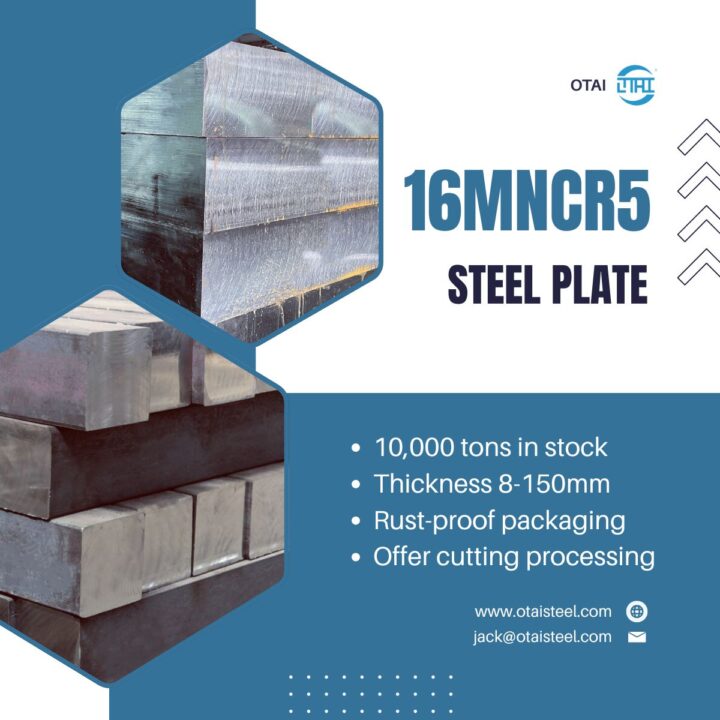
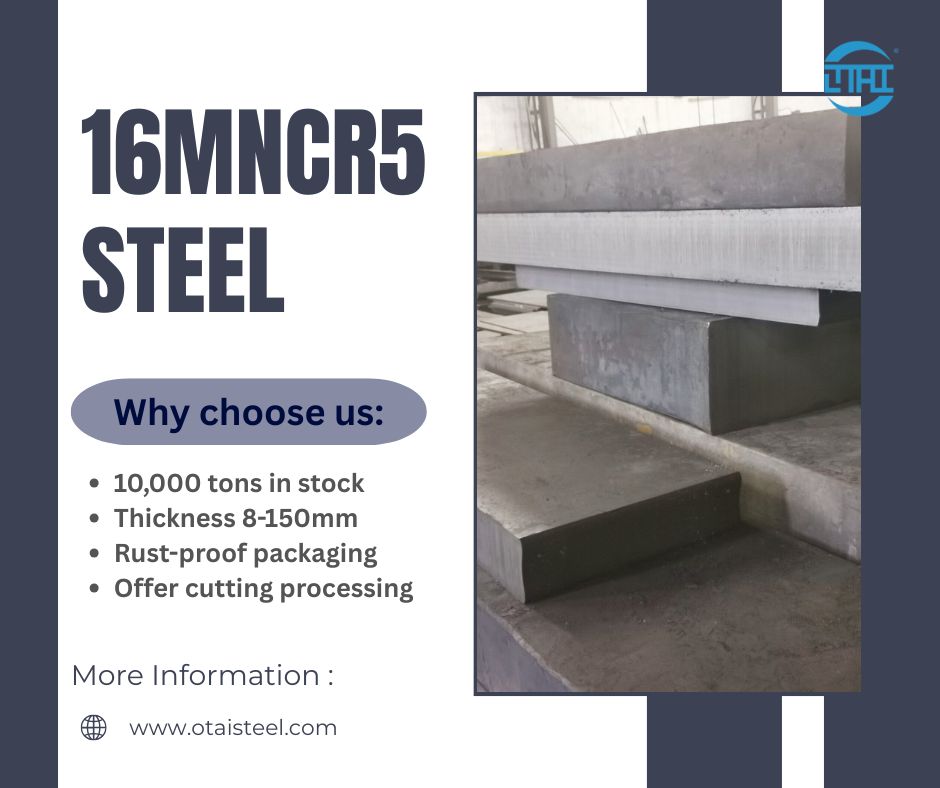
- 16MnCr5 steel plate stock: Otai Special Steel keeps 16MnCr5 steel plate in 8–150 mm thickness available in stock for different engineering requirements.
- Different dimensions: We can supply different widths, lengths, and thicknesses according to customer requirements.
- Cutting service: We can arrange cutting according to drawings and specified dimensions.
- Heat treatment: Annealing, normalizing, carburizing-related processing, quenching, tempering, and other services can be arranged according to project requirements.
- Quality inspection: Ultrasonic testing and third-party inspection can be arranged for orders with specific quality requirements.
- Export packaging: Steel strapping, wooden cases, and anti-rust packaging help protect products during international transportation.
- International supply experience: Otai Special Steel has supplied steel to customers with demanding technical requirements, including Fortune Global 500 companies.
If you are sourcing 16MnCr5 steel plate for gears, shafts, pinions, or other case-hardening components, provide the required dimensions, standard, supply condition, quantity, and surface requirements. Otai Special Steel can help confirm suitable stock and processing options.
❓ 10. Frequently Asked Questions
1. Is 16MnCr5 corrosion resistant?
16MnCr5 has limited to moderate corrosion resistance. It is not a stainless steel and can rust when exposed to moisture, salt, condensation, or corrosive chemicals. Appropriate surface protection is recommended for demanding environments.
2. Does chromium make 16MnCr5 stainless?
No. The chromium in 16MnCr5 mainly improves hardenability. Its chromium level is not high enough to provide the passive corrosion-resistant behavior associated with stainless steel.
3. Does carburizing improve 16MnCr5 corrosion resistance?
Carburizing primarily improves surface hardness and wear resistance. It should not be considered a dedicated corrosion-protection treatment. Additional protection may still be necessary.
4. How can I prevent 16MnCr5 from rusting?
Common methods include protective oil, phosphating, painting, plating, controlled storage, and suitable packaging. The best solution depends on the operating environment and required service life.
5. What thickness of 16MnCr5 steel plate does Otai have in stock?
Otai Special Steel keeps 16MnCr5 steel plate in 8–150 mm thickness available in stock. The exact available size depends on width, length, quantity, and current inventory.