 16MnCr5 Carbon Percentage: Composition, Effects and Practical Selection
📑 Table of Contents
🔍 1. What Is the 16MnCr5 Carbon Percentage?
🧪 2. 16MnCr5 Chemical Composition
📊 3. Why Carbon Content Matters in 16MnCr5
🔥 4. Carbon Percentage and Carburizing
⚙️ 5. Carbon Content, Hardness and Machinability
🌎 7. 16MnCr5 Grade and Equivalent Materials
🔍 1. What Is the 16MnCr5 Carbon Percentage?
The 16MnCr5 carbon percentage is typically around 0.14–0.19% under the EN 10084 chemical composition range. This relatively low carbon content is one of the most important characteristics of 16MnCr5.
At first glance, a carbon level below 0.20% may seem too low for a steel grade used in gears, shafts, pins, and other wear-resistant components. However, 16MnCr5 does not rely on its original carbon content alone.
Instead, engineers commonly use this steel as a case-hardening grade. During carburizing, the surface absorbs additional carbon. After subsequent hardening and tempering, the component develops a hard outer layer while retaining a tougher core.
This design gives 16MnCr5 a useful balance between surface hardness, wear resistance and core toughness. Therefore, its low carbon percentage is not a weakness. It is an essential part of the material’s engineering design.
Why is the carbon percentage relatively low?
A low initial carbon content allows the core to remain relatively tough after case hardening. If the entire component contained very high carbon levels, the finished part could become excessively hard and brittle.
With 16MnCr5, manufacturers can selectively increase the carbon concentration near the surface. This creates a carbon-rich case without changing the composition of the entire component.
For gears and similar components, this approach works particularly well. The surface needs to resist repeated contact and wear, while the core needs to absorb mechanical loads and occasional impact.
Consequently, the carbon content of 16MnCr5 steel should always be considered together with its carburizing and heat-treatment behavior.
🧪 2. 16MnCr5 Chemical Composition
Carbon is only one part of the 16MnCr5 chemical composition. Manganese and chromium also play important roles in hardenability and the final performance of the steel.
| Element | Typical EN 10084 Range | Main Function |
|---|---|---|
| Carbon (C) | 0.14–0.19% | Supports case hardening and surface hardness |
| Silicon (Si) | ≤ 0.40% | Deoxidation and strength |
| Manganese (Mn) | 1.00–1.30% | Improves hardenability and strength |
| Chromium (Cr) | 0.80–1.10% | Improves hardenability and wear performance |
| Phosphorus (P) | ≤ 0.025% | Controlled to maintain material quality |
| Sulfur (S) | ≤ 0.035% | Controlled for steel cleanliness and machinability |
The exact chemical limits should always follow the applicable material standard and the actual mill certificate. The values above provide a practical reference for understanding the grade.
Carbon
Carbon provides the foundation for the hardening response. However, 16MnCr5 intentionally starts with a relatively low carbon level because the steel normally receives a carburizing treatment before final hardening.
Manganese
Manganese contributes to strength and hardenability. It works together with chromium to help the material develop a suitable hardened case during heat treatment.
Chromium
Chromium improves hardenability and supports the performance of the hardened surface. Its presence also helps distinguish 16MnCr5 from simple low-carbon steels.
Therefore, the performance of 16MnCr5 does not come from carbon alone. The complete alloy system determines how the steel responds during carburizing, quenching and tempering.
📊 3. Why Carbon Content Matters in 16MnCr5
The relatively low 16MnCr5 carbon percentage directly influences how the material behaves during manufacturing and heat treatment.
| Carbon Level / Condition | General Effect | Practical Significance |
|---|---|---|
| Low original carbon content | Tougher core potential | Suitable for case-hardening applications |
| Carburized surface | Higher surface carbon concentration | Creates a hardenable outer layer |
| Hardened case | High surface hardness | Improves wear and contact resistance |
| Low-carbon core | Greater toughness than the hardened case | Helps resist impact and bending loads |
Surface hardness
Carbon has a major influence on the hardness that steel can achieve after quenching. By increasing carbon concentration near the surface during carburizing, 16MnCr5 can develop a significantly harder case than its original composition would suggest.
This makes the grade suitable for components exposed to sliding, rolling, or repeated contact.
Core toughness
The lower carbon level in the original steel helps preserve a tougher core. This distinction is particularly important for gears and shafts.
A gear tooth, for example, must resist surface wear while also surviving repeated bending loads. A completely brittle structure would not provide the required service reliability.
Hardenability
Carbon works together with chromium and manganese to determine hardenability. Therefore, engineers should not judge the hardening behavior of 16MnCr5 by carbon content alone.
The actual result also depends on the component size, carburizing conditions, quenching medium, cooling rate, and tempering process.
🔥 4. Carbon Percentage and Carburizing
The most important reason for the low 16MnCr5 carbon percentage becomes clear during carburizing.
Carburizing introduces carbon into the surface of a steel component at elevated temperature. After sufficient carbon diffusion, the outer layer contains more carbon than the original material.
The manufacturer can then harden the component. The carbon-rich surface develops a high hardness, while the lower-carbon core remains comparatively tough.
How the process works
| Step | Process | Purpose |
|---|---|---|
| 1 | Machining | Produce the required component geometry |
| 2 | Carburizing | Increase carbon concentration at the surface |
| 3 | Quenching | Develop the hardened surface structure |
| 4 | Tempering | Reduce brittleness and adjust final properties |
| 5 | Finishing | Achieve final dimensions and surface requirements |
Case depth is also important
A hard surface alone does not fully describe the performance of a carburized component. Engineers must also consider effective case depth.
A shallow case may not provide sufficient protection under heavy contact loads. Conversely, excessive case depth may not provide the best balance between performance and processing cost.
Therefore, buyers should specify case-depth requirements when the component design requires them.
This is especially important for gears, shafts, pins and other parts that experience repeated contact stress.
⚙️ 5. Carbon Content, Hardness and Machinability
Carbon content affects both hardness potential and machining behavior. However, the relationship becomes more complex when the material receives carburizing and hardening.
Machinability before heat treatment
In a suitable soft or annealed condition, 16MnCr5 offers good machinability. The relatively low carbon level helps manufacturers perform turning, milling, drilling and other machining operations before final heat treatment.
This is one reason manufacturers prefer to machine many 16MnCr5 components before carburizing.
Machinability after hardening
After carburizing and hardening, the surface becomes significantly harder. Conventional machining becomes more difficult and may require grinding or specialized cutting tools.
Therefore, production planning should separate rough machining from final finishing where appropriate.
| Condition | Carbon Distribution | Relative Hardness | Machining |
|---|---|---|---|
| Original / soft condition | Low and relatively uniform | Low to moderate | Good |
| After carburizing | Higher near surface | Higher near surface | Limited on treated surface |
| After hardening | High-carbon hardened case | High surface hardness | Usually requires finishing operations |
Does more carbon always mean better steel?
No. More carbon does not automatically make a material better.
A higher carbon level can increase the potential hardness of steel, but it can also reduce toughness and make machining more difficult. Engineers therefore select carbon content according to the intended application.
The design of 16MnCr5 demonstrates this principle clearly. The steel starts with low carbon because the final component needs different properties at the surface and core.
🏭 6. Applications of 16MnCr5
The chemical design of 16MnCr5 makes it particularly useful for components that need a wear-resistant surface and a tough core.
| Application | Reason for Using 16MnCr5 |
|---|---|
| Gears | Hard case with a tougher core |
| Transmission components | Good resistance to repeated contact loads |
| Shafts | Useful combination of wear resistance and toughness |
| Pins | Good surface durability after case hardening |
| Bushings | Suitable for wear-prone contact surfaces |
| Automotive components | Well suited to many case-hardened parts |
| Industrial machinery | Good balance of machinability and final performance |
Gears
Gears represent one of the clearest examples of why 16MnCr5 uses a low original carbon content. Gear teeth need a hard surface to resist contact fatigue, pitting and wear.
At the same time, the tooth root needs sufficient toughness to withstand repeated bending loads. Case hardening helps create this combination.
Shafts and pins
Shafts and pins can also benefit from a hardened surface. The surface resists wear at contact points, while the core provides support against mechanical loads.
When is another steel better?
If a component needs high hardness throughout its entire cross-section, engineers may choose a through-hardening grade such as 4140 instead.
If corrosion resistance is the main requirement, stainless steel may provide a better solution. Or extreme wear resistance is necessary, a dedicated tool steel or wear-resistant alloy may be more appropriate.
The correct grade therefore depends on the complete service environment rather than carbon content alone.
🌎 7. 16MnCr5 Grade and Equivalent Materials
Buyers searching for 16MnCr5 carbon percentage often also need to identify the correct material designation and equivalent grades.
| Designation | Standard / System | Relationship |
|---|---|---|
| 16MnCr5 | EN 10084 | European case-hardening steel grade |
| 1.7131 | EN material number | Material number commonly associated with 16MnCr5 |
| 16MnCr5 | DIN designation | Common German / European designation |
Although several grades may appear similar, buyers should not select an alternative based only on a similar name. The chemical composition, especially carbon, chromium and manganese limits, should match the required specification.
16MnCr5 versus 20MnCr5
16MnCr5 and 20MnCr5 belong to the same general family of case-hardening steels. Their carbon contents differ, which can influence carburizing response and the properties of the finished component.
For this reason, the material selection should follow the engineering specification rather than assuming that one grade can always replace the other.
What should buyers check?
- Steel grade and applicable standard.
- Carbon and alloying-element limits.
- Product form and dimensions.
- Supply condition.
- Heat-treatment requirements.
- Required case depth.
- Mechanical properties.
- Ultrasonic testing requirements, if applicable.
- Inspection and certification requirements.
For international purchases, the material certificate remains the most reliable way to confirm the actual chemical composition of the supplied steel.
📦 8. Otai Special Steel Advantages
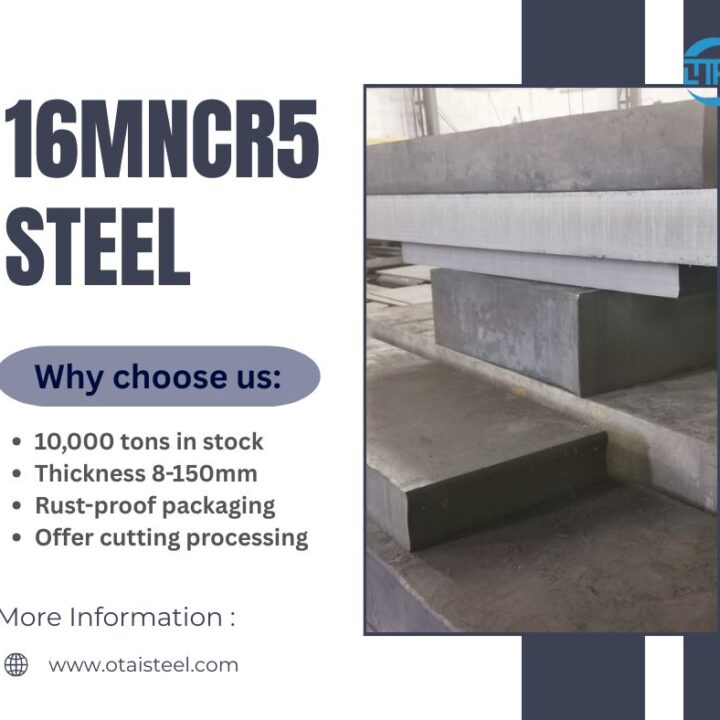
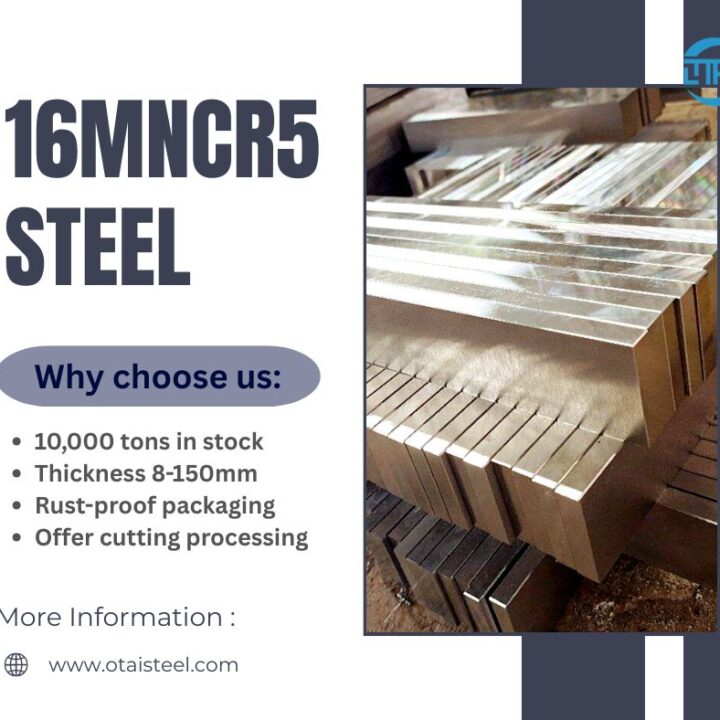
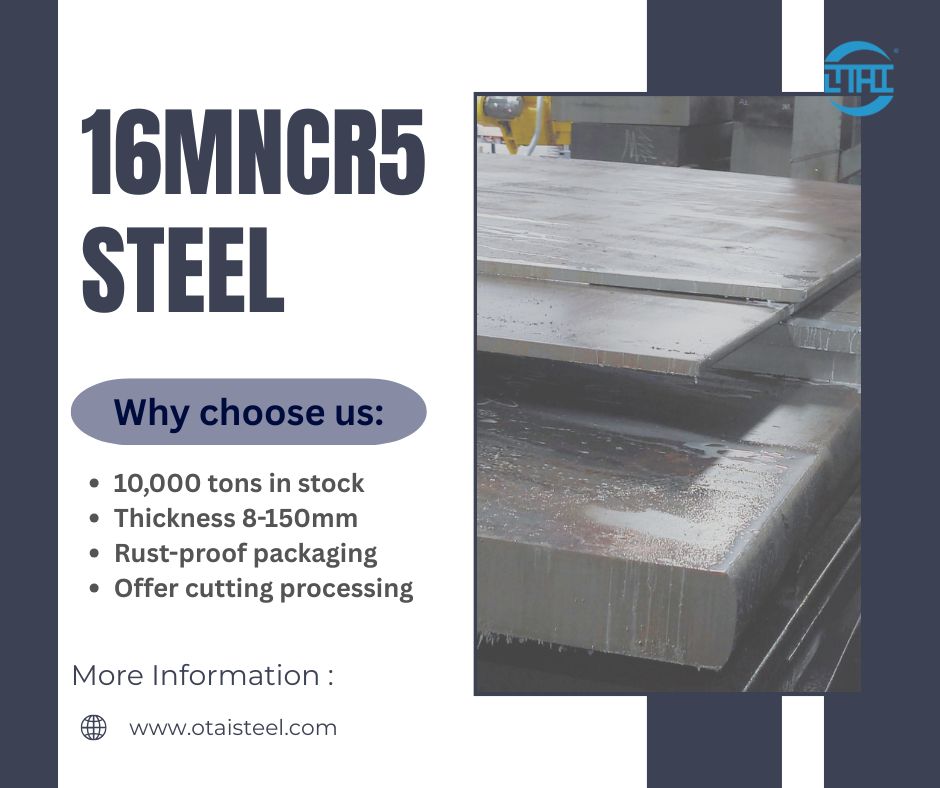
- 16MnCr5 steel plate stock: Otai Special Steel has 16MnCr5 steel plates in 8–150 mm thickness available in stock for customers who need common sizes and shorter lead times.
- Multiple product forms: We can support customers with suitable 16MnCr5 products according to project requirements, including plates and bar products.
- Cutting service: We can arrange cutting according to customer drawings and required dimensions.
- Heat treatment support: We can arrange annealing, carburizing-related processing, hardening, tempering and other heat-treatment services according to project requirements.
- Quality control: Ultrasonic testing and third-party inspection can be arranged for orders with specific quality requirements.
- Export packaging: Steel strapping, wooden cases and anti-rust packaging help protect steel products during international transportation.
- International supply experience: Otai Special Steel has supplied steel to customers with demanding technical requirements, including Fortune Global 500 companies.
If you are sourcing 16MnCr5 steel, please provide the required product form, dimensions, standard, supply condition and application. We can then help you confirm the appropriate material and processing requirements.
❓ 9. Frequently Asked Questions
1. What is the 16MnCr5 carbon percentage?
The carbon content of 16MnCr5 is typically 0.14–0.19% according to the EN 10084 composition range. The exact value should be confirmed against the applicable specification and mill certificate.
2. Why does 16MnCr5 have such a low carbon content?
The low original carbon level allows the core to remain relatively tough. During carburizing, the surface absorbs additional carbon and becomes suitable for high surface hardness after hardening.
3. Is 16MnCr5 a high-carbon steel?
No. 16MnCr5 is a relatively low-carbon alloy case-hardening steel. Its final surface hardness comes mainly from carburizing and subsequent heat treatment rather than from its original bulk carbon content.
4. Does carbon content affect 16MnCr5 hardness?
Yes. Carbon strongly affects the hardening response. However, the final hardness also depends on carburizing conditions, quenching, tempering, component size and the complete alloy composition.
5. What thickness of 16MnCr5 steel plate is available from Otai?
Otai Special Steel has 16MnCr5 steel plate in 8–150 mm thickness available in stock. Actual availability depends on the required width, length and quantity.