 42CrMo4 QT vs 16MnCr5: Which Steel Is Better for Your Application?
📑 Table of Contents
🔍 1. 42CrMo4 QT vs 16MnCr5: The Main Difference
🧪 2. Chemical Composition Comparison
🔥 3. Heat Treatment: QT vs Carburizing
⚙️ 4. Mechanical Properties and Hardness
🏭 5. Applications of 42CrMo4 QT and 16MnCr5
🔄 6. 42CrMo4 QT vs 16MnCr5: Which One Should You Choose?
📦 7. Otai Special Steel Advantages
🔍 1. 42CrMo4 QT vs 16MnCr5: The Main Difference
When comparing 42CrMo4 QT vs 16MnCr5, the first thing to understand is that these two alloy steels serve different metallurgical purposes. 42CrMo4 in the +QT condition is a quenched and tempered chromium-molybdenum steel. 16MnCr5 is a low-carbon case-hardening steel designed for carburizing.
In simple terms, 42CrMo4 QT aims to provide high strength and good toughness throughout the component. 16MnCr5 aims to create a very hard wear-resistant surface while maintaining a tougher core after carburizing and hardening.
This difference affects almost every part of material selection. The heat treatment route, hardness profile, mechanical properties, wear behavior and typical applications are different.
| Feature | 42CrMo4 +QT | 16MnCr5 |
|---|---|---|
| Material Number | 1.7225 | 1.7131 |
| Steel Type | Quenched and tempered alloy steel | Case-hardening alloy steel |
| Standard | EN 10083-3 | EN 10084 |
| Main Alloying Elements | Cr + Mo | Mn + Cr |
| Typical Heat Treatment | Quenching + tempering | Carburizing + hardening + tempering |
| Main Strength | High bulk strength and toughness | Hard surface with tough core |
| Typical Applications | Shafts, crankshafts, bolts, heavy-duty machine parts | Gears, pinions, shafts, transmission parts |
Therefore, 42CrMo4 QT vs 16MnCr5 should not be treated as a simple “which grade is stronger?” comparison. The better question is: which steel provides the right property profile for the component?
42CrMo4 QT: Strength Throughout the Section
42CrMo4 contains substantially more carbon than 16MnCr5. Its chromium and molybdenum content also improves hardenability. After quenching and tempering, the material can achieve high tensile strength and yield strength.
This makes it attractive for components that experience high tensile loads, bending stress, torsion or repeated mechanical loading.
16MnCr5: Hard Surface, Tough Core
16MnCr5 contains much less carbon than 42CrMo4. This low carbon content allows the steel to receive a carburizing treatment. During carburizing, carbon enters the surface and creates a carbon-rich layer.
After hardening, the surface becomes very hard while the lower-carbon core remains tougher. This structure works especially well for gears and other components exposed to repeated contact stress and wear.
🧪 2. Chemical Composition Comparison
Chemical composition explains much of the difference between these two steels. According to EN-based composition ranges, 42CrMo4 contains approximately 0.38–0.45% carbon, 0.60–0.90% manganese, 0.90–1.20% chromium and 0.15–0.30% molybdenum.
By comparison, 16MnCr5 contains approximately 0.14–0.19% carbon, 1.00–1.30% manganese and 0.80–1.10% chromium. The standard composition does not specify molybdenum as a principal alloying addition. :contentReference[oaicite:1]{index=1}
| Element | 42CrMo4 | 16MnCr5 | Primary Effect |
|---|---|---|---|
| Carbon (C) | 0.38–0.45% | 0.14–0.19% | Hardness and hardenability |
| Manganese (Mn) | 0.60–0.90% | 1.00–1.30% | Strength and hardenability |
| Silicon (Si) | ≤0.40% | ≤0.40% | Deoxidation and strength |
| Chromium (Cr) | 0.90–1.20% | 0.80–1.10% | Hardenability and strength |
| Molybdenum (Mo) | 0.15–0.30% | Not a principal alloying addition | Hardenability and tempering response |
| Phosphorus (P) | ≤0.025% | ≤0.025% | Impurity control |
| Sulfur (S) | ≤0.035% | ≤0.035% | Impurity control |
Why Does 42CrMo4 Have More Carbon?
The higher carbon content gives 42CrMo4 a strong response to quenching. It can develop a hard martensitic structure through the section, depending on component size, cooling conditions and heat-treatment parameters.
The addition of molybdenum further improves hardenability and supports the performance of the steel during tempering. As a result, 42CrMo4 works well when the component needs high bulk strength rather than only a hardened surface.
Why Does 16MnCr5 Use Lower Carbon?
The lower initial carbon content of 16MnCr5 is intentional. It allows the manufacturer to add carbon to the surface during carburizing.
This creates a useful carbon gradient between the surface and core. After hardening, the surface can achieve very high hardness while the core retains greater toughness.
This chemical design makes 16MnCr5 carburizing steel particularly suitable for gears, pinions and transmission components where surface wear and contact fatigue are important.
🔥 3. Heat Treatment: QT vs Carburizing
The biggest practical difference in 42CrMo4 QT vs 16MnCr5 appears during heat treatment. 42CrMo4 +QT means the steel has undergone quenching and tempering. 16MnCr5 normally receives carburizing followed by hardening and tempering.
42CrMo4 +QT Heat Treatment
For 42CrMo4, quenching creates a hard martensitic structure. Tempering then reduces internal stresses and adjusts the final combination of hardness, strength and toughness.
Typical processing temperatures depend on the exact product form and supplier specification. One technical data source lists an approximate quenching range of 820–860°C and tempering around 540–680°C for 42CrMo4. :contentReference[oaicite:2]{index=2}
| Process | 42CrMo4 +QT | 16MnCr5 |
|---|---|---|
| Austenitizing | Yes | Yes |
| Carburizing | No | Yes |
| Quenching | Yes | Yes |
| Tempering | Yes | Usually after hardening |
| Surface Carbon Enrichment | No | Yes |
| Main Hardening Strategy | Through-section hardening | Case hardening |
| Typical Result | High strength and balanced toughness | Hard surface and tough core |
Carburizing 16MnCr5
Carburizing changes the surface chemistry of 16MnCr5. The treatment introduces carbon into the surface, creating a hardened case after subsequent heat treatment.
This process makes 16MnCr5 particularly attractive for components where the surface must resist repeated contact, sliding and wear while the core must absorb mechanical loads.
For example, a transmission gear can benefit from a hard tooth surface because the teeth experience repeated contact stress. At the same time, the tougher core helps reduce the risk of catastrophic fracture.
This is why engineering standards classify 16MnCr5 among case-hardening steels, while 42CrMo4 belongs to the quenched-and-tempered alloy steel group. :contentReference[oaicite:3]{index=3}
Which Heat Treatment Gives Better Wear Resistance?
If the application requires a very hard surface, properly carburized 16MnCr5 generally has the advantage. If the component needs high strength and hardness through a substantial section, 42CrMo4 +QT may be the better choice.
Therefore, 42CrMo4 QT vs 16MnCr5 wear resistance depends on how the component experiences wear. Surface contact favors a case-hardening design, while general mechanical loading may favor a quenched-and-tempered alloy steel.
⚙️ 4. Mechanical Properties and Hardness
42CrMo4 +QT can provide high tensile and yield strength. For example, published EN 10083-based data for 42CrMo4 +QT show tensile strength values that vary with section size, with smaller sections reaching higher specified strength levels. :contentReference[oaicite:4]{index=4}
The mechanical behavior of 16MnCr5 requires a different evaluation because its final performance often depends on the carburized case and the core condition. Comparing only the nominal hardness of untreated materials can therefore produce a misleading conclusion.
| Property | 42CrMo4 +QT | 16MnCr5 Carburized |
|---|---|---|
| Bulk Strength | High | Moderate core strength compared with QT 42CrMo4 |
| Core Toughness | Good | Good after appropriate case-hardening treatment |
| Surface Hardness | High after suitable hardening | Very high after carburizing and hardening |
| Wear Resistance | Good, especially with suitable hardness | Excellent at the hardened case |
| Contact Fatigue Performance | Good | Excellent potential for carburized gear applications |
| Impact Resistance | Good when properly tempered | Good because of the tougher core |
| Typical Strength Strategy | Strength throughout the section | Hard surface + tough core |
42CrMo4 QT Hardness
The final hardness of 42CrMo4 +QT depends on the component size and tempering conditions. One published technical sheet gives guidance hardness ranges that decrease as section size increases, reflecting the effect of hardenability and section thickness.
This makes the grade useful for shafts, crankshafts, connecting rods and heavily loaded machine components. Its performance comes from the combination of strength and toughness rather than from an extremely hard surface alone.
16MnCr5 Surface Hardness
16MnCr5 takes a different route. Carburizing creates a carbon-enriched surface that can reach a very high hardness after hardening.
That hard case makes the grade highly suitable for gears and pinions. The core remains less hard and more capable of absorbing mechanical loads.
In other words, 42CrMo4 QT vs 16MnCr5 hardness is not simply a comparison between two hardness numbers. The location of the hardness matters just as much as the absolute value.
🏭 5. Applications of 42CrMo4 QT and 16MnCr5
The best way to understand 42CrMo4 QT vs 16MnCr5 is to look at where engineers actually use these grades. Although both steels can serve demanding mechanical applications, they solve different problems.
42CrMo4 +QT works particularly well when the entire component needs high strength, good toughness and resistance to repeated mechanical loading. 16MnCr5 works better when the surface must resist wear and contact fatigue while the core needs to remain tough.
Typical Applications of 42CrMo4 QT
| Component | Why 42CrMo4 QT Works | Typical Requirement |
|---|---|---|
| Drive Shafts | High strength and torsional resistance | High bulk strength |
| Crankshafts | Good fatigue strength and toughness | Repeated mechanical loading |
| Connecting Rods | High strength-to-weight performance | Alternating loads |
| Heavy-Duty Bolts | High tensile strength after QT | High preload and mechanical stress |
| Hydraulic Components | Good strength and hardenability | Pressure and mechanical loading |
| Machine Shafts | Good combination of strength and toughness | Bending and torsion |
| Forged Components | Good response to heat treatment | Heavy mechanical service |
These applications benefit from the fact that 42CrMo4 +QT develops useful mechanical properties through much of the component rather than only at the surface.
Typical Applications of 16MnCr5
| Component | Why 16MnCr5 Works | Typical Requirement |
|---|---|---|
| Gears | Hard carburized tooth surface | Wear and contact fatigue resistance |
| Pinions | High surface hardness | Repeated tooth contact |
| Transmission Parts | Hard case and tougher core | Impact and contact loads |
| Gear Shafts | Wear-resistant surface | Sliding and rolling contact |
| Cams | Good case-hardening response | Repeated surface contact |
| Mechanical Pins | Hard surface with supportive core | Contact wear |
42CrMo4 QT for Shafts vs 16MnCr5 for Gear Components
This comparison provides a useful example. Suppose a machine contains a heavily loaded drive shaft and a gear transmission.
The drive shaft may benefit from 42CrMo4 +QT because it needs high strength throughout the section. The gear teeth, however, experience repeated surface contact and sliding. A carburized 16MnCr5 gear can provide a harder working surface and a tougher core.
Therefore, selecting one grade for every component can create unnecessary compromises. Engineers often choose different steels for different components within the same machine.
This is one of the most important points when evaluating 42CrMo4 QT vs 16MnCr5 applications: material selection should follow the actual load path and failure mechanism.
🔄 6. 42CrMo4 QT vs 16MnCr5: Which One Should You Choose?
There is no universal winner in the 42CrMo4 QT vs 16MnCr5 comparison. The correct choice depends on whether your component needs high bulk strength or a hard wear-resistant case.
| Requirement | Recommended Grade | Reason |
|---|---|---|
| High strength throughout the component | 42CrMo4 QT | Quenched-and-tempered structure provides high bulk strength |
| High tensile and yield strength | 42CrMo4 QT | Higher carbon content and QT treatment support high strength |
| High torsional loading | 42CrMo4 QT | Good combination of strength and toughness |
| Very hard wear-resistant surface | 16MnCr5 | Carburizing creates a high-carbon hardened case |
| Gear teeth | 16MnCr5 | Excellent case-hardening behavior |
| Contact fatigue | 16MnCr5 | Hard case supports repeated surface contact |
| Heavy-duty shafts | 42CrMo4 QT | High strength and toughness through the section |
| Case-hardened transmission components | 16MnCr5 | Hard surface + tougher core |
Choose 42CrMo4 QT When Strength Is the Priority
Choose 42CrMo4 +QT when the component faces high tensile stress, bending, torsion or repeated mechanical loads. It is particularly attractive for shafts and forged components that require a strong and tough core.
The grade also works well when the manufacturer wants to control the final hardness through tempering rather than creating a carburized surface.
Choose 16MnCr5 When Surface Wear Is the Priority
Choose 16MnCr5 when the component needs a hard case and a relatively tough core. This property profile makes it especially useful for gears, pinions and transmission components.
The carburized case can resist repeated contact and sliding wear, while the core helps the component tolerate mechanical loads without becoming excessively brittle.
Can 42CrMo4 Replace 16MnCr5?
In some applications, 42CrMo4 can replace 16MnCr5, but the two materials are not direct equivalents. The substitution depends on the required heat treatment, surface hardness, core properties, component geometry and service conditions.
For example, a simple shaft may work very well with 42CrMo4 +QT. A precision transmission gear that requires a hard carburized case may still need 16MnCr5.
Can 16MnCr5 Replace 42CrMo4 QT?
Generally, this requires more caution. 16MnCr5 is designed around a low-carbon case-hardening concept. It does not provide the same through-section strength profile as quenched-and-tempered 42CrMo4.
If a component requires high bulk tensile strength and substantial resistance to bending or torsion, 42CrMo4 +QT will often provide a more suitable property profile.
Therefore, 42CrMo4 QT vs 16MnCr5 mechanical properties should always be evaluated together with component geometry and heat-treatment requirements.
📦 7. Otai Special Steel Advantages
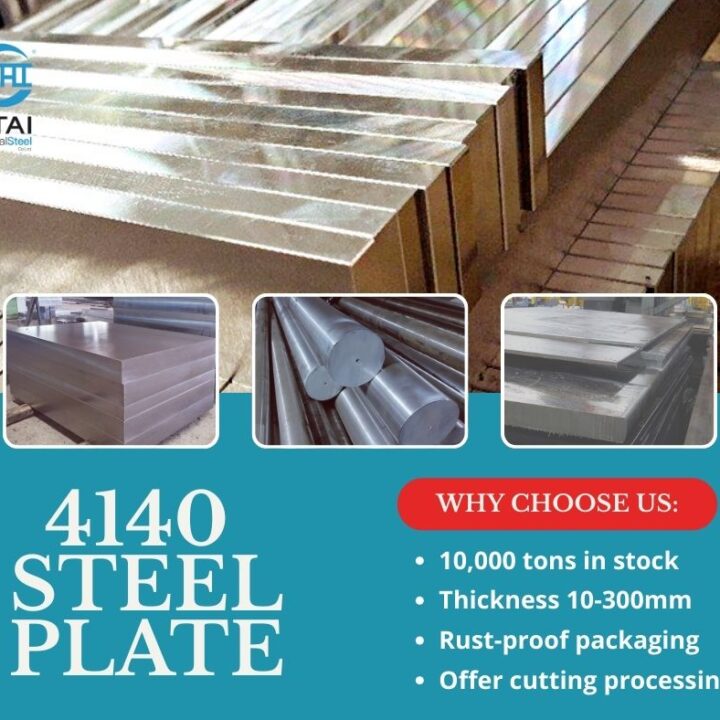
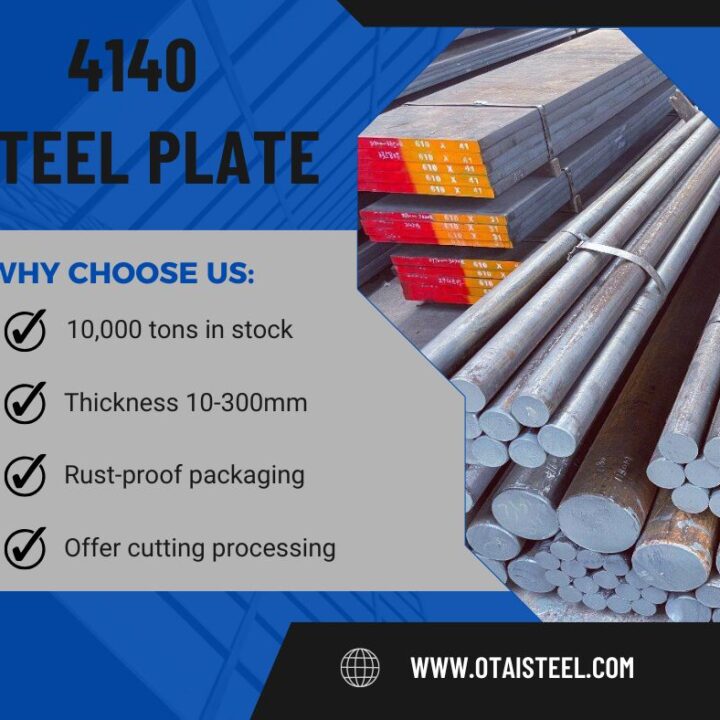
Choosing the right steel grade is important, but material availability, processing capability, and quality control also affect the final result. Otai Special Steel supplies alloy steels to international customers and supports different machining and fabrication requirements.
- Large inventory: Otai maintains approximately 10,000 tons of steel inventory, allowing us to respond quickly to different project requirements.
- Different sizes available: We keep different sizes and thicknesses available to provide greater flexibility for machining and fabrication projects.
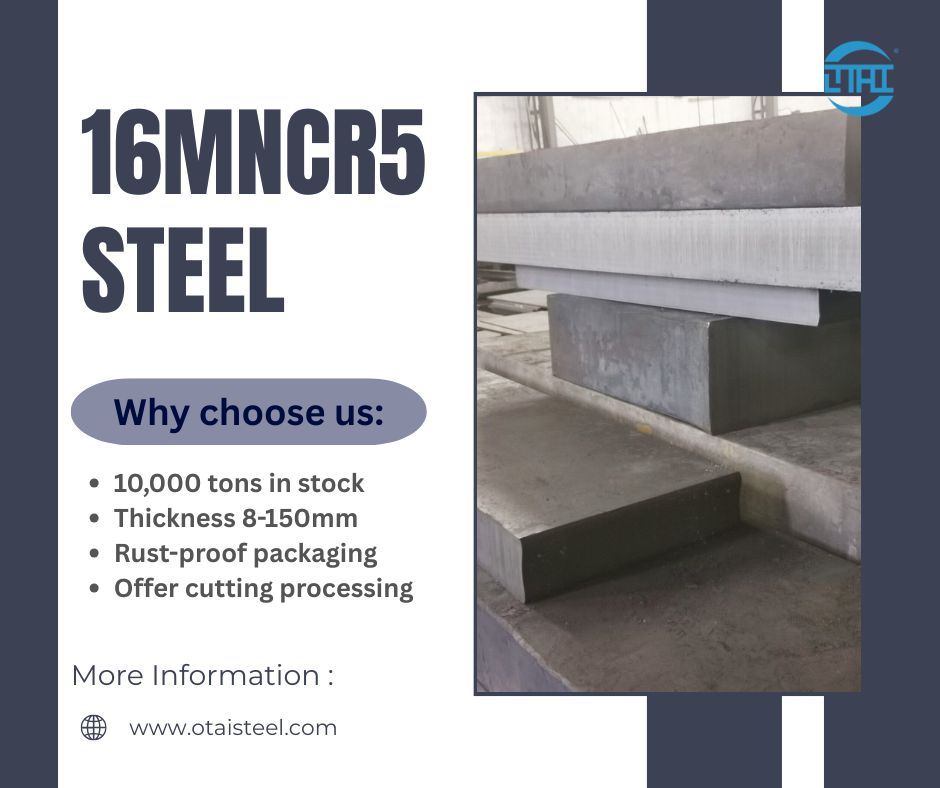
- 16MnCr5 plates in stock: For projects requiring 16MnCr5, we have 8–150 mm thick plates available in stock, depending on specification and availability.
- Custom cutting: We can cut steel plates according to customer-specified dimensions.
- Processing and heat treatment: We can arrange machining and heat treatment services according to the technical requirements of the project.
- Ultrasonic testing: We can provide ultrasonic testing for projects that require additional verification of internal material quality.
- Third-party inspection: We can arrange independent inspections for orders with specific quality requirements.
- Export packaging: We provide steel strapping, anti-rust protection, and wooden cases to protect the material during international transportation.
❓ 8. Frequently Asked Questions About 42CrMo4 QT vs 16MnCr5
1. What is the main difference between 42CrMo4 QT and 16MnCr5?
42CrMo4 +QT is a chromium-molybdenum alloy steel designed for quenching and tempering. 16MnCr5 is a low-carbon alloy steel mainly designed for carburizing. 42CrMo4 focuses on high strength throughout the component, while 16MnCr5 focuses on a very hard surface with a tougher core.
2. Is 42CrMo4 +QT stronger than 16MnCr5?
For bulk mechanical strength, 42CrMo4 +QT generally offers an advantage. However, the comparison depends on the heat treatment condition. Carburized 16MnCr5 can provide a much harder surface and excellent resistance to wear and contact fatigue.
3. Is 16MnCr5 better than 42CrMo4 for gears?
For many gear applications, yes. 16MnCr5 can develop a very hard carburized case while maintaining a tougher core. This combination works especially well against tooth wear and contact fatigue.
4. Is 42CrMo4 +QT suitable for shafts?
Yes. 42CrMo4 +QT is widely considered for shafts exposed to high loads, torsion, bending, and fatigue. Its combination of strength and toughness allows it to handle demanding mechanical conditions.
5. Can 42CrMo4 replace 16MnCr5?
In some applications, it can, but the two grades are not direct equivalents. If the component needs a very hard carburized surface, 16MnCr5 may be more suitable. If it needs high strength and toughness throughout the section, 42CrMo4 +QT will often be the better choice.