 What Is the Rockwell Hardness of 4140 Steel? Hardness by Condition and Heat Treatment
📑 Table of Contents
🔍 1. What Is the Rockwell Hardness of 4140 Steel?
🔥 2. 4140 Hardness by Heat Treatment
⚙️ 3. 4140 Rockwell Hardness and Mechanical Properties
📊 4. Can 4140 Steel Reach 40 HRC or 50 HRC?
🛠️ 5. 4140 Hardness vs Machinability and Wear Resistance
🏭 6. Applications of 4140 Steel at Different Hardness Levels
🎯 7. How to Choose the Right 4140 Hardness
📦 8. Otai Special Steel Advantages
🔍 1. What Is the Rockwell Hardness of 4140 Steel?
When engineers ask what is the Rockwell hardness of 4140 steel, they may expect one fixed HRC number. However, 4140 does not have one universal Rockwell hardness value.
The final hardness depends on the material condition, heat treatment, section size, cooling method and tempering temperature. Annealed 4140 is relatively soft and easy to machine. Quenched and tempered 4140 can achieve much higher hardness and strength.
AISI 4140 is a chromium-molybdenum alloy steel with approximately 0.38–0.43% carbon under common specifications. Chromium and molybdenum improve hardenability and allow the steel to develop useful mechanical properties after heat treatment.
Therefore, the most useful way to discuss 4140 steel hardness in HRC is to identify the material condition first.
| 4140 Condition | Typical Hardness Reference | Main Purpose |
|---|---|---|
| Annealed | Approximately 20–25 HRC or lower | Machining and fabrication |
| Normalized | Approximately 20–30 HRC | General mechanical applications |
| Quenched and Tempered | Commonly about 28–45 HRC | High strength and toughness |
| Hardened | 50 HRC and above is possible | Higher hardness and wear resistance |
| Surface Hardened | Often around 50–58 HRC at the surface | Surface wear resistance |
These figures are practical reference ranges rather than universal requirements. Actual hardness can vary with the product specification, section thickness, heat-treatment process and test location.
Why Does 4140 Have Different Hardness Values?
The reason is simple: hardness describes the condition of the steel, not only its chemical grade.
For example, annealed 4140 and quenched and tempered 4140 have the same basic alloy designation. However, their microstructures and mechanical properties differ considerably.
This flexibility makes 4140 useful for many applications. A manufacturer can choose a softer condition for machining or a harder condition for strength and wear resistance.
What Does HRC Mean?
HRC means Rockwell Hardness, C scale. It is commonly used for steels with relatively high hardness. The test measures the depth of indentation created under a specified load.
For buyers, a requirement such as “4140, 30–35 HRC” provides much more useful information than simply requesting “4140 steel.”
🔥 2. 4140 Hardness by Heat Treatment
Heat treatment has a major influence on 4140 Rockwell hardness. By changing the microstructure, manufacturers can adjust hardness, strength, toughness and machinability.
Annealed 4140
Annealing reduces hardness and internal stresses while improving machinability. This condition is useful when the component requires extensive cutting, drilling, milling or turning.
Many manufacturers machine 4140 before the final hardening process. This approach can reduce cutting difficulty and tool wear.
Normalized 4140
Normalizing creates a relatively uniform microstructure and provides moderate strength and hardness. It can serve as a useful condition for general mechanical components.
Quenched and Tempered 4140
Quenching rapidly cools the steel after austenitizing and creates a hard martensitic structure. However, as-quenched 4140 can have excessive hardness and brittleness for many applications.
Tempering follows quenching to reduce internal stresses and adjust the final combination of hardness, strength and toughness.
| Heat Treatment | Hardness Effect | Typical Benefit |
|---|---|---|
| Annealing | Reduces hardness | Improves machinability |
| Normalizing | Produces moderate hardness | Uniform structure and strength |
| Quenching | Greatly increases hardness | Creates a hard martensitic structure |
| Tempering | Adjusts quenched hardness | Improves toughness and controls strength |
| Induction Hardening | Creates high surface hardness | Improves surface wear resistance |
How Does Tempering Affect 4140 Hardness?
Tempering temperature has a strong influence on final hardness. Lower tempering temperatures generally retain more hardness, while higher tempering temperatures reduce hardness and increase toughness.
This relationship allows engineers to specify a practical target. For example, a component that needs approximately 30–35 HRC may use a different tempering condition from a component requiring approximately 40–45 HRC.
Therefore, 4140 hardness after heat treatment should always be evaluated together with the required mechanical properties.
⚙️ 3. 4140 Rockwell Hardness and Mechanical Properties
Hardness is an important property of 4140, but it does not tell the entire story. Engineers also need to consider tensile strength, yield strength, toughness, ductility, fatigue performance and wear resistance.
In general, increasing hardness can increase tensile strength and resistance to surface deformation. At the same time, excessive hardness can reduce ductility and toughness.
This creates an important balance when selecting 4140 steel hardness and mechanical properties.
| Property | Effect of Higher Hardness | Engineering Consideration |
|---|---|---|
| Tensile Strength | Generally increases | Useful for highly loaded components |
| Yield Strength | Generally increases | Improves resistance to permanent deformation |
| Wear Resistance | Generally increases | Useful for contact and sliding surfaces |
| Toughness | Can decrease | Important for impact-loaded parts |
| Ductility | Generally decreases | Important when deformation must be tolerated |
| Machinability | Generally decreases | Harder material requires more demanding machining |
Hardness and Strength
A properly heat-treated 4140 component can achieve a strong combination of hardness and tensile strength. This makes the grade popular for shafts, axles, gears, bolts and other mechanically loaded components.
However, engineers should not simply select the highest possible hardness. The component may also need to absorb impact or resist cyclic loading.
Hardness and Toughness
Toughness becomes especially important for components exposed to sudden loads. A very hard material may resist surface deformation well, but it can become less forgiving under severe impact conditions.
For this reason, quenched and tempered 4140 often provides a practical compromise between hardness and toughness.
Hardness and Hardenability Are Different
Another important distinction is hardness versus hardenability.
Hardness describes the resistance of the material to indentation. Hardenability describes how deeply a steel can harden during heat treatment.
4140 has good hardenability because of its chromium and molybdenum alloying. This characteristic becomes particularly important for larger sections where the center must also achieve useful mechanical properties.
📊 4. Can 4140 Steel Reach 40 HRC or 50 HRC?
Yes. 4140 can reach approximately 40 HRC and can also achieve 50 HRC or higher under suitable hardening conditions.
However, the final hardness depends on the heat-treatment process, component size, cooling conditions and tempering parameters.
Can 4140 Steel Reach 40 HRC?
Yes. A quenched and tempered condition can produce 4140 around 40 HRC when the heat treatment is properly controlled.
This hardness level can provide a useful balance between strength, wear resistance and toughness. It is therefore relevant for many shafts, machine parts and heavy-duty components.
Can 4140 Steel Reach 50 HRC?
Yes. Properly hardened 4140 can exceed 50 HRC. However, a very high hardness level may reduce toughness and machinability.
Therefore, 4140 steel 50 HRC hardness may suit wear-focused applications, but it is not automatically the best condition for every mechanical component.
| Target Hardness | General Performance | Typical Consideration |
|---|---|---|
| 20–25 HRC | Relatively soft | Good machinability |
| 28–35 HRC | Balanced strength and toughness | General mechanical components |
| 35–40 HRC | Higher strength and wear resistance | Loaded shafts and machine parts |
| 40–45 HRC | High strength and hardness | Demanding mechanical applications |
| 50 HRC+ | High hardness and wear resistance | Requires careful application-specific selection |
Why Is 40 HRC Often a Useful Target?
Many engineering applications need more than basic strength but do not require extremely hard material. A hardness around 40 HRC can provide a practical balance.
Nevertheless, the correct value depends on the component design. A large shaft exposed to impact may need different properties from a small wear component.
Therefore, the question should not only be “How hard can 4140 become?” It should also be “How hard should 4140 be for this application?”
🛠️ 5. 4140 Hardness vs Machinability and Wear Resistance
Hardness strongly influences machining performance. As 4140 becomes harder, cutting generally becomes more difficult.
Harder 4140 can increase cutting forces and tool wear. Therefore, manufacturers often complete major machining operations before final hardening when the component design allows this process.
| 4140 Condition | Machinability | Wear Resistance | Typical Manufacturing Strategy |
|---|---|---|---|
| Annealed | Good to excellent | Low to moderate | Machine before heat treatment |
| Normalized | Good | Moderate | General machining |
| QT, 28–35 HRC | Moderate | Good | Machining and finishing |
| QT, 35–45 HRC | More difficult | High | Controlled machining and finishing |
| Hardened / Surface Hardened | Difficult at hardened areas | Very high | Machine before final hardening where possible |
Does Higher Hardness Mean Better Wear Resistance?
Higher hardness generally improves resistance to abrasive wear and surface deformation. However, hardness alone does not determine the complete wear performance of a component.
Different applications involve different wear mechanisms. Abrasive wear, adhesive wear, sliding wear and contact fatigue can require different material strategies.
For example, a shaft may need high bulk strength and toughness, while a gear tooth may benefit more from high surface hardness.
4140 Hardness and Machinability
4140 steel hardness and machinability have an important inverse relationship in many manufacturing conditions. Softer material usually allows easier machining, while harder material requires more appropriate cutting parameters and tooling.
For this reason, customers should consider the complete manufacturing route before selecting the final hardness.
Why Heat Treatment After Machining Can Help
When the design permits, manufacturers can machine annealed or normalized 4140 first and then apply quenching and tempering.
This approach can reduce machining difficulty while allowing the finished component to achieve the required mechanical properties.
🏭 6. Applications of 4140 Steel at Different Hardness Levels
One of the biggest advantages of 4140 is its versatility. Manufacturers can adjust its hardness and mechanical properties for different components and service conditions.
| Application | Typical Requirement | Suitable 4140 Condition |
|---|---|---|
| Drive Shafts | Strength, toughness and torsional resistance | Quenched and tempered |
| Axles | Fatigue resistance and strength | Quenched and tempered |
| Crankshafts | Strength and fatigue resistance | Quenched and tempered |
| Heavy-Duty Bolts | High tensile strength | Quenched and tempered |
| Gears | Strength and surface wear resistance | QT or surface hardened |
| Hydraulic Components | Strength and wear resistance | QT or surface hardened |
| Machine Shafts | Bending and torsional strength | Quenched and tempered |
| Wear Components | High surface hardness | Hardened or induction hardened |
4140 for Shafts
Shafts often experience bending, torsion and cyclic loading. Therefore, they require more than a hard surface.
Quenched and tempered 4140 can provide high strength throughout the section while retaining useful toughness. This makes it suitable for drive shafts, axles, spindles and other heavily loaded components.
4140 for Gears
4140 can also serve gear applications, especially when the design requires a combination of strength and surface hardness.
Depending on the service conditions, engineers may use quenched and tempered material or apply surface hardening to selected areas.
4140 for Heavy-Duty Machine Parts
Heavy machinery components often face a combination of impact, bending, friction and repeated loading.
A moderate hardness can sometimes provide a better balance than extremely hard steel. This is why 4140 steel hardness for heavy-duty applications should always match the actual service conditions.
Why 4140 Is Widely Used
The combination of alloy composition, hardenability, strength and heat-treatment flexibility makes 4140 a practical choice for many industrial components.
Instead of selecting a completely different steel for every hardness requirement, engineers can often adjust 4140 through heat treatment to obtain the desired property balance.
🎯 7. How to Choose the Right 4140 Hardness
Choosing the correct hardness starts with the application rather than the material catalog.
Engineers should consider the load, component geometry, wear mechanism, machining process and required service life before specifying the final HRC value.
| Requirement | Possible Hardness Direction | Reason |
|---|---|---|
| Easy machining | Lower hardness | Reduces cutting difficulty |
| General mechanical strength | Moderate hardness | Balances strength and toughness |
| High tensile loading | Moderate to high hardness | Improves strength |
| High wear resistance | Higher hardness | Improves resistance to surface deformation |
| Impact loading | Moderate hardness | Retains more useful toughness |
| Surface wear | Surface hardening | Combines a hard surface with a tougher core |
Consider Component Thickness
Section size can influence the hardness achieved during quenching. Thin sections generally cool more quickly, while thick sections can cool more slowly at the center.
Because of this, large 4140 components may show different hardness values from the surface toward the center.
This is especially important when purchasing thick 4140 plates, large bars or forged components.
Specify the Hardness Range Clearly
A clear purchase specification should include the steel grade, delivery condition, dimensions, heat treatment and hardness requirement.
For example, a customer may specify:
AISI 4140, quenched and tempered, 30–35 HRC.
This specification provides a clear target for production and inspection.
Hardness Should Match the Failure Mode
If the component mainly suffers from wear, higher hardness may provide an advantage.
If the component mainly suffers from impact or fatigue, toughness becomes equally important.
Machining represents a major part of the production process, a softer delivery condition may be more practical before final heat treatment.
Therefore, the best 4140 hardness specification is the one that matches the component’s actual working conditions.
📦 8. Otai Special Steel Advantages
Choosing the correct 4140 hardness is important, but material availability, processing capability and quality control also affect the final result. Otai Special Steel supplies 4140 alloy steel and other special steels to international customers.
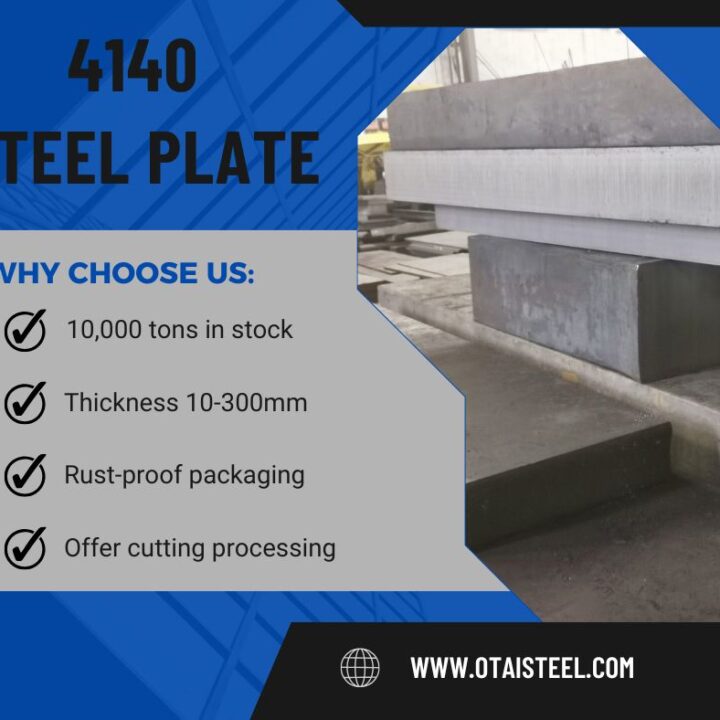
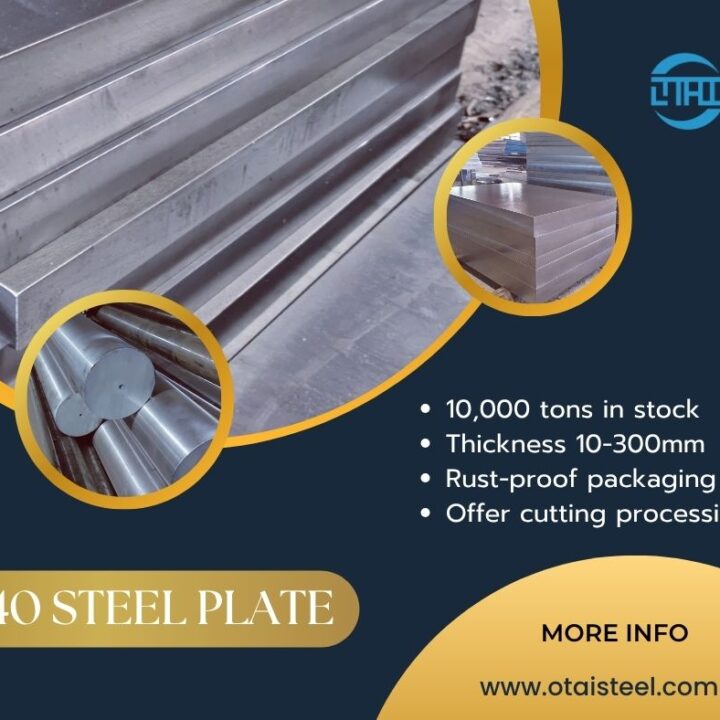
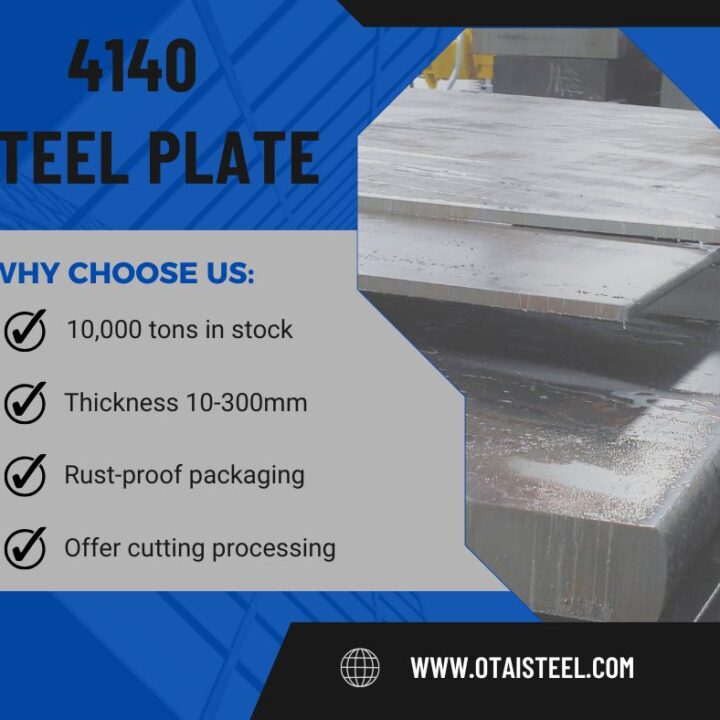
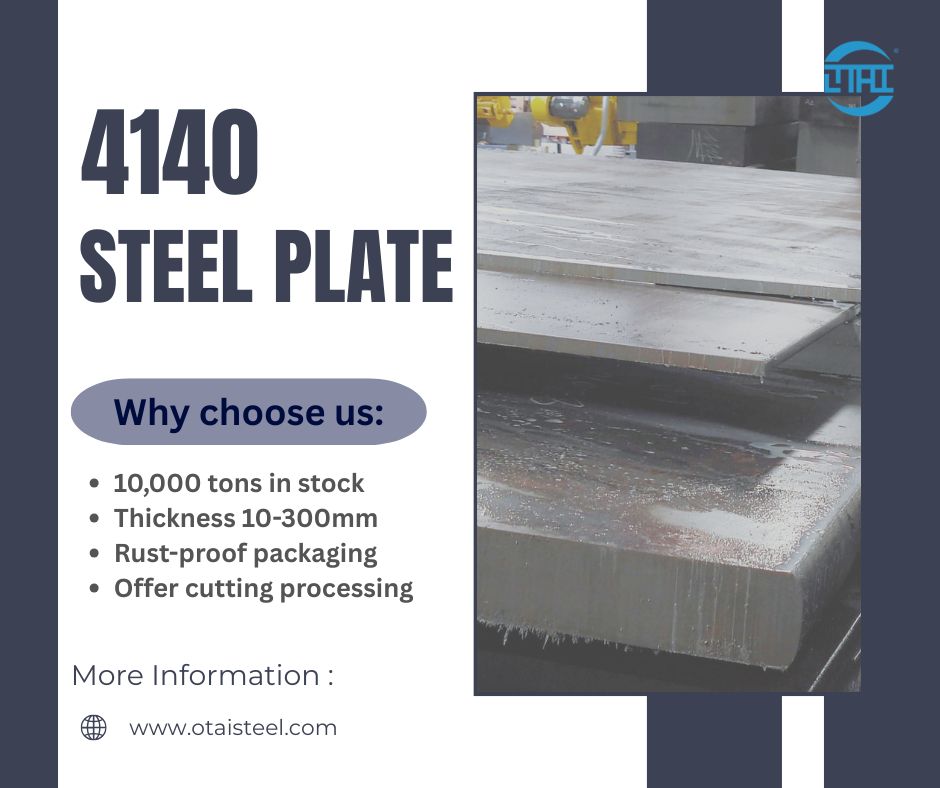
- Large inventory: Otai maintains approximately 10,000 tons of steel inventory, with different sizes available for different project requirements.
- Different sizes available: We maintain various dimensions of alloy steel products to support machining and fabrication projects.
- Custom cutting: We can cut steel plates according to customer-specified dimensions.
- Heat treatment: We can arrange heat treatment according to the required material condition and technical requirements.
- Ultrasonic testing: We can provide ultrasonic testing for projects that require additional verification of internal material quality.
- Third-party inspection: We can arrange independent inspection according to customer quality requirements.
- Fortune Global 500 experience: Otai has supplied steel products to Fortune Global 500 companies and customers with demanding technical requirements.
- Export packaging: We provide steel strapping, anti-rust protection and wooden cases to protect materials during international transportation.
For customers who need 4140 steel with a specific Rockwell hardness, providing the required dimensions, heat-treatment condition and hardness range can help ensure the material matches the intended application.
❓ 9. Frequently Asked Questions
1. What is the Rockwell hardness of 4140 steel?
4140 does not have one fixed Rockwell hardness. Annealed 4140 is commonly around the low 20s HRC or lower, while quenched and tempered 4140 can commonly fall within approximately 28–45 HRC. Proper hardening can produce hardness above 50 HRC.
2. Can 4140 steel reach 40 HRC?
Yes. Suitable quenching and tempering can produce approximately 40 HRC. The final result depends on section size, cooling conditions and tempering parameters.
3. Can 4140 steel reach 50 HRC?
Yes. Properly hardened 4140 can exceed 50 HRC. However, higher hardness can reduce toughness and machinability, so the target should match the application.
4. What is the hardness of annealed 4140 steel?
Annealed 4140 is relatively soft and offers good machinability. A practical reference is around 20–25 HRC or lower, although the exact value depends on the material specification and delivery condition.
5. What is a good hardness for 4140 steel?
There is no single best hardness. Many mechanical components use quenched and tempered 4140 at a moderate hardness because it provides a useful balance of strength and toughness. Wear-focused applications may require higher hardness.