 4140 Steel Equivalent UK – EN19 Full Engineering Guide & Industrial Applications
The topic of 4140 steel equivalent UK is widely referenced in engineering procurement, machining industries, and global steel distribution systems. In the UK market, AISI 4140 is not directly used as a primary designation. Instead, engineers rely on equivalent grades such as EN19, 708M40, and in some cases 817M40 depending on specification history and application standards.
However, equivalence does not simply mean identical naming. It requires deep understanding of chemical composition, mechanical properties, heat treatment behavior, and real industrial performance. Therefore, engineers must carefully evaluate whether EN19 or other UK grades can safely replace 4140 in structural and mechanical applications.
In addition, global supply chains frequently mix ASTM, EN, and BS standards. As a result, material substitution becomes a critical engineering decision rather than a simple procurement choice. Incorrect substitution may lead to failure in shafts, gears, or high-load rotating components.
Because of this, 4140 and its UK equivalents are among the most important alloy steels in automotive, oil and gas, heavy machinery, and industrial manufacturing systems worldwide.
🧪 Metallurgical Structure of 4140 Steel Equivalent UK Grades
The metallurgical foundation of 4140 steel equivalent UK materials is based on chromium-molybdenum alloy steel systems. 4140 is designed to achieve a balance between high strength, toughness, and hardenability. This balance makes it suitable for dynamic load-bearing components.
EN19 shares a nearly identical metallurgical philosophy. Both steels contain controlled levels of carbon, chromium, manganese, and molybdenum. These elements interact to form a stable microstructure after heat treatment.
Carbon plays the most important role in hardness development. Chromium improves wear resistance and increases hardenability depth. Molybdenum enhances high-temperature stability and reduces temper brittleness. Meanwhile, manganese improves deep section hardening and structural uniformity.
After quenching and tempering, both materials typically form tempered martensite. This structure provides high tensile strength combined with acceptable toughness, making it ideal for mechanical applications.
However, even small differences in composition range can influence large-section hardening performance. Therefore, engineers must consider component size, cooling rate, and heat treatment method before final selection.
In industrial practice, metallurgical consistency is also affected by forging ratio, rolling process, and cooling control. As a result, two steels with similar chemistry may still show slight performance differences under stress.
🔥 Heat Treatment Behavior and Transformation Mechanism
Heat treatment is the most critical factor in determining the performance of 4140 steel equivalent UK materials. Both 4140 and EN19 respond extremely well to quenching and tempering processes, which define their final mechanical properties.
During austenitizing, the steel is heated to a high temperature where the internal structure transforms into austenite. This allows carbon and alloying elements to distribute uniformly across the matrix.
Next, the material is rapidly quenched in oil or controlled cooling media. This process transforms the structure into martensite, which provides very high hardness but also increases brittleness.
To balance this, tempering is applied. Tempering reduces internal stress, improves toughness, and stabilizes the microstructure. As a result, the steel achieves a balance between strength and ductility.
In addition, both steels are suitable for induction hardening and surface hardening. This allows engineers to achieve a hard wear-resistant surface while maintaining a tough inner core.
However, process control is extremely important. Even slight variation in temperature or cooling rate can significantly affect hardness distribution, distortion, and fatigue performance.
Therefore, industrial heat treatment must always follow strict process parameters and quality control standards.
⚙️ Mechanical Properties and Engineering Performance
The mechanical performance of 4140 steel equivalent UK materials is one of the main reasons for their widespread industrial adoption. After heat treatment, tensile strength typically ranges from 850 MPa to 1000 MPa depending on tempering condition.
Yield strength remains high enough to support heavy static and dynamic loads without permanent deformation. This makes the material suitable for high-stress rotating components.
Fatigue resistance is another key advantage. Many mechanical parts operate under repeated cyclic loading. Therefore, resistance to fatigue failure is essential for long service life.
Toughness is also well balanced. Even at high strength levels, the material maintains good impact resistance, which prevents sudden brittle fracture under shock loading.
Because of this combination of properties, engineers commonly use these steels in crankshafts, axle shafts, gears, spindles, and structural mechanical parts.
Machinability is good in annealed condition, but becomes more difficult after heat treatment. Therefore, machining operations are usually completed before hardening.
Production planning must therefore carefully consider machining, heat treatment, and finishing sequence.
🏭 Industrial Applications of 4140 Steel Equivalent UK Materials
The application range of 4140 steel equivalent UK materials is extremely wide due to their balanced performance and cost efficiency.
In automotive engineering, they are used for crankshafts, axle shafts, steering components, and transmission systems. These parts require both fatigue resistance and high strength.
In oil and gas industries, these steels are used for drilling equipment, connectors, and high-pressure mechanical systems. These environments require extreme reliability under stress.
In construction machinery, they are used for hydraulic rods, structural joints, and load-bearing components exposed to vibration and shock.
Industrial machinery applications include gears, couplings, spindles, and rotating shafts used in continuous operation systems.
Because of this versatility, 4140 and EN19 are considered core alloy steels in global mechanical engineering.
💡 Engineering Selection and Material Substitution Strategy
Selecting a 4140 steel equivalent UK material requires careful engineering evaluation beyond chemical similarity.
First, heat treatment capability must be confirmed. Without controlled quenching and tempering, mechanical properties may vary significantly.
Second, mechanical test certificates such as tensile strength, yield strength, and hardness must be verified.
Third, machining history and production process can influence final performance, especially in large cross-section parts.
Therefore, substitution should always be based on engineering validation rather than assumption.
Proper selection ensures both safety and long-term operational reliability.
📊 Chemical Composition Comparison Table
| Element | 4140 | EN19 |
|---|---|---|
| Carbon | 0.38–0.43% | 0.35–0.45% |
| Chromium | 0.80–1.10% | 0.80–1.10% |
| Molybdenum | 0.15–0.25% | 0.15–0.30% |
| Manganese | 0.75–1.00% | 0.60–1.00% |
📊 Mechanical Properties Table
| Property | Value |
|---|---|
| Tensile Strength | 850–1000 MPa |
| Yield Strength | 650–850 MPa |
| Hardness | 28–32 HRC |
| Toughness | High |
🏭 Company Advantages – Otai Special Steel
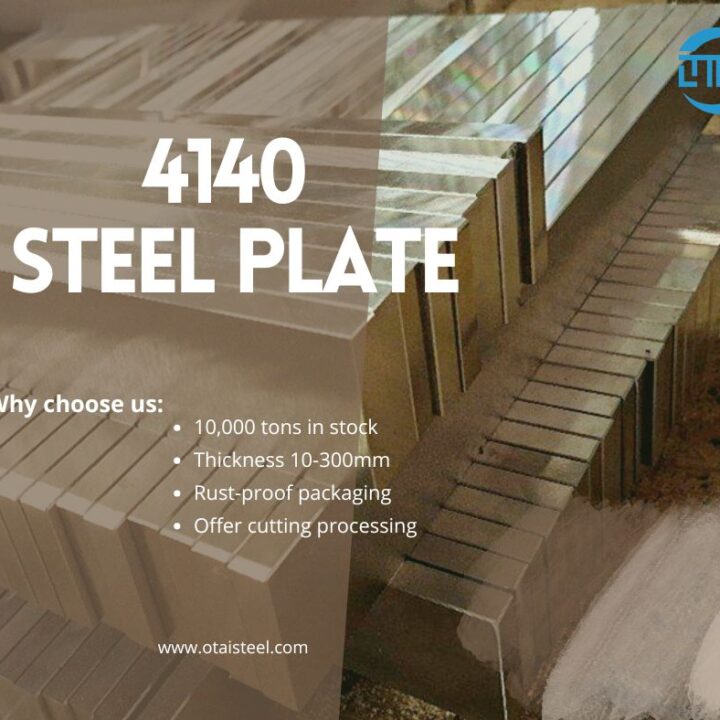
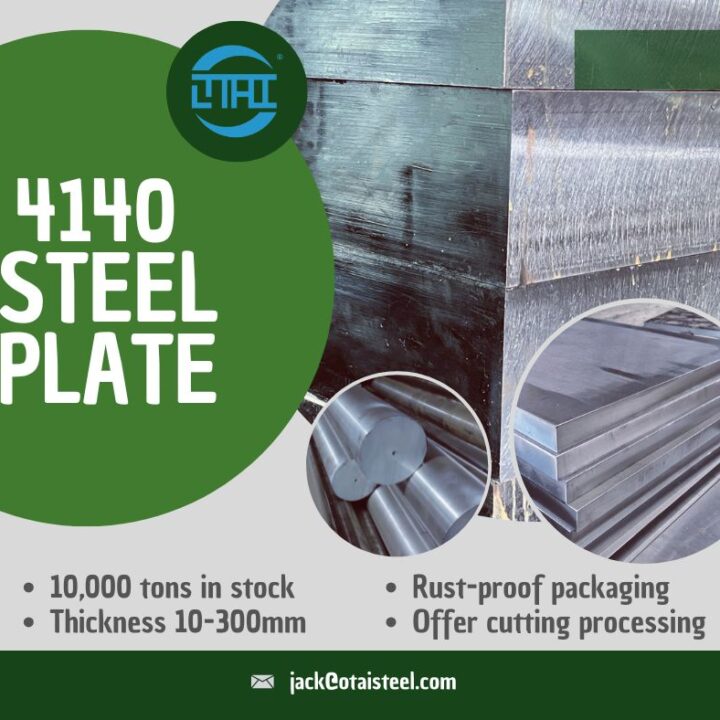
- Large stock of 4140 and EN19 equivalent steels
- Cutting, machining and processing services
- Heat treatment technical support
- Ultrasonic testing (UT) inspection
- Export packaging with anti-rust protection
- Stable global supply capability
❓ FAQ – 4140 Steel Equivalent UK
1. What is 4140 equivalent in UK?
EN19 or 708M40 is the common equivalent.
2. Is EN19 the same as 4140?
They are very similar but not identical in specification.
3. Can 4140 replace EN19?
Yes, but engineering validation is required.
4. What is the hardness after heat treatment?
Typically 28–32 HRC.
5. What industries use it?
Automotive, oil & gas, machinery and construction.
🏁 Conclusion
4140 steel equivalent UK mainly refers to EN19 and similar grades. Their mechanical performance after heat treatment is highly comparable, making them widely interchangeable in industrial applications when properly verified.