 16MnCr5 Steel Gear – Full Engineering Guide & Industrial Applications
Manufacturers widely use 16MnCr5 steel gear in automotive, industrial machinery, and power transmission systems because it delivers an ideal combination of surface hardness and core toughness. In modern mechanical engineering, this balance is essential because gears must resist both wear and impact under continuous load conditions.
Unlike standard carbon steel gears, 16MnCr5 steel gears rely on carburizing heat treatment to achieve their final performance. Therefore, engineers carefully control processing parameters to ensure consistent hardness depth, dimensional stability, and long fatigue life.
In addition, global demand for high-efficiency transmission systems continues to increase. As a result, 16MnCr5 has become one of the most widely adopted case-hardening steels in gear manufacturing.
—
🧪 1. Metallurgical Basis of 16MnCr5 Steel Gear Performance
The performance of a 16MnCr5 steel gear is based on its chemical composition, which includes controlled levels of carbon, manganese, and chromium. These elements play different roles in determining hardenability and wear resistance.
Carbon enables surface hardening during carburizing. Meanwhile, chromium improves hardenability and increases resistance to wear and oxidation. In addition, manganese enhances strength and improves deep hardening capability.
Because of this balanced composition, engineers achieve a stable carburized layer while maintaining a ductile core. Therefore, the gear can absorb shock loads without cracking or deformation.
Moreover, metallurgical stability ensures consistent performance during long-term cyclic loading. As a result, 16MnCr5 gears perform reliably in demanding mechanical systems such as gearboxes and differential drives.
In industrial practice, this material is preferred when engineers require both cost efficiency and mechanical reliability in medium-load applications.
—
🔥 2. Carburizing and Heat Treatment Behavior
Heat treatment is the most critical step in producing a high-performance 16MnCr5 steel gear. First, manufacturers heat the gear to approximately 900°C–950°C. During this stage, carbon atoms diffuse into the surface layer.
Then, the carburized gear is rapidly quenched. This process transforms the outer layer into martensite, which significantly increases hardness and wear resistance. Meanwhile, the core remains relatively soft and tough.
After quenching, tempering is applied to reduce internal stress. In addition, tempering improves structural stability and prevents brittle failure during operation.
As a result, the gear achieves a hardness gradient structure. This gradient is essential because it allows the surface to resist wear while the core absorbs mechanical shock.
Furthermore, precise control of carburizing time and temperature directly influences case depth. Therefore, manufacturers must carefully adjust process parameters based on gear size and load requirements.
In high-end applications, engineers also perform post-heat-treatment grinding to ensure dimensional accuracy and surface finish quality.
—
⚙️ 3. Mechanical Performance Under Real Working Conditions
A properly processed 16MnCr5 steel gear exhibits excellent mechanical performance under real operating conditions. Surface hardness typically reaches 58–62 HRC, which provides strong resistance to abrasion and contact fatigue.
Meanwhile, the core hardness remains significantly lower. Therefore, the gear maintains toughness and avoids brittle fracture when exposed to shock loads or sudden torque changes.
In addition, the hardness gradient structure improves resistance to pitting failure. Pitting is one of the most common failure modes in gear systems operating under rolling contact stress.
Moreover, 16MnCr5 gears perform well under variable load conditions. Even when torque fluctuates frequently, the material maintains structural stability and dimensional integrity.
Because of these advantages, engineers often select this steel grade for medium-to-high load transmission systems that require long service life without frequent maintenance.
In addition, fatigue resistance plays a major role in extending operational life. Therefore, 16MnCr5 gears are widely used in continuous-duty industrial environments.
—
🏭 4. Industrial Applications and Engineering Use Cases
Manufacturers apply 16MnCr5 steel gear across multiple industries due to its balanced mechanical properties. In automotive systems, it is widely used in transmission gears, differential systems, and timing mechanisms.
In addition, industrial gearbox manufacturers rely on this material for reducers and heavy-duty drive systems. These applications require stable torque transmission and long operational life.
Furthermore, agricultural machinery uses 16MnCr5 gears because they perform reliably under harsh working environments. Dust, vibration, and irregular load conditions require materials with strong fatigue resistance.
Construction machinery also benefits from this material. Excavators, loaders, and cranes use gears that must withstand high torque and frequent load variation.
Because of its versatility, 16MnCr5 has become a standard engineering material for power transmission systems across global industries.
Moreover, its cost-performance ratio makes it more attractive compared to higher-alloy steels, especially in medium-load applications.
—
💡 5. Manufacturing Process and Precision Control
Manufacturing a high-quality 16MnCr5 steel gear requires strict process control. First, engineers prepare the raw blank through forging or machining. This ensures material uniformity and structural integrity.
Next, machining operations define the gear geometry. At this stage, dimensional accuracy is critical because any deviation may affect meshing performance and noise levels.
After machining, heat treatment introduces structural changes. However, carburizing also causes volume expansion. Therefore, manufacturers intentionally leave machining allowance before heat treatment.
Following heat treatment, grinding is often required to achieve final precision. This step ensures correct tooth profile and surface finish quality.
In addition, quality inspection plays a key role. Engineers use hardness testing and dimensional measurement to verify performance consistency.
As a result, well-controlled manufacturing processes ensure high reliability and long service life of 16MnCr5 gears.
—
🏭 Company Advantages – Otai Special Steel
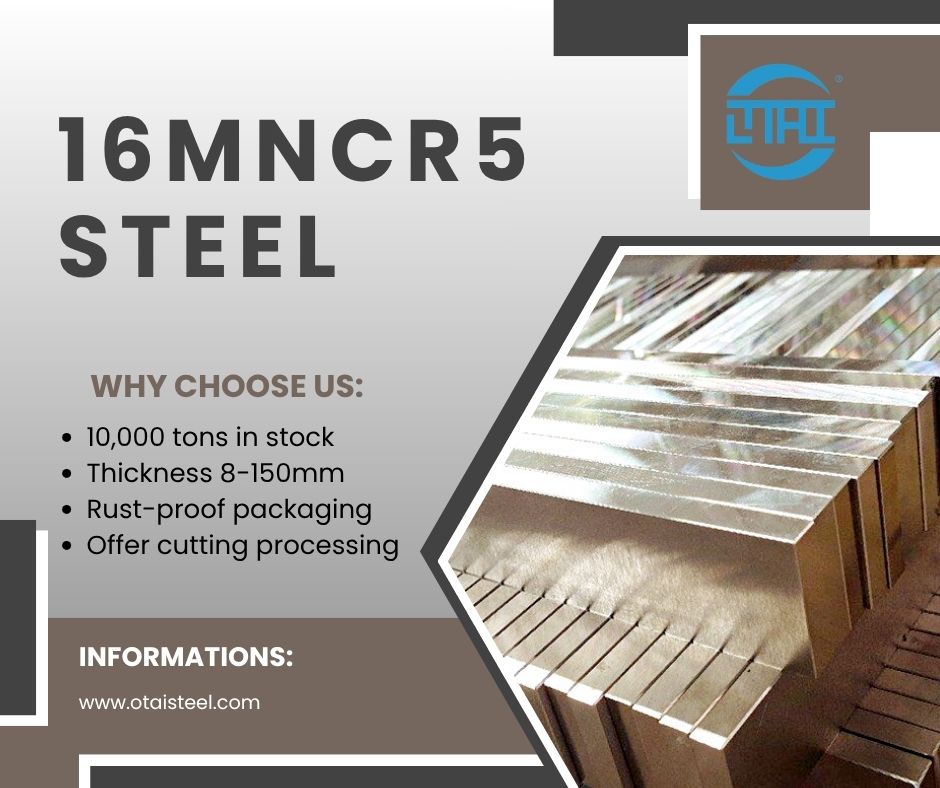
- 📦 Large stock of alloy steel including 16MnCr5 gear materials
- ✂️ Cutting, machining, and customization services
- 🔥 Heat treatment technical support
- 🔬 Ultrasonic testing (UT) inspection
- 📦 Export-grade packaging with rust protection
- 🌍 Stable supply for global gear manufacturers
❓ FAQ – 16MnCr5 Steel Gear
1. Why is 16MnCr5 used for gears?
Because it provides excellent wear resistance and strong core toughness after carburizing.
2. What hardness does it achieve?
Surface hardness typically reaches 58–62 HRC after heat treatment.
3. Is it suitable for high-load gears?
Yes, it performs well in medium to high-load transmission systems.
4. Why is carburizing important?
It creates a hard surface layer while maintaining a tough core.
5. Which industries use it most?
Automotive, machinery, agriculture, and construction equipment industries.
🏁 Conclusion
The 16MnCr5 steel gear remains a widely used engineering solution due to its excellent balance of hardness, toughness, and cost efficiency. Moreover, its carburizing response ensures stable performance in demanding mechanical systems.
Therefore, engineers continue to select this material for gear applications that require durability, reliability, and long service life under real industrial conditions.