 16MnCr5 Steel Composition: How Alloy Elements Influence Performance and Heat Treatment
The 16MnCr5 steel composition plays a critical role in determining the material’s strength, hardenability, wear resistance, and carburizing performance. As one of the most widely used low-alloy case hardening steels in Europe and international manufacturing industries, 16MnCr5 has become a preferred material for components that require a combination of:
- High surface hardness
- Excellent fatigue resistance
- Tough internal core
- Reliable dimensional stability
- Good machinability before heat treatment
Manufacturers commonly use 16MnCr5 steel for:
- Gears
- Pinions
- Shafts
- Bushings
- Bearing sleeves
- Transmission parts
- Automotive drivetrain systems
Its balanced chemical composition allows the steel to respond extremely well to carburizing and quenching processes, making it ideal for high-load mechanical applications.
🔍 What is 16MnCr5 Steel?
16MnCr5 is a low-carbon chromium-manganese alloy carburizing steel developed according to EN/DIN standards. The steel belongs to the family of case hardening steels, meaning engineers typically carburize the surface to create a hard outer layer while maintaining a tough and ductile core.
The designation “16MnCr5” provides information about the alloy system:
| Designation Part | Meaning |
|---|---|
| 16 | Approximate carbon content ×100 |
| Mn | Manganese alloying element |
| Cr | Chromium alloying element |
| 5 | Alloy classification indicator |
This composition gives the steel excellent mechanical balance for precision engineering components.
⚗️ Full Chemical Composition of 16MnCr5 Steel
The following table shows the standard chemical composition range for 16MnCr5 steel.
| Element | Composition (%) | Main Function |
|---|---|---|
| Carbon (C) | 0.14 – 0.19 | Increases hardness after carburizing |
| Silicon (Si) | 0.17 – 0.37 | Improves strength and oxidation resistance |
| Manganese (Mn) | 1.00 – 1.30 | Enhances hardenability and toughness |
| Chromium (Cr) | 0.80 – 1.10 | Improves wear resistance and fatigue strength |
| Phosphorus (P) | ≤ 0.025 | Controlled impurity |
| Sulfur (S) | ≤ 0.035 | Improves machinability |
Although the composition appears relatively simple, every alloying element contributes directly to the steel’s carburizing behavior and final mechanical performance.
🔬 Role of Carbon in 16MnCr5 Steel
Carbon is one of the most important alloying elements in steel.
🔹 Why Low Carbon Matters
16MnCr5 contains only 0.14–0.19% carbon, which helps maintain:
- Good ductility
- Tough core structure
- Improved machinability
- Better impact resistance
During carburizing, additional carbon diffuses into the surface layer, allowing the outer case to achieve very high hardness after quenching.
🔹 Surface Hardness After Carburizing
After proper heat treatment, carburized 16MnCr5 can achieve:
| Property | Typical Value |
|---|---|
| Surface Hardness | 58 – 62 HRC |
| Case Depth | 0.8 – 1.5 mm |
This hardened surface significantly improves wear resistance and rolling contact fatigue life.
⚙️ Importance of Manganese in 16MnCr5
Manganese is essential for improving hardenability and toughness.
Benefits of Manganese
| Effect | Engineering Benefit |
|---|---|
| Improved hardenability | Deeper hardened layer |
| Increased strength | Better load capacity |
| Enhanced toughness | Improved shock resistance |
| Better heat treatment response | More uniform hardness |
The relatively high manganese content in 16MnCr5 helps the steel maintain good core properties after carburizing and quenching.
⚙️ Chromium and Wear Resistance
Chromium is another critical alloying element in 16MnCr5 steel composition.
Functions of Chromium
- Improves wear resistance
- Enhances fatigue strength
- Supports carburizing performance
- Increases corrosion resistance slightly
- Improves hardenability
Why Chromium Matters for Gears
Gear teeth experience:
- Continuous friction
- Surface pressure
- Rolling contact stress
- Cyclic fatigue loading
Chromium helps create a durable hardened surface capable of resisting these demanding operating conditions.
Engineering Insight: The combination of chromium and manganese gives 16MnCr5 better carburizing performance than ordinary carbon steels.
🔥 Heat Treatment Behavior Based on Composition
The alloy composition allows 16MnCr5 to respond extremely well to heat treatment processes.
⚙️ Typical Carburizing Parameters
| Parameter | Typical Range |
|---|---|
| Carburizing Temperature | 880 – 980°C |
| Quenching Temperature | 780 – 850°C |
| Tempering Temperature | 150 – 200°C |
| Surface Hardness | 58 – 62 HRC |
The alloying elements help achieve:
- Uniform case depth
- Stable martensitic structure
- Reduced distortion
- Improved fatigue resistance
🔬 Microstructure After Heat Treatment
After carburizing and quenching, the steel develops a dual-structure microstructure.
| Region | Microstructure | Main Benefit |
|---|---|---|
| Surface Layer | Martensite | High hardness and wear resistance |
| Core | Ferrite/Bainitic Structure | Toughness and impact resistance |
This combination is ideal for gears and transmission components exposed to repeated stress.
📊 Mechanical Properties of 16MnCr5 Steel
The composition and heat treatment together determine the steel’s final mechanical performance.
| Property | Annealed Condition | Carburized & Hardened |
|---|---|---|
| Tensile Strength | 550 – 800 MPa | 800 – 1200 MPa |
| Yield Strength | 300 – 500 MPa | 550 – 850 MPa |
| Surface Hardness | 180 HB | 58 – 62 HRC |
| Elongation | 20 – 25% | 12 – 16% |
| Fatigue Resistance | Good | Excellent |
These properties make 16MnCr5 one of the most versatile steels for transmission systems and rotating mechanical assemblies.
🚗 Applications Influenced by Steel Composition
The balanced composition allows 16MnCr5 to perform reliably in demanding industrial environments.
| Industry | Typical Components |
|---|---|
| Automotive | Gears, shafts, synchronizers |
| Industrial Machinery | Gearboxes, reducers |
| Agricultural Equipment | Axles, transmission parts |
| Heavy Equipment | Drive systems and couplings |
🔹 Automotive Gear Example
Automotive transmission gears made from 16MnCr5 benefit from:
- Hard tooth surfaces resisting wear
- Tough cores resisting shock loading
- Excellent fatigue resistance under repeated torque cycles
This combination improves gearbox durability and reduces maintenance frequency.
🌐 Equivalent Grades of 16MnCr5
Several international grades offer similar composition and carburizing performance.
| Standard | Equivalent Grade |
|---|---|
| AISI / SAE | SAE 5115 |
| JIS | SCM420 |
| GB | 20CrMnTi |
| ISO | 18CrMo4 |
Although these grades are similar, slight composition differences may influence hardenability and fatigue performance.
⚖️ 16MnCr5 vs Plain Carbon Steel Composition
Compared with ordinary carbon steel, 16MnCr5 contains additional alloying elements that significantly improve performance.
| Property | 16MnCr5 | Plain Carbon Steel |
|---|---|---|
| Hardenability | Excellent | Moderate |
| Wear Resistance | Excellent | Lower |
| Fatigue Resistance | Excellent | Moderate |
| Core Toughness | Superior | Lower |
| Carburizing Response | Excellent | Limited |
These advantages explain why engineers prefer alloy carburizing steels for critical transmission components.
🏭 Company Advantages
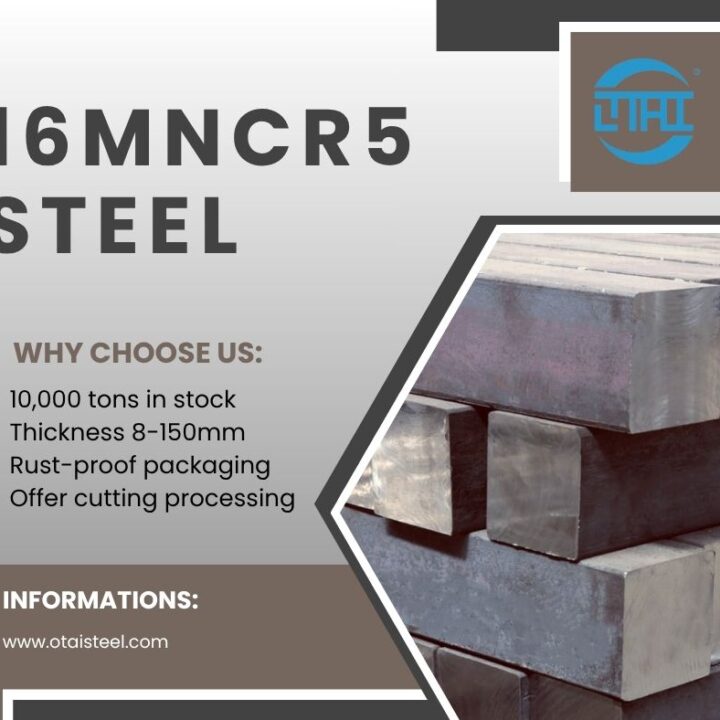
Otai Special Steel supplies premium-quality 16MnCr5 steel materials for demanding engineering applications.
- Large inventory and stable supply
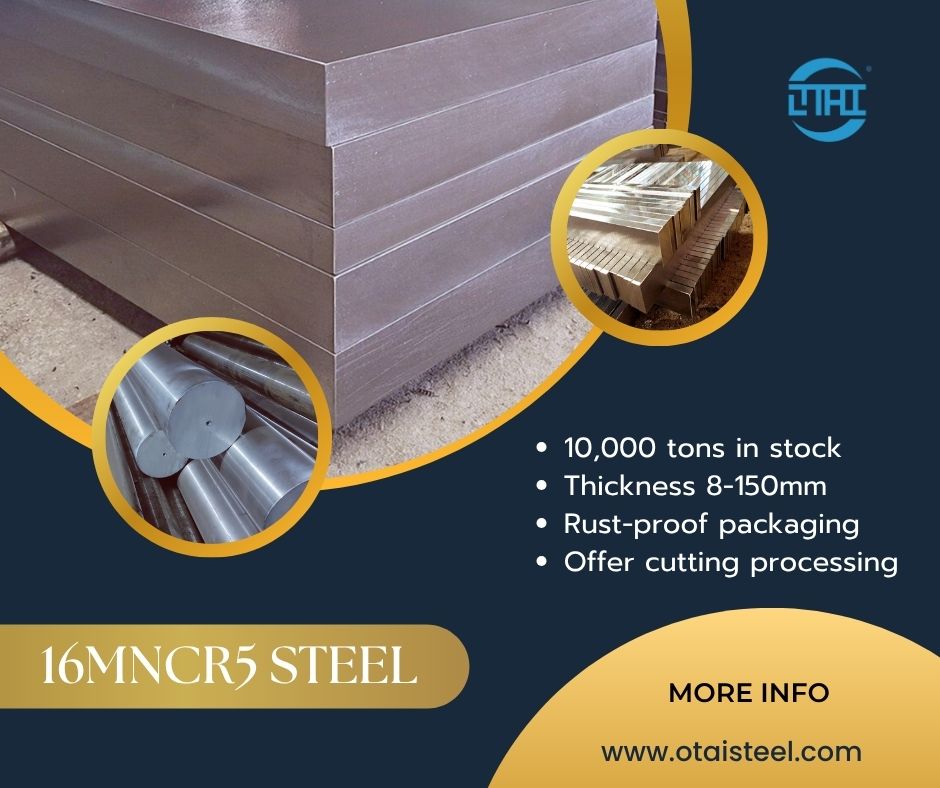
- 8–150mm thickness plates available in stock
- Custom cutting and heat treatment services
- Ultrasonic testing (UT) and chemical composition verification
- Third-party inspection support (SGS)
- Professional export packaging and logistics support
We support customers in automotive, industrial machinery, agricultural equipment, and heavy engineering industries with reliable material quality and technical assistance.
❓ FAQ
Q1: What type of steel is 16MnCr5?
A1: 16MnCr5 is a low-carbon chromium-manganese alloy carburizing steel.
Q2: Why does 16MnCr5 contain low carbon?
A2: Low carbon helps maintain a tough and ductile core while carburizing hardens the surface.
Q3: What elements improve wear resistance in 16MnCr5?
A3: Chromium mainly improves wear resistance and hardenability.
Q4: What hardness can 16MnCr5 achieve after carburizing?
A4: Proper heat treatment can achieve approximately 58–62 HRC surface hardness.
Q5: Which industries commonly use 16MnCr5 steel?
A5: Automotive, industrial machinery, agricultural equipment, and heavy engineering industries widely use this material.