 16MnCr5 MatWeb – Material Properties and Engineering Applications
Many engineers search for 16MnCr5 MatWeb when they need reliable material data for design, manufacturing, and procurement decisions. As one of the most widely used case hardening steels, 16MnCr5 offers an excellent combination of wear resistance, fatigue strength, and core toughness after carburizing and heat treatment.
Material databases such as MatWeb provide valuable information regarding chemical composition, mechanical properties, physical characteristics, and processing recommendations. However, engineers often need additional context to understand how these values translate into real-world applications. This article explains the key information typically associated with 16MnCr5 MatWeb data and shows how manufacturers use this steel in demanding industrial environments.
Buyers frequently search for related terms such as 16MnCr5 material properties, 16MnCr5 steel specification, 16MnCr5 density, 16MnCr5 hardness, and 16MnCr5 equivalent material. Understanding these characteristics helps engineers select the correct material for gears, shafts, pinions, and other power transmission components.
🔵 What Is 16MnCr5 Steel?
16MnCr5 is a low-carbon chromium-manganese alloy steel developed primarily for carburizing applications. Engineers choose this material when components require a hard wear-resistant surface while maintaining a strong and impact-resistant core.
After carburizing, quenching, and tempering, the surface hardness typically reaches levels suitable for heavily loaded gears and transmission parts. At the same time, the core retains excellent toughness, allowing the component to withstand shock loading and cyclic stresses.
Because of this balanced performance, 16MnCr5 remains one of the most common engineering steels used in automotive transmissions, industrial gearboxes, agricultural machinery, and mining equipment.
🟢 Typical Chemical Composition Found in 16MnCr5 MatWeb Data
One of the most important sections engineers review when searching 16MnCr5 MatWeb information is chemical composition. Alloying elements determine hardenability, wear resistance, and heat treatment response.
| Element | Typical Content (%) | Function |
|---|---|---|
| Carbon (C) | 0.14–0.19 | Supports carburized hardness |
| Manganese (Mn) | 1.00–1.30 | Improves hardenability |
| Chromium (Cr) | 0.80–1.10 | Enhances wear resistance |
| Silicon (Si) | ≤0.40 | Contributes to strength |
| Phosphorus (P) | ≤0.025 | Controlled impurity |
| Sulfur (S) | ≤0.035 | Supports machinability |
This composition allows 16MnCr5 to achieve excellent surface hardness after carburizing while maintaining sufficient core ductility for demanding mechanical applications.
🟠 Mechanical Properties Engineers Commonly Review
Another critical section associated with 16MnCr5 MatWeb searches is mechanical property data. Although exact values vary depending on heat treatment conditions, engineers often use typical ranges when evaluating material suitability.
| Property | Typical Value |
|---|---|
| Density | 7.85 g/cm³ |
| Tensile Strength | 800–1200 MPa |
| Yield Strength | 600–900 MPa |
| Surface Hardness After Carburizing | 58–62 HRC |
| Elongation | 10–15% |
These properties make the material suitable for components that must resist wear while maintaining structural integrity under repeated loading cycles.
🟣 Heat Treatment Information Commonly Referenced in 16MnCr5 MatWeb Searches
When engineers review 16MnCr5 MatWeb data, they often focus on heat treatment recommendations because heat treatment has a direct impact on final component performance. Unlike through-hardening steels, 16MnCr5 achieves its best results through carburizing, followed by quenching and tempering.
During carburizing, carbon diffuses into the surface layer of the steel. This process creates a high-carbon outer zone that can reach very high hardness levels after quenching. Meanwhile, the lower-carbon core remains relatively tough and ductile. This combination allows gears and shafts to resist wear while absorbing impact loads.
Manufacturers frequently adjust carburizing depth according to component size and service requirements. Shallow case depths may suit small gears, while heavy-duty transmission components often require deeper carburized layers to maximize service life.
| Heat Treatment Stage | Typical Temperature | Purpose |
|---|---|---|
| Carburizing | 880–950°C | Increase surface carbon content |
| Quenching | Oil Quench | Develop high hardness |
| Tempering | 150–200°C | Improve toughness |
| Stress Relieving | Optional | Reduce residual stress |
The excellent carburizing response is one of the main reasons engineers continue to rely on 16MnCr5 MatWeb property data when designing wear-resistant mechanical systems.
🔷 Physical Properties of 16MnCr5 Steel
In addition to mechanical performance, engineers often review physical properties when selecting materials. Thermal expansion, density, and thermal conductivity influence machining, assembly, and operating behavior. These characteristics become particularly important when components operate at elevated temperatures or under varying environmental conditions.
| Physical Property | Typical Value |
|---|---|
| Density | 7.85 g/cm³ |
| Elastic Modulus | 210 GPa |
| Thermal Conductivity | Approximately 46 W/m·K |
| Thermal Expansion | 11–12 ×10⁻⁶ /°C |
| Specific Heat Capacity | Approximately 460 J/kg·K |
These values help engineers predict dimensional changes, heat transfer characteristics, and structural behavior during operation. As a result, many technical teams review this information alongside mechanical properties when evaluating 16MnCr5 MatWeb data.
🔴 16MnCr5 vs 20MnCr5 Comparison
Many buyers compare 16MnCr5 with 20MnCr5 because both grades belong to the carburizing steel family. Although they share many similarities, differences in carbon content can influence hardness potential and heat treatment response.
| Property | 16MnCr5 | 20MnCr5 |
|---|---|---|
| Carbon Content | 0.14–0.19% | 0.17–0.22% |
| Carburizing Capability | Excellent | Excellent |
| Core Toughness | Very Good | Good |
| Wear Resistance | High | Slightly Higher |
| Typical Applications | Gears, shafts | Heavy-duty gears |
For many applications, both materials perform exceptionally well. However, engineers should always review project-specific requirements before selecting a substitute.
🟤 International Equivalent Grades
Another common reason engineers search for 16MnCr5 MatWeb information is to identify equivalent grades from different standards. Global supply chains often require cross-referencing materials between European, American, Japanese, and Chinese systems.
| Standard | Equivalent Grade | Remarks |
|---|---|---|
| EN | 16MnCr5 | Reference Grade |
| DIN | 1.7131 | Material Number |
| JIS | SCr420 | Similar Application |
| AISI | 5115 | Comparable Grade |
| GB | 20CrMnTi | Similar Engineering Use |
Equivalent grades may share similar applications, but engineers should always verify composition and heat treatment requirements before approval.
⚙️ Major Applications of 16MnCr5 Steel
The popularity of 16MnCr5 MatWeb searches reflects the broad industrial use of this material. Manufacturers rely on 16MnCr5 when components require excellent wear resistance, fatigue strength, and dimensional stability.
Automotive companies use the material extensively for transmission gears, synchronizer hubs, differential gears, and drive shafts. Industrial machinery manufacturers select it for couplings, bushings, pinions, and precision mechanical components. Agricultural equipment producers also use it because of its durability in harsh operating environments.
The combination of a hardened case and a tough core enables long service life, making 16MnCr5 one of the most economical carburizing steels available today.
🏭 Company Advantages – Otai Special Steel
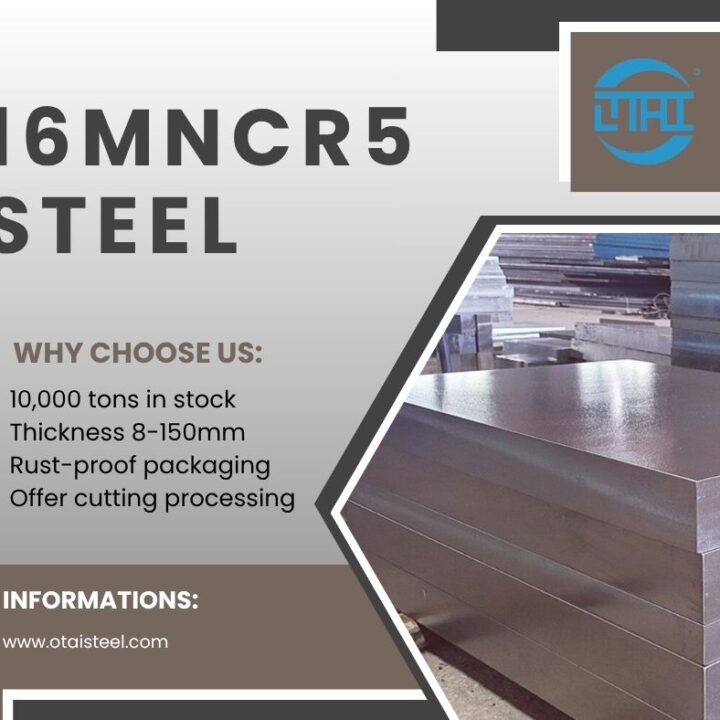
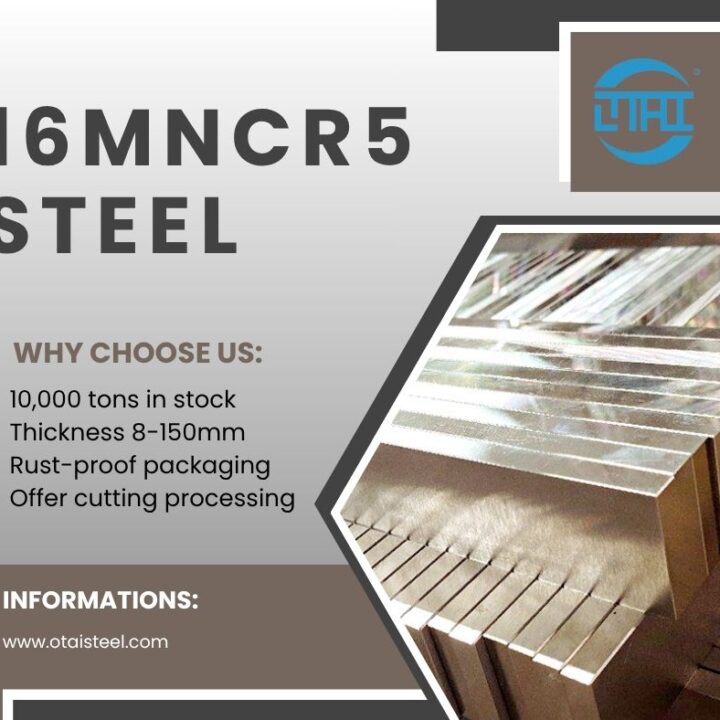
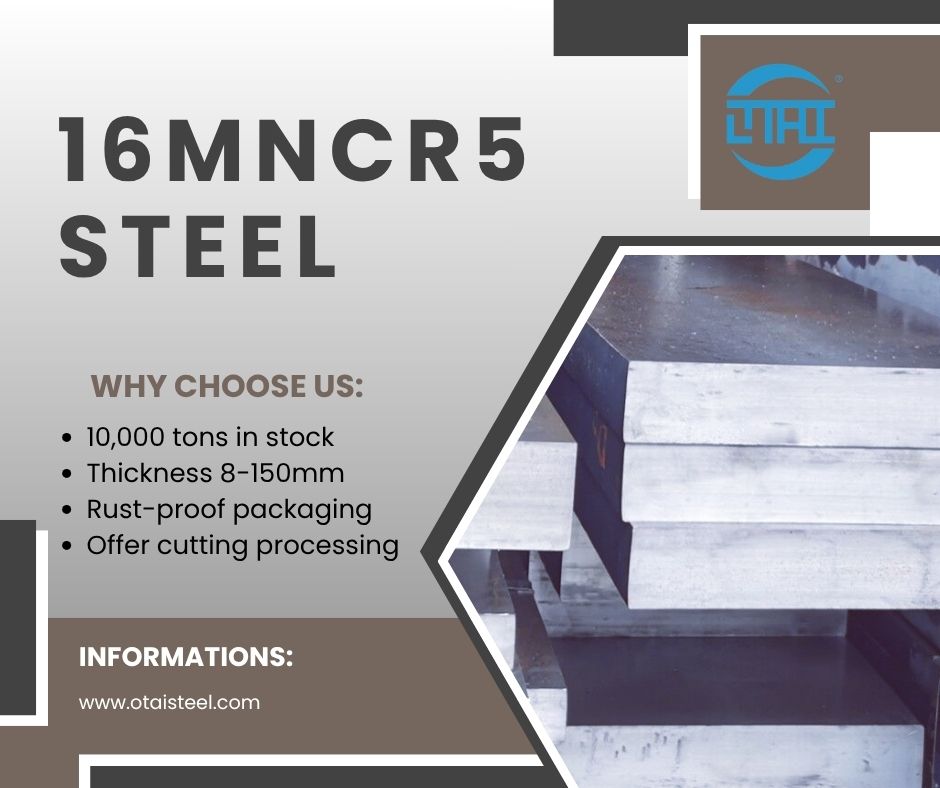
- 📏 16MnCr5 steel plate thickness range: 8–150mm in stock
- 📦 Large inventory available for rapid delivery
- ✂️ Precision cutting, machining, and heat treatment services
- 🔬 Ultrasonic testing and third-party inspection support
- 🌍 Rich export experience serving customers worldwide
- 🏆 Reliable quality control and technical support
❓ FAQ About 16MnCr5 MatWeb Data
1. What information does 16MnCr5 MatWeb typically provide?
It usually includes chemical composition, mechanical properties, physical properties, heat treatment information, and material standards.
2. What is the density of 16MnCr5 steel?
The typical density is approximately 7.85 g/cm³.
3. Is 16MnCr5 suitable for gears?
Yes. Engineers commonly use 16MnCr5 for gears because it develops high surface hardness after carburizing while maintaining a tough core.
4. What is the material number for 16MnCr5?
The European material number is 1.7131.
5. Which industries use 16MnCr5 steel?
Automotive, industrial machinery, mining equipment, agricultural machinery, and power transmission industries frequently use this grade.
🏁 Conclusion
Engineers frequently search for 16MnCr5 MatWeb information because this steel offers an outstanding balance of carburizing performance, wear resistance, fatigue strength, and core toughness. Understanding chemical composition, mechanical properties, physical characteristics, and heat treatment recommendations helps manufacturers select the right material for demanding applications.
Whether the application involves automotive gears, industrial shafts, or precision transmission components, 16MnCr5 remains one of the most trusted case hardening steels available in the global engineering market.