 16MnCr5 Steel Uses: Where This Case Hardening Steel Performs Best
The wide range of 16MnCr5 steel uses makes this alloy one of the most important carburizing steels in modern manufacturing and heavy engineering industries. Engineers select 16MnCr5 because it delivers an outstanding combination of surface hardness, core toughness, fatigue resistance, and wear performance after heat treatment.
Manufacturers around the world use this steel for components that operate under continuous friction, heavy cyclic loading, and high contact stress. Its excellent carburizing response allows engineers to produce parts with a very hard outer layer while maintaining a shock-resistant and ductile core.
Because of these advantages, 16MnCr5 steel has become a preferred material for:
- Automotive transmission systems
- Industrial gearbox components
- Heavy-duty shafts
- Power transmission equipment
- Agricultural machinery
- Construction equipment
- Mechanical drive systems
🔍 What is 16MnCr5 Steel?
16MnCr5 is a low-carbon chromium-manganese alloy steel produced according to EN/DIN standards. The steel belongs to the family of case hardening steels, meaning manufacturers typically carburize the surface to improve hardness and wear resistance.
After carburizing and quenching, the steel develops:
- A hard martensitic surface
- A strong and ductile core
- Excellent fatigue resistance
- Outstanding wear performance
- Reliable dimensional stability
This dual-property structure makes the material highly suitable for heavily loaded mechanical systems.
| Property | Performance |
|---|---|
| Surface Hardness | Excellent |
| Wear Resistance | Excellent |
| Core Toughness | Very Good |
| Fatigue Resistance | Excellent |
⚗️ Chemical Composition and Industrial Performance
The alloy composition directly affects the engineering performance and application range of 16MnCr5 steel.
| Element | Content (%) | Main Benefit |
|---|---|---|
| Carbon (C) | 0.14 – 0.19 | Supports carburized hardness |
| Manganese (Mn) | 1.00 – 1.30 | Improves hardenability |
| Chromium (Cr) | 0.80 – 1.10 | Enhances wear resistance |
| Silicon (Si) | 0.17 – 0.37 | Improves strength |
The combination of chromium and manganese gives 16MnCr5 excellent hardenability and mechanical reliability in demanding industrial environments.
🚗 Automotive Industry Uses
The automotive industry represents one of the largest application sectors for 16MnCr5 steel. Modern vehicles require transmission components capable of handling continuous rotational stress and repeated torque loading.
Manufacturers commonly use 16MnCr5 for:
- Transmission gears
- Differential gears
- Synchronizer hubs
- Drive shafts
- Pinion gears
- Clutch components
The carburized surface improves wear resistance, while the tough core prevents sudden failure during shock loading conditions.
| Automotive Component | Main Requirement |
|---|---|
| Gear Teeth | Wear resistance |
| Drive Shafts | Fatigue strength |
| Differential Parts | Shock resistance |
🏭 Industrial Machinery Applications
Industrial machinery operates under demanding mechanical conditions involving continuous motion, high loads, and repetitive contact stress. 16MnCr5 performs exceptionally well in these environments because of its balanced hardness and toughness.
Common industrial uses include:
- Gearboxes
- Reducers
- Industrial rollers
- Power transmission shafts
- Heavy-duty couplings
- Mining equipment gears
The steel helps reduce maintenance frequency and improve equipment reliability in long-term industrial operation.
🌾 Agricultural and Construction Equipment Uses
Agricultural and construction machinery often operates in dusty, muddy, and high-impact environments. Components in these systems experience continuous friction, vibration, and heavy loading.
16MnCr5 steel performs extremely well in these applications because the carburized surface resists abrasive wear while the strong core absorbs impact energy.
Manufacturers commonly use the steel for:
- Tractor transmission gears
- Axle shafts
- Drive couplings
- Hydraulic transmission components
- Excavator drive systems
- Loader gearbox components
The material helps improve service life and reduce unexpected mechanical failures in heavy-duty field operation.
| Equipment Type | Typical Components |
|---|---|
| Agricultural Machinery | Transmission gears and shafts |
| Excavators | Drive systems and couplings |
| Construction Equipment | Gearbox components |
🔥 Why 16MnCr5 Steel Performs Well in Mechanical Systems
The success of 16MnCr5 steel comes from its ability to combine multiple important engineering properties in one material.
After carburizing and quenching, the steel develops:
- High surface hardness
- Excellent fatigue strength
- Strong impact resistance
- Reliable dimensional stability
- Outstanding wear performance
This unique structure allows mechanical systems to operate efficiently under repeated cyclic loading and severe friction conditions.
| Performance Factor | Benefit |
|---|---|
| Hard Surface Layer | Improves wear resistance |
| Ductile Core | Prevents brittle fracture |
| Fatigue Strength | Extends component life |
| Hardenability | Improves heat treatment response |
⚙️ Heat Treatment and Performance Optimization
Heat treatment plays a critical role in maximizing the performance of 16MnCr5 steel. Engineers carefully control carburizing depth, quenching temperature, and tempering conditions to achieve the desired mechanical properties.
| Heat Treatment Process | Typical Temperature |
|---|---|
| Carburizing | 880 – 980°C |
| Quenching | 780 – 850°C |
| Tempering | 150 – 200°C |
Proper heat treatment improves:
- Surface hardness
- Fatigue performance
- Wear resistance
- Dimensional stability
- Impact toughness
Many high-performance transmission systems depend on optimized carburizing treatment to ensure long-term operational reliability.
🌍 International Equivalent Grades
Several international standards provide steels with similar carburizing performance and mechanical characteristics to 16MnCr5.
| Standard | Equivalent Grade |
|---|---|
| AISI / SAE | SAE 5115 |
| JIS | SCM420 |
| GB | 20CrMnTi |
| ISO | 18CrMo4 |
Although these steels offer similar application performance, slight differences in chemical composition may affect hardenability and fatigue behavior.
🏭 Company Advantages
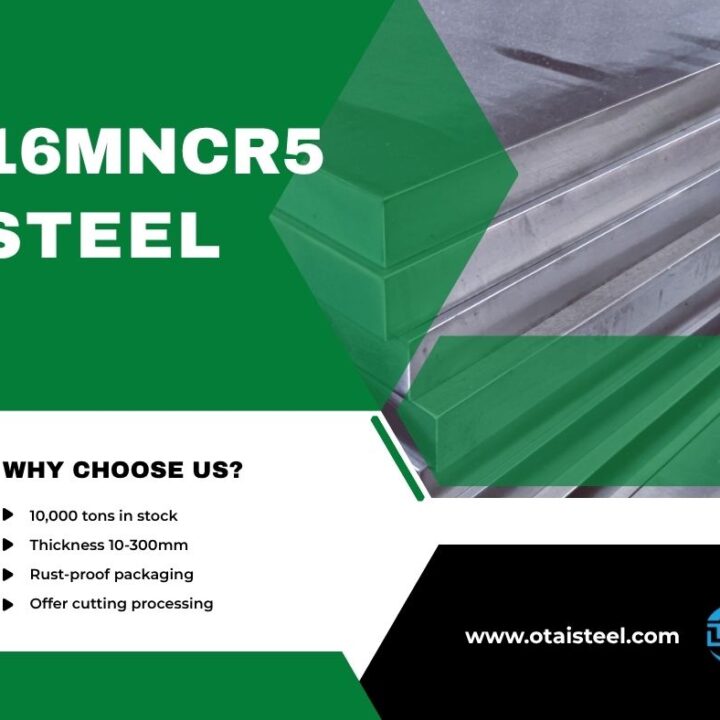
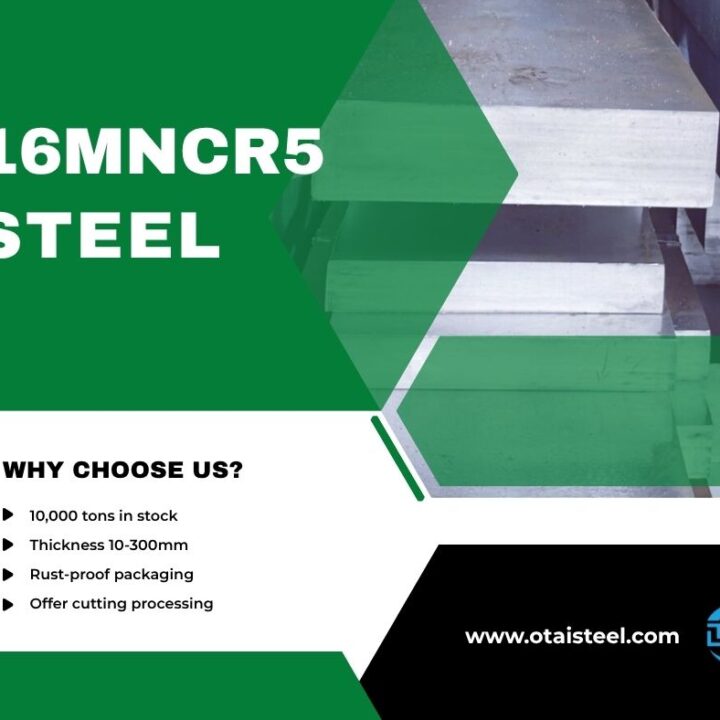
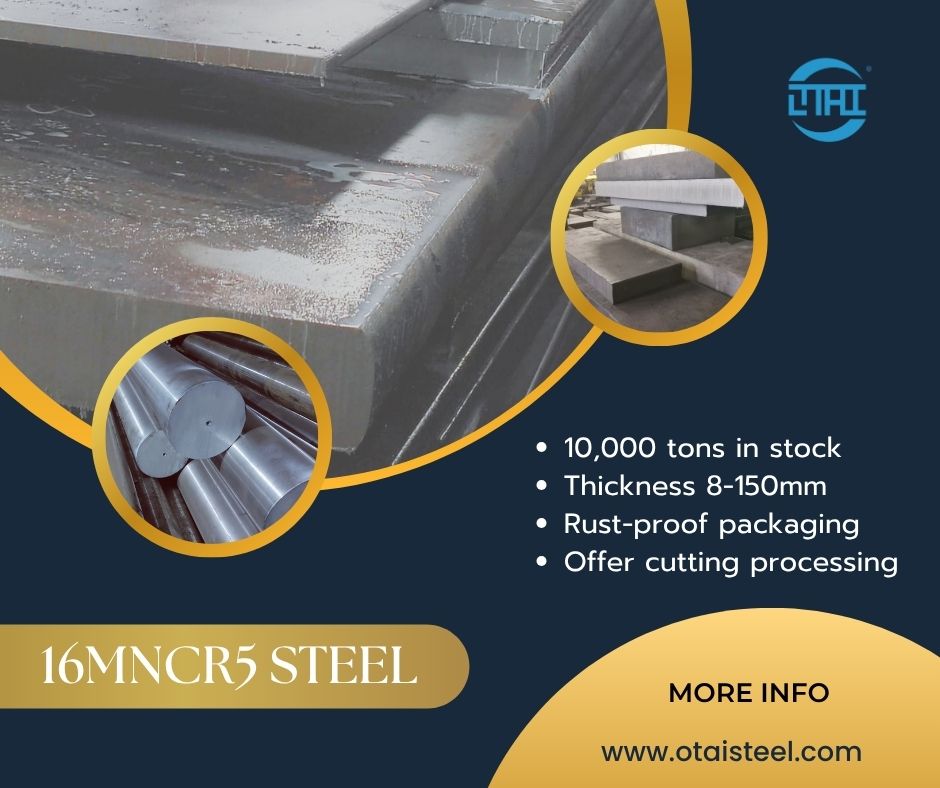
Otai Special Steel supplies high-quality 16MnCr5 steel materials for automotive, industrial machinery, agricultural equipment, and heavy engineering applications.
- Large inventory and stable year-round supply
- 8–150mm thickness plates available in stock
- Custom cutting services based on customer drawings
- Professional heat treatment support
- Ultrasonic testing (UT) and chemical composition verification
- Third-party inspection support including SGS
- Export packaging and global logistics support
- Fast response for urgent material requirements
Our team supports customers with reliable material quality, technical assistance, and stable delivery performance for demanding engineering projects.
❓ FAQ
Q1: What are the main uses of 16MnCr5 steel?
A1: Manufacturers commonly use 16MnCr5 steel for gears, shafts, pinions, couplings, and transmission components that require high wear resistance and strong core toughness.
Q2: Why is 16MnCr5 suitable for gears?
A2: The steel develops a hard carburized surface and a shock-resistant core after heat treatment, making it ideal for heavily loaded gear systems.
Q3: Which industries commonly use 16MnCr5 steel?
A3: Automotive, industrial machinery, agricultural equipment, mining, and construction industries widely use this material.
Q4: Can 16MnCr5 steel resist wear effectively?
A4: Yes. After carburizing and quenching, the steel achieves excellent wear resistance and fatigue performance.
Q5: What is the typical hardness of carburized 16MnCr5?
A5: Proper heat treatment can achieve approximately 58–62 HRC surface hardness.