41Cr4 Steel: Properties, Chemical Composition, Hardness, Heat Treatment and Applications
📑 Table of Contents
When engineers and purchasing teams search for 41Cr4 steel, they are usually looking for more than a basic material definition. They need to know its chemical composition, mechanical properties, hardness, heat-treatment response, equivalent grades, available dimensions and suitability for a specific component.
41Cr4 is a chromium alloy steel designed for quenching and tempering. The European designation is 41Cr4, material number 1.7035, and the grade belongs to the EN family of alloy steels for quenching and tempering. Its combination of medium carbon content and chromium gives it a useful balance of strength, toughness and hardenability for mechanical components.
For buyers, the important point is that material selection should connect the steel grade with the final working condition. A component requiring moderate strength may use 41Cr4 in a quenched and tempered condition, while a surface-hardening application may take advantage of its ability to develop a hard outer layer while retaining a tougher core.
This article explains the grade from both an engineering and purchasing perspective, including chemistry, properties, heat treatment, hardness, equivalents, applications and supplier considerations.
🔍 1. What Is 41Cr4 Steel?
41Cr4 is a medium-carbon chromium alloy steel commonly used for components that require higher strength than ordinary carbon steels can provide. The material number is 1.7035, and it is associated with EN 10083-3 for alloy steels used in quenching and tempering applications.
The grade contains approximately 0.38–0.45% carbon and 0.90–1.20% chromium. This chemistry gives 41Cr4 a stronger hardening response than plain medium-carbon steels while keeping the alloy system relatively simple.
In practical production, the material can be supplied in different conditions, including annealed, normalized or quenched-and-tempered states depending on the product specification. The selected condition directly affects hardness, machinability and final mechanical performance.
| Property | 41Cr4 Information |
|---|---|
| European grade | 41Cr4 |
| Material number | 1.7035 |
| Steel family | Alloy steel for quenching and tempering |
| Main alloying element | Chromium |
| Typical use condition | Quenched and tempered or surface hardened |
In short, 41Cr4 is a versatile medium-carbon chromium alloy steel for strength-oriented mechanical components. It is not a stainless steel, and its chromium content does not provide stainless corrosion resistance.
🧪 2. 41Cr4 Steel Chemical Composition
The chemical composition explains much of the performance of 41Cr4. Carbon provides the basic strength and hardening potential, while chromium improves hardenability and contributes to the grade’s response during heat treatment.
| Element | EN 10083-3 Reference Range / Limit (%) | Main Function |
|---|---|---|
| C | 0.38–0.45 | Strength and hardening response |
| Si | Max. 0.40 | Deoxidation and strengthening |
| Mn | 0.60–0.90 | Strength and hardenability |
| P | Max. 0.025 | Controlled residual element |
| S | Max. 0.035 | Machinability influence |
| Cr | 0.90–1.20 | Hardenability and strength |
The carbon level places 41Cr4 well above low-carbon engineering steels in terms of hardening potential. Meanwhile, chromium supports more consistent hardening through the section than a comparable plain carbon steel.
Buyers should still check the actual mill certificate rather than relying only on nominal grade chemistry. Heat number, product standard, delivery condition and actual chemical analysis all matter when the material goes into a controlled production process.
For procurement, the material certificate should confirm the specified 41Cr4 chemistry and the agreed delivery standard. This becomes particularly important when a project specifies EN 10083-3 rather than simply asking for a commercially equivalent grade.
⚙️ 3. 41Cr4 Steel Mechanical Properties
The mechanical properties of 41Cr4 depend strongly on product size and delivery condition. A quenched-and-tempered component will behave very differently from annealed material, so buyers should never treat one hardness or tensile-strength value as universal for every size.
For reference, EN-based data show that tensile strength in the quenched-and-tempered condition varies with section size. For round products, typical specified ranges can run from approximately 1000–1200 MPa for smaller diameters to around 800–950 MPa for larger sections.
| Product / Size Range | Typical Minimum / Range in +QT | Engineering Significance |
|---|---|---|
| Round, up to 16 mm | Rm about 1000–1200 MPa | High strength for small sections |
| Round, 16–40 mm | Rm about 900–1100 MPa | Balanced strength and toughness |
| Round, 40–100 mm | Rm about 800–950 MPa | Section size affects hardening response |
| Flat product, up to 8 mm | Rm min. about 1000 MPa | Suitable for high-strength thin sections |
| Flat product, 20–50 mm | Rm min. about 800 MPa | Larger sections require attention to QT condition |
Yield strength also decreases as section size increases under the referenced delivery conditions. For example, published EN data give minimum proof/yield values of approximately 800 MPa, 660 MPa and 560 MPa across increasing round-product size ranges.
Therefore, when a customer specifies a mechanical-property requirement, the inquiry should include the product form and dimensions. Saying only “41Cr4 steel” does not fully define the expected mechanical performance.
🔥 4. 41Cr4 Steel Heat Treatment
Heat treatment is one of the most important parts of working with 41Cr4. The grade responds well to quenching and tempering, allowing manufacturers to adjust the balance between strength, hardness and toughness according to the component’s service requirements.
For hardening, a commonly used reference range for 41Cr4 is approximately 830–860°C, followed by suitable quenching. The exact furnace temperature, holding time and cooling medium should depend on section size, furnace conditions and the required microstructure.
| Treatment | Reference Range | Purpose |
|---|---|---|
| Hardening | Approx. 830–860°C | Form a hardenable austenitic structure before quenching |
| Quenching | Often oil for suitable sections | Develop martensitic hardness |
| Tempering | Selected according to target properties | Reduce brittleness and adjust strength/toughness |
| Stress relieving | Application-dependent | Reduce machining or processing stress |
For larger sections, hardening behavior becomes increasingly important because the cooling rate at the core differs from the surface. Ovako notes that 41Cr4 can through-harden in oil to approximately 40 mm diameter under its reference production conditions. This does not mean every 40 mm component will achieve the same hardness at the center; actual results depend on steelmaking, section geometry and heat-treatment practice.
Tempering temperature should therefore come from the required final hardness and mechanical properties rather than from a single universal number. In production, the practical sequence is define target hardness → select hardening temperature → control holding → quench → temper → verify hardness and mechanical properties.
📏 5. 41Cr4 Steel Hardness
The hardness of 41Cr4 varies significantly with delivery condition and heat treatment. Annealed material is easier to machine, while quenched-and-tempered material provides substantially higher strength and hardness.
Reference EN data list hardness values around 241 HBW in the annealed condition and around 255 HBW in the treated-for-machinability condition, depending on the specified condition.
After quenching and tempering, the final hardness depends on tempering temperature, section size and the required mechanical-property combination. Consequently, buyers should specify the required hardness range instead of assuming that the grade name alone defines the hardness.
| Condition | Hardness / Performance | Typical Reason for Selection |
|---|---|---|
| Annealed | Around 241 HBW reference value | Machining and forming before final treatment |
| Machinability-treated | Around 255 HBW reference value | Improved cutting performance |
| Quenched and tempered | Depends on tempering and section size | Strength, toughness and service performance |
| Induction hardened | Surface can reach high hardness | Wear-resistant surface with tougher core |
For surface hardening, 41Cr4 is particularly useful. Ovako lists the grade as suitable for induction surface hardening with a minimum surface hardness reference of 52 HRC. The actual specification should include the required hardened depth, hardness profile and acceptance method.
🔄 6. 41Cr4 Steel Equivalent Grades
Equivalent-grade questions appear frequently in international steel purchasing. However, “equivalent” should not automatically mean “chemically identical.” Different standards can use different composition limits, product requirements and mechanical-property specifications.
41Cr4 is commonly compared with AISI/SAE 5140 because both belong to the medium-carbon chromium alloy steel family. Depending on the standard and product form, other designations such as 530M40, 42C4 and Japanese SCR440/SCr440H may also appear in comparison tables.
| Designation | Standard / Region | Relationship to 41Cr4 |
|---|---|---|
| 41Cr4 | EN / Europe | Reference grade |
| 1.7035 | Werkstoff number | Material number for 41Cr4 |
| AISI/SAE 5140 | USA | Commonly considered a close equivalent; verify chemistry and specification |
| 530M40 | UK | Common comparison designation |
| 42C4 | France / historical designation | Commonly listed as a comparable grade |
| SCR440 / SCr440H | Japan | Comparable chromium alloy steel designation |
When replacing a specified grade, the safe approach is to compare chemical composition + product standard + delivery condition + mechanical properties + dimensions. A simple grade-name comparison is not enough for safety-critical components.
For international purchasing, the buyer should also ask the supplier to confirm whether the offered grade is produced to the requested standard or merely offered as a commercial equivalent.
🏭 7. 41Cr4 Steel Applications
41Cr4 is suited to mechanical components that need a useful combination of strength, toughness and hardenability. It works particularly well when the designer does not need the higher strength potential of a more heavily alloyed grade such as 42CrMo4.
Typical applications include shafts, axles, pins, bolts, gears, spindles, machine components and other transmission or load-bearing parts. The final choice depends on load, section size, fatigue requirements, wear, impact loading and heat-treatment condition.
| Application | Why 41Cr4 Can Be Considered | Important Design Check |
|---|---|---|
| Shafts | Good strength after QT | Fatigue and torsional loading |
| Axles and pins | Useful balance of toughness and strength | Impact and section size |
| Gears | Can support surface hardening | Surface hardness and case depth |
| Machine components | Good general-purpose alloy steel behavior | Machinability and final hardness |
| Pins and connecting parts | Suitable for strength-oriented applications | Wear and contact stress |
In practice, 41Cr4 makes sense when the component needs more strength and hardenability than a basic carbon steel but does not necessarily require the higher alloy content of 42CrMo4. That position makes it useful for general engineering and machinery applications.
For heavily loaded components, engineers should compare 41Cr4 with 42CrMo4 rather than selecting the material from the grade name alone. The higher alloy content of 42CrMo4 can provide a different strength and hardenability level, particularly for demanding sections.
🛠️ 8. Machining, Welding and Surface Hardening
Machining performance depends on the material condition. Annealed 41Cr4 generally offers a more practical starting condition for extensive machining, while hardened or quenched-and-tempered material requires cutting parameters and tooling appropriate for the actual hardness.
For CNC machining, buyers should consider the final component size before deciding whether to purchase annealed stock, pre-machined material or quenched-and-tempered material. Removing large amounts of material from heavily hardened stock can increase tool wear and machining cost.
Welding requires more attention because the medium carbon content increases hardening sensitivity in the heat-affected zone. Preheating, controlled heat input and suitable post-weld treatment may be required depending on section thickness and joint requirements.
Therefore, 41Cr4 should not be treated like a simple low-carbon structural steel during welding. For critical welded components, the welding procedure should be qualified according to the actual material specification and thickness.
Surface hardening is one of the more attractive options for this grade. Induction hardening can create a hard wear-resistant surface while retaining a comparatively tougher core. The supplier or heat-treatment processor should confirm the required surface hardness, effective hardened depth and inspection method before production.
A practical specification may therefore include steel grade + product size + delivery condition + hardness + heat treatment + ultrasonic testing + dimensional tolerance. This gives the supplier enough information to provide material that fits the actual manufacturing process.
📦 9. Buying 41Cr4 Steel: What Should Buyers Check?
When purchasing 41Cr4 steel internationally, the grade name is only the starting point. A professional inquiry should define the product form, dimensions, standard, delivery condition and inspection requirements.
For example, “41Cr4 steel plate” is not enough information for a quotation. The supplier needs to know thickness, width, length, quantity, surface condition, heat-treatment condition and any special testing requirements.
| Purchase Item | What to Confirm |
|---|---|
| Grade | 41Cr4 / 1.7035 and requested standard |
| Product form | Plate, round bar, flat bar or forged product |
| Dimensions | Thickness/diameter, width and length |
| Delivery condition | Annealed, normalized, QT or other specified condition |
| Inspection | Mill test certificate, dimensional inspection, UT or third-party inspection |
| Processing | Cutting, machining, heat treatment or custom tolerance |
| Packaging | Anti-rust protection, steel strapping or wooden cases |
Stock availability can also make a major difference in international purchasing. If the required dimensions are already available, buyers can reduce production lead time compared with waiting for a new mill production schedule.
For a quotation, the most useful inquiry format is simple: grade + standard + product form + dimensions + quantity + delivery condition + testing + processing requirements. This allows the supplier to confirm availability and calculate the quotation more accurately.
🏢 10. Why Buy 41Cr4 Steel from Otai?
Otai Special Steel supplies alloy steels and tool steels to international industrial customers. For buyers looking for 41Cr4 steel supplier support, the focus is not only on supplying the correct grade but also on dimensions, processing, inspection and export handling.
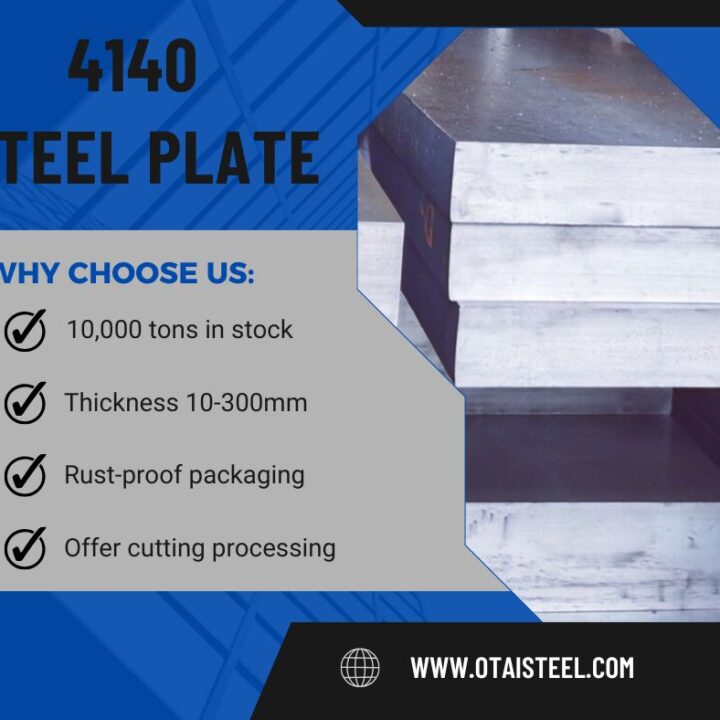
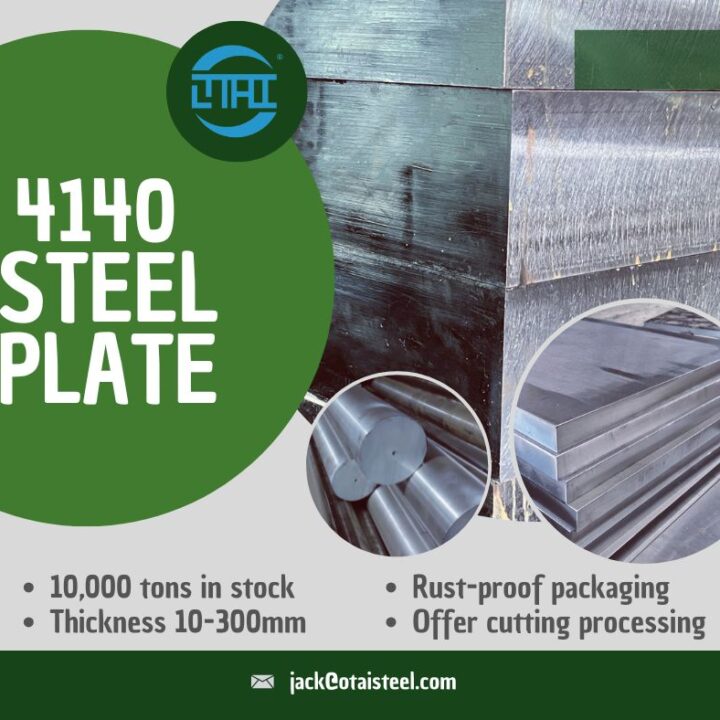
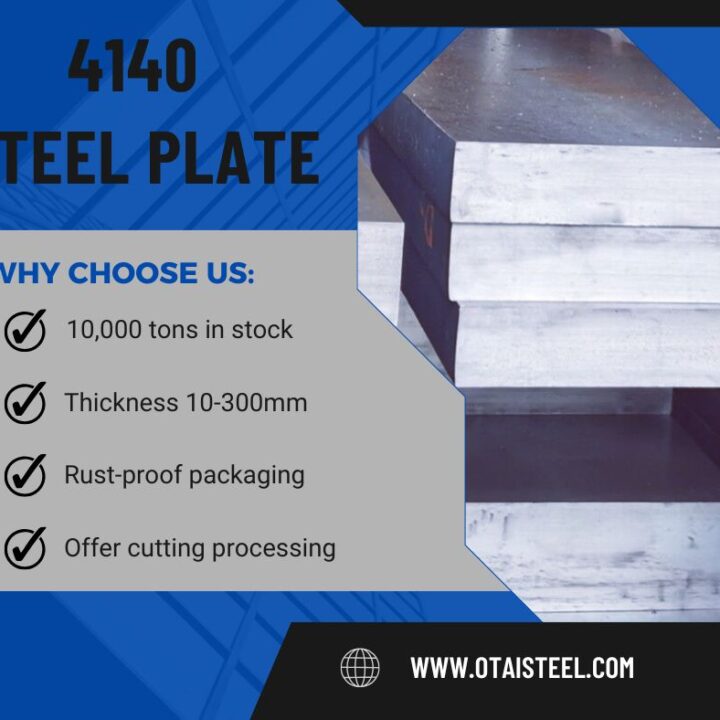
- 41Cr4 steel plate stock: 4–300 mm thickness available from stock, subject to current inventory confirmation.
- 10,000+ tons of total steel stock: Large inventory supports faster material selection and shipment planning.
- 20 saw cutting machines: Cutting service helps customers order closer to the required dimensions.
- CNC machining and grinding: Additional processing can reduce downstream preparation work.
- Custom size and tolerance: Otai can coordinate cutting and machining according to the customer’s drawing or specification.
- One-stop service: Cutting, machining, heat treatment, inspection and export packaging can be coordinated through one supplier.
- Quality inspection: Material certificates and ultrasonic testing can be arranged according to project requirements, with third-party inspection support when required.
- Export experience: Otai has exported steel to customers in 54+ countries since 1999.
- Export packaging: Anti-rust protection, steel strapping and wooden box packaging are available according to shipment requirements.
- B2B technical support: The team can help buyers confirm grade, dimensions, delivery condition and processing requirements before shipment.
For buyers comparing different 41Cr4 steel manufacturers, stockists and distributors, the practical question is whether the supplier can consistently match the requested grade, dimensions, inspection level and delivery schedule. That combination often matters more than the nominal material price alone.
❓ FAQ
1. What is 41Cr4 steel?
41Cr4 is a medium-carbon chromium alloy steel for quenching and tempering. Its European material number is 1.7035, and it is commonly used for shafts, pins, axles, gears and other mechanical components requiring a combination of strength and toughness.
2. Is 41Cr4 the same as AISI 5140?
41Cr4 and AISI/SAE 5140 are commonly treated as close or equivalent grades in international steel trading, but they should not automatically be considered chemically identical. Buyers should compare the applicable standard, chemical composition, product form and mechanical-property requirements before approving substitution.
3. What is the hardness of 41Cr4 steel?
The hardness depends on delivery condition and heat treatment. Reference EN data list approximately 241 HBW in the annealed condition, while induction-hardened 41Cr4 can achieve a surface hardness of at least about 52 HRC under suitable processing conditions.
4. What is the heat treatment temperature for 41Cr4?
A commonly used hardening reference range is approximately 830–860°C. The actual temperature, holding time, quenching medium and tempering condition should be determined according to section size, furnace practice and the required final mechanical properties.
5. Is 41Cr4 suitable for induction hardening?
Yes. 41Cr4 is suitable for induction surface hardening and can develop a hard surface while retaining a tougher core. For production orders, buyers should specify the required surface hardness and effective hardened depth instead of requesting only “induction hardened 41Cr4.”