 16MnCr5 Weight Calculator: Plate, Round Bar, Flat Bar and Steel Weight Formulas
📑 Table of Contents
🔍 1. 16MnCr5 Weight Calculator: What Does It Calculate?
📐 2. 16MnCr5 Density and Basic Weight Formula
📊 3. 16MnCr5 Plate Weight Calculator
⚙️ 4. 16MnCr5 Round Bar Weight Calculator
🔢 5. Weight Formulas for Flat Bar, Square Bar and Hex Bar
🏭 6. Practical 16MnCr5 Weight Calculation Examples
📦 7. Why Accurate Steel Weight Matters
💡 8. How to Use a 16MnCr5 Weight Calculator
🔍 1. 16MnCr5 Weight Calculator: What Does It Calculate?
A 16mncr5 weight calculator helps buyers, engineers, fabricators, and steel distributors estimate the weight of 16MnCr5 steel from its dimensions. The calculation uses the material volume and density.
16MnCr5 is a chromium-manganese case-hardening steel with Werkstoff number 1.7131. It conforms to the EN case-hardening steel family and commonly serves gears, shafts, pinions, camshafts, and transmission components.
When you order or process 16MnCr5, weight matters for several practical reasons. It helps you estimate material requirements, prepare purchase quantities, check shipment weights, plan lifting operations, and estimate transportation requirements.
The calculation itself is simple. First, determine the volume of the steel. Next, multiply the volume by the density. The difficult part is choosing the correct geometric formula for the product shape.
| Product Shape | Dimensions Needed | Main Calculation |
|---|---|---|
| Plate | Length × Width × Thickness | Rectangular volume |
| Round bar | Diameter × Length | Cylindrical volume |
| Flat bar | Width × Thickness × Length | Rectangular volume |
| Square bar | Side × Side × Length | Square-section volume |
| Hexagonal bar | Across-flats × Length | Hexagonal-section volume |
| Pipe or tube | Outside diameter × Wall thickness × Length | Hollow cylindrical volume |
Therefore, a useful 16MnCr5 steel weight calculator should not only provide one formula. It should support the common product shapes used in steel purchasing and machining.
📐 2. 16MnCr5 Density and Basic Weight Formula
Density is the key number behind every steel weight calculation. For practical weight estimation, 16MnCr5 is commonly calculated using a density of approximately 7.85 g/cm³, or 7,850 kg/m³. Several 16MnCr5 datasheets list this practical density value.
Some material databases report slightly different values, such as 7.81 kg/dm³. This small difference comes from the specific reference and material data used. For normal purchasing and fabrication estimates, 7.85 g/cm³ provides a convenient industry calculation basis.
The fundamental formula is:
Weight = Volume × Density
For metric calculations:
Weight (kg) = Volume (m³) × 7,850
For many steel products, simplified formulas are faster. These formulas assume dimensions in millimeters and length in meters.
| Product | Weight Formula | Result |
|---|---|---|
| Plate | Length (m) × Width (m) × Thickness (mm) × 7.85 | kg |
| Round bar | Diameter² × 0.006165 × Length (m) | kg |
| Flat bar | Width (mm) × Thickness (mm) × 0.00785 × Length (m) | kg |
| Square bar | Side² × 0.00785 × Length (m) | kg |
The constants come directly from the density and geometry of the steel. Using the correct units is important because mixing millimeters, centimeters, and meters can create large errors.
For a purchase estimate, the calculated weight is normally an approximate theoretical weight. Actual delivered weight can differ because of dimensional tolerances, cutting allowances, scale, surface condition, and manufacturing tolerances.
📊 3. 16MnCr5 Plate Weight Calculator
A 16mncr5 weight calculator is especially useful when purchasing steel plates because plate weight increases quickly as thickness, width, or length increases.
The basic formula for a rectangular 16MnCr5 plate is:
Weight (kg) = Length (m) × Width (m) × Thickness (mm) × 7.85
For example, consider a 16MnCr5 plate measuring 2000 × 1000 × 50 mm.
The dimensions convert to 2 m × 1 m × 0.05 m. Therefore:
Weight = 2 × 1 × 0.05 × 7,850 = 785 kg
So, one theoretical plate weighs approximately 785 kg.
| 16MnCr5 Plate Size | Volume | Approx. Weight |
|---|---|---|
| 1000 × 1000 × 10 mm | 0.010 m³ | 78.5 kg |
| 1000 × 1000 × 20 mm | 0.020 m³ | 157 kg |
| 1500 × 1000 × 30 mm | 0.045 m³ | 353.25 kg |
| 2000 × 1000 × 50 mm | 0.100 m³ | 785 kg |
| 2000 × 1500 × 60 mm | 0.180 m³ | 1,413 kg |
| 2500 × 1500 × 100 mm | 0.375 m³ | 2,943.75 kg |
These values are theoretical estimates based on 7.85 g/cm³. Actual steel weight can vary slightly because the actual dimensions and density may differ from the nominal values.
Weight per square meter
A quick method is to calculate the weight per square meter first. For 16MnCr5 plate, every 1 mm of thickness represents approximately 7.85 kg/m².
| Thickness | Approx. Weight per m² |
|---|---|
| 10 mm | 78.5 kg/m² |
| 20 mm | 157 kg/m² |
| 30 mm | 235.5 kg/m² |
| 50 mm | 392.5 kg/m² |
| 80 mm | 628 kg/m² |
| 100 mm | 785 kg/m² |
This method is convenient for purchasing teams because they can quickly estimate the weight of a plate from its area and thickness without calculating the complete volume each time.
⚙️ 4. 16MnCr5 Round Bar Weight Calculator
Round bars require a different calculation because their cross-section is circular. The volume depends on the diameter squared, so a small increase in diameter can create a noticeable increase in weight.
The formula is:
Weight (kg) = Diameter² (mm) × 0.006165 × Length (m)
For example, a 16MnCr5 round bar with a diameter of 100 mm and a length of 3 meters has an estimated weight of:
100² × 0.006165 × 3 = 184.95 kg
Therefore, the theoretical weight is approximately 184.95 kg.
| Diameter | Approx. Weight per Meter | Weight for 3 m |
|---|---|---|
| 20 mm | 2.47 kg/m | 7.40 kg |
| 30 mm | 5.55 kg/m | 16.65 kg |
| 50 mm | 15.41 kg/m | 46.23 kg |
| 80 mm | 39.46 kg/m | 118.37 kg |
| 100 mm | 61.65 kg/m | 184.95 kg |
| 150 mm | 138.71 kg/m | 416.13 kg |
The round-bar formula is useful when you need to estimate raw material weight before machining gears, shafts, pins, or other 16MnCr5 components.
Because machining removes material, the finished component will usually weigh less than the original round bar. However, the purchasing calculation should normally use the supplied raw-material dimensions rather than the final component dimensions.
🔢 5. Weight Formulas for Flat Bar, Square Bar and Hex Bar
A useful 16MnCr5 steel weight calculator should also cover other common profiles. The same density applies, but the cross-sectional geometry changes the formula.
16MnCr5 flat bar
For a flat bar, multiply width, thickness, and length. With dimensions in millimeters and length in meters:
Weight (kg) = Width × Thickness × 0.00785 × Length
16MnCr5 square bar
For a square bar:
Weight (kg) = Side² × 0.00785 × Length
16MnCr5 hexagonal bar
For a regular hexagonal bar measured across flats, a practical formula is:
Weight (kg/m) ≈ Across-Flats² × 0.006798
The hexagonal formula requires more care because the cross-sectional area differs from a circle or square. Therefore, buyers should make sure the calculator identifies whether the input refers to across-flats or another dimension.
| Shape | Example Size | Approx. Weight per Meter |
|---|---|---|
| Flat bar | 50 × 10 mm | 3.93 kg/m |
| Flat bar | 100 × 20 mm | 15.70 kg/m |
| Square bar | 30 × 30 mm | 7.07 kg/m |
| Square bar | 50 × 50 mm | 19.63 kg/m |
| Hex bar | 30 mm across flats | Approx. 6.12 kg/m |
| Hex bar | 50 mm across flats | Approx. 16.99 kg/m |
For hollow sections such as tubes, subtract the inner volume from the outer volume. The formula therefore requires both outside diameter and wall thickness.
When the product has an unusual shape or machining allowance, volume-based calculation provides the most reliable theoretical estimate. For commercial orders, the supplier’s actual weighing records and agreed tolerances remain important.
🏭 6. Practical 16MnCr5 Weight Calculation Examples
The following examples show how buyers can apply a 16mncr5 weight calculator to common purchasing situations.
Example 1: 16MnCr5 plate
Suppose you need five plates measuring 1500 × 1000 × 40 mm.
One plate weighs:
1.5 × 1.0 × 0.04 × 7,850 = 471 kg
Five plates therefore have a theoretical total weight of:
471 × 5 = 2,355 kg
Example 2: 16MnCr5 round bar
Suppose you need ten round bars with a diameter of 80 mm and a length of 2 meters.
One bar weighs approximately:
80² × 0.006165 × 2 = 78.91 kg
Ten bars therefore weigh approximately:
78.91 × 10 = 789.1 kg
Example 3: Mixed steel order
A customer may order both plates and round bars in one shipment. In this situation, calculate each product separately and then add the theoretical weights.
| Product | Quantity | Approx. Unit Weight | Approx. Total |
|---|---|---|---|
| 16MnCr5 plate 1500 × 1000 × 40 mm | 5 pcs | 471 kg | 2,355 kg |
| 16MnCr5 round bar Ø80 × 2000 mm | 10 pcs | 78.91 kg | 789.1 kg |
| Total | 15 pcs | — | 3,144.1 kg |
This approach gives the purchasing team a practical estimate before placing the order. It also helps logistics teams plan loading capacity and handling equipment.
However, theoretical weight should not replace the agreed commercial method of determining actual shipment weight. Always check the applicable dimensional tolerances and the supplier’s weighing method.
📦 7. Why Accurate Steel Weight Matters
Knowing the estimated weight of 16MnCr5 steel is useful far beyond simple material calculations. Weight affects purchasing, logistics, machining, lifting, and production planning.
Purchasing and material planning
Buyers can estimate the total steel quantity before requesting a quotation. This helps them compare material requirements and prepare more accurate purchase orders.
Transportation planning
Steel is heavy, so shipment weight directly affects container loading and transportation planning. A reliable theoretical calculation helps logistics teams estimate whether the order fits within the intended shipping arrangement.
Machining and production
16MnCr5 is commonly used for carburized gears, shafts, pinions, and other components. The raw material usually has larger dimensions than the finished part. Weight calculations help manufacturers estimate material utilization and machining allowances.
Cutting optimization
When a large plate must be cut into smaller pieces, the original plate weight and the individual cut-piece weights can both be estimated before processing.
This makes it easier to plan cutting patterns and understand how much raw material remains after processing.
| Purpose | Why Weight Calculation Helps |
|---|---|
| Purchasing | Estimates material quantity |
| Shipping | Supports load and transportation planning |
| Machining | Estimates raw material requirements |
| Cutting | Helps compare raw and finished-piece weights |
| Warehouse management | Supports stock quantity estimates |
| Project planning | Provides a practical material-weight reference |
For these reasons, the 16MnCr5 weight calculator can be a useful purchasing and engineering tool, especially when the order contains multiple sizes or large quantities.
💡 8. How to Use a 16MnCr5 Weight Calculator
Using a 16mncr5 weight calculator is straightforward. First, identify the product shape. Next, enter the correct dimensions and quantity. Finally, select the required unit system and calculate the theoretical weight.
| Step | What to Do |
|---|---|
| 1 | Identify the 16MnCr5 product shape. |
| 2 | Measure or confirm the nominal dimensions. |
| 3 | Enter length, width, thickness, diameter, or other required dimensions. |
| 4 | Enter the quantity of pieces. |
| 5 | Use approximately 7.85 g/cm³ as the calculation density. |
| 6 | Check the theoretical total weight. |
| 7 | Compare the result with actual supplier weighing data when required. |
For example, if you are buying 16MnCr5 plate, enter length, width, thickness, and quantity. If you are buying round bar, enter diameter, length, and quantity instead.
Always keep the units consistent. A common mistake is to enter millimeter dimensions into a formula that expects meters. Another common mistake is to use the final machined dimensions instead of the supplied raw-material dimensions.
It is also important to remember that the calculator provides a theoretical estimate. The actual weight can vary because of dimensional tolerances and differences between nominal and measured dimensions.
For industrial purchasing, the best approach is to use the calculator for planning and then confirm the final shipment weight with the supplier when the order requires precise commercial documentation.
In short, the 16MnCr5 weight calculator gives you a fast way to estimate steel weight, while the actual mill or supplier data provides the final reference for delivered material.
📦 9. Otai Special Steel Advantages
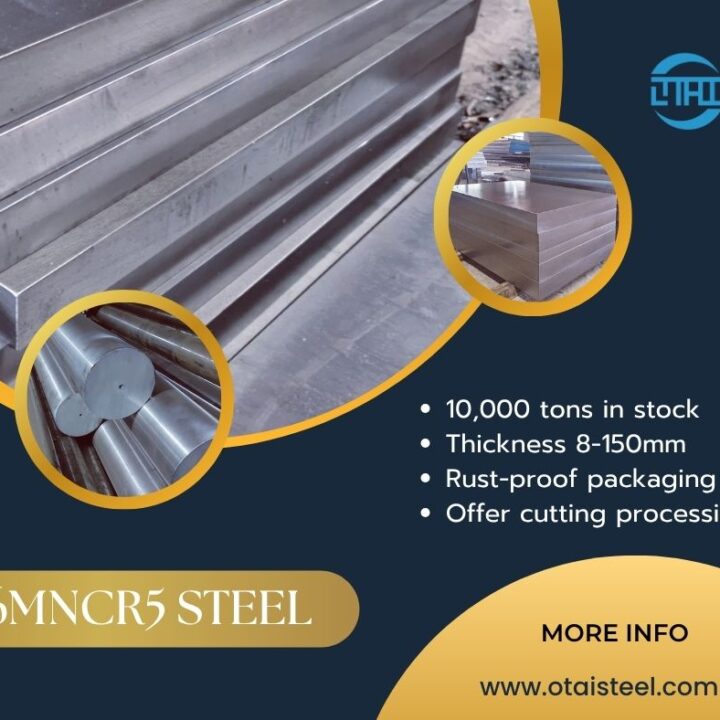
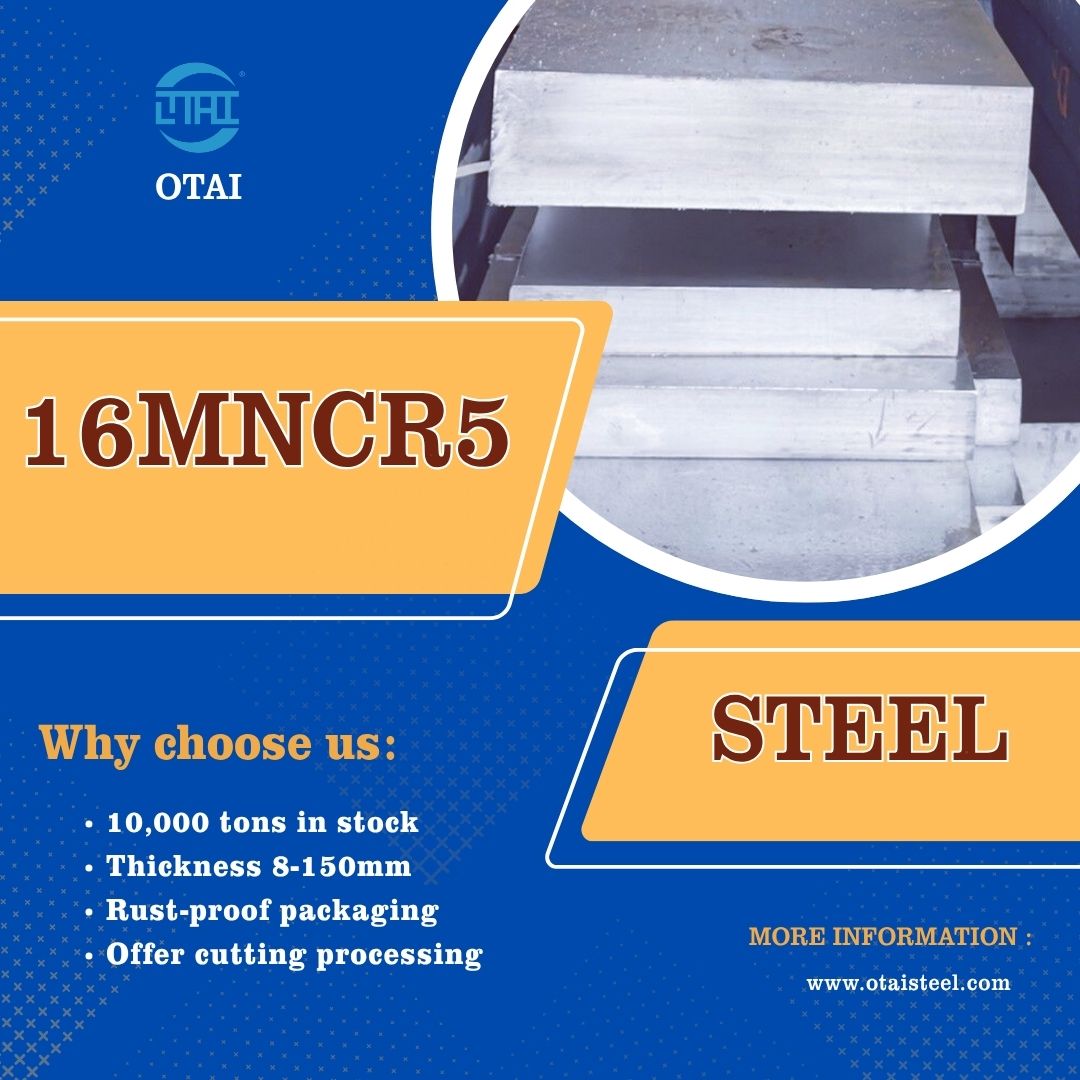
- 16MnCr5 steel plate stock: Otai Special Steel keeps 16MnCr5 plates in 8–150 mm thickness available in stock for industrial applications.
- Different dimensions: We can supply different thicknesses, widths, lengths, and other dimensions according to project requirements.
- Cutting service: Steel can be cut according to customer drawings and specified dimensions.
- Heat treatment: Annealing, normalizing, quenching, tempering, and other heat-treatment services can be arranged according to project requirements.
- Quality inspection: Ultrasonic testing and third-party inspection can be arranged for orders with specific quality requirements.
- Processing support: Cutting, processing, heat treatment, and customized preparation can be arranged before shipment.
- Export packaging: Steel strapping, wooden cases, and anti-rust packaging help protect steel products during international transportation.
- International supply experience: Otai Special Steel has supplied steel products to customers with demanding technical requirements, including Fortune Global 500 companies.
If you need to calculate the weight of 16MnCr5 steel plate or other 16MnCr5 products, provide the shape, dimensions, quantity, and required delivery condition. Otai Special Steel can help confirm the suitable material and processing options.
❓ 10. Frequently Asked Questions
1. What is the density of 16MnCr5 steel?
For practical weight calculations, 16MnCr5 is commonly calculated using a density of approximately 7.85 g/cm³, or 7,850 kg/m³. Some material databases report slightly different values, so the actual material data should be checked when very precise calculations are required. :contentReference[oaicite:4]{index=4}
2. How do I calculate the weight of a 16MnCr5 plate?
Use the formula: Weight (kg) = Length (m) × Width (m) × Thickness (mm) × 7.85. For example, a 2000 × 1000 × 50 mm plate weighs approximately 785 kg theoretically.
3. How do I calculate the weight of a 16MnCr5 round bar?
Use Weight (kg) = Diameter² (mm) × 0.006165 × Length (m). The result gives the approximate theoretical weight of the round bar.
4. Is the weight from a 16MnCr5 weight calculator exact?
No. The calculator provides a theoretical weight based on nominal dimensions and assumed density. Actual weight can vary because of dimensional tolerances, measured dimensions, surface condition, and manufacturing factors.
5. What 16MnCr5 steel plates does Otai Special Steel have in stock?
Otai Special Steel keeps 16MnCr5 plates in 8–150 mm thickness available in stock. Different dimensions, cutting, heat treatment, inspection, and packaging options can also be arranged according to project requirements.