 16MnCr5 vs 18CrNiMo7-6: Strength, Hardenability, Heat Treatment and Gear Applications
📑 Table of Contents
🔍 1. 16MnCr5 vs 18CrNiMo7-6: What Is the Main Difference?
🧪 2. Chemical Composition Comparison
📊 3. Mechanical Properties and Hardenability
🔥 4. Heat Treatment and Carburizing
⚙️ 5. Machinability and Manufacturing
🏭 6. Applications of 16MnCr5 and 18CrNiMo7-6
🦾 7. 16MnCr5 vs 18CrNiMo7-6 for Gears
💡 8. Which Steel Should You Choose?
🔍 1. 16MnCr5 vs 18CrNiMo7-6: What Is the Main Difference?
The comparison between 16MnCr5 vs 18CrNiMo7-6 starts with their different alloy designs. Both grades belong to the case-hardening steel family and both can produce a hard surface with a tough core after carburizing.
However, they target different levels of engineering performance. 16MnCr5 is a widely used chromium-manganese case-hardening steel. It offers a practical balance of machinability, hardenability, wear resistance, and core toughness.
18CrNiMo7-6 is a more highly alloyed nickel-chromium-molybdenum case-hardening steel. Its higher nickel, chromium, and molybdenum contents improve hardenability and support stronger core properties after carburizing and hardening.
This difference becomes especially important when engineers design large gears, heavily loaded shafts, industrial gearboxes, and other components exposed to high cyclic loads.
| Feature | 16MnCr5 | 18CrNiMo7-6 |
|---|---|---|
| Material Number | 1.7131 | 1.6587 |
| Steel family | Cr-Mn case-hardening steel | Cr-Ni-Mo case-hardening steel |
| Carbon level | Low carbon | Low carbon |
| Nickel | Not a principal alloying element | Approx. 1.40–1.70% |
| Molybdenum | Not a principal alloying element | Approx. 0.25–0.35% |
| Hardenability | Good | Very high |
| Typical heat treatment | Carburizing and hardening | Carburizing and hardening |
| Typical use | Automotive gears, shafts, general transmission parts | Heavy-duty gears, industrial gearboxes, high-load components |
In simple terms, 16MnCr5 is a versatile case-hardening steel for many standard applications, while 18CrNiMo7-6 is better suited to components that require deeper hardening, higher core strength, and greater toughness.
Therefore, the question is not simply which grade is stronger. Engineers should compare section size, load level, case depth, fatigue requirements, heat treatment, and production cost before selecting the material.
🧪 2. Chemical Composition Comparison
Chemical composition explains why these two case-hardening steels behave differently. 16MnCr5 relies mainly on manganese and chromium, while 18CrNiMo7-6 adds substantial nickel and molybdenum to its alloy system.
| Element | 16MnCr5 | 18CrNiMo7-6 | Main Effect |
|---|---|---|---|
| Carbon (C) | 0.14–0.19% | 0.15–0.21% | Surface hardness after carburizing |
| Silicon (Si) | Max. 0.40% | Max. 0.40% | Strength and deoxidation |
| Manganese (Mn) | 1.00–1.30% | 0.50–0.90% | Strength and hardenability |
| Chromium (Cr) | 0.80–1.10% | 1.50–1.80% | Hardenability and wear resistance |
| Nickel (Ni) | Not specified as a principal alloying element | 1.40–1.70% | Toughness and hardenability |
| Molybdenum (Mo) | Not specified as a principal alloying element | 0.25–0.35% | Hardenability and temper resistance |
| Phosphorus (P) | Max. 0.035% | Max. 0.025% | Controlled as an impurity |
| Sulfur (S) | Max. 0.035% | Max. 0.035% | Controlled for steel quality |
The standard composition ranges show the main alloying difference clearly. 18CrNiMo7-6 contains significantly more chromium and adds nickel and molybdenum. These alloying elements help it maintain stronger and tougher core properties in larger sections.
Why 16MnCr5 uses more manganese
Manganese contributes to strength and hardenability. The relatively high manganese content of 16MnCr5 helps the steel respond effectively to carburizing and subsequent hardening.
This makes the grade suitable for many automotive and industrial transmission components where moderate section sizes and reliable case-hardening performance are required.
Why 18CrNiMo7-6 contains nickel and molybdenum
Nickel improves toughness, while chromium and molybdenum increase hardenability. Together, these elements give 18CrNiMo7-6 a stronger alloy design for demanding components.
This chemistry is especially useful when the component has a large cross-section or carries high loads. The deeper hardening response can help maintain suitable core properties after heat treatment.
Therefore, the 16MnCr5 vs 18CrNiMo7-6 chemical composition comparison points to a clear difference: 16MnCr5 focuses on economical and versatile case hardening, while 18CrNiMo7-6 provides a more heavily alloyed solution for high-performance components.
📊 3. Mechanical Properties and Hardenability
Mechanical properties depend heavily on the final heat-treatment condition. Therefore, engineers should not compare the two grades using only one tensile-strength or hardness value.
Case-hardening steels work differently from conventional through-hardening steels. The manufacturer first machines the component in a relatively soft condition. Carburizing then increases the carbon concentration at the surface before final hardening.
| Property | 16MnCr5 | 18CrNiMo7-6 |
|---|---|---|
| Case-hardening capability | Excellent | Excellent |
| Surface hardness after carburizing | Typically around 58–62 HRC | Typically around 58–63 HRC |
| Core toughness | Good | Excellent |
| Hardenability | Good to moderate | Very high |
| Large-section performance | Suitable for many applications | Better suited to demanding large sections |
| Fatigue performance | Good after suitable treatment | Excellent potential after suitable treatment |
| Heavy-duty gear suitability | Good | Excellent |
16MnCr5 hardness
After carburizing and quenching, 16MnCr5 can develop a hard surface that provides good resistance to wear and contact fatigue.
The core remains tougher than the hardened surface because the original carbon content is relatively low. This combination makes 16MnCr5 effective for gears, shafts, pinions, and other components that experience repeated mechanical loads.
18CrNiMo7-6 hardness
18CrNiMo7-6 can also develop a high-hardness carburized case. Its major advantage comes from the alloying elements that improve hardenability and core performance.
As a result, the grade becomes particularly attractive for large gears and components where engineers need more reliable hardening through the section.
Which steel has better hardenability?
In general, 18CrNiMo7-6 provides higher hardenability than 16MnCr5. Its chromium, nickel, and molybdenum content supports a deeper hardening response.
This does not make 16MnCr5 a poor material. Instead, it means that 16MnCr5 often fits standard and medium-duty case-hardening applications, while 18CrNiMo7-6 offers additional performance for larger or more highly loaded components.
🔥 4. Heat Treatment and Carburizing
Both 16MnCr5 and 18CrNiMo7-6 are designed for case hardening. However, their different alloy contents affect hardenability, core properties, and the suitable process window.
16MnCr5 heat treatment
A typical 16MnCr5 heat treatment route starts with machining the steel in a soft condition. The component then undergoes carburizing to increase the carbon concentration near the surface.
After carburizing, the manufacturer performs hardening and tempering. The final structure contains a hard surface with a tougher low-carbon core.
This treatment makes 16MnCr5 particularly effective for components that require wear resistance without the higher alloy cost associated with more heavily alloyed gear steels.
18CrNiMo7-6 heat treatment
18CrNiMo7-6 also uses carburizing followed by hardening and tempering. The additional nickel, chromium, and molybdenum improve its response during hardening.
The higher hardenability becomes particularly useful for larger gears and heavily loaded components. Engineers can obtain more reliable core properties across thicker sections when the heat-treatment process is properly controlled.
| Heat-Treatment Feature | 16MnCr5 | 18CrNiMo7-6 |
|---|---|---|
| Carburizing | Yes | Yes |
| Quenching after carburizing | Yes | Yes |
| Tempering | Yes | Yes |
| Case-hardening response | Very good | Excellent |
| Deep hardening potential | Moderate to good | High |
| Large-section suitability | Good for suitable designs | Excellent for demanding designs |
Why heat treatment matters
The final performance of a case-hardening steel does not depend only on the nominal grade. Case depth, surface carbon, quenching conditions, core microstructure, tempering, distortion, and finishing all influence the final component.
For this reason, buyers should specify the required case depth, hardness, core properties, and heat-treatment condition when ordering steel for critical gears.
A well-controlled heat-treatment process can allow 16MnCr5 to perform extremely well in standard applications. At the same time, 18CrNiMo7-6 offers more hardenability when the component design pushes beyond the practical range of 16MnCr5.
⚙️ 5. Machinability and Manufacturing
Machinability is another practical consideration when selecting between these grades. Both steels can be machined before carburizing, which allows manufacturers to complete most dimensional operations while the material remains relatively soft.
Machining 16MnCr5
16MnCr5 provides good machinability in suitable delivery conditions. Manufacturers commonly use turning, milling, drilling, and other machining operations before carburizing.
This makes the grade attractive for high-volume production. Automotive gears, shafts, pinions, and transmission components can benefit from its combination of machinability and case-hardening performance.
Machining 18CrNiMo7-6
18CrNiMo7-6 can also be machined before heat treatment. However, its more specialized alloy design often supports applications where performance requirements are more demanding.
After carburizing and hardening, manufacturers may need grinding or other finishing processes to achieve the required dimensional accuracy and surface quality.
| Manufacturing Factor | 16MnCr5 | 18CrNiMo7-6 |
|---|---|---|
| Machining before carburizing | Good | Good |
| High-volume production | Excellent | Suitable for demanding components |
| Post-hardening grinding | Common when required | Common for precision gears |
| Heat-treatment distortion control | Important | Very important |
| Processing complexity | Moderate | Higher for demanding applications |
Production cost considerations
16MnCr5 can provide an economical solution when the component does not require the additional hardenability of a nickel-chromium-molybdenum steel.
18CrNiMo7-6 contains more alloying elements and often serves more demanding applications. The material and processing cost can therefore be higher.
However, material price should not be the only purchasing factor. If a component fails because it cannot maintain adequate core strength or fatigue resistance, the cost of downtime can far exceed the initial steel price.
Therefore, manufacturers should compare total production cost, heat-treatment requirements, service life, and failure risk rather than looking only at the price per kilogram.
🏭 6. Applications of 16MnCr5 and 18CrNiMo7-6
The application difference becomes clearer when engineers consider load level, section size, fatigue requirements, and expected service life.
| Application | 16MnCr5 | 18CrNiMo7-6 | Preferred Choice |
|---|---|---|---|
| Automotive gears | Excellent | Excellent for higher loads | Depends on design |
| Transmission shafts | Very suitable | Excellent for high-load applications | Depends on load |
| Pinions | Excellent | Excellent | Depends on load and size |
| Industrial gearboxes | Suitable | Excellent | 18CrNiMo7-6 for severe duty |
| Wind turbine gears | Limited for highly demanding designs | Excellent candidate | 18CrNiMo7-6 |
| Mining equipment gears | Suitable for selected designs | Excellent for heavy-duty applications | 18CrNiMo7-6 |
| General machinery components | Very versatile | Often more than necessary | 16MnCr5 |
16MnCr5 applications
Common 16MnCr5 applications include automotive gears, transmission components, shafts, pinions, cams, bushings, and other carburized parts.
The grade works particularly well when the component needs a hard wear-resistant surface but does not require the very high hardenability of a premium Cr-Ni-Mo gear steel.
18CrNiMo7-6 applications
18CrNiMo7-6 is associated with heavily loaded gears and transmission components. It is particularly useful when engineers need high toughness and reliable hardening in larger sections.
Typical applications include heavy industrial gearboxes, wind-turbine gear systems, mining machinery, high-load shafts, and other critical mechanical components.
Why application matters
A standard automotive gear may not need the additional alloying and hardenability of 18CrNiMo7-6. In that situation, 16MnCr5 can provide an effective balance of performance and cost.
By contrast, a large industrial gear operating under severe cyclic loading may justify 18CrNiMo7-6 because its higher hardenability and core toughness can provide additional design margin.
🦾 7. 16MnCr5 vs 18CrNiMo7-6 for Gears
The 16MnCr5 vs 18CrNiMo7-6 for gears comparison is one of the most important ways to understand these two grades.
Both steels can produce a hard carburized surface and a tough core. However, 18CrNiMo7-6 offers higher hardenability and stronger core performance, which becomes increasingly important as gear size and load increase.
16MnCr5 remains an excellent choice for many automotive and industrial gears. Its balance of cost, machinability, case-hardening performance, and availability makes it a practical material for a wide range of components.
| Gear Requirement | 16MnCr5 | 18CrNiMo7-6 |
|---|---|---|
| Standard automotive gears | Excellent | Excellent but often more than necessary |
| Medium-duty transmission gears | Excellent | Excellent |
| Large gears | Suitable depending on section | Excellent |
| High contact stress | Good with proper treatment | Excellent |
| Deep hardening requirement | Moderate | Very good |
| High core toughness | Good | Excellent |
| Heavy-duty gearbox | Suitable for selected designs | Preferred |
| High-cycle fatigue | Good | Excellent potential |
Surface hardness
Both grades can achieve a high-hardness carburized surface. Therefore, surface hardness alone does not provide enough information to determine which steel is better.
The more important difference appears in the core and through-hardening behavior. 18CrNiMo7-6 can provide stronger core properties in demanding larger-section components.
Fatigue resistance
Gear fatigue depends on many factors, including material cleanliness, case depth, surface hardness, residual stresses, tooth geometry, surface finish, lubrication, and heat-treatment quality.
When these factors are properly controlled, both steels can provide good fatigue performance. However, 18CrNiMo7-6 offers additional hardenability and toughness that can benefit heavily loaded gear designs.
Which is better for large gears?
For large and heavily loaded gears, 18CrNiMo7-6 is generally the stronger candidate. Its higher alloy content supports deeper hardening and better core performance.
For smaller or moderately loaded gears, 16MnCr5 can provide an excellent balance between performance, manufacturing efficiency, and material cost.
💡 8. Which Steel Should You Choose?
The right choice depends on the actual requirements of the component. Neither 16MnCr5 nor 18CrNiMo7-6 is universally better.
Choose 16MnCr5 when:
- You need a reliable case-hardening steel for standard gears.
- The component has a moderate section size.
- You need good surface hardness and wear resistance.
- You want a good balance between performance and material cost.
- The application involves automotive gears, shafts, pinions, or general transmission components.
- You do not require the higher hardenability of a Cr-Ni-Mo grade.
Choose 18CrNiMo7-6 when:
- The component carries very high loads.
- You need higher hardenability through a larger section.
- The design requires excellent core toughness.
- You are manufacturing large or heavily loaded gears.
- The component operates under severe cyclic or contact loading.
- The application involves heavy industrial gearboxes or other demanding transmission systems.
| Requirement | Recommended Choice |
|---|---|
| Standard automotive gears | 16MnCr5 |
| General transmission components | 16MnCr5 |
| Moderate-duty shafts | 16MnCr5 |
| Large heavy-duty gears | 18CrNiMo7-6 |
| High-load industrial gearboxes | 18CrNiMo7-6 |
| Large-section carburized components | 18CrNiMo7-6 |
| High core toughness requirement | 18CrNiMo7-6 |
| Cost-sensitive standard applications | 16MnCr5 |
The most practical way to select between these grades is to define the required case depth, surface hardness, core hardness, section size, fatigue requirements, load level, and heat-treatment process.
If the component has moderate loads and standard dimensions, 16MnCr5 often provides enough performance without unnecessary alloying cost.
If the component has a large section, severe loading, or demanding core toughness requirements, 18CrNiMo7-6 can provide a stronger technical solution.
Therefore, the real difference between 16MnCr5 vs 18CrNiMo7-6 is not simply hardness. It is the combination of hardenability, core toughness, section size, fatigue performance, and application requirements.
📦 9. Otai Special Steel Advantages
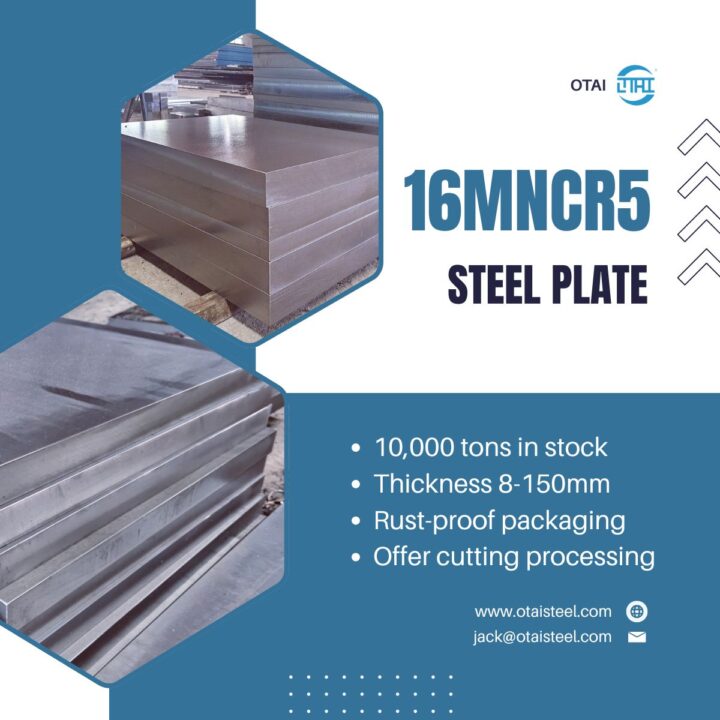
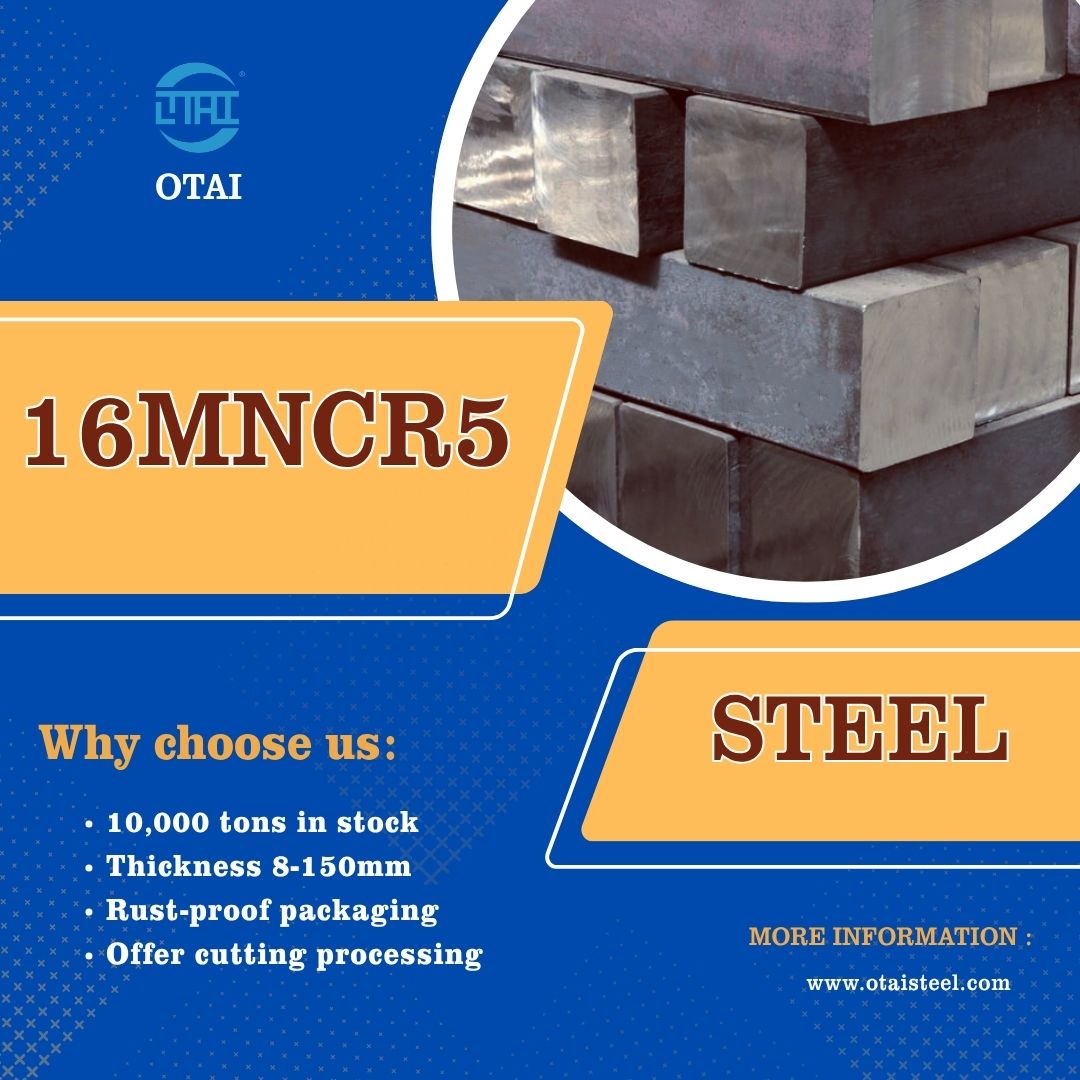
- 16MnCr5 steel stock: Otai Special Steel keeps 16MnCr5 plates in 8–150 mm thickness available in stock for industrial applications.
- Different dimensions: We can supply different thicknesses, widths, lengths, and other dimensions according to project requirements.
- Cutting service: Steel can be cut according to customer drawings and specified dimensions.
- Heat treatment: Annealing, normalizing, quenching, tempering, and other heat-treatment services can be arranged according to project requirements.
- Quality inspection: Ultrasonic testing and third-party inspection can be arranged for orders with specific quality requirements.
- Processing support: We can support customers with cutting, processing, heat treatment, and customized preparation before shipment.
- Export packaging: Steel strapping, wooden cases, and anti-rust packaging help protect steel products during international transportation.
- International supply experience: Otai Special Steel has supplied steel products to customers with demanding technical requirements, including Fortune Global 500 companies.
If you are comparing 16MnCr5 vs 18CrNiMo7-6 for a gear, shaft, or transmission project, provide the required dimensions, heat-treatment condition, application, and quantity. Otai Special Steel can help confirm suitable 16MnCr5 stock and processing options.
❓ 10. Frequently Asked Questions
1. What is the main difference between 16MnCr5 and 18CrNiMo7-6?
16MnCr5 is a chromium-manganese case-hardening steel, while 18CrNiMo7-6 is a more highly alloyed nickel-chromium-molybdenum case-hardening steel. 18CrNiMo7-6 generally provides higher hardenability and stronger core performance.
2. Is 18CrNiMo7-6 stronger than 16MnCr5?
For demanding carburized components, 18CrNiMo7-6 generally offers better hardenability and core toughness. However, the final strength depends on section size, carburizing, quenching, tempering, and the actual heat-treatment condition.
3. Is 16MnCr5 good for gears?
Yes. 16MnCr5 is widely used for carburized gears, shafts, pinions, and transmission components. It provides a good combination of surface hardness, wear resistance, core toughness, machinability, and cost efficiency.
4. Is 18CrNiMo7-6 better for large gears?
In many demanding large-gear applications, yes. Its higher nickel, chromium, and molybdenum content provides higher hardenability and strong core properties, making it suitable for heavily loaded and large-section components.
5. What 16MnCr5 products does Otai Special Steel have in stock?
Otai Special Steel keeps 16MnCr5 plates in 8–150 mm thickness available in stock. Different dimensions and processing options can also be arranged according to project requirements.