 16MnCr5 Nitriding: Surface Hardness, Process, Properties and Applications
📑 Table of Contents
🔍 1. What Is 16MnCr5 Nitriding?
🧪 2. Chemical Composition of 16MnCr5 for Nitriding
🔥 3. 16MnCr5 Nitriding Process and Heat Treatment
📊 4. Hardness and Mechanical Properties After Nitriding
⚙️ 5. Advantages of Nitriding 16MnCr5 Steel
🏭 6. Applications of Nitrided 16MnCr5 Components
🔄 7. 16MnCr5 Nitriding vs Other Surface Treatments
💡 8. How to Choose the Right Nitriding Process
🔍 1. What Is 16MnCr5 Nitriding?
16MnCr5 nitriding is a surface hardening process that improves the wear resistance, fatigue strength, and surface durability of 16MnCr5 steel components. By introducing nitrogen atoms into the steel surface, nitriding creates a hard nitrided layer while keeping the original toughness of the core.
16MnCr5 is a low-carbon alloy steel widely used for gears, shafts, sprockets, and transmission components. Its chemical composition contains manganese and chromium, which help improve hardenability and make it suitable for different heat treatment processes.
Unlike carburizing, nitriding does not require a high-temperature carbon diffusion process. The nitriding temperature is usually lower, which helps reduce distortion and maintain dimensional accuracy. Therefore, 16MnCr5 nitriding process is often selected for precision mechanical parts that require stable dimensions after surface strengthening.
The main purpose of nitriding is not to increase the overall strength of the entire material. Instead, it focuses on improving the surface performance. A properly nitrided 16MnCr5 component can achieve excellent wear resistance while maintaining a tough internal structure.
| Feature | 16MnCr5 Before Nitriding | 16MnCr5 After Nitriding |
|---|---|---|
| Surface hardness | Medium | Significantly increased |
| Wear resistance | Good | Excellent |
| Fatigue resistance | Good | Improved |
| Dimensional stability | Good | Very good |
| Surface durability | Standard | Enhanced |
Because of these advantages, nitrided 16MnCr5 steel is commonly used in applications where components experience repeated friction, contact stress, and mechanical loading.
🧪 2. Chemical Composition of 16MnCr5 for Nitriding
The chemical composition of 16MnCr5 plays an important role during nitriding. Chromium and manganese improve hardenability, while carbon provides the basic strength foundation of the steel.
Although nitriding mainly modifies the surface layer, the original alloy composition affects the quality and stability of the nitrided structure. A balanced chemical composition helps produce a strong compound layer and diffusion zone.
| Element | Content (%) | Function |
|---|---|---|
| Carbon (C) | 0.14–0.19 | Provides basic strength and hardness |
| Silicon (Si) | ≤0.40 | Improves deoxidation and strength |
| Manganese (Mn) | 1.00–1.30 | Improves hardenability |
| Chromium (Cr) | 0.80–1.10 | Enhances wear resistance and nitriding response |
| Phosphorus (P) | ≤0.025 | Controlled impurity |
| Sulfur (S) | ≤0.035 | Controlled impurity |
The relatively low carbon content makes 16MnCr5 different from medium-carbon steels such as 4140. It provides good toughness and makes the material suitable for components that need surface strengthening rather than extremely high core hardness.
For customers searching for 16MnCr5 surface hardening treatment, nitriding is one of the effective solutions when the main goal is improving surface performance without significant dimensional changes.
🔥 3. 16MnCr5 Nitriding Process and Heat Treatment
The performance of 16MnCr5 nitriding depends heavily on the preparation before nitriding. Proper heat treatment creates a suitable microstructure that allows nitrogen diffusion and improves final surface properties.
Before nitriding, manufacturers usually perform normalizing, quenching and tempering, or other heat treatment processes depending on the application requirements.
| Process Step | Purpose |
|---|---|
| Pre-machining | Prepare accurate component dimensions |
| Heat treatment | Improve core strength and stability |
| Surface preparation | Ensure uniform nitrogen diffusion |
| Nitriding | Create a hard nitrogen-rich surface layer |
| Final inspection | Check hardness and dimensional accuracy |
Common nitriding methods include gas nitriding, salt bath nitriding, and plasma nitriding. Among them, plasma nitriding provides accurate control of the nitrided layer and is widely used for precision components.
The required nitriding depth of 16MnCr5 steel depends on the working conditions. Components exposed to higher contact pressure usually require a deeper nitrided layer.
A suitable combination of core hardness, nitriding temperature, treatment time, and cooling method determines the final performance of the component.
📊 4. Hardness and Mechanical Properties After Nitriding
The main advantage of 16MnCr5 nitriding is the improvement of surface hardness without losing the toughness of the core. After nitriding, nitrogen atoms diffuse into the surface and form a hardened layer that improves resistance against wear and repeated mechanical stress.
The final hardness depends on several factors, including nitriding temperature, treatment time, steel condition before nitriding, and the required application performance.
Compared with untreated 16MnCr5 steel, nitrided material provides better surface protection for components that operate under friction, sliding contact, and cyclic loading conditions.
| Property | Before Nitriding | After Nitriding |
|---|---|---|
| Surface hardness | Approx. 200–300 HB depending on condition | Can reach approximately 600–1000 HV depending on process |
| Wear resistance | Standard mechanical performance | Significantly improved |
| Fatigue strength | Normal fatigue performance | Improved due to compressive surface stress |
| Corrosion resistance | Standard | Slightly improved surface protection |
| Dimensional change | – | Low compared with carburizing |
The term 16MnCr5 nitrided hardness refers to the hardness value achieved after the nitriding treatment. Unlike carburized steels, the hardness increase mainly occurs in the surface layer instead of throughout the entire section.
This feature makes nitrided 16MnCr5 especially suitable for precision components. Manufacturers can achieve higher surface performance while maintaining accurate dimensions and avoiding excessive deformation.
Surface Layer Structure After Nitriding
A typical nitrided layer contains two important zones:
- Compound layer: The outermost layer with very high hardness and excellent wear resistance.
- Diffusion zone: The deeper area where nitrogen atoms strengthen the steel gradually and support load transfer.
The balance between these two zones determines the overall performance of the component. A very hard surface without sufficient support from the diffusion zone may lead to cracking under heavy loads.
⚙️ 5. Advantages of Nitriding 16MnCr5 Steel
Nitriding provides several advantages for 16MnCr5 steel components. Compared with traditional surface treatments, it offers a combination of high hardness, low distortion, and excellent dimensional stability.
1. Excellent Wear Resistance
One of the biggest benefits of nitriding is improved wear resistance. The hardened nitrogen-rich surface reduces material loss caused by friction and repeated contact.
For components such as gears, shafts, and transmission parts, this improvement can extend service life and reduce maintenance frequency.
2. Better Fatigue Performance
During nitriding, compressive residual stress forms near the surface. This stress helps resist crack initiation caused by repeated loading.
Therefore, 16MnCr5 nitriding process is often selected for components that experience continuous mechanical cycles.
3. Low Distortion During Treatment
Nitriding usually operates at a lower temperature than carburizing. Because of this, components experience less dimensional change after treatment.
This advantage is important for precision parts where final machining allowance is limited.
4. Improved Surface Stability
The nitrided layer provides a stable surface structure. It helps components maintain performance under friction, heat, and repeated loading conditions.
| Advantage | Benefit for Components |
|---|---|
| Higher surface hardness | Improves wear resistance |
| Low treatment distortion | Maintains dimensional accuracy |
| Compressive stress layer | Improves fatigue resistance |
| Hard diffusion layer | Supports long service life |
| Stable performance | Suitable for precision mechanical parts |
For companies requiring reliable mechanical components, nitriding offers a practical method to improve surface performance while keeping the original advantages of 16MnCr5 steel.
🏭 6. Applications of Nitrided 16MnCr5 Components
The combination of a strong core and hardened surface makes nitrided 16MnCr5 steel suitable for many industrial applications. It is especially valuable where components require wear resistance, stable dimensions, and long operating life.
| Application | Why Use Nitrided 16MnCr5? |
|---|---|
| Gears | High surface hardness and improved contact fatigue resistance |
| Transmission shafts | Good combination of strength and wear resistance |
| Sprockets | Improved resistance against repeated contact |
| Precision machine parts | Low distortion after surface treatment |
| Automotive components | Long service life under cyclic loading |
| Industrial equipment | Reliable performance under friction conditions |
Automotive Applications
In automotive systems, gears and transmission components often work under high contact pressure. Nitrided 16MnCr5 can provide improved surface durability while maintaining a tough internal structure.
This makes it suitable for components where reliability and dimensional accuracy are important.
Industrial Gear Applications
Industrial gears require excellent resistance against wear and fatigue. The hardened surface produced by nitriding helps protect gear teeth from damage during continuous operation.
Compared with untreated steel, nitrided 16MnCr5 can achieve better long-term stability in demanding environments.
Precision Mechanical Components
For precision components, excessive heat treatment deformation can create additional machining costs. Because nitriding causes relatively small dimensional changes, it provides advantages for finished or semi-finished parts.
🔄 7. 16MnCr5 Nitriding vs Other Surface Treatments
When improving the surface performance of 16MnCr5 steel, nitriding is not the only available option. Other treatments such as carburizing, induction hardening, and coating processes may also be used.
However, each treatment has different advantages. The correct choice depends on hardness requirements, component size, operating conditions, and production requirements.
| Treatment | Main Feature | Suitable Applications |
|---|---|---|
| Nitriding | High surface hardness with low distortion | Precision gears, shafts, mechanical parts |
| Carburizing | Deep hardened surface layer | Heavy-duty gears and transmission parts |
| Induction hardening | Localized surface hardening | Shafts, gears, wear areas |
| Coating | Surface protection layer | Special wear or corrosion applications |
Nitriding vs Carburizing
Carburizing can create a deeper hardened layer and is widely used for heavily loaded gears. However, it usually involves higher temperatures and greater distortion risks.
Nitriding provides lower distortion and excellent dimensional stability. Therefore, it is often preferred for precision components.
Nitriding vs Induction Hardening
Induction hardening can quickly harden selected areas of a component. Nitriding, however, creates a more uniform hardened layer and can improve surface fatigue performance.
The choice depends on the component design and required performance.
💡 8. How to Choose the Right Nitriding Process
Choosing the correct nitriding process requires considering several factors, including component size, required hardness, operating temperature, loading conditions, and final dimensional requirements.
Different applications require different nitriding depths and surface properties. Therefore, engineers should define the working environment before selecting the treatment parameters.
| Requirement | Recommended Consideration |
|---|---|
| High wear resistance | Select suitable nitriding depth and surface hardness |
| Precision dimensions | Use nitriding due to lower distortion |
| Heavy contact loads | Consider deeper diffusion layer |
| Long service life | Optimize heat treatment before nitriding |
| Complex components | Control treatment temperature and time carefully |
Before nitriding, the material condition is also important. Proper 16MnCr5 heat treatment before nitriding helps create a stable structure and improves the final performance of the nitrided layer.
For industrial buyers, selecting the correct steel supplier is equally important. Stable material quality, accurate dimensions, and reliable inspection support directly influence the success of the final product.
📦 9. Otai Special Steel Advantages
As a professional alloy steel supplier, Otai Special Steel provides reliable 16MnCr5 steel products for international customers who require stable quality, accurate dimensions, and flexible processing services.
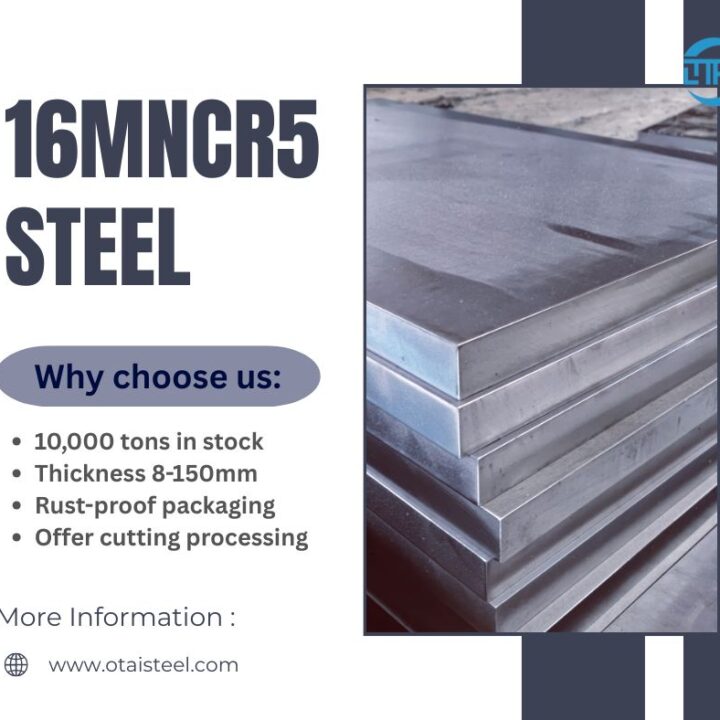
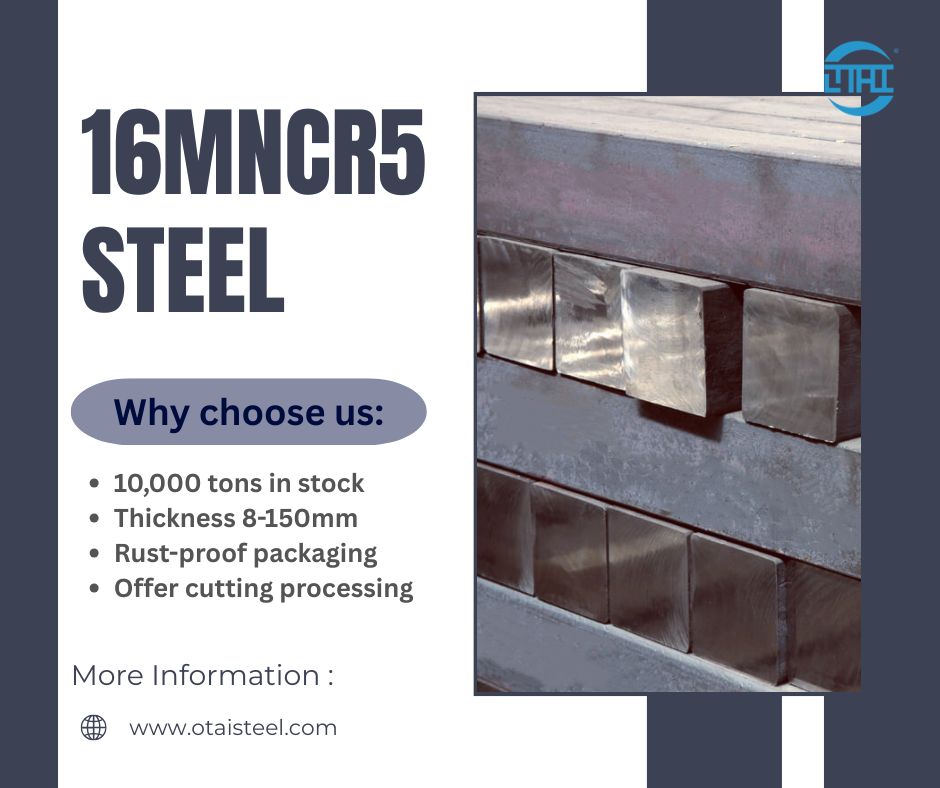
- 16MnCr5 steel plate stock: Otai Special Steel keeps 16MnCr5 steel plates with thicknesses of 8–150 mm available in stock for different industrial applications.
- Stable material supply: We provide alloy steel products with consistent quality and support customized orders according to customer requirements.
- Cutting service: We offer cutting services based on drawings, required dimensions, and project specifications to reduce additional processing work for customers.
- Heat treatment support: We can arrange different heat treatment services, including annealing, normalizing, quenching, and tempering according to application requirements.
- Quality inspection: Ultrasonic testing and third-party inspection services are available for customers who require additional quality verification.
- Export packaging: We provide professional export packaging solutions, including steel strapping, wooden cases, and anti-rust protection to ensure safe transportation.
- Technical experience: Otai Special Steel has supplied alloy steel materials to customers with strict technical requirements, including international industrial companies.
For customers selecting materials for 16MnCr5 nitriding applications, choosing the correct steel condition before surface treatment is essential. Otai Special Steel can help provide suitable material solutions based on component design, dimensions, and processing requirements.
❓ 10. FAQ About 16MnCr5 Nitriding
1. What is 16MnCr5 nitriding?
16MnCr5 nitriding is a surface hardening process that introduces nitrogen into the steel surface to improve hardness, wear resistance, and fatigue performance while maintaining the toughness of the core.
2. How hard can nitrided 16MnCr5 become?
The final hardness depends on nitriding parameters, material condition, and treatment method. A properly nitrided surface can achieve very high hardness levels, often reaching approximately 600–1000 HV depending on the process.
3. What is the difference between nitriding and carburizing 16MnCr5?
Nitriding mainly improves surface hardness with low distortion, while carburizing creates a deeper carbon-rich hardened layer. Nitriding is often preferred for precision components that require dimensional stability.
4. What applications use nitrided 16MnCr5 steel?
Nitrided 16MnCr5 is commonly used for gears, shafts, sprockets, transmission components, and precision mechanical parts that require high wear resistance and stable performance.
5. Does Otai Special Steel supply 16MnCr5 steel plates?
Yes. Otai Special Steel supplies 16MnCr5 steel plates with thicknesses of 8–150 mm available in stock. We also provide cutting, heat treatment support, inspection services, and export packaging according to customer requirements.