16MnCr5 Material Name – Designation and International Equivalents
Understanding the 16MnCr5 material name is important for engineers,managers, and manufacturers who work with case hardening steels. Although 16MnCr5 is one of the most common carburizing steels used worldwide, many buyers encounter different names, standards, and material numbers when sourcing steel from international suppliers. These variations can create confusion during procurement, technical documentation review, and material substitution projects.
The 16MnCr5 material name originates from the European EN steel designation system. The name itself provides information about the steel’s composition and intended application. Manufacturers commonly use this grade for gears, shafts, pinions, bushings, transmission components, and other wear-resistant mechanical parts that require a hard surface and a tough core.
Many engineers also search for terms such as 16MnCr5 steel grade, 16MnCr5 material designation, 16MnCr5 steel equivalent, DIN 16MnCr5 material number, and 16MnCr5 steel specification. Understanding these related terms helps buyers communicate more effectively with suppliers and ensures accurate material selection.
🔵 What Does the 16MnCr5 Material Name Mean?
The 16MnCr5 material name follows the European steel naming convention. Each part of the designation provides technical information about the steel grade. The number “16” indicates the approximate carbon content multiplied by 100, meaning the steel contains roughly 0.16% carbon. The letters “Mn” and “Cr” represent manganese and chromium, which are the primary alloying elements. The number “5” relates to the alloy content classification used within the EN system.
This naming method allows engineers to quickly identify the steel’s composition and intended performance characteristics. Because 16MnCr5 belongs to the carburizing steel family, manufacturers primarily use it when components require high surface hardness and excellent wear resistance after heat treatment.
The designation also helps differentiate 16MnCr5 from other alloy steels such as 20MnCr5, 18CrNiMo7-6, and 8620 steel. Although these grades may appear similar, their chemical compositions and hardenability characteristics differ significantly.
| Designation Part | Meaning |
|---|---|
| 16 | Approximately 0.16% carbon |
| Mn | Manganese alloy addition |
| Cr | Chromium alloy addition |
| 5 | Alloy classification indicator |
🟢 Material Number Associated with 16MnCr5
In addition to the grade designation, the 16MnCr5 material name has an official European material number: 1.7131. Many technical drawings, procurement specifications, and quality documents reference this number instead of the grade name. Engineers should recognize both identifiers because suppliers may use either format.
The material number system provides a standardized method for identifying steels regardless of language differences. This approach simplifies international trade and reduces the risk of material selection errors. When reviewing certificates or technical specifications, buyers should verify that both the grade designation and material number match project requirements.
| Grade Name | Material Number | Standard |
|---|---|---|
| 16MnCr5 | 1.7131 | EN 10084 |
| 16MnCrS5 | 1.7139 | EN 10084 |
| 20MnCr5 | 1.7147 | EN 10084 |
🟠 Chemical Composition Behind the 16MnCr5 Material Name
The popularity of the 16MnCr5 material name comes from its balanced chemical composition. The steel contains enough carbon to achieve high surface hardness after carburizing while maintaining a tough and ductile core. Chromium and manganese improve hardenability and wear resistance, making the material suitable for heavily loaded mechanical components.
This composition allows manufacturers to achieve excellent fatigue performance, which is critical for gears and transmission systems that operate under repeated stress cycles. As a result, 16MnCr5 remains one of the most widely specified case hardening steels in Europe and many international markets.
| Element | Typical Content (%) | Main Function |
|---|---|---|
| Carbon (C) | 0.14–0.19 | Supports case hardening |
| Manganese (Mn) | 1.00–1.30 | Improves hardenability |
| Chromium (Cr) | 0.80–1.10 | Enhances wear resistance |
| Silicon (Si) | ≤0.40 | Improves strength |
| Phosphorus (P) | ≤0.025 | Controlled impurity |
| Sulfur (S) | ≤0.035 | Supports machinability |
🟣 International Names and Equivalent Grades
Many buyers searching for the 16MnCr5 material name also need equivalent grades from other standards. Different regions use different naming systems, but several materials provide similar carburizing performance. Engineers should evaluate chemical composition and heat treatment response before selecting an equivalent grade.
Although equivalent grades often perform similarly, small differences in alloy content can influence hardenability, core strength, and carburizing depth. Therefore, engineers should review technical requirements carefully before approving a substitute.
| Country/Standard | Equivalent Grade |
|---|---|
| Germany (DIN) | 1.7131 |
| USA (AISI) | 5115 / Similar |
| USA (AISI) | 8620 (Application dependent) |
| Japan (JIS) | SCr420 |
| China (GB) | 20CrMnTi (Similar application) |
🔷 Applications Associated with the 16MnCr5 Material Name
The 16MnCr5 material name frequently appears in industries that require excellent wear resistance and fatigue strength. Automotive manufacturers use it extensively for gears, synchronizer hubs, and transmission shafts. Industrial machinery companies select it for couplings, bushings, and precision motion components.
The steel performs particularly well in applications where a hard wear-resistant surface must coexist with a shock-resistant core. This combination helps components survive long operating cycles while maintaining dimensional stability and mechanical reliability.
Because of these advantages, engineers continue to specify 16MnCr5 for both high-volume manufacturing and custom-engineered mechanical systems.
⚙️ Why Engineers Prefer 16MnCr5
Engineers choose 16MnCr5 because it offers an excellent balance between cost, machinability, heat treatment response, and final performance. Compared with higher-alloy alternatives, the material delivers reliable carburizing results without significantly increasing manufacturing costs.
The steel also supports efficient machining before heat treatment, which helps manufacturers reduce production time and tooling expenses. After carburizing and quenching, components achieve the hardness levels necessary for demanding industrial service.
These advantages explain why the 16MnCr5 material name appears frequently in engineering specifications across automotive, industrial, and power transmission industries.
🏭 Company Advantages – Otai Special Steel
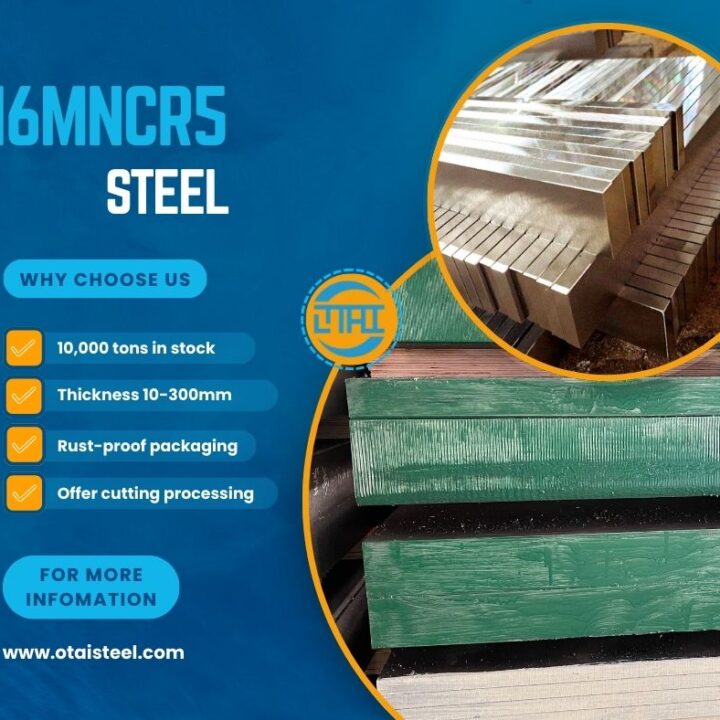
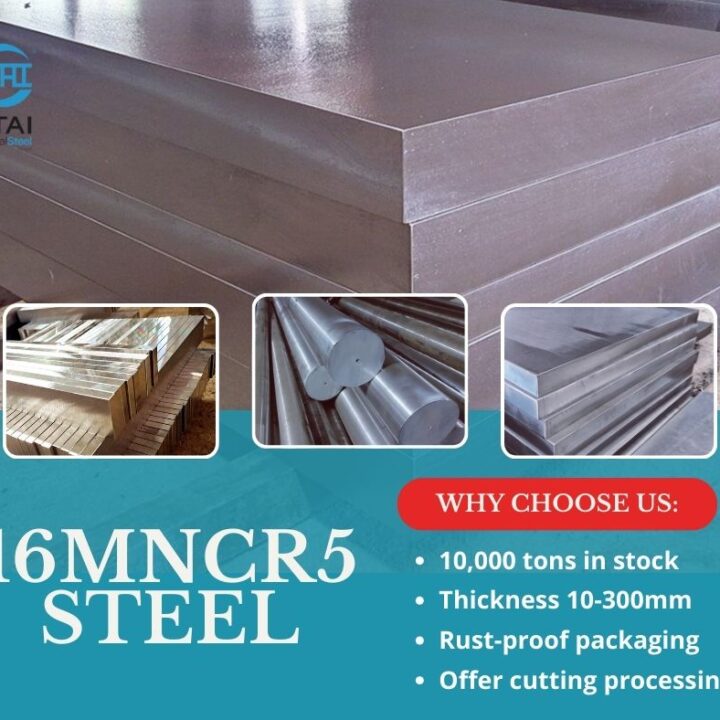
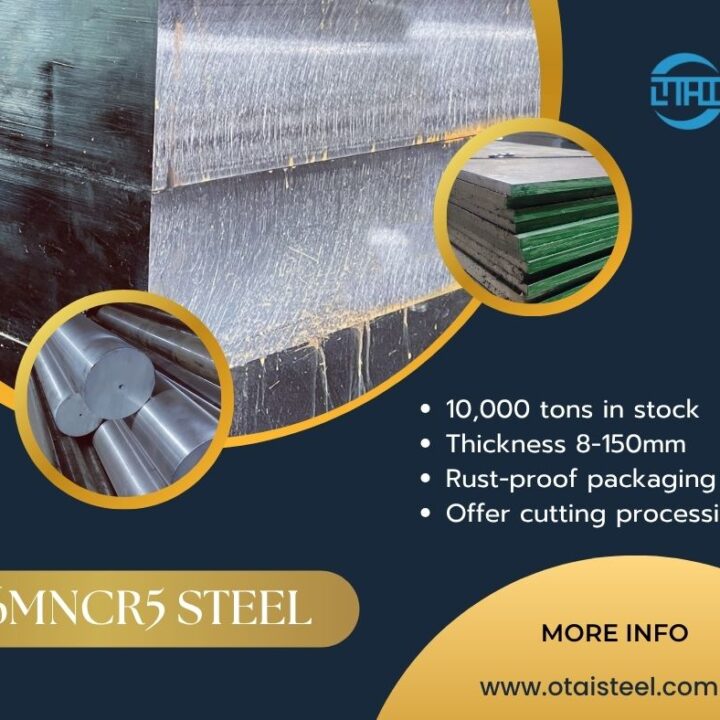
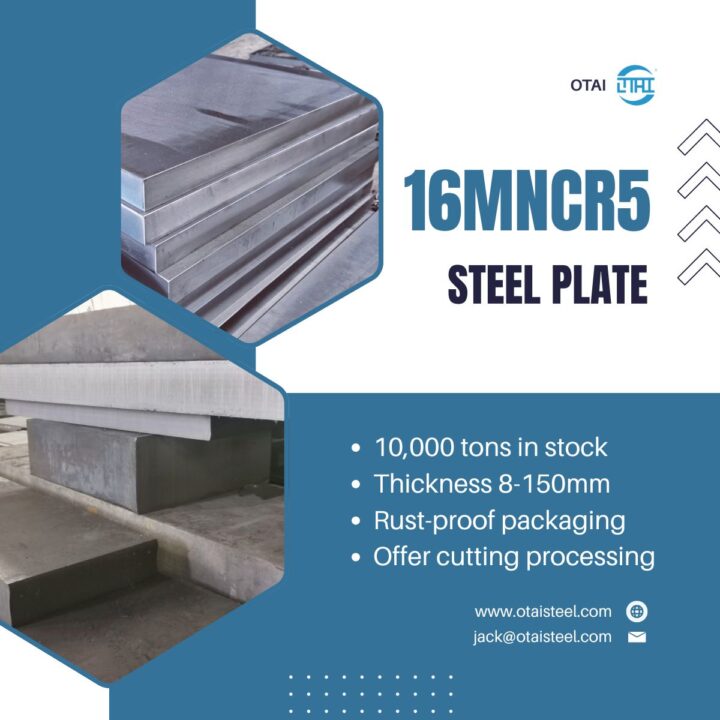
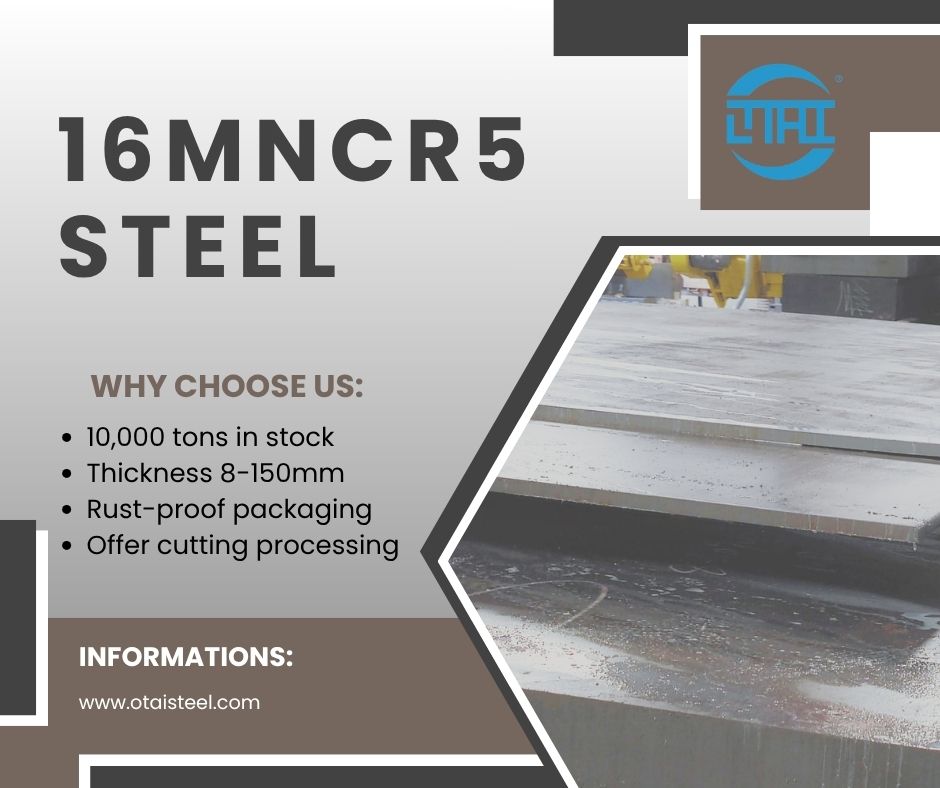
- 📏 16MnCr5 steel plate thickness range: 8–150mm in stock
- 📦 Large inventory available for fast shipment
- ✂️ Precision cutting, machining, and heat treatment services
- 🔬 Ultrasonic testing and third-party inspection support
- 🌍 Extensive export experience serving global customers
❓ FAQ – 16MnCr5 Material Name
1. What is the material number of 16MnCr5?
The official European material number for 16MnCr5 is 1.7131.
2. What does the name 16MnCr5 mean?
It indicates a carburizing steel containing approximately 0.16% carbon with manganese and chromium alloy additions.
3. Is 16MnCr5 the same as 8620 steel?
They share similar applications but have different chemical compositions and heat treatment characteristics.
4. What standard defines 16MnCr5?
EN 10084 defines the technical requirements for 16MnCr5 carburizing steel.
5. Where is 16MnCr5 commonly used?
Manufacturers commonly use it for gears, shafts, pinions, bushings, and transmission components.
🏁 Conclusion
The 16MnCr5 material name represents one of the most important carburizing steel grades used in modern engineering. Understanding its designation, material number, composition, and international equivalents helps engineers and buyers make informed material selection decisions.
By working with an experienced supplier and verifying technical specifications, manufacturers can fully utilize the performance advantages that 16MnCr5 offers in demanding industrial applications.