 16MnCr5 AISI: US Equivalent, Composition, Properties and Applications
📑 Table of Contents
🔍 1. What Does 16MnCr5 AISI Mean?
🧪 2. 16MnCr5 Chemical Composition
🇺🇸 3. What Is the AISI Equivalent of 16MnCr5?
🔥 4. 16MnCr5 AISI Equivalent and Heat Treatment
⚙️ 5. 16MnCr5 Properties and Applications
📊 6. 16MnCr5 vs AISI 5115, 5120 and 8620
🔍 1. What Does 16MnCr5 AISI Mean?
When buyers search for 16MnCr5 AISI, they usually want to know which AISI or SAE grade corresponds to the European 16MnCr5 steel grade. This question appears frequently in international purchasing because Europe and the United States use different steel designation systems.
16MnCr5 is a European alloy case-hardening steel. Its EN material number is 1.7131. The grade contains relatively low carbon and controlled amounts of manganese and chromium. This composition allows the steel to absorb additional carbon during carburizing.
After carburizing and hardening, 16MnCr5 can develop a hard and wear-resistant surface while maintaining a tougher core. Therefore, manufacturers commonly select it for gears, pinions, shafts, cams and other components that experience repeated surface contact.
The term 16MnCr5 AISI equivalent does not describe a single officially identical grade in every application. AISI and SAE grades use their own chemical ranges and specifications. Therefore, buyers should compare the actual chemistry, hardenability and heat-treatment requirements before approving a replacement.
| Item | 16MnCr5 | Typical AISI/SAE Reference |
|---|---|---|
| Designation System | EN | AISI / SAE |
| Material Number | 1.7131 | Depends on selected US grade |
| Steel Type | Case-hardening alloy steel | Case-hardening alloy steel |
| Main Alloying Elements | Mn + Cr | Depends on grade |
| Main Heat Treatment | Carburizing + hardening | Carburizing + hardening |
| Typical Applications | Gears, pinions, shafts and cams | Similar carburizing applications |
In practical purchasing, AISI 5115 often appears as a US reference for 16MnCr5. However, it is better to describe it as a close reference or potential equivalent rather than claiming that the two grades are chemically identical.
🧪 2. 16MnCr5 Chemical Composition
Understanding the chemical composition is essential when evaluating 16MnCr5 AISI equivalent grades. The low carbon content gives 16MnCr5 its case-hardening characteristics, while manganese and chromium improve strength and hardenability.
| Element | Typical 16MnCr5 Range | Main Function |
|---|---|---|
| Carbon (C) | 0.14–0.19% | Controls core carbon level and supports carburizing |
| Silicon (Si) | ≤ 0.40% | Deoxidation and strength |
| Manganese (Mn) | 1.00–1.30% | Improves strength and hardenability |
| Chromium (Cr) | 0.80–1.10% | Improves hardenability and case-hardening response |
| Phosphorus (P) | ≤ 0.025% | Controlled impurity |
| Sulfur (S) | ≤ 0.035% | Controlled impurity |
The carbon content is especially important. 16MnCr5 starts with relatively low carbon, then gains carbon at the surface during carburizing. This process creates a carbon-rich case that can become very hard after quenching.
The manganese and chromium additions also help the material respond to hardening. As a result, 16MnCr5 steel composition provides a useful balance between surface hardness and core toughness.
Why Is 16MnCr5 a Low-Carbon Steel?
A low initial carbon content allows the manufacturer to create a carbon gradient from the surface toward the center. During carburizing, carbon diffuses into the outer layer. The surface therefore develops a much higher carbon concentration than the original core.
After hardening, the surface becomes hard enough to resist wear and repeated contact. Meanwhile, the lower-carbon core remains tougher and better able to absorb mechanical loads.
This design explains why 16MnCr5 works particularly well in gears and transmission components. The working surface needs hardness, while the interior needs toughness.
🇺🇸 3. What Is the AISI Equivalent of 16MnCr5?
For customers searching for an AISI equivalent for 16MnCr5, AISI 5115 is one of the most commonly referenced US grades. However, the word “equivalent” requires careful interpretation.
AISI 5115 belongs to the low-carbon alloy steel family used for carburizing. Its general material concept is therefore close to 16MnCr5. Both grades can support applications where manufacturers need a hard case and a tougher core.
However, a cross-reference table alone cannot guarantee a technically identical replacement. The exact chemistry, hardenability, product standard and heat-treatment requirements may differ.
| Grade | Material System | Case Hardening | Relationship to 16MnCr5 |
|---|---|---|---|
| 16MnCr5 | Mn-Cr | Excellent | Original EN grade |
| AISI 5115 | Low-carbon alloy steel | Good | Common US reference |
| AISI 5120 | Mn-Cr alloy steel | Excellent | Possible alternative depending on specification |
| AISI 8620 | Ni-Cr-Mo alloy steel | Excellent | Functional alternative, not direct equivalent |
Is AISI 5115 Exactly the Same as 16MnCr5?
No. It is safer to describe AISI 5115 as a close US reference rather than an absolutely identical grade. The two standards define their own chemical limits and requirements.
For general procurement, AISI 5115 may be a useful starting point. For safety-critical or highly engineered components, the customer should compare the material certificates and obtain engineering approval before substitution.
What About AISI 5120?
AISI 5120 is another low-carbon alloy steel commonly associated with carburizing applications. Its chemical balance can make it useful for gears and other case-hardened components.
However, it should not automatically replace 16MnCr5. The correct choice depends on component size, required case depth, hardness profile, distortion limits and final mechanical properties.
What About AISI 8620?
AISI 8620 is widely used for carburized gears and transmission components. It contains nickel, chromium and molybdenum, giving it a different alloy design from 16MnCr5.
Therefore, 8620 is better described as a 16MnCr5 functional alternative rather than a direct AISI equivalent.
🔥 4. 16MnCr5 AISI Equivalent and Heat Treatment
Heat treatment is one of the most important factors when comparing 16MnCr5 with an AISI grade. Even if two steels have similar chemical compositions, they may deliver different results if the heat-treatment process changes.
16MnCr5 is normally used as a carburizing steel. The process introduces additional carbon into the surface. After carburizing, the component undergoes hardening and tempering to create the required surface and core properties.
| Heat Treatment Stage | Purpose | Effect on 16MnCr5 |
|---|---|---|
| Carburizing | Add carbon to the surface | Creates a carbon-enriched case |
| Hardening | Transform the structure | Creates a hard surface |
| Tempering | Reduce internal stress | Improves toughness and dimensional stability |
| Final Inspection | Verify hardness and case depth | Confirms the required material performance |
Surface Hardness vs Core Toughness
The biggest advantage of 16MnCr5 carburizing steel is the ability to combine two different property zones in one component.
The surface becomes hard and wear resistant. The core remains relatively tough. This combination works well when a component experiences repeated surface contact but also needs to absorb impact or mechanical loads.
A gear provides a good example. The tooth surface needs high hardness because the teeth repeatedly contact each other. However, the entire tooth cannot become excessively brittle because impact and bending loads can cause cracking.
This is why the heat treatment must match the material grade and component design. A customer should specify the required case depth and hardness rather than simply requesting “hardened 16MnCr5.”
Can an AISI Equivalent Follow the Same Heat Treatment?
Not necessarily. A similar case-hardening steel may require different carburizing temperatures, holding times, quenching conditions or tempering parameters.
Therefore, the 16MnCr5 AISI equivalent should always receive a heat-treatment procedure developed for the actual grade rather than copying the exact process used for 16MnCr5 without verification.
⚙️ 5. 16MnCr5 Properties and Applications
The main reason engineers choose 16MnCr5 is its ability to provide a strong combination of surface hardness, wear resistance and core toughness after carburizing.
The untreated steel has relatively low carbon content and can be machined before final case hardening. This makes it practical for complex components that need accurate machining before heat treatment.
| Property | Typical Characteristics of 16MnCr5 |
|---|---|
| Steel Type | Low-carbon case-hardening alloy steel |
| Material Number | 1.7131 |
| Core Carbon | Approximately 0.14–0.19% |
| Surface Hardness After Carburizing | High, depending on treatment |
| Core Toughness | Good after appropriate heat treatment |
| Wear Resistance | Excellent at the hardened surface |
| Machinability Before Hardening | Good under suitable condition |
16MnCr5 for Gears
Gears are one of the most common applications for 16MnCr5. Gear teeth experience repeated rolling and sliding contact, which can create wear and contact fatigue.
A carburized 16MnCr5 gear can develop a hard surface that resists these conditions. At the same time, the core provides the toughness needed to support the tooth structure.
This makes 16MnCr5 for gear manufacturing a practical choice for many transmission and mechanical engineering applications.
16MnCr5 for Shafts and Pinions
16MnCr5 can also work well for shafts and pinions that need a wear-resistant surface. The final design should determine whether carburizing provides the required hardness profile.
For components that need high strength throughout the entire cross-section rather than a hard case, engineers may prefer a quenched-and-tempered grade such as 42CrMo4.
16MnCr5 vs 42CrMo4
| Feature | 16MnCr5 | 42CrMo4 |
|---|---|---|
| Main Treatment | Carburizing | Quenching + tempering |
| Carbon Content | Low | Medium |
| Hard Surface | Excellent after carburizing | Good after suitable hardening |
| Core Strength | Moderate | High |
| Typical Application | Gears and pinions | Shafts and heavy-duty machine parts |
This comparison shows why material selection should focus on the actual failure mode. If surface wear dominates, 16MnCr5 can offer a strong solution. If bulk strength and torsional loading dominate, 42CrMo4 may be more appropriate.
📊 6. 16MnCr5 vs AISI 5115, 5120 and 8620
For international buyers, comparing several AISI grades can make the selection process easier. However, each comparison should focus on both chemistry and application.
| Grade | Steel Concept | Typical Heat Treatment | Potential Use as 16MnCr5 Alternative |
|---|---|---|---|
| 16MnCr5 | Mn-Cr case-hardening steel | Carburizing + hardening | Original grade |
| AISI 5115 | Low-carbon alloy case-hardening steel | Carburizing + hardening | Close US reference |
| AISI 5120 | Low-carbon Cr-Mn alloy steel | Carburizing + hardening | Potential alternative |
| AISI 8620 | Ni-Cr-Mo case-hardening steel | Carburizing + hardening | Functional alternative |
| 42CrMo4 | Cr-Mo quenched and tempered steel | Quenching + tempering | Not a direct equivalent |
Which AISI Grade Should You Choose?
If the customer needs the closest general US reference, AISI 5115 is a logical grade to investigate first. If the customer needs a different hardenability profile or alloy system, AISI 5120 or 8620 may become relevant.
However, the final choice should depend on the component. A small gear, a large gear, a pinion and a shaft may require different hardenability and case-depth characteristics.
For this reason, the safest approach is to provide the original 16MnCr5 specification, component dimensions, required case depth, surface hardness and core requirements to the steel supplier.
Quick Selection Checklist
- Confirm whether the component requires carburizing.
- Confirm the required surface hardness.
- Confirm the required effective case depth.
- Check the core hardness and toughness requirements.
- Compare chemical composition with the proposed AISI grade.
- Check hardenability for the actual component size.
- Confirm the replacement with the engineering department before production.
This approach reduces the risk of treating a similar steel grade as an automatic one-to-one replacement.
📦 7. Otai Special Steel Advantages
For customers sourcing 16MnCr5, material availability, dimensions and processing capability can be just as important as the steel grade itself. Otai Special Steel supplies alloy and special steels to international customers and supports different processing requirements.
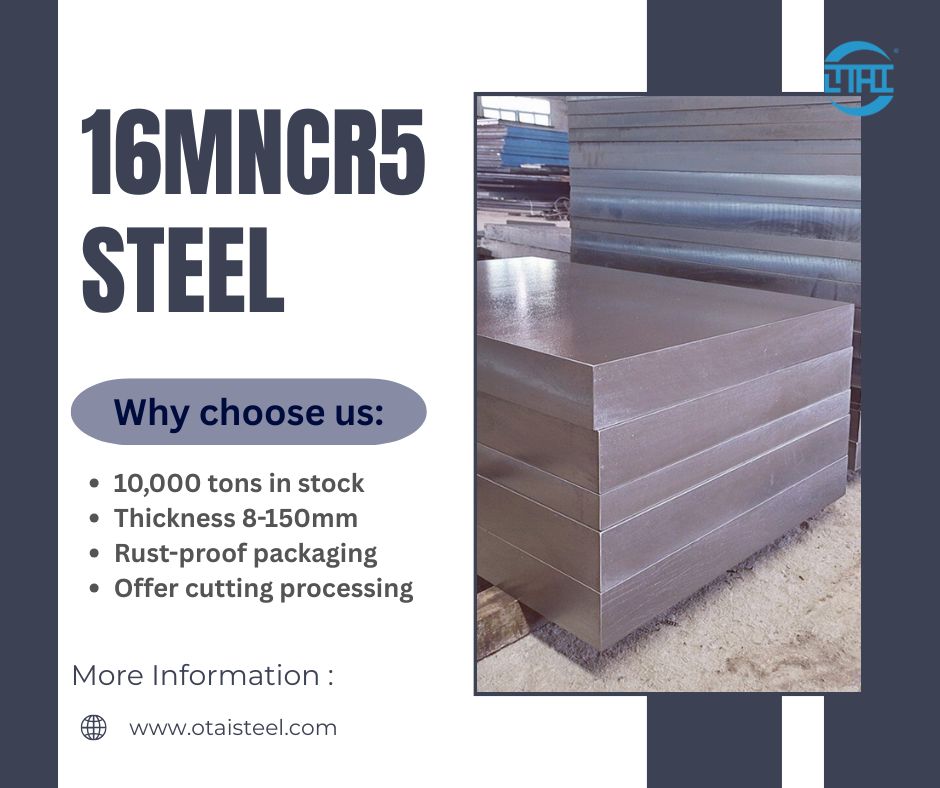
- 16MnCr5 stock: We have 8–150 mm thick 16MnCr5 plates available in stock, depending on specification and current inventory.
- Different sizes available: We can supply different dimensions to meet machining and fabrication requirements.
- Cutting service: We can cut plates according to customer dimensions and drawings.
- Heat treatment: We can arrange suitable heat treatment services according to project requirements.
- Quality inspection: Ultrasonic testing and third-party inspection can be arranged for orders with specific quality requirements.
- Export packaging: Anti-rust protection, steel strapping and wooden cases help protect the material during international transportation.
If you need 16MnCr5, AISI 5115 or another potential alternative, provide the required specification, dimensions, heat-treatment condition and application. Otai can help confirm the appropriate material option before production.
❓ 8. Frequently Asked Questions About 16MnCr5 AISI
1. What is the AISI equivalent of 16MnCr5?
AISI 5115 is commonly cited as a US reference for 16MnCr5. However, it should not automatically be treated as an identical one-to-one replacement. Chemical composition, hardenability and heat-treatment requirements should be checked before substitution.
2. What is the material number of 16MnCr5?
The material number of 16MnCr5 is 1.7131. It is an EN case-hardening steel designed for carburizing applications.
3. Is AISI 5115 the same as 16MnCr5?
No. AISI 5115 is a close US reference, but the two grades belong to different standards and may have different specified chemistry ranges. Always verify the actual requirements before using one as a replacement for the other.
4. Is 16MnCr5 suitable for gears?
Yes. 16MnCr5 is widely used for carburized gears, pinions and transmission components because it can develop a hard, wear-resistant surface while maintaining a tougher core.
5. Can AISI 8620 replace 16MnCr5?
AISI 8620 can serve as a functional alternative in some carburizing applications, but it is not a direct chemical equivalent. It uses a different Ni-Cr-Mo alloy system, so the engineering requirements should be reviewed before substitution.