 16MnCr5 Material Equivalent: International Grades and Engineering Applications
The 16MnCr5 material equivalent topic is extremely important for global manufacturers, purchasing engineers, and industrial suppliers working across different international steel standards. Since various countries use different steel designation systems, understanding the equivalent grades of 16MnCr5 helps engineers select compatible materials for gears, shafts, transmission systems, and wear-resistant mechanical components.
16MnCr5 is a low-carbon chromium alloy case-hardening steel commonly supplied according to the EN 10084 standard. The material is well known for its excellent carburizing capability, high surface hardness, good machinability, and strong core toughness.
Manufacturers worldwide use this steel for:
- Automotive gears
- Transmission shafts
- Pinions
- Industrial couplings
- Heavy-duty wear components
- Mechanical power transmission systems
Although equivalent grades may have slightly different compositions or standards, they generally provide very similar performance after proper heat treatment.
🧪 Chemical Composition of 16MnCr5 Steel
The balanced chemical composition of 16MnCr5 steel gives the material excellent carburizing and mechanical performance.
The low carbon content improves toughness and machinability, while chromium and manganese enhance hardenability and wear resistance.
| Element | Typical Content (%) | Main Function |
|---|---|---|
| Carbon (C) | 0.14 – 0.19 | Supports carburizing response |
| Manganese (Mn) | 1.00 – 1.30 | Improves hardenability |
| Chromium (Cr) | 0.80 – 1.10 | Enhances wear resistance |
| Silicon (Si) | 0.17 – 0.37 | Improves structural stability |
| Phosphorus (P) | ≤ 0.025 | Controls brittleness |
| Sulfur (S) | ≤ 0.035 | Improves machinability |
This composition allows the steel to achieve high surface hardness after carburizing while maintaining excellent impact resistance in the core region.
🌍 International Equivalent Grades of 16MnCr5
Different countries and standards use different names for steels with similar chemical compositions and mechanical properties.
The following table shows the most common international equivalents of 16MnCr5 material.
| Country / Standard | Equivalent Grade | Standard |
|---|---|---|
| Germany / Europe | 16MnCr5 / 1.7131 | DIN EN 10084 |
| USA | SAE 5115 | AISI / SAE |
| Japan | SCM420 | JIS |
| China | 20CrMnTi | GB |
| France | 16MC5 | AFNOR |
| United Kingdom | 655M13 | BS |
Although these materials are considered equivalent, small variations in alloying elements and manufacturing standards may slightly influence final performance.
📊 Mechanical Properties Comparison
Equivalent grades of 16MnCr5 generally provide similar mechanical properties after proper carburizing and heat treatment.
| Property | Typical Value |
|---|---|
| Tensile Strength | 800 – 1200 MPa |
| Yield Strength | 550 – 900 MPa |
| Surface Hardness After Carburizing | 58 – 62 HRC |
| Core Toughness | Excellent |
| Wear Resistance | Very High |
The combination of hard surface and ductile core makes these equivalent materials ideal for gears and rotating mechanical systems.
🔥 Heat Treatment Characteristics
Most equivalent grades of 16MnCr5 are specifically designed for carburizing and case hardening operations.
The standard heat treatment sequence usually includes carburizing, quenching, and tempering.
| Heat Treatment Process | Typical Temperature |
|---|---|
| Carburizing | 880 – 930°C |
| Quenching | 780 – 820°C |
| Tempering | 150 – 200°C |
Proper heat treatment significantly improves wear resistance, fatigue strength, and operational reliability.
⚙️ Machinability and Processing Performance
Equivalent grades of 16MnCr5 generally provide good machinability before carburizing and hardening.
Manufacturers commonly perform machining operations in the annealed condition to improve productivity and reduce tool wear.
Common machining operations include:
- Turning
- Milling
- Drilling
- Gear hobbing
- Grinding
- CNC machining
| Processing Property | Performance |
|---|---|
| Machinability | Good |
| Carburizing Response | Excellent |
| Grinding Performance | Very Good |
| Dimensional Stability | Good after heat treatment |
The excellent balance between machinability and final hardness makes 16MnCr5 equivalents highly suitable for precision mechanical manufacturing.
🚗 Industrial Applications of 16MnCr5 Equivalent Materials
Equivalent grades of 16MnCr5 are widely used in industries requiring high wear resistance and excellent fatigue performance.
These steels are especially common in automotive transmission systems and heavy mechanical equipment.
| Industry | Typical Applications |
|---|---|
| Automotive | Transmission gears and shafts |
| Industrial Machinery | Gear wheels and couplings |
| Agricultural Equipment | Drive train systems |
| Mining Equipment | Wear-resistant rotating parts |
| Heavy Engineering | Mechanical transmission components |
The excellent carburizing capability and strong fatigue resistance make these equivalent steels highly reliable in long-term service environments.
🔬 Microstructure and Performance Advantages
After carburizing and quenching, equivalent grades of 16MnCr5 develop a hardened martensitic surface layer with excellent wear resistance.
The inner core remains relatively ductile and tough, which improves impact resistance and reduces cracking risk during service.
| Microstructural Region | Main Structure | Performance Benefit |
|---|---|---|
| Surface Layer | Martensite | Very high wear resistance |
| Transition Zone | Mixed structures | Improved fatigue strength |
| Core Region | Ferrite and pearlite | Excellent toughness |
This combination of surface hardness and core toughness is one of the key reasons why 16MnCr5 equivalent steels remain extremely popular in gear manufacturing industries.
⚠️ Important Selection Considerations
Although international equivalent grades are similar, engineers should still verify detailed specifications before material substitution.
Several factors can influence final component performance:
- Chemical composition tolerances
- Heat treatment practices
- Manufacturing standards
- Mechanical property requirements
- Case depth specifications
- Application stress conditions
| Selection Factor | Why It Matters |
|---|---|
| Chemical Composition | Affects hardenability and wear resistance |
| Heat Treatment | Determines final hardness and toughness |
| Case Depth | Influences fatigue performance |
| Operating Environment | Affects service life and reliability |
Careful material selection helps manufacturers maximize component durability, efficiency, and long-term operational stability.
🏭 Company Advantages
Otai Special Steel supplies high-quality 16MnCr5 equivalent steel materials for automotive, industrial machinery, mining, and heavy engineering applications.
- Large inventory and stable year-round supply
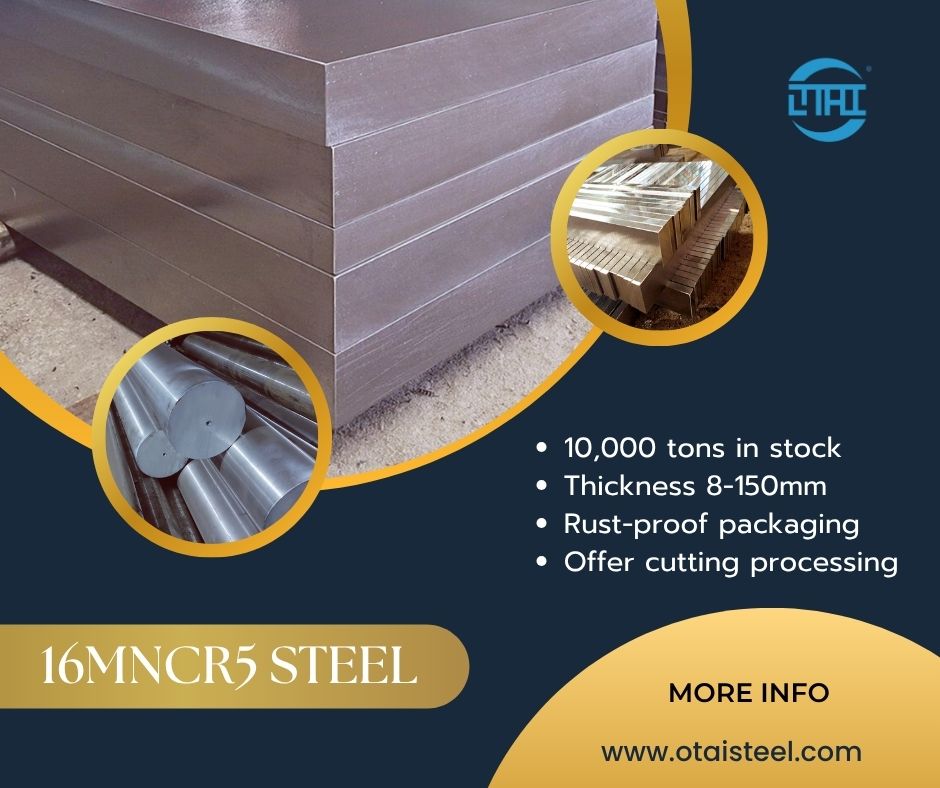
- 8–150mm thickness plates available in stock
- Custom cutting and machining services
- Heat treatment support including carburizing and quenching
- Ultrasonic testing (UT) support
- Chemical composition verification
- Third-party inspection support including SGS
- Professional export packaging and worldwide logistics support
We provide reliable quality, competitive pricing, and fast delivery for customers worldwide.
❓ FAQ
Q1: What is the American equivalent of 16MnCr5?
A1: SAE 5115 is commonly considered the closest American equivalent grade.
Q2: What is the Japanese equivalent of 16MnCr5?
A2: SCM420 is widely used as the Japanese equivalent material.
Q3: Can equivalent grades fully replace 16MnCr5?
A3: In most applications yes, but engineers should still verify detailed specifications and heat treatment requirements.
Q4: Why is 16MnCr5 widely used for gears?
A4: The material provides excellent carburizing response, wear resistance, and fatigue strength.
Q5: Are all equivalent grades chemically identical?
A5: No. Small differences in alloy content and standards may exist between equivalent grades.