5140 Steel Properties: How Does Section Size Affect Final Performance?
📑 Table of Contents
- 🔍 Why Does Section Size Matter for 5140 Steel?
- 📏 How Does Section Size Affect 5140 Steel Hardening?
- 🔥 Why Can Large and Small Sections Have Different Hardness?
- ⚙️ How Does Cooling Rate Influence Through-Hardening?
- 📊 5140 Steel Properties: Small vs. Large Section Comparison
- 🏭 Which 5140 Product Dimensions Suit Different Applications?
- 🔬 How Should Buyers Evaluate Mechanical Properties by Section Size?
- 📋 What Should Be Specified in a 5140 Steel Purchase Order?
- 🚚 How Can Buyers Reduce Performance Risks When Sourcing 5140 Steel?
- 🏢 Company Advantages
- ❓ Frequently Asked Questions
When buyers evaluate 5140 steel, they often compare chemical composition, tensile strength, yield strength, and hardness. However, one important factor can change the actual performance of a finished component: section size. A small round bar and a large-diameter shaft may use the same 5140 grade, but they do not necessarily develop the same mechanical properties after heat treatment.
This difference matters when manufacturers produce shafts, gears, axles, pins, and other components that require a balance of strength, toughness, and wear resistance. A heat treatment process that works well for a small section may not deliver uniform hardness throughout a much larger section. Buyers therefore need to consider both the steel grade and the dimensions of the material.
This article explains how section size affects 5140 steel properties, why the surface and center can respond differently during quenching, and what procurement teams should check before ordering. The goal is to help buyers connect material dimensions with actual component performance rather than relying on a single mechanical-property figure.
🔍 Why Does Section Size Matter for 5140 Steel?
Section size changes the heat treatment response
5140 is a chromium alloy steel commonly selected for components that need greater strength and hardenability than plain carbon steel can provide. Its carbon and chromium content support hardening and tempering, but the final result also depends on how quickly the material cools during quenching.
Section size directly affects that cooling process. A small-diameter bar has a relatively short distance between its surface and center. Heat can therefore leave the core more quickly. In contrast, a large-diameter bar or thick plate has a greater internal volume and a longer heat-transfer path. Its center generally cools more slowly than its surface.
As a result, the surface and center of a large 5140 section may develop different microstructures and hardness levels. The surface can achieve a higher hardness while the core retains a softer structure. This difference can influence tensile strength, yield strength, impact performance, and resistance to repeated loading.
Why buyers should look beyond the grade name
Two suppliers may offer 5140 steel that meets the same chemical composition requirements. Nevertheless, the products may behave differently if their actual dimensions, heat treatment conditions, or hardenability characteristics differ.
For procurement teams, the important question is not simply whether a product is 5140. It is whether the supplied section can achieve the required properties throughout the area that matters in the finished component.
Buyers should specify the actual section dimensions and required mechanical properties together. This gives the supplier and heat treatment provider enough information to evaluate whether the proposed material and process are suitable.
📏 How Does Section Size Affect 5140 Steel Hardening?
Small sections generally cool faster
During quenching, the steel transfers heat from its interior to the surrounding cooling medium. A small round bar has a relatively high surface-area-to-volume ratio. Consequently, it can release heat more quickly than a much larger bar under comparable conditions.
Faster cooling can encourage martensite formation, which increases hardness and strength after quenching. If the manufacturer follows an appropriate tempering process, the steel can then achieve a useful balance between strength and toughness.
However, faster cooling does not automatically mean better performance. Excessive cooling severity can increase residual stress, distortion, and cracking risk. The correct process must match the grade, dimensions, geometry, and required properties.
Large sections face a greater core-hardening challenge
As the section becomes thicker, the center takes longer to cool. The surface may pass through the transformation temperature range quickly, while the core remains hot for a longer period. This difference can create a hardness gradient across the section.
For example, a large 5140 shaft may achieve the specified surface hardness but still have a lower core hardness. If the design relies on high strength throughout the cross-section, surface hardness alone cannot confirm suitability.
Manufacturers should therefore evaluate the actual cross-section rather than assuming that a successful small-bar heat treatment will work for every larger size.
| Section characteristic | Typical heat treatment response | Buyer consideration |
|---|---|---|
| Small diameter or thin section | Core can cool relatively quickly | Check hardness and distortion after quenching |
| Medium section | Surface and core may show measurable differences | Confirm the specified test location |
| Large or thick section | Core cools more slowly and may develop lower hardness | Evaluate core properties and hardenability |
The table shows general tendencies rather than fixed size limits. Actual results depend on the steel’s hardenability, cooling medium, agitation, furnace conditions, and component geometry.
🔥 Why Can Large and Small Sections Have Different Hardness?
Surface hardness does not represent the entire section
Hardness testing provides useful information, but the test location matters. A reading taken near the surface of a quenched 5140 bar may not represent the hardness at its center. This issue becomes more important as the bar diameter or plate thickness increases.
During quenching, the surface usually experiences more rapid cooling than the core. The surface may form a greater proportion of martensite, while the slower-cooling center may contain a mixture of transformation products. Because these microstructures have different hardness levels, the measured values can vary across the section.
For components that experience surface contact, a specified surface hardness may be important. However, shafts and other load-bearing parts may also require sufficient core strength and toughness. Buyers should identify which region controls the component’s performance.
Tempering changes the final hardness and strength
After quenching, manufacturers normally temper 5140 steel to reduce brittleness and adjust its mechanical properties. Tempering temperature and holding time influence the final hardness, tensile strength, yield strength, and toughness.
Nevertheless, tempering cannot completely eliminate a hardness difference caused by uneven cooling during quenching. If the core did not harden sufficiently, applying the same tempering cycle to the entire component will not automatically create uniform properties.
For this reason, a heat treatment specification should address both quenching and tempering. It should also identify the required hardness range and the location where the manufacturer must measure it.
Geometry can make the problem more complex
Real components rarely have perfectly uniform cross-sections. A shaft may include shoulders, grooves, keyways, steps, or different diameters. These features can change local heat transfer and create uneven cooling conditions.
Consequently, the largest nominal diameter does not always tell the complete story. The shape and thickness transitions of the finished component can also influence distortion, residual stress, and local mechanical properties.
⚙️ How Does Cooling Rate Influence Through-Hardening?
Understand hardenability before choosing a section size
Hardenability describes a steel’s ability to develop hardness to a certain depth during hardening. It differs from maximum hardness. Carbon content strongly influences the hardness that martensite can achieve, while alloying elements and other metallurgical factors influence how deeply the steel can harden.
Chromium contributes to the hardenability of 5140 steel. However, 5140 does not have unlimited through-hardening capability. When the section becomes larger, the slower cooling rate at the center can prevent the core from developing the same hardened structure as the surface.
Therefore, buyers should not treat the nominal grade as a guarantee of uniform hardness at every possible diameter or thickness.
Use hardenability data to evaluate the material
The Jominy end-quench test provides a standardized way to examine how hardness changes with distance from a quenched end. The test creates different cooling rates along a specimen and measures the resulting hardness profile.
For 5140 steel, a hardenability curve can help engineers assess whether a particular heat has enough hardening response for a proposed component size. The actual chemical composition within the permitted grade range can also influence the result.
However, a Jominy curve is not a direct substitute for testing a production component. Engineers must consider the real quenching conditions, section geometry, and heat treatment equipment when applying the data.
Quenching medium and process control matter
Water, oil, and polymer-based quenchants provide different cooling characteristics. The selected medium affects how quickly the surface loses heat and how much temperature difference develops between the surface and core.
A more severe quench may improve core hardening in some situations, but it can also increase distortion and cracking risks. A less severe quench may reduce those risks while producing a softer core in a large section.
The best solution is not necessarily the fastest cooling process. Instead, the heat treatment provider should select a controlled process that achieves the required properties without creating unacceptable manufacturing risks.
📊 5140 Steel Properties: Small vs. Large Section Comparison
Why published property values need context
Buyers often find tensile strength, yield strength, elongation, and hardness values in material datasheets. These figures can help compare materials, but they only apply under the conditions stated in the relevant data source.
For example, published 5140 data may describe annealed material, normalized material, or a quenched-and-tempered specimen. These conditions produce different results. In addition, a mechanical-property value from a 25 mm round bar should not automatically become the acceptance value for a much larger section.
Some material specifications also define mechanical-property ranges according to product diameter or thickness. This approach recognizes that section size affects the achievable properties after heat treatment.
Illustrative section-based property requirements
The following table explains how buyers should interpret section-based performance. It is a procurement comparison framework, not a universal 5140 mechanical-property standard. The required numerical values must come from the applicable product specification, heat treatment agreement, and test requirements.
| Evaluation item | Smaller section | Larger section |
|---|---|---|
| Cooling response | Generally faster through the section | Core generally cools more slowly |
| Hardness distribution | May be more uniform | Surface-to-core variation may increase |
| Core strength | May reach a higher level under comparable conditions | Requires specific verification |
| Distortion risk | Depends on geometry and quench severity | May increase with uneven cooling and complex geometry |
| Testing priority | Confirm specified mechanical properties | Confirm test location and core performance |
Example: Why a 25 mm test result may not represent a large shaft
Imagine a manufacturer evaluates 5140 steel using a 25 mm round specimen. The specimen reaches the required tensile strength after quenching and tempering. The manufacturer then plans to use the same grade for a shaft with a much larger diameter.
The larger shaft has a longer heat-transfer path. Its center may cool more slowly, so the core may not develop the same microstructure as the smaller specimen. Even if both products have the same chemical composition, their final properties can differ.
For this reason, the buyer should request mechanical-property data that matches the actual product size or an agreed representative test method. This reduces the risk of approving a material based on a test that does not reflect the production component.
🏭 Which 5140 Product Dimensions Suit Different Applications?
Start with the finished component drawing
The correct 5140 product size depends on the finished component, machining allowance, heat treatment route, and required mechanical properties. Buyers should begin with the component drawing rather than selecting stock solely by price per ton.
For example, a shaft manufacturer needs to consider the finished diameter, machining allowance, keyway depth, and heat treatment distortion. A plate-machining project needs to consider the finished thickness, material removal, and the possibility of property variation through the thickness.
These details help the supplier recommend a suitable starting size and identify whether additional processing or testing is necessary.
Consider plate thickness and machining allowance
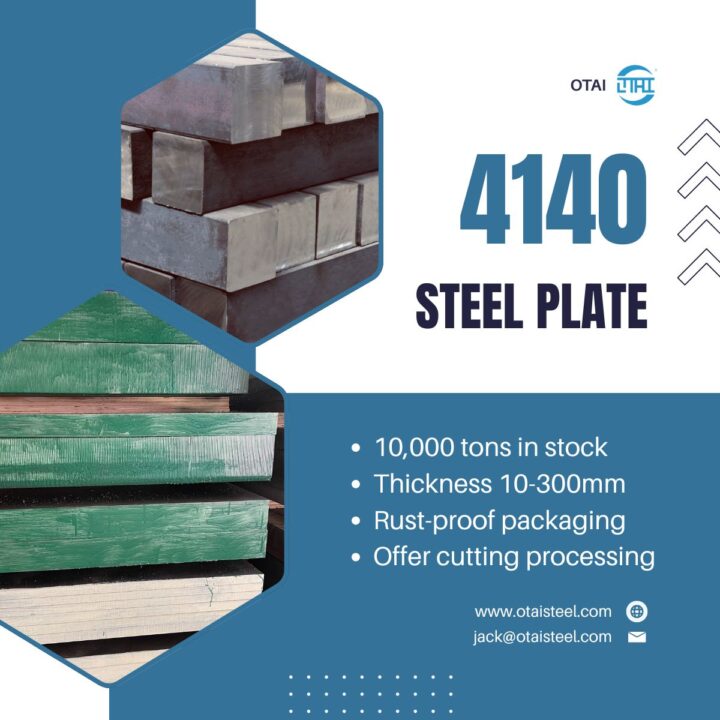
5140 steel plate can support the production of machined mechanical components, fixtures, and structural parts. However, a thicker plate does not automatically provide the same heat treatment response as a thin plate. The core cooling rate and required mechanical properties still need evaluation.
Buyers should also avoid ordering stock that is unnecessarily thick. Excessive machining allowance increases material consumption, cutting time, and production cost. On the other hand, insufficient allowance can make it difficult to remove surface defects or achieve the final drawing dimensions.
Match the product form to the manufacturing process
Round bars are often suitable for shafts, pins, and cylindrical components. Plates can suit parts that require sawing, milling, drilling, or other machining operations. The final choice should reflect the geometry and processing route rather than a general assumption that one product form is always better.
For 5140 steel, buyers can review the available plate range and discuss the required dimensions with the supplier. The supplier should confirm the actual stock condition, cutting allowance, and inspection options before order placement.
| Application | Typical material consideration | Important buyer check |
|---|---|---|
| Shafts and axles | Round section and core performance | Core hardness, strength, and fatigue requirements |
| Gears and mechanical parts | Section geometry and surface requirements | Hardness distribution and dimensional stability |
| Machined plates | Plate thickness and machining allowance | Thickness, condition, and test location |
| Pins and connecting components | Finished diameter and load conditions | Tensile strength, toughness, and hardness |
🔬 How Should Buyers Evaluate Mechanical Properties by Section Size?
Check the material test certificate carefully
A material test certificate (MTC) provides important information about the supplied steel. Depending on the order and inspection requirements, it may include the heat number, chemical composition, mechanical properties, heat treatment condition, and inspection results.
When reviewing 5140 steel, buyers should check whether the certificate identifies the actual supplied product and its delivery condition. They should also confirm whether the mechanical-property results relate to the ordered section size or to a separate test specimen.
A certificate showing a tensile strength value does not automatically prove that every location in a large component has the same strength. The test method, specimen location, and applicable specification determine what the result represents.
Confirm the test location and direction
Mechanical properties can vary according to the position and orientation of the test specimen. For thick products, a surface test may not represent the core. Similarly, longitudinal and transverse specimens can produce different results depending on the product and applicable standard.
Before production, buyers should agree on the following details:
- Whether the required properties apply to the surface, mid-radius, or core.
- Whether the test specimen must come from the actual product or a representative sample.
- Whether testing must follow a specified longitudinal or transverse direction.
- Which hardness scale and acceptance range apply.
- Whether tensile, impact, or additional tests are required.
Distinguish delivery condition from final heat treatment
Suppliers may deliver 5140 steel in an annealed, normalized, or other agreed condition. The properties in that delivery state may differ significantly from those achieved after the buyer performs quenching and tempering.
Therefore, the purchase specification should clearly identify whether the buyer requires properties in the supplied condition or after a particular heat treatment. This distinction prevents misunderstandings when comparing quotations and reviewing inspection documents.
A useful purchasing practice is to evaluate chemical composition, section dimensions, delivery condition, and mechanical properties as one complete package. No single figure can confirm the suitability of a large 5140 section.
📋 What Should Be Specified in a 5140 Steel Purchase Order?
Identify the grade and applicable standard
The purchase order should identify 5140 steel clearly and state the applicable material standard or specification. Buyers should avoid relying only on a commercial grade name when the project requires compliance with a particular standard.
Although 5140 is associated with several international grade designations, buyers should not assume that every similar grade is automatically interchangeable. Chemical composition limits, product specifications, and mechanical-property requirements may differ. The agreed standard should control the acceptance criteria.
Provide complete product dimensions
Section size is essential information for material selection and heat treatment planning. The purchase order should specify the product form, thickness or diameter, width, length, and required quantity. If the component has a complex shape, a drawing can help the supplier understand the intended application.
For cut-to-size material, buyers should also define dimensional tolerances, cutting method, and whether the dimensions refer to the supplied blank or finished component.
Define inspection and property requirements
Buyers should state the required delivery condition and mechanical-property acceptance criteria. If the final component needs quenching and tempering, the purchase order should clarify whether the supplier or the buyer will arrange this process.
For large sections, it is particularly important to define the hardness test location and whether core testing is necessary. If the project requires ultrasonic testing, third-party inspection, or special documentation, these requirements should also appear in the order.
| Purchase order item | Information to specify |
|---|---|
| Steel grade | 5140 and the applicable standard |
| Product form | Plate, round bar, or another agreed form |
| Dimensions | Thickness or diameter, width, length, and tolerances |
| Delivery condition | Annealed, normalized, quenched and tempered, or another agreed condition |
| Mechanical properties | Hardness, tensile strength, yield strength, elongation, and impact requirements where applicable |
| Test requirements | Test method, specimen location, direction, and inspection level |
| Documentation | MTC, ultrasonic test report, and third-party inspection documents if required |
🚚 How Can Buyers Reduce Performance Risks When Sourcing 5140 Steel?
Share the application before requesting a quotation
A supplier can provide a more useful recommendation when the buyer explains how the material will be used. Instead of asking only for a price per ton, provide the finished component dimensions, loading conditions, machining process, and required heat treatment condition.
This information helps the supplier evaluate whether the requested product size is practical and whether additional technical confirmation is necessary. It also reduces the risk of comparing quotations that cover different material conditions or inspection requirements.
Compare quotations on equivalent specifications
A lower quotation may reflect a different delivery condition, dimensional tolerance, testing level, or packaging arrangement. Buyers should therefore compare the technical scope as well as the unit price.
For large 5140 sections, confirm whether the supplier can provide the required dimensions and documentation. If the project requires specific mechanical properties after heat treatment, clarify who will perform the treatment and who will verify the results.
Check traceability and inspection arrangements
Traceability is important for industrial components because it connects the supplied material with its production and inspection records. Buyers should request clear heat-number identification and an MTC that corresponds to the delivered material.
For demanding applications, additional inspection may be appropriate. Depending on the project specification, this can include ultrasonic testing, dimensional inspection, hardness mapping, or third-party verification.
Choose a supplier with suitable processing capability
A capable steel supplier should be able to discuss material dimensions, cutting requirements, tolerances, inspection documents, and export packaging. These services can reduce coordination work between the buyer, steel supplier, machining shop, and heat treatment provider.
For buyers sourcing 5140 steel internationally, it is also useful to confirm packing details, rust prevention, shipment marks, and document requirements before production begins. Clear communication at the quotation stage helps prevent delays and unnecessary costs later.
🏢 Company Advantages
- 5140 steel plate stock: Thickness range of 4–300 mm, subject to current inventory confirmation.
- 10,000+ tons of total steel stock: Supports sourcing requirements across multiple steel grades and product categories.
- 20 saw cutting machines: Supports cutting services for different customer dimensions.
- Machining capability: CNC machining and grinding services help customers obtain material closer to their required dimensions.
- Custom size and tolerance: Cutting and processing can be arranged according to customer drawings and project requirements.
- Quality inspection: Material testing, ultrasonic testing arrangements, and third-party inspection support are available according to order requirements.
- One-stop service: Supports material selection, cutting, machining coordination, inspection, and export packaging.
- Export experience: Supplying international customers in more than 54 countries since 1999.
- Export packaging: Anti-rust protection, steel strapping, bundling, and wooden cases can be arranged according to shipment requirements.
- Technical and commercial support: Helps buyers confirm material specifications, dimensions, inspection requirements, and delivery arrangements.
For product details, visit our 5140 alloy steel product page or contact our team with your required dimensions and technical specification.
❓ Frequently Asked Questions
1. Does section size affect 5140 steel hardness?
Yes. Larger sections generally cool more slowly at the center during quenching. This can create a hardness difference between the surface and core. The actual result depends on the steel’s hardenability, chemical composition, quenching conditions, and heat treatment process.
2. Can large-diameter 5140 steel achieve uniform hardness?
It depends on the required hardness level, section dimensions, material hardenability, and quenching process. A large section may not achieve the same through-hardness as a smaller bar under identical conditions. Buyers should define the required hardness distribution and confirm it through an appropriate test method.
3. Is 5140 steel suitable for large shafts?
5140 can be considered for shafts and other mechanical components, but suitability depends on the shaft diameter, loading conditions, required core properties, and heat treatment capability. Engineers should evaluate the actual section size rather than relying only on the grade designation.
4. Why can the surface hardness of 5140 steel be higher than its core hardness?
The surface normally cools faster than the center during quenching. This difference can produce different microstructures across the section. The surface may develop a harder structure, while the slower-cooling core may retain a softer structure. A hardness test at only one location cannot describe the entire section.
5. What should buyers check when purchasing large-section 5140 steel?
Buyers should confirm the applicable standard, product dimensions, delivery condition, chemical composition, mechanical-property requirements, and inspection method. They should also identify the required test location, especially when core properties are important. An MTC and any agreed additional inspection reports should match the supplied material.