4130 Steel Bending: How Do Thickness and Strength Affect Forming?
📑 Table of Contents
- 🔍 Why Do Thickness and Strength Matter in 4130 Steel Bending?
- 📏 How Does 4130 Steel Thickness Affect Bending Force?
- ⚙️ How Does Material Strength Influence Bendability?
- 🔄 How Do Annealed and Heat-Treated Conditions Affect Forming?
- 📐 How Should Manufacturers Select the Bend Radius?
- ⚠️ What Causes Cracking During 4130 Steel Bending?
- 🏭 How Do Thickness and Strength Affect Different Applications?
- 🔬 What Should Buyers Check Before Purchasing 4130 Steel for Bending?
- 🚚 How Can Suppliers Help Reduce Bending and Forming Risks?
- 🏢 Company Advantages
- ❓ Frequently Asked Questions
4130 steel is a chromium-molybdenum alloy steel used in aircraft structures, automotive components, mechanical parts, and fabricated assemblies. Manufacturers choose it for its combination of strength, toughness, and heat treatment response. However, when a component requires bending or forming, the material’s strength and thickness become important production considerations.
A thin 4130 sheet in an annealed condition may allow relatively easy cold forming. A thicker plate with higher strength can require substantially greater bending force, a larger inside radius, and more careful process control. If manufacturers ignore these differences, they may encounter surface cracks, excessive springback, dimensional variation, or unexpected forming costs.
For buyers, the challenge begins before production. The selected product thickness, delivery condition, mechanical properties, and final forming requirements must work together. This article explains how these factors influence 4130 steel bending and what procurement teams should confirm when sourcing material for formed components.
🔍 Why Do Thickness and Strength Matter in 4130 Steel Bending?
Thickness determines the deformation required
During bending, the material changes shape around a punch or forming tool. The outer surface stretches, while the inner surface compresses. Between these two regions lies the neutral axis, where longitudinal strain is relatively low.
As material thickness increases, the outer surface must accommodate greater deformation for a given inside bend radius. A thick section also needs more force to form than a thin section of comparable width and material condition. Therefore, manufacturers cannot simply reuse the same tooling settings for every 4130 thickness.
Strength affects resistance to forming
4130 steel strength depends on its chemical composition, manufacturing history, and delivery condition. Annealed material generally offers better formability than material that has undergone hardening and tempering. Normalized and quenched-and-tempered products can have higher strength, but they may require greater forming force and more conservative bending conditions.
Higher yield strength means the material resists permanent deformation more strongly. Consequently, the press brake or forming equipment must apply enough force to produce the intended bend. Higher strength can also increase springback after the forming load is removed.
Thickness and strength work together
These two factors should never be evaluated independently. A thin, high-strength 4130 sheet and a thick, annealed 4130 plate present different forming challenges. The first may resist deformation because of its strength, while the second may require substantial equipment capacity because of its thickness.
For reliable forming, buyers should specify both the required thickness and the delivery condition. A grade name alone does not tell the fabricator how much force the material will require or what bend radius will be appropriate.
📏 How Does 4130 Steel Thickness Affect Bending Force?
Thicker material generally requires more forming force
Press brake capacity depends on several factors, including material thickness, tensile strength, bend length, die opening, and tooling configuration. As thickness increases, the machine must overcome greater resistance to deformation across the bend line.
For a given 4130 grade and comparable forming conditions, a thicker plate normally requires a higher bending load than a thinner sheet. A fabricator must therefore calculate the required machine capacity before production. Using an undersized press brake can result in incomplete forming, inaccurate angles, or unsafe operating conditions.
The required force also depends on the length of the bend. A long workpiece generally needs more total force than a short one of the same thickness. In addition, the selected V-die opening and punch geometry influence the force and final bend radius.
Thicker sections need more attention to strain distribution
When a manufacturer bends a thick 4130 plate, the outer surface experiences tensile strain while the inner surface experiences compressive strain. If the inside radius is too small, the outer surface may exceed its available ductility and develop cracks.
A larger inside radius can reduce the severity of the deformation. However, it also changes the finished component geometry. Designers should therefore consider the bend radius during the initial drawing stage rather than leaving the fabricator to solve the problem after material procurement.
Thickness affects springback and dimensional control
Springback occurs when elastic strain recovers after the forming force is released. The workpiece may open slightly, so the final angle becomes larger than the angle under the press brake load.
Material strength, thickness, bend radius, and tooling all influence this behavior. Higher-strength 4130 generally requires more attention to springback compensation. Fabricators may need to adjust the forming angle, tooling, or process settings after conducting trial bends.
| Thickness factor | Potential forming effect | Production consideration |
|---|---|---|
| Thin sheet | Lower total forming force in comparable conditions | Control angle accuracy and surface condition |
| Medium thickness | Higher force and more noticeable tooling influence | Confirm die opening, punch radius, and springback |
| Thick plate | Substantially greater force and deformation demand | Check machine capacity, bend radius, and forming procedure |
This comparison describes general forming behavior rather than fixed machine-capacity values. Fabricators should calculate the actual load using the material’s certified properties and the planned tooling arrangement.
Do not select tooling based on thickness alone
Two 4130 products with the same thickness may require different bending settings if their tensile strength and delivery conditions differ. The fabricator should obtain the material certificate and confirm the actual properties before finalizing the process.
⚙️ How Does Material Strength Influence Bendability?
Yield strength determines resistance to permanent deformation
Yield strength indicates the stress at which a material begins to deform permanently under a specified test method. During bending, the material must exceed its local yield strength to retain the new shape after the forming load is removed.
When 4130 steel has higher yield strength, the forming equipment generally needs to apply more force to produce the same deformation. The material may also show greater springback, which makes angle control more demanding.
However, yield strength alone cannot determine whether a particular bend will succeed. Elongation, tensile strength, material condition, bend radius, and surface quality also influence the result.
Elongation helps indicate forming capacity
Elongation measures how much a tensile test specimen stretches before fracture. It provides useful information about ductility, although it does not directly predict every bending result.
For bending operations, the outer surface of the material experiences tensile deformation. If the available ductility is insufficient for the required strain, cracks may form along the outside of the bend. A material with suitable elongation and a properly selected bend radius generally offers a better forming opportunity.
Buyers should therefore review tensile strength and elongation together. A high-strength condition with limited elongation may be less suitable for tight-radius forming than an annealed condition with greater ductility.
Hardness can provide an additional reference
Hardness often changes with heat treatment and can help buyers understand the general condition of 4130 steel. However, hardness is not a direct substitute for tensile testing or bend qualification.
For example, two materials may show similar hardness readings but still differ in elongation, microstructure, or surface condition. When bending performance matters, the fabricator should use the complete mechanical-property information rather than relying on hardness alone.
| Property | Relationship with bending | What buyers should check |
|---|---|---|
| Yield strength | Influences the force needed for permanent deformation | Actual value and delivery condition |
| Tensile strength | Helps characterize resistance to tensile failure | Test result and applicable specification |
| Elongation | Provides an indication of ductility | Specified test length and actual result |
| Hardness | Provides an additional indication of material condition | Hardness scale and test location |
For bending applications, a balanced combination of strength and ductility is usually more useful than maximizing strength alone. The required balance depends on the component’s final load and forming requirements.
🔄 How Do Annealed and Heat-Treated Conditions Affect Forming?
Annealed 4130 is generally preferred for forming
Annealing reduces hardness and strength compared with many hardened conditions. It can also improve ductility, making annealed 4130 a common starting condition for bending, drawing, and other forming operations.
Manufacturers often prefer to form the material before final heat treatment. This approach allows them to use a more workable material condition during fabrication and then apply the specified heat treatment to achieve the required service properties.
Nevertheless, annealed material still needs a suitable bend radius and controlled tooling. Poor surface quality, incorrect forming direction, or excessive deformation can cause cracking even when the material has good ductility.
Normalized 4130 may require more conservative bending
Normalizing produces a different microstructure and mechanical-property profile from annealing. Normalized 4130 can offer useful strength and toughness, but its forming behavior may differ from that of annealed material.
Manufacturers should not assume that a bend radius suitable for annealed sheet will also work for normalized material of the same thickness. A trial bend or qualified forming procedure can help confirm the required conditions.
Quenched-and-tempered 4130 needs careful evaluation
Quenching and tempering can significantly increase 4130 steel strength and hardness. However, the resulting material may have less forming capacity than its annealed counterpart.
Cold bending a high-strength quenched-and-tempered product can introduce substantial local strain. If the design requires a tight radius or a large forming angle, the risk of cracking may become unacceptable. In such cases, engineers should evaluate whether forming before heat treatment is a better production route.
Plan the manufacturing sequence early
Manufacturers should decide when to bend the material in relation to machining, welding, and heat treatment. Forming first and heat treating afterward may be appropriate for some components, but the final process must account for distortion, dimensional changes, and the required mechanical properties.
Post-forming heat treatment also requires technical control. An unsuitable thermal cycle can change strength, hardness, or toughness. Buyers should therefore specify the final condition and agree on the process responsibility before ordering.
| 4130 condition | General forming characteristics | Recommended consideration |
|---|---|---|
| Annealed | Generally softer and more ductile | Common starting condition for bending |
| Normalized | Generally stronger than annealed material | Confirm bend radius and forming response |
| Quenched and tempered | Higher strength and potentially reduced formability | Evaluate forming before final heat treatment |
📐 How Should Manufacturers Select the Bend Radius?
Understand the relationship between radius and thickness
The inside bend radius describes the curved surface on the inner side of a formed component. Manufacturers often compare this radius with material thickness using a radius-to-thickness ratio. For example, a radius of twice the material thickness is commonly described as 2T.
This ratio provides a convenient way to communicate design requirements. However, it does not establish a universal minimum bend radius for every 4130 product. The acceptable value depends on the material condition, mechanical properties, thickness, bending direction, tooling, and forming method.
A smaller inside radius creates greater deformation on the outside surface. Consequently, tight bends generally require more attention to ductility and surface quality. A larger radius reduces local strain but may affect the component’s space requirements and finished geometry.
Material condition changes the recommended radius
Annealed 4130 sheet can generally tolerate tighter forming than a stronger normalized or quenched-and-tempered product. Some aerospace fabrication references provide different cold-bend radius recommendations for annealed and normalized 4130 sheet, demonstrating why material condition must accompany any radius recommendation.
Those reference values apply to defined product forms, thickness ranges, and conditions. Buyers should not transfer a thin-sheet recommendation directly to a thick 4130 plate without confirming its applicability.
Consider the rolling direction
Rolled steel can show directional differences in mechanical behavior. The orientation of the bend line relative to the rolling direction may influence crack resistance and forming performance.
For demanding applications, the drawing or manufacturing specification should identify the required bend orientation. If the design allows flexibility, the fabricator can select an orientation that supports the forming process. If the orientation is fixed, the material and bend radius should be qualified for that condition.
Use trial bends for critical components
When a component requires a tight radius, high forming accuracy, or a demanding mechanical condition, a trial bend can provide valuable information. The manufacturer can inspect the outer surface, verify the final angle, and check for cracks or other defects.
For critical production, the trial should use material that represents the actual grade, thickness, condition, and production batch as closely as practical. This approach is more reliable than selecting a radius from a general table without considering the actual material.
| Bend design factor | Effect on forming | Action before production |
|---|---|---|
| Inside radius | Smaller radii increase outer-surface strain | Confirm radius against material condition |
| Material thickness | Changes deformation demand and forming force | Calculate tooling and machine capacity |
| Rolling direction | May influence crack resistance | Identify bend orientation where necessary |
| Material strength | Affects force, springback, and forming limits | Review certified mechanical properties |
⚠️ What Causes Cracking During 4130 Steel Bending?
Excessive outer-surface strain
Cracking often begins when the tensile strain on the outside of the bend exceeds the material’s available ductility. A bend radius that is too small, combined with a thick or high-strength section, can create this condition.
Manufacturers can reduce the risk by increasing the inside radius, choosing a more formable delivery condition, or changing the manufacturing sequence. They should also verify that the proposed bend meets the component’s dimensional requirements.
Incorrect material condition
A buyer may order 4130 without clearly specifying the delivery condition. If the supplier provides material in a stronger condition than the fabricator expected, the forming process may become more difficult.
This problem is especially important when a design uses forming parameters developed for annealed material. The production team should check the MTC and confirm the material condition before starting the operation.
Surface defects and damaged edges
Scratches, seams, edge tears, and cutting damage can act as local stress concentration points. During bending, these imperfections may become crack initiation sites, particularly on the tensile side of the workpiece.
Before forming, manufacturers should inspect the material surface and cut edges. They should remove unacceptable defects using an approved method and avoid introducing sharp notches during cutting or preparation.
Incorrect tooling and forming setup
A punch radius or die opening that does not match the material can produce excessive local deformation. Poor alignment can also cause uneven bending and inconsistent strain along the workpiece.
Operators should verify tooling condition, machine alignment, and the planned forming sequence. For thick sections, they may need specialized equipment or multiple controlled forming stages rather than attempting the entire bend in one operation.
Uncontrolled temperature and process changes
Cold forming and hot forming produce different material responses. Heating can reduce forming resistance, but uncontrolled temperature or cooling can affect the microstructure and mechanical properties of 4130 steel.
Manufacturers should not apply improvised heating methods to solve a difficult bend. If hot forming is necessary, the process should follow a qualified procedure that defines the temperature range, heating uniformity, deformation sequence, and any required post-forming heat treatment.
Crack prevention begins with material verification and process planning. Increasing the forming force alone will not solve a bendability problem caused by unsuitable material condition or excessive strain.
🏭 How Do Thickness and Strength Affect Different Applications?
Aircraft and structural components
4130 steel has a long history of use in aircraft structures and related mechanical components. Some applications require formed sheet or tube sections with carefully controlled dimensions and mechanical properties.
For these parts, manufacturers must balance weight, strength, and forming requirements. Thin products may support complex shapes, while stronger conditions may be necessary for the final service load. The production sequence should preserve the required properties without introducing unacceptable cracks or distortion.
Automotive and motorsport components
Automotive fabricators may use 4130 for brackets, structural members, chassis components, and tubular assemblies. Tube bending introduces additional considerations because the cross-section can flatten, wrinkle, or collapse if the tooling and bend radius are unsuitable.
Tube diameter, wall thickness, bend radius, internal support, and material condition all influence the result. Buyers should therefore specify the tube dimensions and forming requirements rather than treating tube bending as equivalent to flat-plate bending.
Industrial machinery and fabricated parts
Industrial components may require thicker 4130 sections to provide stiffness and load-bearing capacity. In these applications, the fabricator must consider the higher forming force and the possibility of greater springback.
Some designs can avoid difficult bending by using machined profiles, welded assemblies, or alternative component geometries. Engineers should compare these options based on performance, production cost, inspection requirements, and the intended service environment.
| Application type | Key forming challenge | Important specification |
|---|---|---|
| Aircraft sheet components | Maintaining shape and surface integrity | Material condition, thickness, and qualified bend radius |
| Automotive tubular structures | Preventing flattening and wrinkling | Tube diameter, wall thickness, and centerline radius |
| Industrial brackets | Managing forming force and springback | Yield strength, thickness, and angle tolerance |
| Thick fabricated components | High forming load and crack prevention | Machine capacity, inside radius, and forming procedure |
Each application needs its own forming assessment. A bend that works for thin aircraft sheet cannot automatically serve as a recommendation for a thick industrial plate or a tubular structure.
🔬 What Should Buyers Check Before Purchasing 4130 Steel for Bending?
Confirm the exact product dimensions
Buyers should provide the required thickness, width, length, and product form. For tube applications, they should also specify outside diameter and wall thickness. These dimensions help the supplier identify suitable stock and allow the fabricator to assess machine capacity and tooling.
When the final component requires a specific bend radius or angle, include the drawing or relevant dimensional details with the inquiry. This makes it easier to identify possible forming difficulties before the order is placed.
Specify the delivery condition
Do not describe the order only as 4130 steel. State whether the project requires annealed, normalized, or another agreed delivery condition. If forming must take place before final heat treatment, make that requirement clear.
This step is particularly important when the buyer has already established a forming process. The supplier must understand the expected material condition so that the delivered product matches the manufacturing plan.
Review the actual mechanical properties
Ask for the material test certificate and review the reported chemical composition and mechanical properties. For bending projects, pay particular attention to yield strength, tensile strength, elongation, and hardness where specified.
Do not rely on generic online values as acceptance criteria. Published values may describe a different product form, thickness, heat treatment condition, or test specimen. The actual MTC and agreed product specification should determine whether the supplied material meets the order requirements.
Discuss inspection and surface quality
For components that require tight bends or high reliability, surface quality deserves attention. Buyers should agree on the inspection requirements for the supplied material and any additional checks needed before forming.
Depending on the application, these may include dimensional inspection, visual surface examination, hardness testing, ultrasonic testing, or third-party inspection. The appropriate inspection scope should follow the project specification rather than adding tests without a clear purpose.
Compare suppliers on the complete technical offer
A low material price does not necessarily produce the lowest final component cost. If the supplied condition requires additional preparation, causes more forming trials, or increases scrap risk, the total manufacturing cost may rise.
When comparing quotations, buyers should evaluate material condition, dimensions, tolerances, inspection documents, cutting services, packaging, and delivery arrangements together.
🚚 How Can Suppliers Help Reduce Bending and Forming Risks?
Recommend a suitable starting material size
A steel supplier can help buyers compare available stock dimensions with the finished component drawing. The goal is to provide enough machining or forming allowance without creating unnecessary material waste.
For 4130 plate, the supplier should confirm the available thickness, width, length, delivery condition, and actual stock status. If the required dimension is not available as a standard size, cutting or other agreed processing may provide a practical alternative.
Provide traceable material documentation
Reliable material documentation helps the fabricator verify that the supplied steel matches the purchase specification. The MTC should identify the relevant heat number and report the test results required by the order.
When buyers need additional inspection, the supplier should clarify whether it can arrange the requested testing or coordinate with an approved third-party inspection provider.
Support cutting and dimensional preparation
Accurate cutting can reduce preparation time and help manufacturers control their material usage. Suppliers with suitable sawing and machining equipment can provide cut-to-size products according to agreed tolerances.
However, buyers should explain whether the material will undergo bending, machining, welding, or heat treatment after delivery. This information helps the supplier understand the required dimensions and avoid confusion between stock size and finished-part size.
Coordinate packaging and export delivery
International buyers should also consider rust prevention, identification, bundling, and transport protection. Appropriate packaging helps protect 4130 steel during storage and shipment, especially when the material will travel long distances before entering production.
Clear communication about labels, heat numbers, packing methods, and shipping documents can reduce receiving problems and support material traceability at the buyer’s facility.
For manufacturers sourcing 4130 steel, a capable supplier should provide more than a grade name and a price. The supplier should help confirm the product dimensions, delivery condition, documentation, and processing requirements that influence the final component.
🏢 Company Advantages
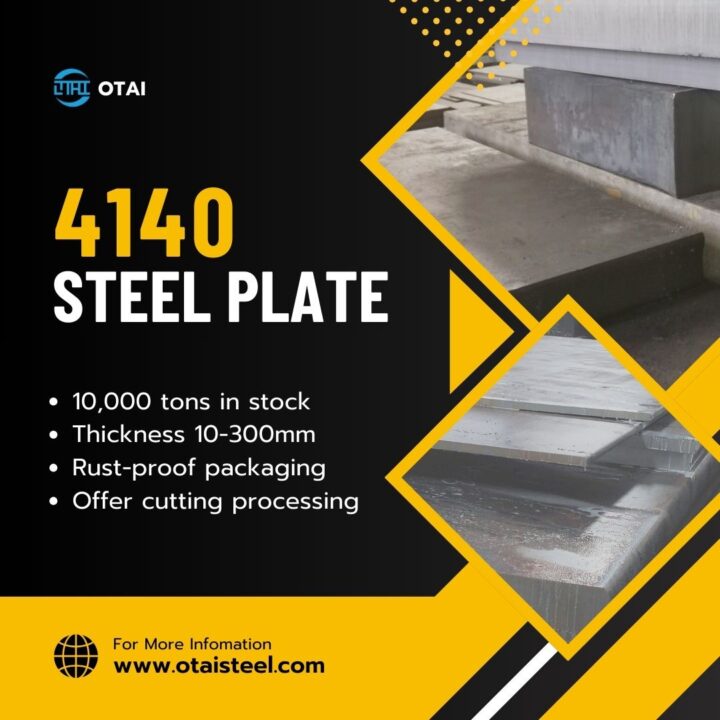
- 4130 steel plate stock: Thickness range of 10–70 mm, subject to current inventory confirmation.
- 10,000+ tons of total steel stock: Supports sourcing requirements across multiple steel grades and product categories.
- 20 saw cutting machines: Supports cutting services for different customer dimensions.
- CNC machining and grinding: Helps customers obtain material closer to their required dimensions.
- Custom sizes and tolerances: Cutting and processing can be arranged according to customer drawings and project requirements.
- Quality inspection support: Material testing, ultrasonic testing arrangements, and third-party inspection support are available according to order requirements.
- One-stop service: Supports material selection, cutting, machining coordination, inspection, and export packaging.
- International export experience: Supplying customers in more than 54 countries since 1999.
- Export packaging: Anti-rust protection, steel strapping, bundling, and wooden cases can be arranged according to shipment requirements.
- Technical and commercial support: Helps buyers confirm material specifications, dimensions, inspection requirements, and delivery arrangements.
For product details, visit our 4130 steel product page. Contact our team with your required thickness, dimensions, delivery condition, and application details for a quotation.
❓ Frequently Asked Questions
1. Can 4130 steel be bent without cracking?
Yes, 4130 steel can be bent when the material condition, thickness, bend radius, and forming process are suitable. Annealed 4130 is generally more formable than high-strength quenched-and-tempered material. Manufacturers should confirm the required bend radius and inspect the material surface before production.
2. Is annealed 4130 better for bending than normalized 4130?
Annealed 4130 is generally softer and more ductile, so manufacturers often prefer it for forming operations. Normalized 4130 may offer higher strength but can require a larger bend radius or more careful process control. The actual mechanical properties and product dimensions should guide the decision.
3. Does thicker 4130 steel require a larger bend radius?
Thicker material generally requires more forming force and can experience greater deformation demands. A larger inside radius may help reduce tensile strain on the outer surface. However, the required radius also depends on material strength, ductility, forming direction, and tooling, so buyers should not apply one fixed ratio to every product.
4. Can quenched-and-tempered 4130 steel be cold bent?
It may be possible for some designs, but high-strength quenched-and-tempered 4130 generally requires more careful evaluation. Its higher strength and potentially lower formability can increase forming force, springback, and cracking risk. For demanding bends, manufacturers should assess whether forming before final heat treatment is more suitable.
5. What information should buyers provide when purchasing 4130 steel for bending?
Buyers should provide the required product form, thickness, width, length, delivery condition, bend radius, forming direction, and final application. They should also identify mechanical-property requirements, inspection documents, dimensional tolerances, and any planned heat treatment. This information helps the supplier recommend suitable material and confirm the order details.