16MnCr5 1.7131: How Should Buyers Specify This Steel in Purchase Orders?
📑 Table of Contents
- 🔍 Why Purchase Order Details Matter for 16MnCr5 1.7131
- 📋 Specify the Correct Steel Grade and Material Number
- 📐 Define Product Form, Dimensions and Tolerances
- 🔥 Confirm the Required Delivery Condition
- 🧪 Include Chemical Composition and Mechanical Requirements
- 📄 Specify the Material Test Certificate Requirements
- 🔬 Clarify Inspection and Testing Requirements
- 📦 Define Packaging, Marking and Export Requirements
- 🤝 What Should Buyers Confirm with a 16MnCr5 Supplier?
- 🏭 Otai Company Advantages
- ❓ Frequently Asked Questions
When purchasing 16MnCr5 steel, specifying only the grade name may not provide enough information for a supplier to prepare the correct material. The designation 16MnCr5 and material number 1.7131 identify a commonly used case-hardening steel, but they do not define every detail of a commercial order. Product form, dimensions, delivery condition, applicable standard, inspection scope and documentation can all affect whether the delivered material meets the buyer’s requirements.
These details matter especially when the steel will enter a controlled manufacturing process. For example, a buyer producing gears may require a particular condition for machining before carburizing. Another buyer may need steel plates for machined components and have strict thickness and flatness requirements. If the purchase order does not communicate these needs clearly, the supplier may quote a material that matches the grade but not the production requirements.
This article explains how procurement teams can prepare a practical 16MnCr5 1.7131 purchase order. It covers the information to include, the documents to request and the questions to settle with a supplier before production or shipment.
🔍 Why Purchase Order Details Matter for 16MnCr5 1.7131
One steel grade can involve different supply requirements
16MnCr5 is a low-carbon manganese-chromium case-hardening steel. Manufacturers commonly use it for components that need a hard wear-resistant surface and a tougher core after suitable carburizing and heat treatment. However, the grade designation alone does not tell a supplier how the buyer plans to process the material.
A buyer may need plate for cutting and machining, while another may purchase a different product form for producing transmission components. Even when both orders specify 16MnCr5, their dimensional tolerances, delivery conditions and inspection requirements may differ considerably.
Incomplete specifications create avoidable risks
Consider an order that states only “16MnCr5, 1.7131, 10 tons.” The supplier still needs to clarify the product form, thickness, width, length, applicable standard, delivery condition and required documents. If the buyer leaves these points open, the supplier may make assumptions that do not match the customer’s production process.
Unclear requirements can lead to several problems:
- Incorrect dimensions: The supplied material may require additional cutting or machining.
- Unsuitable delivery condition: The steel may not be in the condition expected for the buyer’s next operation.
- Documentation gaps: The shipment may arrive without the inspection records required by the buyer’s quality department.
- Acceptance disputes: The buyer and supplier may interpret quality or tolerance requirements differently.
- Delivery delays: Missing information may require order amendments or additional confirmation before shipment.
Use the purchase order as a shared technical record
A well-prepared purchase order connects the buyer’s engineering requirements with the supplier’s production and inspection responsibilities. It should identify the material clearly and state which requirements are mandatory. If the buyer needs a special test, tighter tolerance or particular packaging method, the order should communicate that requirement before the supplier confirms the order.
In practice, buyers should treat the purchase order as more than a price and quantity document. It should provide enough information for the supplier to quote, source, inspect, process and ship the correct material.
📋 Specify the Correct Steel Grade and Material Number
Write both 16MnCr5 and 1.7131
Buyers should identify the material using both its grade designation and material number. The designation 16MnCr5 and material number 1.7131 refer to the same commonly recognized steel grade. Including both helps purchasing teams, suppliers and inspection personnel identify the intended material more clearly.
However, a material number does not replace the need to state the applicable standard. Buyers should identify the relevant standard and edition required by their drawings, technical specifications or quality system. 16MnCr5 is commonly specified under EN 10084 for case-hardening steels. The applicable standard edition and any contractual amendments should be confirmed before the order is released.
Do not rely on a similar grade name alone
International steel standards contain grades with similar applications or broadly comparable characteristics. Nevertheless, similar applications do not automatically make two grades interchangeable. Chemical composition limits, hardenability, product requirements and heat-treatment response may differ.
For this reason, buyers should avoid writing only “16MnCr5 equivalent” unless the purchasing specification explicitly permits alternative grades. If a supplier proposes a substitute, the buyer’s engineering or quality department should review the proposed material against the original technical requirements.
State the standard and any approved deviations
The purchase order should identify the standard that governs the material. If the buyer’s drawing or internal specification adds requirements beyond the standard, list them separately. This prevents the supplier from assuming that standard compliance automatically covers every customer-specific requirement.
| Purchase order field | Recommended information | Why it matters |
|---|---|---|
| Steel grade | 16MnCr5 | Identifies the requested grade. |
| Material number | 1.7131 | Provides an additional grade identifier. |
| Applicable standard | Relevant EN standard and edition | Defines the technical basis for acceptance. |
| Additional requirements | Drawing or customer specification number | Covers requirements beyond the standard. |
| Substitution policy | No substitution without written approval | Prevents unapproved grade changes. |
When the buyer has a controlled drawing or material specification, referencing its document number and revision can also reduce confusion. The supplier should confirm that the referenced documents are available and understood before accepting the order.
📐 Define Product Form, Dimensions and Tolerances
Identify the product form first
A purchase order should clearly state whether the buyer requires plate, bar or another product form. This distinction matters because product standards, dimensional tolerances and inspection arrangements can vary with the form supplied.
For plate orders, specify thickness, width and length. If the supplier must cut the material into individual pieces, provide the finished cutting dimensions and indicate whether the dimensions refer to the raw stock or the final cut pieces. A cutting list or drawing can help avoid misunderstandings, especially when an order contains several sizes.
Specify tolerances rather than assuming them
Nominal dimensions alone may not be enough for precision machining. A buyer should state the permitted dimensional variation when the production process requires a defined tolerance. For example, a component manufacturer may need tighter thickness control to reduce machining allowance and material waste.
Buyers should also consider the following points where relevant:
- Thickness, width and length tolerances.
- Flatness and straightness requirements.
- Surface condition and permissible defects.
- Cutting accuracy and edge condition.
- Machining allowance, if the supplier provides pre-machined material.
Separate stock dimensions from finished dimensions
Some buyers need standard stock sizes for further processing. Others require pieces cut to specific dimensions. The purchase order should distinguish these requirements. If the supplier performs saw cutting, state the required finished dimensions and any cutting tolerance. Also confirm whether the quoted price includes cutting, additional machining or only the supply of raw material.
| Dimension or condition | What the buyer should state | Useful clarification |
|---|---|---|
| Product form | 16MnCr5 plate | Confirm the exact form required. |
| Nominal size | Thickness × width × length | Use millimetres or another stated unit. |
| Tolerance | Required dimensional limits | Reference a standard or drawing where applicable. |
| Cutting | Required piece sizes and cutting tolerance | Confirm whether cutting is included. |
| Surface and geometry | Flatness, surface or edge requirements | Specify only the requirements relevant to the application. |
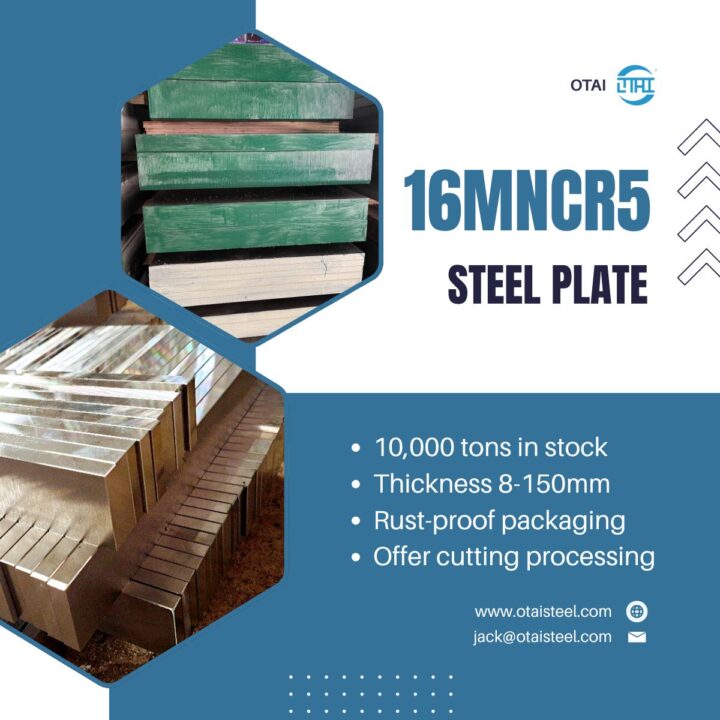
For buyers sourcing 16MnCr5 plate, Otai’s listed stock thickness range is 8–150 mm. The required width, length, available quantity and current stock condition should still be confirmed for each order. Buyers can review the 16MnCr5 product information and provide their exact cutting requirements when requesting a quotation.
🔥 Confirm the Required Delivery Condition
Delivery condition affects the next manufacturing step
16MnCr5 is commonly selected for components that undergo carburizing and subsequent heat treatment. Before that process, however, the material may need machining, cutting or other preparation. The delivery condition should therefore match the buyer’s planned production route.
For example, a manufacturer that plans to machine a component before carburizing may prefer a condition that supports the required machining operation. Another buyer may have a specific hardness or processing requirement established by an internal manufacturing procedure. The supplier needs this information before selecting or preparing the material.
Do not confuse delivery condition with final heat treatment
The condition in which steel arrives is not necessarily the final condition of the finished component. A buyer should distinguish the supplied material condition from the later carburizing, quenching and tempering operations performed during manufacturing.
If the purchase order simply states “heat treated,” the supplier may not know whether the buyer means a particular delivery condition or the final component treatment. Instead, specify the required condition using the terminology and requirements of the applicable standard or agreed technical specification.
Confirm hardness requirements carefully
If the buyer needs a hardness range, the purchase order should state the required value, test method and applicable testing conditions. Hardness results can depend on product size, material condition, test location and preparation. Therefore, buyers should avoid adding an isolated hardness number without defining how the supplier should verify it.
For a standard stock order, the buyer may only need the agreed delivery condition and its corresponding certificate information. For a more demanding application, the engineering team may need to define additional testing or processing requirements before the order is placed.
Ask the supplier to confirm feasibility
Before finalizing the order, ask the supplier to confirm that the requested condition is available for the specified product form and dimensions. If the buyer requires a special condition, the supplier should clarify whether it can be supplied directly or whether additional processing will affect price and lead time.
🧪 Include Chemical Composition and Mechanical Requirements
Reference the standard instead of copying isolated values
Buyers should normally identify the applicable material standard and require the supplied steel to comply with its relevant chemical composition limits. For 16MnCr5, commonly referenced composition ranges include carbon around 0.14–0.19%, manganese around 1.00–1.30% and chromium around 0.80–1.10%. These figures are useful for understanding the grade, but the exact requirements must be checked against the applicable standard edition and product specification.
Do not treat one published chemical analysis as the universal composition of every 16MnCr5 heat. A standard defines permitted limits, while a mill test certificate reports the actual analysis for the supplied heat. The buyer should use the standard for acceptance limits and the certificate for the delivered material’s recorded results.
Distinguish standard limits from typical analysis
Typical analysis data can help engineers understand a material’s general characteristics. However, typical values do not replace contractual acceptance requirements. If the buyer copies typical values into a purchase order as mandatory limits, the supplier may face requirements that differ from the governing standard.
A better approach is to state the applicable standard and require a heat-specific chemical analysis on the material test certificate. If the application requires a narrower composition range or additional elements, the buyer should identify those requirements separately and obtain the supplier’s written agreement.
Define mechanical properties in context
Mechanical properties should also relate to the product form, delivery condition and test requirements. Tensile strength, yield strength, elongation and hardness may vary with section size and material condition. A value taken from a general datasheet may not apply to every plate thickness or supply condition.
Therefore, buyers should avoid specifying mechanical values without confirming their relevance to the ordered product. If a drawing or customer specification requires particular properties, include the relevant document reference and test conditions. The supplier can then confirm whether the requested properties apply to the supplied condition.
Make application-specific requirements explicit
For a component that will undergo carburizing, the buyer may have requirements related to the subsequent heat-treatment process rather than only the incoming raw material. These may include hardening performance, case depth or final hardness after processing. Such requirements should be identified as finished-component or process requirements, not confused with the delivery condition of the raw steel.
When the buyer needs the supplier to guarantee a special property, the order should state the test method, sampling location, acceptance criteria and responsible party. This creates a clear basis for quotation and inspection.
📄 Specify the Material Test Certificate Requirements
Request a certificate that identifies the supplied material
A material test certificate provides important evidence of the material’s reported properties and traceability. Buyers should state the required certificate type before placing the order, rather than waiting until shipment preparation to request documentation.
For many industrial steel purchases, buyers request an EN 10204 3.1 inspection certificate when applicable. This document includes inspection results validated by the manufacturer’s authorized inspection representative in accordance with the relevant requirements. If the buyer’s contract requires another certificate type, the purchase order should state it clearly.
Check the key information on the certificate
When reviewing the certificate, buyers should confirm that the document corresponds to the actual shipment. The grade, material number, standard, heat number, product dimensions and reported test results should be consistent with the order and material identification.
Useful certificate information includes:
- Manufacturer or issuing organization.
- Steel grade and material number.
- Applicable material standard.
- Heat or cast number for traceability.
- Chemical composition results.
- Mechanical or hardness test results, where required.
- Product form and dimensions, where recorded.
- Certificate number, date and authorized validation.
Make traceability a contractual requirement
Traceability connects the material received by the buyer with its inspection records. This is particularly important when the buyer operates a quality management system or supplies components to customers with strict material documentation requirements.
Ask the supplier how the heat number will remain identifiable after cutting. If one plate is divided into several pieces, the buyer may need each piece or bundle to retain a clear link to the original heat and certificate. The purchase order should state the marking and documentation arrangement needed to maintain that connection.
Review the certificate before accepting the shipment
The receiving team should compare the certificate with the purchase order and physical markings. A certificate for the correct grade is not sufficient if the heat number does not match the delivered material. Similarly, a certificate may report compliant chemistry while the order also requires dimensional or additional inspection records.
Buyers should establish a document review process before shipment or upon receipt, depending on their quality procedures. If a certificate contains missing or inconsistent information, contact the supplier before using the material in production.
🔬 Clarify Inspection and Testing Requirements
Separate standard inspection from additional inspection
Not every 16MnCr5 order requires the same inspection scope. A routine stock purchase may need standard documentation and dimensional checks. A critical component order may require additional testing, third-party inspection or customer-specific quality records.
Buyers should identify which inspections are mandatory and which are optional. This helps the supplier calculate the quotation accurately and arrange the correct inspection resources before dispatch.
State any additional tests clearly
Depending on the application and contractual requirements, buyers may request additional testing such as ultrasonic testing, hardness testing or dimensional inspection. However, these tests should not be added as vague phrases. The order should identify the applicable method or standard, acceptance criteria, inspection extent and reporting requirements.
For example, if ultrasonic testing is required, the buyer should specify the relevant testing standard, acceptance level and inspection coverage. The supplier can then confirm whether the requirement is suitable for the ordered product form and dimensions.
Agree on third-party inspection arrangements
Some buyers require an independent inspection company to witness testing or review documents before shipment. If this applies, state the inspection agency, inspection scope, notification period and any required hold points. Also clarify who pays the inspection cost and whether the supplier must wait for written release before shipping.
Use a clear inspection plan
A simple inspection plan can help purchasing, quality and supplier teams work from the same requirements. The following table provides a practical starting point. Buyers should adapt it to their product specification and risk level.
| Inspection item | Possible requirement | Buyer action |
|---|---|---|
| Visual inspection | Surface condition and visible defects | Define acceptance expectations. |
| Dimensional inspection | Thickness, width, length and tolerance | Reference the order or drawing. |
| Chemical analysis | Heat-specific composition | Require certificate results. |
| Mechanical testing | Specified properties and test conditions | Confirm applicability to product condition. |
| Ultrasonic testing | Agreed standard and acceptance level | Specify scope and reporting. |
| Third-party inspection | Witnessing or independent verification | Agree agency, timing and cost. |
Clear inspection requirements help prevent disputes after production. They also allow the supplier to identify additional cost or lead-time implications before confirming the order.
📦 Define Packaging, Marking and Export Requirements
Protect the material during storage and transportation
Packaging is an important part of a steel purchase, particularly when the material travels internationally. Buyers should consider the transportation method, storage environment, shipment duration and unloading arrangements before deciding on the packaging specification.
For 16MnCr5 plate, the buyer may require bundled or strapped material, protective wrapping or wooden cases, depending on the order size and shipping route. If the material needs additional protection against moisture or corrosion during transit, state the required protective measures in the purchase order.
Specify identification and marking
Each bundle or package should carry enough information for the receiving team to identify the material. Depending on the buyer’s traceability system, the marking may include:
- Steel grade: 16MnCr5.
- Material number: 1.7131.
- Heat number or batch identification.
- Dimensions and quantity.
- Purchase order or item number.
- Package number and gross or net weight, where required.
If the buyer needs individual pieces marked rather than only the bundle, this requirement should be agreed in advance. The supplier should also confirm whether the selected marking method will remain readable during handling and transportation.
Agree on export documents and shipping terms
International orders may require a commercial invoice, packing list, certificate of origin or other documents depending on the destination country and buyer’s import procedures. The purchase order should identify any special documentation requirements and the information that must appear on each document.
Buyers should also state the agreed Incoterms rule and named place, such as the relevant port, terminal or delivery location. This clarifies the responsibilities for transportation, costs and risk transfer. The buyer and supplier should confirm the exact rule and version rather than using an incomplete term such as “FOB” without a named port.
Check packaging before shipment
Before dispatch, buyers can request package photographs, marking photographs and copies of shipping documents for review. This simple step helps identify incorrect labels, missing package numbers or documentation inconsistencies before the goods leave the supplier’s facility.
🤝 What Should Buyers Confirm with a 16MnCr5 Supplier?
Confirm stock and production feasibility
Once the technical specification is ready, buyers should send it to the supplier for a feasibility review. The supplier can confirm whether the requested dimensions and delivery condition are available, whether cutting is required and whether additional inspection can be arranged.
For stock purchases, buyers should distinguish between the supplier’s general product range and the quantity currently available. A published size range does not guarantee that every thickness, width or length is immediately available in the required quantity. Ask for current stock confirmation before issuing the final purchase order.
Review the quotation against the specification
A quotation should reflect the same material requirements as the purchase order. Buyers should compare the quoted grade, product form, dimensions, delivery condition, inspection scope, packaging, quantity and delivery terms. If the supplier excludes a requested service, such as precision cutting or third-party inspection, the quotation should make that exclusion clear.
Price comparisons are meaningful only when suppliers quote against equivalent specifications. A lower price may reflect a different delivery condition, looser tolerance, reduced inspection scope or different packaging arrangement. Procurement teams should review these differences before selecting a supplier.
Use a pre-order confirmation checklist
Before approving the purchase order, buyers can use the following checklist to make sure the most important details are covered.
| Confirmation item | Question to ask | Status |
|---|---|---|
| Grade and standard | Is 16MnCr5 / 1.7131 specified against the correct standard? | Confirmed / Pending |
| Product form | Does the quotation identify the required product form? | Confirmed / Pending |
| Dimensions | Are sizes and tolerances clearly stated? | Confirmed / Pending |
| Delivery condition | Does the supplied condition match the manufacturing plan? | Confirmed / Pending |
| Testing | Are all required inspections and acceptance criteria agreed? | Confirmed / Pending |
| Documentation | Is the required certificate type stated? | Confirmed / Pending |
| Packaging and marking | Are protection and traceability requirements clear? | Confirmed / Pending |
| Delivery | Are lead time, shipping terms and destination agreed? | Confirmed / Pending |
Send drawings and technical documents when necessary
If the buyer has a drawing, cutting plan or customer-specific material specification, sending it with the inquiry can reduce repeated clarification. The supplier should review the documents and identify any unclear or conflicting requirements before confirming the quotation.
For buyers sourcing 16MnCr5 plate, the product page at Otai 16MnCr5 case-hardening steel provides a starting point for discussing the required material. Buyers can then provide the target dimensions, quantity, delivery condition and inspection requirements for a more accurate quotation.
Choose a supplier that can support the full order process
A reliable steel supplier should do more than identify the grade and quote a price. The supplier should understand the buyer’s specification, confirm stock or processing feasibility, provide agreed inspection documents and arrange suitable packaging for delivery. For overseas buyers, clear communication and traceability are particularly important because resolving a material discrepancy after shipment can take additional time and cost.
In short, a complete purchase order reduces uncertainty for both parties. It gives the supplier a clear basis for supply and gives the buyer a practical reference for inspection and acceptance.
🏭 Otai Company Advantages
- 16MnCr5 plate stock: Available thickness range of 8–150 mm, subject to current inventory confirmation.
- Large overall inventory: More than 10,000 tons of steel stock across the company’s product range.
- Cutting capacity: 20 saw cutting machines support stock cutting and customized dimensions.
- Processing services: CNC machining and grinding help meet agreed size and tolerance requirements.
- One-stop service: Material supply, cutting, machining coordination, inspection support and packaging.
- Quality support: Material testing, ultrasonic testing arrangements and third-party inspection support according to order requirements.
- Export experience: Supplying international customers in more than 54 countries since 1999.
- Export packaging: Strapping, bundling, anti-rust protection and wooden case packaging according to shipment needs.
- Order communication: Support for reviewing grade, dimensions, tolerances, delivery condition and documentation before order confirmation.
❓ Frequently Asked Questions
1. Are 16MnCr5 and 1.7131 the same material?
Yes. 16MnCr5 is the steel grade designation, while 1.7131 is its material number. Buyers should include both identifiers in the purchase order and also state the applicable material standard and edition.
2. Which standard should buyers specify for 16MnCr5?
16MnCr5 is commonly associated with EN 10084 for case-hardening steels. Buyers should check the standard and edition required by their drawings, customer specifications or quality system before placing an order.
3. Should a purchase order include the delivery condition?
Yes. The delivery condition can affect machining and subsequent manufacturing operations. Buyers should state the required condition clearly and distinguish it from the final carburizing or heat-treatment condition of the finished component.
4. Which certificate should buyers request for 16MnCr5 steel?
Many industrial buyers request an EN 10204 3.1 inspection certificate, subject to the contract and applicable requirements. The purchase order should identify the required certificate type and any additional inspection records needed for acceptance.
5. What information should buyers send when requesting a 16MnCr5 quotation?
Provide the grade and material number, applicable standard, product form, dimensions, quantity, delivery condition, tolerance requirements, inspection scope, certificate requirements, packaging instructions and destination. Drawings or customer specifications can also help the supplier confirm the order accurately.