16MnCr5 Chemical Composition: Elements, Properties, Carbon Content and Steel Grade Explained
📑 Table of Contents
🔍 1. 16MnCr5 Chemical Composition: What Does It Contain?
🧪 2. Chemical Composition of 16MnCr5
📊 3. What Each Alloying Element Does
🔥 4. Carbon Content and Carburizing Behavior
⚙️ 5. How Chemical Composition Affects Hardness and Strength
🛠️ 6. 16MnCr5 Chemical Composition and Heat Treatment
🏭 7. Applications Related to Its Chemical Design
💡 8. 16MnCr5 vs Other Case-Hardening Steels
📐 9. Selecting 16MnCr5 for Industrial Components
🔍 1. 16MnCr5 Chemical Composition: What Does It Contain?
Understanding the 16MnCr5 chemical composition is important when selecting this steel for gears, shafts, pinions, bushings, and other components that need a hard surface and tough core. 16MnCr5 is a low-carbon alloy steel commonly used for case-hardening applications. Its chemistry combines manganese and chromium with a relatively low carbon level.
The grade belongs to the family of case-hardening steels. Unlike a medium-carbon engineering steel that develops hardness mainly through through-hardening, 16MnCr5 uses its low initial carbon content as an advantage during carburizing. The manufacturer enriches the surface with carbon, then applies quenching and tempering to create a hard working layer.
The result is a useful combination of surface wear resistance, contact-fatigue resistance, and core toughness. Therefore, the chemical design directly supports the requirements of transmission components and other parts exposed to repeated loads.
For buyers researching 16MnCr5 steel chemical composition, the most important points are its low carbon content, manganese addition, chromium content, and controlled alloy balance. Exact chemical limits can vary according to the applicable standard, product form, and supplier specification.
| Key Feature | 16MnCr5 Characteristics |
|---|---|
| Steel type | Low-carbon alloy case-hardening steel |
| Main alloying elements | Manganese and chromium |
| Carbon level | Approximately 0.14–0.19% |
| Main heat-treatment route | Carburizing followed by hardening and tempering |
| Typical design objective | Hard surface with a tough core |
| Common applications | Gears, pinions, shafts, bushings and transmission parts |
The chemistry alone does not determine the final mechanical properties. Heat-treatment parameters, carburizing depth, section size, cooling conditions, and final machining all influence component performance.
🧪 2. Chemical Composition of 16MnCr5
The standard chemistry of 16MnCr5 explains why this grade performs well during case hardening. The following values represent typical ranges used for understanding the grade; engineers should always check the applicable material standard and mill certificate for exact requirements.
| Element | Typical Content | Main Function |
|---|---|---|
| Carbon (C) | 0.14–0.19% | Supports carburizing and final surface hardness |
| Silicon (Si) | Up to approximately 0.40% | Deoxidation and strength contribution |
| Manganese (Mn) | Approximately 1.00–1.30% | Strength and hardenability |
| Phosphorus (P) | Controlled at a low level | Kept low to maintain toughness and quality |
| Sulfur (S) | Controlled according to specification | Machinability contribution when permitted |
| Chromium (Cr) | Approximately 0.80–1.10% | Hardenability and wear resistance |
The name itself provides a useful clue. The “16” in 16MnCr5 refers to the approximate carbon content expressed in the European grade naming system, while “MnCr” indicates manganese and chromium as important alloying elements.
This naming system does not mean that every chemical value can be calculated directly from the grade name. Instead, the relevant EN specification defines the acceptable chemical range.
Why carbon is relatively low
The low carbon level allows the steel to remain relatively tough before carburizing. During carburizing, carbon enters the surface and produces a carbon-enriched layer. After quenching, that layer can reach much higher hardness than the original low-carbon material.
This approach gives manufacturers considerable flexibility. They can design the case depth according to the component’s load, contact conditions, and expected service life.
Why chromium matters
Chromium improves hardenability and supports the formation of a durable hardened case. It also contributes to wear resistance and helps the material respond consistently to heat treatment.
As a result, chromium is an important part of the 16MnCr5 alloy composition, especially when the steel is used for carburized gears and transmission components.
📊 3. What Each Alloying Element Does
Every element in 16MnCr5 contributes to the final behavior of the steel. However, the effect of one element should not be considered independently. The alloy works as a combined chemical system, and the heat-treatment process determines how that chemistry translates into performance.
Carbon (C)
Carbon is the most important element when discussing the final hardness of a carburized component. The original carbon content remains relatively low, which helps maintain a suitable core structure. During carburizing, the surface absorbs additional carbon and becomes capable of reaching high hardness after quenching.
Manganese (Mn)
Manganese increases strength and hardenability. It also supports the steel’s response during quenching, helping the component achieve the required hardened structure at suitable section sizes.
For 16MnCr5 manganese content, the controlled level provides a practical balance between hardenability, mechanical performance, and manufacturability.
Chromium (Cr)
Chromium increases hardenability and contributes to wear resistance. It also supports the case-hardening response of the steel. For gears and pinions, these characteristics become valuable because the working surface must withstand repeated contact stresses.
Silicon (Si)
Silicon mainly contributes to deoxidation during steelmaking and can provide some strengthening. Its content remains controlled because the overall chemistry needs to support the required case-hardening behavior.
Phosphorus and sulfur
Steelmakers control phosphorus and sulfur carefully. Excessive phosphorus can reduce toughness, while sulfur can affect ductility and inclusion behavior. At controlled levels, sulfur may help machinability, depending on the specific steel specification.
| Element | Primary Effect | Importance in 16MnCr5 |
|---|---|---|
| Carbon | Hardness and carburizing response | Very high |
| Manganese | Strength and hardenability | High |
| Chromium | Hardenability and wear resistance | High |
| Silicon | Deoxidation and strengthening | Moderate |
| Phosphorus | Controlled impurity | Low permitted level |
| Sulfur | Machinability and inclusion effects | Controlled level |
This balance explains why 16MnCr5 remains popular for components that need both surface durability and a reliable core.
🔥 4. Carbon Content and Carburizing Behavior
One of the most important characteristics of 16MnCr5 is its relatively low initial carbon content. This feature makes the grade particularly suitable for carburizing, which changes the carbon concentration near the component surface.
During carburizing, manufacturers heat the component in a controlled carbon-rich environment. Carbon diffuses into the surface over time. The resulting carbon-enriched layer can then respond strongly to quenching.
The core retains much of its original low-carbon character. Consequently, the finished component can combine a hard external layer with a comparatively tough interior.
| Condition | Carbon Distribution | Expected Function |
|---|---|---|
| Before carburizing | Low carbon throughout | Good machinability and suitable core condition |
| During carburizing | Carbon increases near surface | Development of a hardenable case |
| After quenching | High-carbon surface transforms to hard structure | High surface hardness and wear resistance |
| After tempering | Case and core properties are stabilized | Improved balance of hardness and toughness |
How deep should the carburized layer be?
There is no universal case depth for every 16MnCr5 component. Engineers determine the required effective case depth from gear size, tooth geometry, load, contact stress, fatigue requirements, and service conditions.
A larger gear or heavily loaded transmission component may require a deeper effective hardened layer than a smaller component operating under moderate loads.
Why low carbon does not mean low performance
It is easy to assume that a low-carbon steel must have low strength. That conclusion does not apply to case-hardening steels. The final component has a deliberately modified surface chemistry.
After carburizing and quenching, the surface can achieve high hardness, while the core provides the toughness needed to tolerate impact and cyclic loading.
That is the central engineering idea behind the 16MnCr5 carbon percentage: the starting carbon level supports a carburized surface while preserving a suitable core structure.
⚙️ 5. How Chemical Composition Affects Hardness and Strength
The relationship between chemistry and hardness becomes clearer when considering the complete manufacturing process. 16MnCr5 does not achieve its characteristic performance from alloy content alone. Carburizing, quenching, tempering, and controlled cooling all play important roles.
Before heat treatment, the relatively low-carbon condition allows manufacturers to machine the component efficiently. After carburizing, the surface contains enough carbon to form a hard martensitic structure during quenching.
Manganese and chromium improve hardenability. Therefore, the steel can respond effectively to the selected quenching process while maintaining useful core properties.
Surface hardness
A properly carburized and hardened 16MnCr5 component can achieve a high surface hardness suitable for gears, pinions, and wear-sensitive components. The actual hardness depends on the carburizing process, quenching parameters, case depth, and final tempering treatment.
Core hardness
The core remains less hard than the carburized case. This difference is intentional rather than a defect. A tough core helps absorb impact and cyclic stresses while the hardened case carries contact loads.
Strength and toughness balance
For many transmission components, maximum hardness throughout the entire cross-section would not provide the best result. A completely hard component can become less tolerant of impact and stress concentrations.
The case-hardening concept solves this problem by creating a functional hardness gradient. The surface resists wear and contact fatigue, while the interior retains greater toughness.
| Performance Requirement | Contribution from 16MnCr5 Chemistry | Heat-Treatment Influence |
|---|---|---|
| High surface hardness | Low initial carbon supports carbon enrichment | Very strong |
| Core toughness | Low-carbon core composition | Strong |
| Hardenability | Mn and Cr additions | Strong |
| Wear resistance | Cr plus high-carbon hardened case | Very strong |
| Contact fatigue resistance | Alloy balance and hardened case | Strongly dependent on treatment |
For this reason, engineers should evaluate both the material chemistry and the intended heat-treatment specification before selecting the grade for a critical component.
🛠️ 6. 16MnCr5 Chemical Composition and Heat Treatment
The chemical design of 16MnCr5 works closely with its heat-treatment route. Manufacturers typically machine the component first, then carburize and harden it when the final application requires a hardened case.
Annealing and normalizing
Annealing can improve machinability and help produce a suitable starting structure. Normalizing can also refine the microstructure and establish a more uniform condition before subsequent processing.
Carburizing
Carburizing introduces additional carbon into the surface. The temperature, atmosphere, holding time, and component geometry influence carbon diffusion and case depth.
Quenching
After carburizing, quenching transforms the carbon-enriched surface into a hard structure. The quenching medium and cooling rate require careful control because excessive thermal stress can increase distortion or cracking risk.
Tempering
Tempering follows quenching to reduce internal stresses and establish the desired balance of hardness and toughness. The selected temperature depends on the required final properties and applicable process specification.
| Process | Purpose | Relationship to Chemistry |
|---|---|---|
| Annealing | Improve machinability and structure | Prepares the low-carbon alloy steel for manufacturing |
| Normalizing | Refine and homogenize structure | Supports consistent subsequent treatment |
| Carburizing | Increase surface carbon | Uses the low initial carbon level as the basis for case hardening |
| Quenching | Create high surface hardness | High-carbon case responds strongly to rapid cooling |
| Tempering | Reduce stresses and adjust properties | Stabilizes the final hardened structure |
The exact heat-treatment cycle should come from the applicable standard, component design, equipment capability, and required final properties. A supplier should not treat one generic heat-treatment recipe as suitable for every component.
🏭 7. Applications Related to Its Chemical Design
The chemical composition of 16MnCr5 directly influences where manufacturers use the grade. Its case-hardening behavior makes it especially useful when a component needs a wear-resistant surface without sacrificing core toughness.
Gears
Gears are one of the most common applications. Gear teeth experience repeated contact stress, sliding, and rolling. A carburized surface can resist wear and pitting, while the tougher core helps the tooth withstand impact and cyclic loading.
Pinions
Pinions often operate under concentrated contact loads. 16MnCr5 provides a practical combination of machinability before treatment and high surface hardness after carburizing and quenching.
Shafts and transmission components
Manufacturers can also use the grade for selected shafts, transmission parts, bushings, and other components where surface durability matters.
Automotive and industrial components
The grade appears in automotive and mechanical engineering applications where case hardening provides an advantage. Its chemistry also supports repeatable production when manufacturers control carburizing and hardening parameters carefully.
| Component | Why 16MnCr5 Can Be Suitable | Typical Requirement |
|---|---|---|
| Gears | Hard case and tough core | Contact fatigue and wear resistance |
| Pinions | Good carburizing response | High surface hardness |
| Bushings | Wear-resistant hardened surface | Surface durability |
| Transmission parts | Balanced case/core performance | Repeated cyclic loading |
| Selected shafts | Suitable case-hardening behavior | Surface wear resistance |
Application requirements still determine whether 16MnCr5 is the best choice. Designers should consider load, section size, case depth, required hardness, dimensional tolerances, fatigue conditions, and the available heat-treatment process.
💡 8. 16MnCr5 vs Other Case-Hardening Steels
When buyers compare 16MnCr5 with other case-hardening grades, the chemical composition provides an excellent starting point. However, the best grade depends on the required case depth, hardenability, core properties, component size, and production conditions.
16MnCr5 vs 20MnCr5
Both grades belong to the low-carbon manganese-chromium family and can support carburizing. Their exact chemistry differs, so engineers should compare the applicable standard and required mechanical properties before substitution.
16MnCr5 vs 18CrNiMo7-6
18CrNiMo7-6 contains nickel and molybdenum at levels that provide strong hardenability and core performance for heavily loaded gears. In comparison, 16MnCr5 offers a simpler alloy system and can be an economical option for many case-hardened components.
16MnCr5 vs SAE 8620
SAE 8620 is another widely used carburizing steel. It contains nickel, chromium, and molybdenum, giving it a different alloy balance from 16MnCr5. The selection should consider specification requirements, availability, section size, heat treatment, and target properties.
| Grade | General Chemistry Design | Typical Strength of the Grade Concept |
|---|---|---|
| 16MnCr5 | Mn-Cr low-carbon case-hardening steel | Balanced case-hardening performance |
| 20MnCr5 | Mn-Cr low-carbon case-hardening steel | Similar case-hardening applications |
| SAE 8620 | Ni-Cr-Mo low-carbon alloy steel | Strong carburizing and core-property potential |
| 18CrNiMo7-6 | Cr-Ni-Mo case-hardening steel | High-performance heavy-duty gears |
These grades should not be treated as automatic one-for-one substitutes. The chemical composition, product standard, heat treatment, section size, and final mechanical requirements all need to match the engineering specification.
For buyers researching 16MnCr5 equivalent steel, the correct approach is to compare standards and actual chemical limits rather than relying only on similar application descriptions.
📐 9. Selecting 16MnCr5 for Industrial Components
Material selection should begin with the component rather than the steel grade name. If the design requires a carburized surface and a tougher core, 16MnCr5 can be a strong candidate. The next step is to define the required chemical specification, dimensions, heat treatment, and inspection requirements.
For procurement teams, the 16MnCr5 material grade should match the applicable standard and the customer’s technical specification. A mill certificate should confirm the actual chemical analysis of the supplied heat.
Check the chemical certificate
The certificate provides the actual heat analysis. This information matters when the component has strict chemistry requirements or when the material must comply with a particular EN specification.
Check the product dimensions
Thickness, diameter, width, and length influence machining allowances and heat-treatment behavior. Larger sections can require different processing conditions than smaller components.
Define the final heat treatment
Specify whether the material will remain in an annealed condition for machining or whether the finished component will undergo carburizing, quenching, and tempering. This distinction affects purchasing and production planning.
Consider inspection requirements
Critical components may require ultrasonic testing, dimensional inspection, mechanical testing, or third-party inspection. Agreeing on these requirements before production helps prevent delays during shipment.
| Purchasing Item | What to Confirm |
|---|---|
| Steel grade | 16MnCr5 and applicable material standard |
| Chemical composition | Actual heat analysis and specification limits |
| Dimensions | Thickness, diameter, width and length |
| Material condition | Annealed, normalized or other specified condition |
| Heat treatment | Carburizing, quenching, tempering and required case depth |
| Inspection | Ultrasonic testing, mechanical testing or third-party inspection when required |
| Packaging | Anti-rust protection and export packaging requirements |
From a steel supplier’s perspective, good material selection also means matching the stock form with the customer’s manufacturing process. A buyer may need plate for cutting and machining, while another project may require bar stock for turning or forging.
This practical approach helps reduce unnecessary processing, improves production planning, and ensures that the selected steel matches the final component requirements.
📦 10. Otai Special Steel Advantages
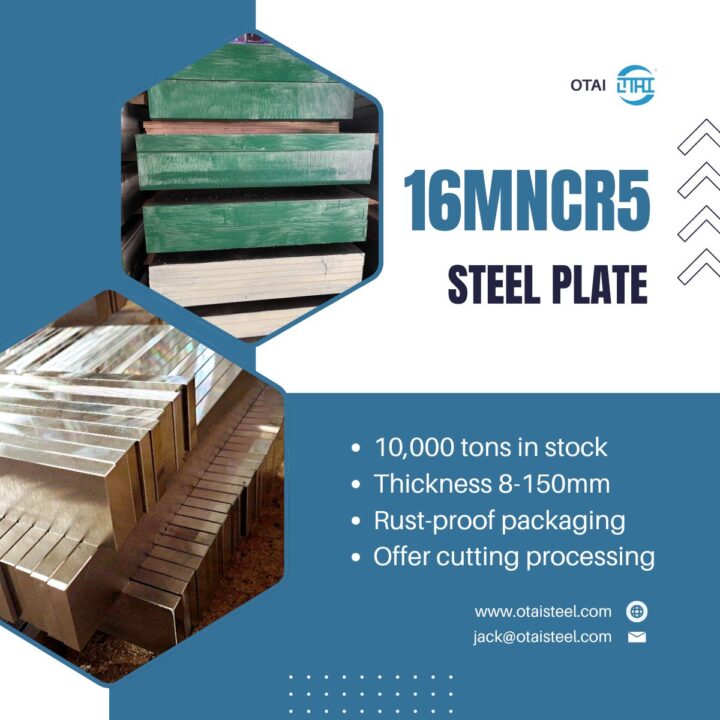
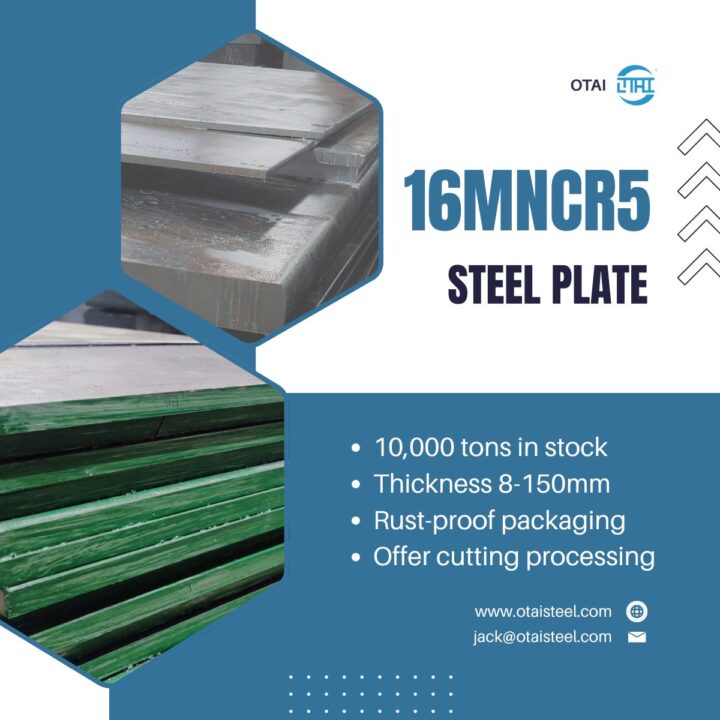
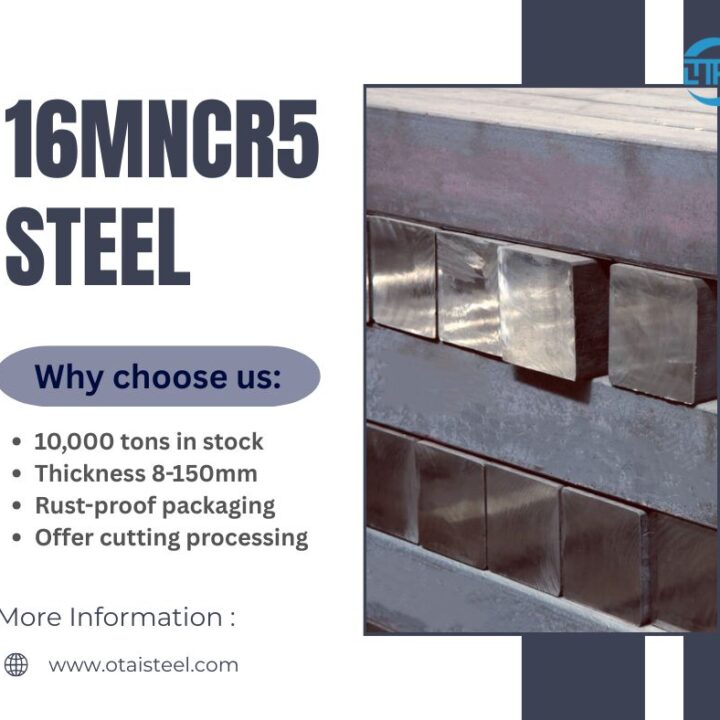
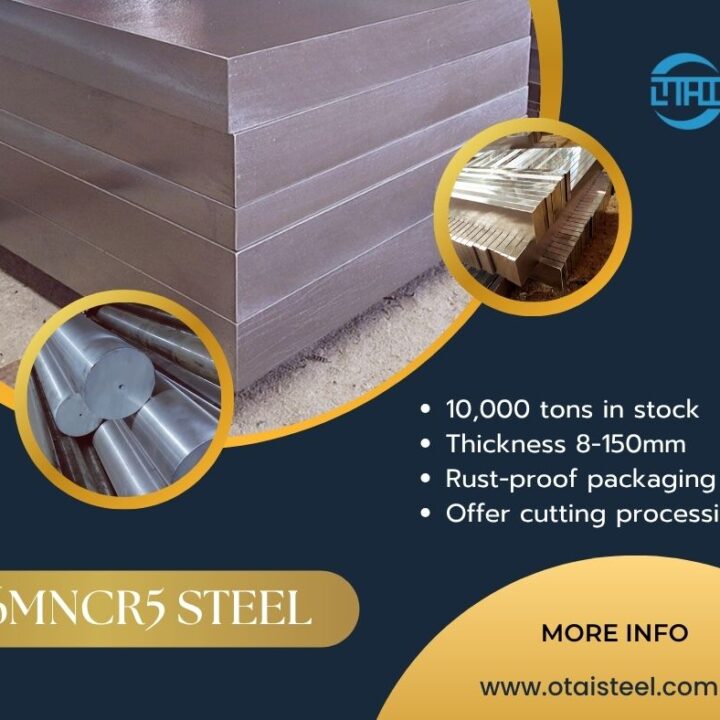
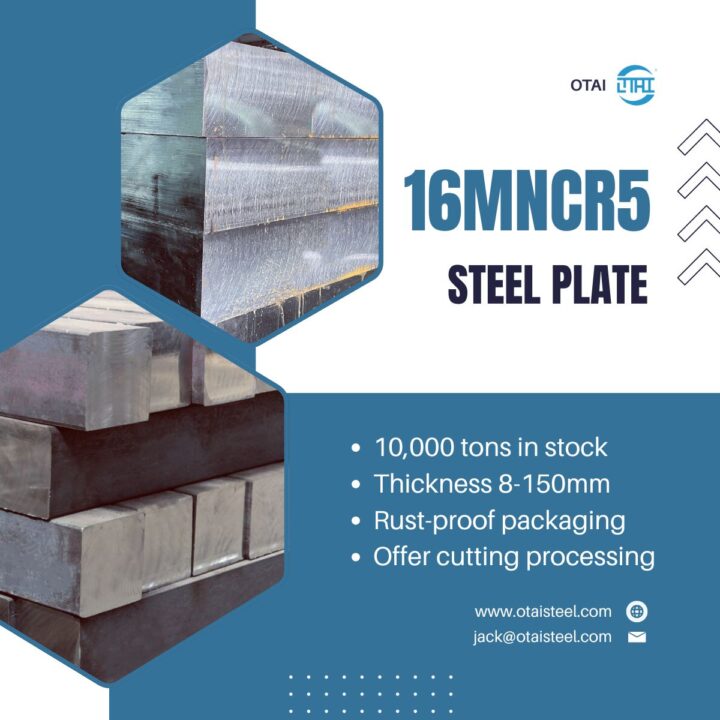
- 16MnCr5 steel plate stock: Otai Special Steel provides 16MnCr5 steel plates with thicknesses of 8–150mm available in stock for different industrial applications.
- Large inventory: We maintain sufficient stock to support projects requiring different dimensions and faster shipment.
- Cutting service: We can arrange precision cutting according to customer drawings and specified dimensions.
- Machining service: Machining can be arranged when customers require customized dimensions or additional processing.
- Heat treatment: Annealing, normalizing, quenching, tempering, and other suitable heat-treatment services can be arranged according to project requirements.
- Quality inspection: Ultrasonic testing and third-party inspection support can be arranged for orders with specific quality requirements.
- Export packaging: Anti-rust packaging, steel strapping, and wooden cases help protect steel products during international transportation.
- International supply experience: Otai Special Steel has experience supplying tool steel and alloy steel to customers with demanding technical requirements, including Fortune Global 500 companies.
If you are sourcing 16MnCr5 steel for gears, shafts, pinions, or other case-hardening components, provide the required dimensions, quantity, material condition, heat-treatment requirements, and inspection standard. Otai Special Steel can help confirm suitable stock and processing options.
❓ 11. Frequently Asked Questions
1. What is the chemical composition of 16MnCr5?
16MnCr5 is a low-carbon manganese-chromium alloy steel. Its typical carbon content is around 0.14–0.19%, with manganese and chromium as the main alloying elements. Exact limits depend on the applicable material standard.
2. What is the carbon percentage of 16MnCr5?
The typical carbon range is approximately 0.14–0.19%. This relatively low carbon level makes the steel suitable for carburizing, after which the surface can achieve much higher carbon concentration and hardness.
3. Why is chromium added to 16MnCr5?
Chromium improves hardenability and contributes to wear resistance. Together with manganese, it helps 16MnCr5 respond effectively to case-hardening processes.
4. Is 16MnCr5 a stainless steel?
No. 16MnCr5 is an alloy case-hardening steel, not stainless steel. Its chromium content is far below the level normally associated with stainless steels, so it does not provide stainless-steel corrosion resistance.
5. What 16MnCr5 products does Otai Special Steel have in stock?
Otai Special Steel provides 16MnCr5 steel plates with thicknesses of 8–150mm available in stock. Cutting, machining, heat treatment, ultrasonic testing, third-party inspection support, and export packaging can also be arranged according to customer requirements.