16MnCr5 Material Supplier: Steel Grade, Stock, Applications and Sourcing Options
📑 Table of Contents
🔍 1. 16MnCr5 Material Supplier: What Should Buyers Look For?
📊 3. 16MnCr5 Chemical Composition and Properties
🔥 4. 16MnCr5 Heat Treatment and Case Hardening
⚙️ 5. 16MnCr5 Material Forms and Stock Availability
🏭 6. 16MnCr5 Applications and Industries
🛠️ 7. How to Choose a Reliable 16MnCr5 Material Supplier
💡 8. Why the Right Supplier Matters for 16MnCr5
🔍 1. 16MnCr5 Material Supplier: What Should Buyers Look For?
Finding the right 16MnCr5 material supplier is not simply about locating the lowest material price. Buyers also need to consider steel grade, product form, dimensions, supply consistency, certification, inspection, and processing capability.
16MnCr5 is a case-hardening alloy steel widely selected for components that need a hard, wear-resistant surface combined with a tougher core. Because the material often enters demanding gear and transmission applications, consistent chemistry and reliable heat-treatment performance are important.
A good supplier should understand the difference between the steel grade supplied in its soft machining condition and the final properties achieved after carburizing and hardening. This distinction becomes especially important when a customer has specific requirements for surface hardness, case depth, or core performance.
Buyers should also confirm whether the supplier can provide the required product form. Depending on the project, this may include round bar, flat bar, plate, square bar, or cut pieces.
| Supplier Factor | Why It Matters |
|---|---|
| Material grade | Ensures the steel matches the engineering specification |
| Product form | Supports different machining and manufacturing processes |
| Dimensions | Reduces additional cutting and material waste |
| Material certification | Helps verify chemical and quality requirements |
| Inspection capability | Provides additional quality control for demanding projects |
| Processing services | Can simplify cutting, heat treatment, and preparation |
| Stock availability | Helps reduce procurement and production delays |
Therefore, the best 16MnCr5 material supplier should offer more than a steel grade name. The supplier should provide a practical combination of material quality, stock, processing, documentation, and technical support.
🧪 2. What Is 16MnCr5 Steel?
16MnCr5 is a low-carbon alloy steel designed primarily for case-hardening applications. It belongs to the family of steels used when engineers need a strong combination of surface hardness and core toughness.
The grade is commonly associated with DIN 1.7131 and EN material specifications. Its relatively low carbon content allows manufacturers to carburize the surface before quenching.
During carburizing, carbon diffuses into the external layer of the component. After quenching, the carbon-enriched surface can develop high hardness, while the core remains comparatively tough.
This structure works particularly well for components that experience repeated contact or surface wear. Gear teeth provide a typical example because their surfaces need high resistance to wear and contact fatigue.
Why 16MnCr5 is different from through-hardening steels
A medium-carbon alloy steel can develop substantial hardness through much of its cross-section after quenching and tempering. 16MnCr5 follows a different strategy.
Its low-carbon composition makes the untreated material easier to machine than a fully hardened component. Manufacturers can then add carbon to the surface during case hardening.
This approach creates a useful hardness gradient. The outside becomes hard and wear resistant, while the interior maintains better toughness.
For this reason, customers should tell their 16MnCr5 material supplier whether they need material for machining, carburizing, or a finished heat-treated component.
| Characteristic | 16MnCr5 |
|---|---|
| Steel type | Case-hardening alloy steel |
| Material number | 1.7131 |
| Carbon level | Low-carbon alloy steel |
| Primary treatment | Carburizing and hardening |
| Surface performance | High hardness and wear resistance after case hardening |
| Core performance | Good toughness after suitable treatment |
| Typical applications | Gears, pinions, shafts, and transmission components |
📊 3. 16MnCr5 Chemical Composition and Properties
Chemical composition determines how 16MnCr5 responds during machining, carburizing, quenching, and subsequent service. The alloy contains carbon, manganese, and chromium as important elements.
| Element | Typical Range / Limit | Main Function |
|---|---|---|
| Carbon (C) | 0.14–0.19% | Supports case hardening and core toughness |
| Silicon (Si) | ≤ 0.40% | Deoxidation and strength contribution |
| Manganese (Mn) | 1.00–1.30% | Improves strength and hardenability |
| Phosphorus (P) | ≤ 0.035% | Controlled to maintain material quality |
| Sulfur (S) | ≤ 0.035% | Influences machinability |
| Chromium (Cr) | 0.80–1.10% | Improves hardenability and case-hardening performance |
The exact chemical requirements depend on the applicable specification and material standard. For a commercial order, the mill test certificate remains the best reference for the actual heat analysis.
16MnCr5 mechanical properties
The mechanical properties of 16MnCr5 depend strongly on the supplied condition and final heat treatment. Engineers should not use one set of mechanical values for every condition.
Before carburizing, manufacturers usually machine the material in a relatively soft condition. After case hardening, the surface and core show very different properties.
This behavior makes the grade especially useful when the component needs both surface durability and internal toughness. A supplier with technical experience can help customers determine the appropriate supply condition before production.
When evaluating 16MnCr5 material properties, always consider the complete manufacturing route rather than looking at chemical composition alone.
🔥 4. 16MnCr5 Heat Treatment and Case Hardening
Heat treatment is central to the performance of 16MnCr5. The steel is specifically designed to respond well to carburizing and subsequent hardening.
The process begins with heating the component in a controlled carburizing environment. Carbon enters the surface and creates a carbon-enriched layer.
After carburizing, the component undergoes quenching. The enriched surface can then transform into a hard martensitic structure.
Tempering normally follows quenching to reduce internal stresses and establish the required final condition. Manufacturers may then grind or finish the component to achieve the required dimensions and surface quality.
| Process | Purpose | Result |
|---|---|---|
| Annealing | Improve machinability | Soft and workable condition |
| Normalizing | Refine structure | More uniform material condition |
| Carburizing | Introduce carbon into the surface | Carbon-enriched case |
| Quenching | Harden the enriched case | High surface hardness |
| Tempering | Reduce quenching stresses | Improved stability and toughness |
Why case depth matters
Surface hardness alone does not fully describe a carburized component. Case depth is equally important because the hardened layer must extend far enough to withstand the expected service loads.
For example, a heavily loaded gear may require a deeper effective case than a smaller component with lighter contact stress.
Therefore, customers should discuss case depth and final hardness with their 16MnCr5 material supplier before placing an order for a demanding application.
⚙️ 5. 16MnCr5 Material Forms and Stock Availability
A reliable 16MnCr5 material supplier should be able to provide the product form that matches the customer’s manufacturing process. Different projects may require bars, plates, flats, squares, or cut pieces.
| Product Form | Typical Use | Processing Advantage |
|---|---|---|
| Round bar | Shafts, pins, gears and machined parts | Suitable for turning and CNC machining |
| Flat bar | Machined blocks and components | Useful for rectangular parts |
| Plate | Industrial components and fabricated parts | Can be cut into customized dimensions |
| Square bar / block | Specialized machined components | Efficient starting shape for machining |
| Cut pieces | Prototype and production components | Reduces additional cutting work |
Why stock matters
Stock availability can directly affect a customer’s production schedule. If the required grade and dimensions are already available, buyers may avoid long manufacturing lead times for standard sizes.
However, stock should always be confirmed before an order because inventory changes continuously. A professional supplier should provide current information about dimensions, quantity, condition, and delivery.
For customers purchasing 16MnCr5 steel bar from a supplier, it is also useful to confirm whether the bar is hot rolled, forged, peeled, ground, or supplied in another surface condition.
The same principle applies to plates and cut pieces. Clear dimensional requirements help the supplier identify the most efficient supply option.
🏭 6. 16MnCr5 Applications and Industries
16MnCr5 is particularly useful for components that combine repeated surface loading with a need for core toughness. The automotive, machinery, power transmission, and general engineering sectors can use this type of case-hardening steel.
| Application | Reason for Using 16MnCr5 |
|---|---|
| Gears | Hard surface and tough core after carburizing |
| Pinions | Good resistance to contact wear |
| Transmission components | Suitable for repeated mechanical loading |
| Shafts | Useful for selected case-hardened shaft designs |
| Pins | Improved surface wear resistance |
| Bushings | Hard surface supports sliding and contact conditions |
| Automotive components | Suitable for selected drive and transmission parts |
16MnCr5 for gears
Gears are one of the most important applications for this grade. Gear teeth experience contact stress on their working surfaces and bending stress near the tooth root.
A carburized surface helps resist wear and contact fatigue. Meanwhile, the tougher core helps the gear tolerate impact and bending loads.
16MnCr5 for transmission components
Transmission parts often operate under cyclic loading. Repeated engagement, torque changes, and surface contact can gradually damage an unsuitable material.
The case-hardening characteristics of 16MnCr5 make it attractive for these conditions. Still, engineers should consider component geometry, load, lubrication, case depth, and final heat treatment before making the final material decision.
A knowledgeable 16MnCr5 material supplier can help match the available product form and material condition to the intended application.
🛠️ 7. How to Choose a Reliable 16MnCr5 Material Supplier
Supplier selection becomes more important when 16MnCr5 is part of a high-volume or high-performance manufacturing process. A supplier should provide clear technical information before the customer commits to an order.
Check the material standard
Confirm the required designation and applicable standard. 16MnCr5 is commonly identified as 1.7131, but the exact purchasing specification should match the customer’s drawings and technical documentation.
Check the mill test certificate
The certificate provides important information about the actual supplied heat. Buyers can use it to verify chemical composition and other specified inspection results.
Check product dimensions
Dimensions influence both material utilization and production cost. A supplier with multiple stock sizes can often provide a more practical starting material.
Ask about cutting and processing
Cutting services can save time when customers require fixed lengths or specific plate dimensions. Additional processing may also simplify the customer’s production workflow.
Confirm heat-treatment requirements
If the final component requires carburizing, quenching, tempering, or another treatment, discuss these requirements before purchasing. The supplier should understand whether the customer needs soft material for machining or finished material for direct use.
| Question to Ask | Why It Is Important |
|---|---|
| What standard does the material meet? | Confirms compatibility with the specification |
| What sizes are currently available? | Helps plan production and reduce lead time |
| Is a mill test certificate available? | Supports traceability and quality verification |
| Can the material be cut? | Provides customized dimensions |
| Can heat treatment be arranged? | Simplifies the purchasing process |
| Can inspection be arranged? | Supports demanding quality requirements |
| How is the steel packaged? | Helps protect material during transportation |
These questions help separate a simple trader from a capable 16MnCr5 material supplier that can support the complete procurement process.
💡 8. Why the Right Supplier Matters for 16MnCr5
Choosing the right supplier can influence more than the purchase order. Material quality affects machining, heat treatment, final dimensions, component performance, and production consistency.
For example, inconsistent material chemistry can create unexpected differences during carburizing and quenching. Poor dimensional control can also increase machining allowance and material waste.
Reliable documentation provides another advantage. With proper traceability, customers can connect the delivered material to the relevant heat and inspection records.
Processing support can make the purchasing process even easier. A supplier that can coordinate cutting, heat treatment, inspection, and packaging gives customers a single point of contact.
| Customer Requirement | Supplier Capability to Consider |
|---|---|
| Small production batches | Flexible cutting and quantity support |
| Large production orders | Stable stock and supply capacity |
| Precision machining | Suitable surface condition and dimensional control |
| Gear manufacturing | Material certification and heat-treatment support |
| International shipping | Export packaging and documentation |
| Strict quality requirements | Ultrasonic and third-party inspection options |
For buyers searching for a 16MnCr5 steel supplier, the best choice is therefore the supplier that can meet the complete project requirement rather than only quote a grade.
Before sending an inquiry, prepare the material grade, product form, dimensions, quantity, supply condition, heat-treatment requirement, inspection standard, and delivery destination. This information allows the supplier to respond more accurately.
If you need 16MnCr5 for gears, shafts, pins, or other case-hardened components, selecting a supplier with suitable stock and processing experience can make the sourcing process much more efficient.
📦 9. Otai Special Steel Advantages
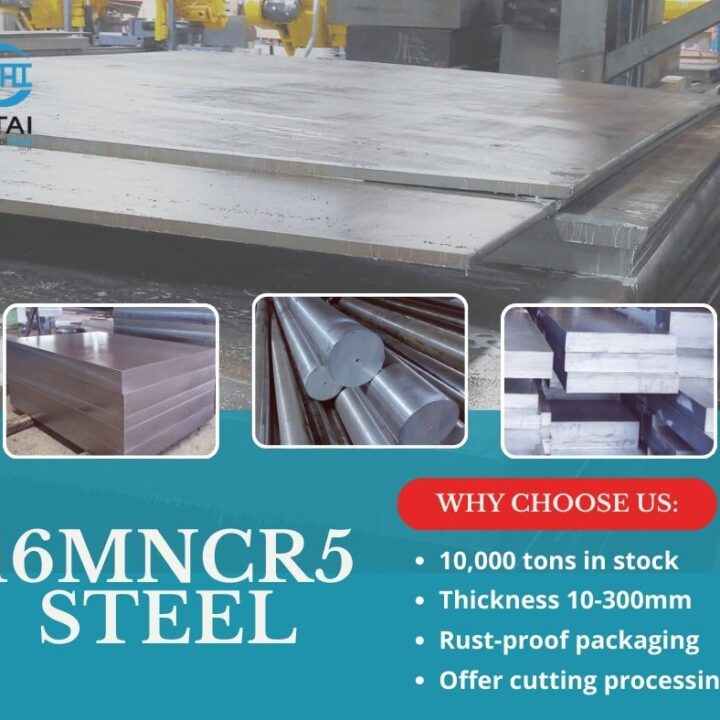
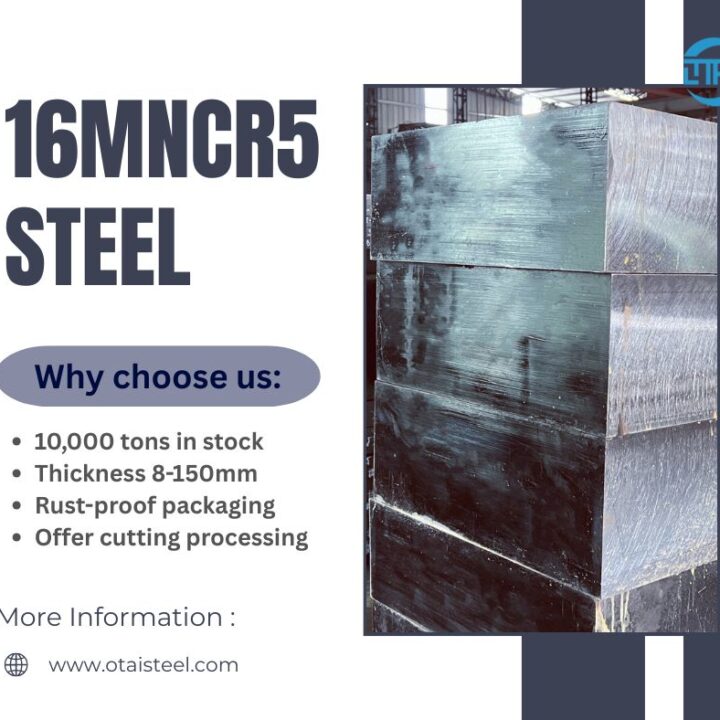
- 16MnCr5 steel plate stock: Otai Special Steel keeps 16MnCr5 steel plates in 8–150mm thicknesses available in stock for different machining and industrial applications.
- Different dimensions: We can supply different thicknesses, widths, and lengths according to project requirements.
- Cutting service: We can arrange cutting according to customer drawings and specified dimensions.
- Heat treatment: Annealing, normalizing, quenching, tempering, carburizing, and other heat-treatment services can be arranged according to requirements.
- Quality inspection: Ultrasonic testing and third-party inspection can be arranged for orders with specific quality requirements.
- Export packaging: Steel strapping, wooden cases, and anti-rust packaging help protect steel products during international transportation.
- International supply experience: Otai Special Steel has supplied steel products to customers with demanding technical requirements, including Fortune Global 500 companies.
If you are looking for a 16MnCr5 material supplier for a specific project, provide the required dimensions, quantity, material condition, heat-treatment requirements, and inspection standards. Otai Special Steel can help confirm suitable stock and processing options.
❓ 10. Frequently Asked Questions
1. What is 16MnCr5 used for?
16MnCr5 is mainly used for case-hardened components such as gears, pinions, shafts, pins, bushings, and transmission parts. Its low-carbon alloy composition supports carburizing and helps create a hard surface with a tougher core.
2. What is the equivalent of 16MnCr5?
16MnCr5 is commonly identified with material number 1.7131. It is also associated with AISI/SAE 5115 in some cross-reference systems. Exact equivalence should be verified against the applicable standard and customer specification.
3. What should I ask a 16MnCr5 material supplier before ordering?
Ask about the material standard, product form, dimensions, available stock, supply condition, mill test certificate, cutting service, heat treatment, inspection options, packaging, and delivery time.
4. Can 16MnCr5 be supplied as steel plate?
Yes. 16MnCr5 can be supplied in plate and other product forms depending on the supplier’s stock and production capability. Otai Special Steel keeps 16MnCr5 steel plates in 8–150mm thicknesses available in stock.
5. Why choose Otai as a 16MnCr5 material supplier?
Otai Special Steel provides 16MnCr5 steel plates in 8–150mm thicknesses available in stock, along with cutting, heat treatment, inspection, and export packaging services. We can also support different dimensions according to project requirements.