 16MnCr5 QT: Heat-Treated Properties, Hardness and Industrial Uses
📑 Table of Contents
🔍 1. What Does 16MnCr5 QT Mean?
🔥 2. 16MnCr5 QT Heat Treatment and Metallurgical Condition
⚙️ 3. Chemical Composition and Mechanical Properties
🛡️ 4. 16MnCr5 QT Hardness and Strength
⚔️ 5. 16MnCr5 QT vs Carburized 16MnCr5
🛠️ 6. Machinability, Welding and Processing
🏭 7. Applications of 16MnCr5 QT
📌 8. Is 16MnCr5 QT Right for Your Project?
🔍 1. What Does 16MnCr5 QT Mean?
16MnCr5 QT combines the steel grade 16MnCr5 with a specific heat-treated delivery condition. The term “QT” normally refers to quenched and tempered.
16MnCr5 is a low-carbon alloy case-hardening steel commonly associated with EN 10084. Its chemical composition gives it good carburizing potential, while the relatively low carbon content helps maintain a tougher core after case hardening.
When a supplier describes material as 16MnCr5 QT, the QT designation indicates that the material has undergone a quenching and tempering treatment. However, buyers should confirm the exact delivery condition and mechanical requirements on the material certificate because supply practices can vary.
This point matters because 16MnCr5 is traditionally known for case hardening. Carburizing creates a carbon-enriched surface that can become very hard after hardening, while the core remains comparatively tough.
A QT condition is different. Quenching and tempering changes the overall microstructure and mechanical properties of the material without automatically creating the deep, high-carbon hardened case associated with carburizing.
| Term | Meaning | Main Purpose |
|---|---|---|
| 16MnCr5 | Low-carbon alloy case-hardening steel | Good combination of machinable core and hardenable surface |
| QT | Quenched and tempered | Improve strength, hardness and toughness |
| Carburizing | Carbon enrichment of the surface | Create a hard wear-resistant case |
| Quenching | Rapid cooling after heating | Increase hardness through microstructural transformation |
| Tempering | Controlled reheating after quenching | Reduce brittleness and adjust hardness and toughness |
Why the “QT” Designation Matters
The same steel grade can show very different mechanical properties depending on its delivery condition. A buyer who needs 16MnCr5 quenched and tempered steel should therefore specify the required heat-treatment condition instead of ordering only the grade name.
For example, an engineer may require a particular hardness range, tensile strength, yield strength, or impact performance. These requirements determine whether a QT condition is suitable.
In addition, the final application matters. A shaft that needs uniform mechanical strength may use a different treatment strategy from a gear that requires a very hard wear-resistant surface.
Therefore, 16MnCr5 QT should not automatically be treated as the same material condition as carburized 16MnCr5. The two processes produce different property profiles.
For buyers researching 16MnCr5 QT meaning, the simplest explanation is: 16MnCr5 identifies the steel grade, while QT identifies a quenched-and-tempered heat-treatment condition.
🔥 2. 16MnCr5 QT Heat Treatment and Metallurgical Condition
The QT condition begins with heating the steel to a suitable austenitizing temperature. The material then undergoes controlled quenching, followed by tempering at a lower temperature.
The purpose of this sequence is not simply to make the steel as hard as possible. Instead, engineers adjust the process to achieve a useful balance between hardness, strength, ductility and toughness.
| Heat Treatment Stage | What Happens | Effect on 16MnCr5 |
|---|---|---|
| Heating / Austenitizing | The steel reaches a suitable temperature for structural transformation | Prepares the microstructure for hardening |
| Quenching | The heated steel cools rapidly | Increases hardness and strength |
| Tempering | The quenched steel is reheated under controlled conditions | Improves toughness and reduces excessive brittleness |
| Cooling | The tempered material cools under controlled conditions | Stabilizes the final mechanical condition |
Quenching: Building the Harder Structure
During quenching, the steel cools rapidly enough to suppress some of the equilibrium transformations that would occur during slow cooling. This promotes the formation of harder transformation products, including martensitic structures depending on the section size and treatment conditions.
However, the cooling rate does not act independently. Section thickness, alloy composition, quenching medium and equipment all influence the final hardness distribution.
This is particularly important for larger components. The surface may cool faster than the center, which can produce differences in microstructure and hardness across the section.
Tempering: Balancing Hardness and Toughness
Freshly quenched steel can contain high internal stresses and excessive brittleness. Tempering reduces these problems by allowing controlled microstructural changes.
The selected tempering temperature has a strong influence on the final properties. A lower tempering temperature generally retains more hardness, while a higher tempering temperature can increase toughness and reduce hardness.
For this reason, 16MnCr5 QT heat treatment should always match the actual service requirements of the component.
Why Section Size Matters
Heat treatment does not produce exactly the same result throughout every steel section. Thick components cool more slowly at the center than at the surface.
The alloying elements in 16MnCr5 improve hardenability, but engineers still need to consider section dimensions when defining a QT specification.
For industrial buyers, this means that a hardness value without a specified test location may not tell the complete story. Material thickness, heat-treatment parameters and testing method should form part of the purchasing specification.
This becomes especially important when ordering thick 16MnCr5 QT plates for machining into large mechanical components.
⚙️ 3. Chemical Composition and Mechanical Properties
The chemical composition of 16MnCr5 explains why the grade works well as a case-hardening steel. Its relatively low carbon content supports a tougher core, while manganese and chromium contribute to hardenability.
| Element | Typical 16MnCr5 Range | Main Role |
|---|---|---|
| Carbon (C) | Approx. 0.14–0.19% | Supports hardenability and case-hardening response |
| Silicon (Si) | Approx. ≤0.40% | Deoxidation and alloy strengthening |
| Manganese (Mn) | Approx. 1.00–1.30% | Improves hardenability and strength |
| Chromium (Cr) | Approx. 0.80–1.10% | Improves hardenability and wear-related performance |
| Phosphorus (P) | Controlled low level | Kept low to maintain material quality |
| Sulfur (S) | Controlled level | Managed according to the applicable specification |
How Composition Supports the QT Condition
The relatively low carbon content distinguishes 16MnCr5 from many medium-carbon engineering steels. The grade can develop a strong surface after carburizing while maintaining a more ductile core.
Chromium and manganese increase hardenability. These elements help the material respond to cooling during heat treatment and support more consistent mechanical properties than a simple low-carbon steel would provide.
For a 16MnCr5 QT material supplier, controlling the chemical composition is therefore essential. The heat-treatment process cannot compensate for material chemistry that falls outside the required specification.
Mechanical Properties Depend on the Condition
It is important not to assign one universal tensile strength or hardness value to every 16MnCr5 product. Mechanical properties depend on the delivery condition, section size, heat treatment and applicable standard.
A QT product can achieve a different property profile from annealed or normalized 16MnCr5. Likewise, a carburized component can show extremely different surface hardness from the original steel before carburizing.
| Material Condition | Typical Property Focus | Common Reason for Selection |
|---|---|---|
| Annealed | Lower hardness and good machinability | Machining and forming preparation |
| Normalized | Refined and more uniform structure | General mechanical preparation |
| Quenched and tempered | Higher strength with controlled toughness | Mechanical components requiring improved strength |
| Carburized and hardened | Very hard surface with tougher core | Gears, pinions and wear-resistant components |
Therefore, buyers should specify both the 16MnCr5 steel grade and the required material condition. This approach reduces the risk of receiving a material that has the correct chemistry but does not meet the mechanical requirements of the finished component.
When a project specifies QT material, the purchase order should clearly state the required standard, dimensions, heat-treatment condition, mechanical properties, inspection requirements and certification.
🛡️ 4. 16MnCr5 QT Hardness and Strength
Hardness is one of the most important factors when evaluating 16MnCr5 QT. However, the final hardness does not come from the steel grade alone. Heat-treatment parameters, section size, cooling conditions and tempering temperature all affect the result.
Quenching increases the hardness of 16MnCr5 by promoting harder transformation products. Tempering then adjusts the final balance between hardness and toughness.
This makes QT treatment useful when a component needs stronger mechanical performance throughout the material rather than only a hardened surface.
| Property | Effect of Quenching | Effect of Tempering |
|---|---|---|
| Hardness | Strong increase | Usually decreases as tempering temperature increases |
| Tensile strength | Strong increase | Can be adjusted through tempering |
| Toughness | May decrease after aggressive quenching | Generally improves with appropriate tempering |
| Internal stress | Can increase | Tempering helps reduce it |
| Wear resistance | Can improve through higher hardness | Depends on the final hardness and microstructure |
What Hardness Can 16MnCr5 QT Reach?
There is no single hardness value that applies to every 16MnCr5 QT hardness specification. The result depends strongly on the actual heat-treatment route.
For this reason, buyers should avoid selecting the material based only on the nominal grade. A more reliable specification includes the required hardness range, test method and test location.
For example, a thin section may cool much faster during quenching than a thick section. The center of a thick plate can therefore show a different microstructure from the surface.
The tempering temperature also changes the final result. Lower tempering temperatures generally retain higher hardness, while higher tempering temperatures normally provide greater toughness and lower hardness.
Hardness vs Toughness: Finding the Balance
A harder material is not automatically a better material. Excessive hardness can reduce toughness and increase the risk of cracking under impact or sudden loading.
That is why the purpose of tempering matters. Engineers select the treatment according to the expected stress, impact, wear and fatigue conditions.
For demanding mechanical components, the best 16MnCr5 quenched and tempered condition is usually the one that provides a practical balance rather than the maximum possible hardness.
When a component requires an extremely hard wear-resistant surface, carburizing may provide a better solution. When the component needs more uniform bulk strength, QT treatment can be more appropriate.
⚔️ 5. 16MnCr5 QT vs Carburized 16MnCr5
One of the most important distinctions for buyers is the difference between 16MnCr5 QT vs carburized 16MnCr5. Both conditions use the same steel grade, but they create very different property profiles.
QT treatment hardens the material through quenching and tempering. Carburizing adds carbon to the surface before hardening, producing a hard case while keeping the core relatively tough.
| Feature | 16MnCr5 QT | Carburized 16MnCr5 |
|---|---|---|
| Main treatment | Quenching + tempering | Carburizing + hardening + tempering |
| Hardness distribution | More uniform through the section | Very high surface hardness with a tougher core |
| Surface wear resistance | Good depending on final hardness | Very high |
| Core toughness | Depends on QT parameters | Designed to retain a tougher core |
| Typical application | General high-strength mechanical parts | Gears, pinions, shafts and wear-loaded components |
| Case depth | No carburized case | Controlled carburized layer |
When Should You Choose QT?
Choose the QT condition when the component needs improved bulk mechanical properties and does not require an extremely hard carburized surface.
This approach can work well for components that experience tensile loads, bending, torsion or general mechanical stress.
For example, a mechanical shaft may benefit from a controlled QT condition when the design requires strength throughout the section rather than a very hard surface layer.
When Is Carburizing Better?
Carburizing becomes more attractive when surface wear and contact fatigue dominate the application.
Gears provide a good example. Gear teeth experience repeated contact stress and sliding. A hard surface can resist wear and contact fatigue, while the tougher core helps absorb mechanical loads.
This is one reason 16MnCr5 has such a strong connection with gear manufacturing.
Therefore, 16MnCr5 QT vs carburized steel should not be viewed as a simple “better or worse” comparison. The two treatments solve different engineering problems.
🛠️ 6. Machinability, Welding and Processing
The manufacturing condition of 16MnCr5 strongly affects machining performance. Annealed material generally offers easier machining than hardened QT material.
When the material receives quenching and tempering, its higher hardness increases cutting forces and tool wear. Manufacturers therefore need to select suitable tooling and cutting parameters.
| Processing Stage | Typical Consideration |
|---|---|
| Annealed condition | Generally favorable for machining |
| Before heat treatment | Often preferred for major machining operations |
| After quenching | High hardness can make machining difficult |
| After tempering | Machinability depends on final hardness |
| Grinding | Useful for achieving accurate dimensions after hardening |
Machining 16MnCr5 QT
If a component requires tight dimensional tolerances, manufacturers often plan the production sequence carefully. Major material removal can take place before final heat treatment, followed by finishing operations after hardening.
Grinding may become necessary when the final hardness makes conventional cutting difficult or when the component requires high dimensional accuracy.
For buyers sourcing 16MnCr5 QT material, it is therefore useful to clarify whether the material will arrive ready for machining or already heat treated for final assembly.
Welding Considerations
Welding 16MnCr5 requires more attention than welding simple low-carbon structural steel. Its alloy content and carbon level can increase the risk of hard microstructures and cracking in the heat-affected zone.
Preheating, controlled heat input and suitable post-weld procedures may become necessary depending on section thickness and the welding process.
Welding requirements should therefore be established before production begins, especially when working with QT material.
Cutting and Surface Processing
Flame cutting and other thermal cutting processes can locally change the microstructure near the cut edge. For precision components, manufacturers may leave machining allowance and remove the affected material during subsequent processing.
The exact procedure should depend on the plate thickness, required tolerance, final heat-treatment condition and component design.
🏭 7. Applications of 16MnCr5 QT
The combination of alloy hardenability and heat-treatment flexibility makes 16MnCr5 useful for a wide range of mechanical applications. The exact application depends on whether the project needs bulk strength, surface hardness, machinability or a combination of these properties.
| Application | Why 16MnCr5 Can Be Suitable |
|---|---|
| Mechanical shafts | Good strength and toughness after suitable treatment |
| Gear components | Excellent case-hardening potential |
| Pinions | Good combination of surface durability and core properties |
| Machine components | Useful balance of strength and machinability |
| Transmission components | Suitable for demanding mechanical loads |
| Wear-loaded components | Can achieve higher hardness through appropriate treatment |
Automotive and Transmission Components
16MnCr5 has long been associated with automotive and transmission applications because its low-carbon alloy chemistry supports case hardening.
Gears and transmission components often need a hard surface to resist repeated contact while retaining sufficient core toughness. Carburized 16MnCr5 can address this requirement effectively.
A QT condition, however, may be selected when the engineering design calls for improved bulk mechanical properties instead of a carburized case.
Industrial Machinery
Industrial machinery can use 16MnCr5 for shafts, mechanical components, gear-related parts and other parts that require controlled strength and hardness.
The final treatment should always match the loading conditions. A component exposed to repeated contact stress may need a different treatment from a component exposed mainly to tensile or bending loads.
Why Material Condition Matters
The phrase 16MnCr5 QT applications should therefore be interpreted together with the actual heat-treatment specification.
A supplier may provide the same nominal steel grade in different conditions. The customer should clearly define whether the material requires annealing, normalizing, QT treatment, carburizing or another condition.
This approach helps prevent problems later in the manufacturing process. It also makes it easier for the steel supplier and end user to verify the material certificate against the purchasing specification.
📌 8. Is 16MnCr5 QT Right for Your Project?
Selecting 16MnCr5 QT starts with the component’s actual service conditions. The most important question is whether the design needs higher bulk strength or a hardened surface.
| Project Requirement | Potential Choice | Reason |
|---|---|---|
| Higher bulk strength | 16MnCr5 QT | Quenching and tempering improve overall mechanical properties |
| High surface hardness | Carburized 16MnCr5 | Creates a hard carbon-enriched surface |
| Good machinability before final treatment | Annealed 16MnCr5 | Lower hardness makes machining easier |
| Controlled structure before machining | Normalized 16MnCr5 | Provides a refined and relatively uniform structure |
| High wear resistance | Carburized and hardened 16MnCr5 | Hard surface improves resistance to contact wear |
Check the Material Certificate
For industrial purchasing, the material certificate provides important information about the supplied product. Buyers should check the chemical composition, mechanical properties, heat-treatment condition, dimensions and inspection requirements.
If the project requires 16MnCr5 QT hardness, the required hardness range should appear clearly in the technical specification rather than relying on the grade name alone.
Consider Thickness and Section Size
Thickness can influence the final result of heat treatment because cooling rates vary between the surface and center of a section.
For this reason, buyers ordering thicker 16MnCr5 QT steel plates should discuss the required hardness and mechanical properties with the supplier before production.
Match the Treatment to the Failure Mode
If wear at the surface represents the main concern, carburizing may offer a stronger solution. If the component needs improved strength through the material, QT treatment may be more appropriate.
The best material choice is therefore not simply the one with the highest hardness. Instead, engineers should consider load, impact, wear, fatigue, machining, dimensions and operating environment together.
This approach makes 16MnCr5 QT a useful option for applications where controlled heat treatment and mechanical performance matter more than extreme surface hardness alone.
📦 9. Otai Special Steel Advantages
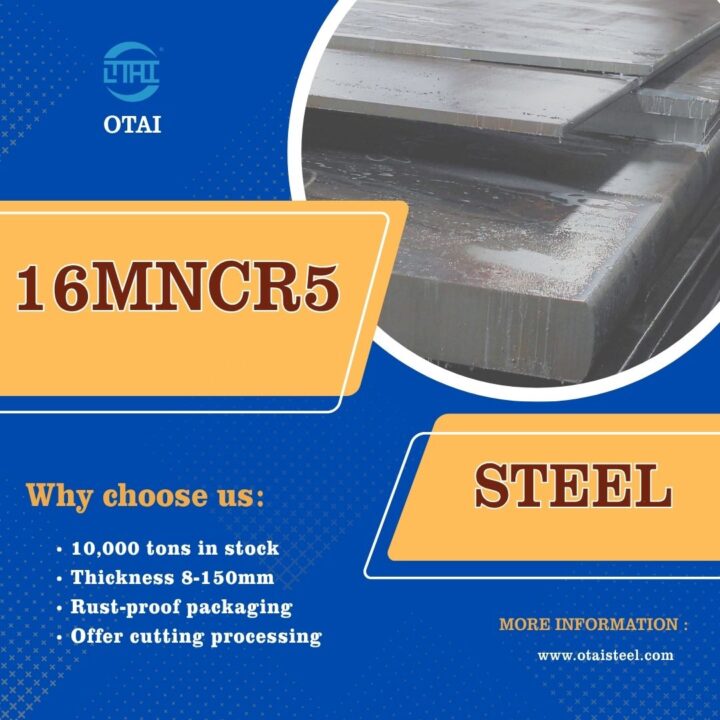
Otai Special Steel supplies 16MnCr5 steel for customers in automotive, gear manufacturing, machinery, transmission and industrial applications. We focus on stable material quality, flexible processing and reliable international supply.
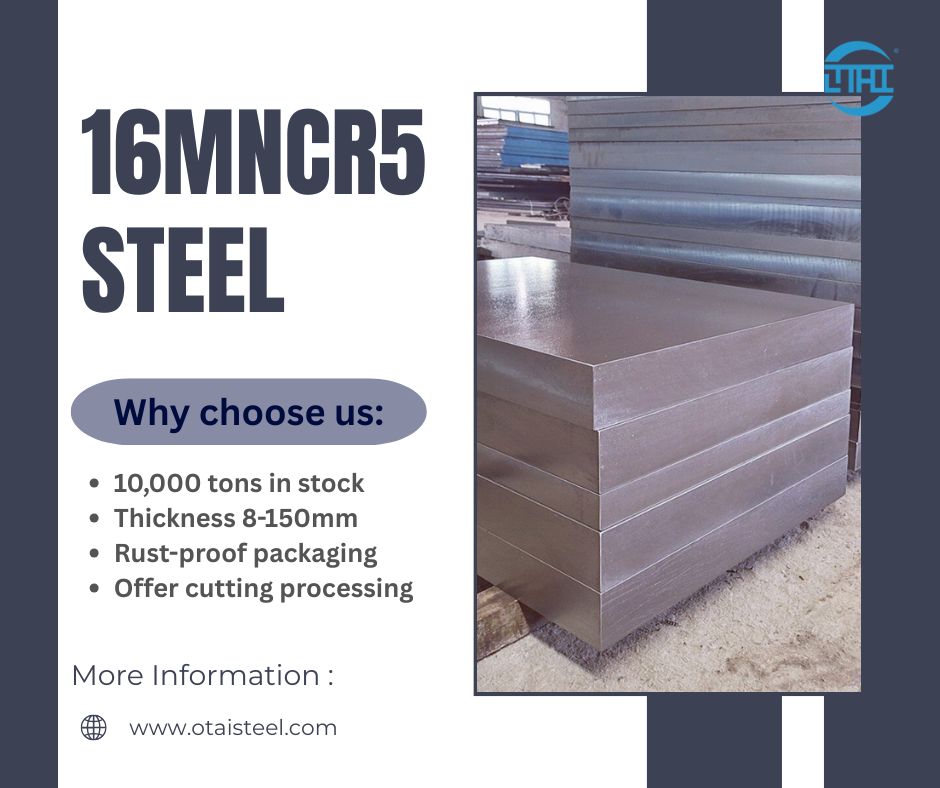
- 16MnCr5 plate stock: We maintain 8–150mm thickness plates in stock, helping customers reduce waiting time for regular and urgent requirements.
- Cutting services: We can cut 16MnCr5 plates according to customer dimensions and project requirements.
- Heat treatment support: We can provide processing support for different material conditions and heat-treatment requirements.
- Quality inspection: Ultrasonic testing and third-party inspection can be arranged when projects require additional quality verification.
- Processing and packaging: We provide cutting, anti-rust protection, steel strapping and wooden box packaging for international shipments.
- International supply experience: We have supplied steel materials to customers with demanding technical requirements, including Fortune Global 500 companies.
For customers sourcing 16MnCr5 QT, it is important to specify the required dimensions, heat-treatment condition, hardness, mechanical properties and inspection requirements before placing an order. This allows the supplier to prepare the material according to the actual application.
❓ 10. FAQ About 16MnCr5 QT
1. What does QT mean in 16MnCr5 QT?
QT normally means quenched and tempered. The 16MnCr5 grade identifies the steel chemistry, while QT describes a heat-treated delivery condition involving quenching followed by tempering. Buyers should confirm the exact treatment and mechanical requirements on the material certificate.
2. Is 16MnCr5 QT the same as carburized 16MnCr5?
No. Quenching and tempering and carburizing create different material conditions. QT mainly improves the overall mechanical properties of the steel, while carburizing enriches the surface with carbon and can create a very hard wear-resistant case with a tougher core.
3. What hardness can 16MnCr5 QT reach?
There is no single hardness value for every 16MnCr5 QT product. Final hardness depends on the quenching process, section size, cooling conditions and tempering temperature. Buyers should specify the required hardness range and test method when ordering the material.
4. Is 16MnCr5 suitable for gears?
Yes. 16MnCr5 is widely associated with gear and transmission applications because its low-carbon alloy chemistry provides good case-hardening potential. Carburized 16MnCr5 can develop a hard surface and tougher core, making it suitable for many gears and pinions.
5. Where can I buy 16MnCr5 steel?
Otai Special Steel supplies 16MnCr5 steel plates for international industrial customers. We have 8–150mm thickness plates available in stock and can provide cutting, heat-treatment support, inspection, anti-rust protection and export packaging according to project requirements.