 16MnCr5 Alternative: Comparing the Best Case-Hardening Steel Options
📑 Table of Contents
🔍 1. What Does 16MnCr5 Alternative Mean?
🧪 2. Why Look for an Alternative to 16MnCr5?
📊 3. The Best Alternatives to 16MnCr5
🌎 5. 16MnCr5 Alternatives in International Standards
🔥 6. Choosing an Alternative Based on Heat Treatment
🏭 7. Practical Applications and Material Selection
🔍 1. What Does 16MnCr5 Alternative Mean?
When buyers search for a 16MnCr5 alternative, they usually need a steel grade that can replace 16MnCr5 in a case-hardening application. However, an alternative does not always mean an exact chemical equivalent.
16MnCr5 is a low-carbon alloy case-hardening steel. It contains manganese and chromium as its main alloying elements. The steel develops a hard, wear-resistant surface after carburizing while maintaining a tougher core.
This combination makes 16MnCr5 popular for gears, shafts, pins, bushes, cams and other components exposed to wear, contact stress and repeated mechanical loads.
The right alternative should therefore provide a similar response during machining, carburizing, quenching and tempering. It should also provide suitable surface hardness and core toughness for the finished component.
Common alternatives include 20MnCr5, SAE 5115 and, for certain demanding applications, SAE 8620. These grades do not have identical chemistry. Instead, engineers select them according to the required performance and applicable standard.
| Material | Designation | Type | Relationship to 16MnCr5 |
|---|---|---|---|
| 16MnCr5 | 1.7131 | Case-hardening steel | Reference grade |
| 20MnCr5 | 1.7147 | Case-hardening steel | Close European alternative |
| SAE 5115 | G51150 | Case-hardening steel | Potential U.S. alternative |
| SAE 8620 | UNS G86200 | Ni-Cr-Mo case-hardening steel | Higher-alloy alternative for selected applications |
The key difference is between an equivalent and an alternative. An equivalent aims to stay close to the original chemistry and standard. An alternative may use different alloying elements while achieving similar functional performance.
That distinction matters when selecting steel for safety-critical components. A material substitution should always consider the complete manufacturing route rather than a simple grade-to-grade comparison.
🧪 2. Why Look for an Alternative to 16MnCr5?
There are several practical reasons to search for a 16MnCr5 alternative. Availability often comes first. A drawing may specify 16MnCr5, but the buyer may need to purchase the material under another national standard.
Product availability also matters. Some suppliers stock bars and forgings but have limited plate sizes. Other suppliers may have the required thickness but not the width or length needed for the project.
A second reason involves performance. A heavy-duty transmission component may require deeper hardening or greater core strength. In such cases, an alternative with a different alloy system may provide a better solution.
A third reason is supply-chain flexibility. International manufacturers often work with European, American, Japanese or Chinese material standards. An approved alternative can make sourcing easier when the original grade becomes difficult to obtain.
The Alternative Must Match the Function
Do not select a replacement only because two grades appear next to each other in an equivalence chart. A component may depend on a specific combination of surface hardness, case depth, core strength, toughness and dimensional stability.
For example, a small gear and a large transmission gear can both use case-hardening steel. Yet their mechanical requirements may differ considerably. The larger gear may require better hardenability and a deeper hardened zone.
Before approving a replacement, compare these factors:
- Chemical composition.
- Carbon content.
- Manganese and chromium content.
- Hardenability.
- Carburized case depth.
- Surface hardness after heat treatment.
- Core strength and toughness.
- Machinability before carburizing.
- Applicable material standard.
- Requirements on the engineering drawing.
This approach helps engineers avoid a common mistake: choosing a steel that looks similar on paper but behaves differently during heat treatment.
For critical components, the engineering team should also validate the substitute through heat-treatment trials or qualification testing before full-scale production.
📊 3. The Best Alternatives to 16MnCr5
There is no single best 16MnCr5 alternative for every application. The correct choice depends on the country, material standard, component size, loading conditions and heat-treatment process.
| Alternative | Designation | Main Advantage | Typical Application |
|---|---|---|---|
| 20MnCr5 | 1.7147 | Higher carbon and alloy content | Gears and higher-load components |
| SAE 5115 | G51150 | Useful U.S. case-hardening grade | Gears, shafts and carburized parts |
| SAE 8620 | G86200 | Higher-alloy Ni-Cr-Mo system | Heavy-duty gears and transmission parts |
| SCr415 | JIS G4053 | Japanese Cr case-hardening grade | Carburized mechanical components |
| 16MC5 | AFNOR | Related French case-hardening designation | Carburized components |
20MnCr5: A Close European Alternative
20MnCr5 is one of the first grades engineers should consider when they need a replacement within the European case-hardening steel family.
Its carbon, manganese and chromium levels differ slightly from 16MnCr5. These differences can influence hardenability and core properties after carburizing and quenching.
Therefore, 20MnCr5 as a 16MnCr5 alternative can work well for many applications, but engineers should still verify the heat-treatment requirements.
SAE 5115: A Practical U.S. Option
SAE 5115 belongs to the U.S. family of case-hardening steels and can be considered when a project requires an American material designation.
It can be suitable for components that require a carburized surface and a tougher core. However, buyers should compare the exact chemical limits and mechanical requirements of the applicable SAE specification before approving the substitution.
SAE 8620: A Higher-Alloy Alternative
SAE 8620 contains nickel, chromium and molybdenum. Its alloy system can provide higher hardenability than simpler manganese-chromium case-hardening grades.
For this reason, 8620 as an alternative to 16MnCr5 can be attractive for larger or more heavily loaded components that require deeper hardening.
However, SAE 8620 is not a direct chemical equivalent of 16MnCr5. Engineers should treat it as a performance-based alternative and review the complete heat-treatment process.
⚙️ 4. 16MnCr5 vs 20MnCr5
The comparison between 16MnCr5 and 20MnCr5 deserves special attention because both grades belong to the European case-hardening steel family and share many applications.
| Composition | 16MnCr5 | 20MnCr5 |
|---|---|---|
| Carbon (C) | 0.14–0.19% | 0.17–0.22% |
| Silicon (Si) | 0.15–0.40% | 0.15–0.40% |
| Manganese (Mn) | 1.00–1.30% | 1.10–1.40% |
| Chromium (Cr) | 0.80–1.10% | 1.00–1.30% |
| Steel Type | Case-hardening steel | Case-hardening steel |
| Werkstoff Number | 1.7131 | 1.7147 |
The chemical differences may appear small, but they can influence the steel’s response to carburizing, quenching and tempering. Therefore, material selection should consider the complete component design.
When Should You Choose 16MnCr5?
16MnCr5 works well for gears, shafts, pins, camshafts and other components that need a wear-resistant surface and a tough core after carburizing.
It also offers a useful balance of machinability, forgeability and heat-treatment response. Manufacturers can machine the component before carburizing and final hardening.
When Should You Choose 20MnCr5?
20MnCr5 can become attractive when the component needs a somewhat different hardenability and core-performance balance within the European case-hardening steel system.
A gear manufacturer may evaluate 20MnCr5 when the component experiences higher loads or when the existing production process already uses this grade successfully.
Still, do not automatically replace 16MnCr5 with 20MnCr5. The heat-treatment schedule, case depth and final hardness may require adjustment.
🌎 5. 16MnCr5 Alternatives in International Standards
International projects often require a 16MnCr5 alternative because different countries use different steel standards. A European drawing may specify 16MnCr5, while a U.S. supplier may work with SAE or AISI designations.
| Region / Standard System | Grade to Evaluate | Important Note |
|---|---|---|
| Europe | 20MnCr5 / 1.7147 | Close alternative within EN case-hardening steels |
| United States | SAE 5115 | U.S. case-hardening grade worth evaluating |
| United States | SAE 8620 | Higher-alloy option, not a direct equivalent |
| Japan | SCr415 | Cr case-hardening steel under JIS |
| France | 16MC5 | Related case-hardening designation |
SAE 5115 vs 16MnCr5
SAE 5115 is an interesting choice when a project needs a U.S. designation. It belongs to the case-hardening steel family and can provide the required carburized surface and core properties for suitable components.
However, equivalence tables should serve as a starting point rather than the final approval document. Engineers should compare the actual chemistry, hardenability, heat-treatment requirements and quality requirements.
8620 vs 16MnCr5
SAE 8620 belongs to a different alloy system because it contains nickel, chromium and molybdenum. This combination can provide stronger hardenability characteristics for demanding applications.
Therefore, 8620 can serve as an alternative to 16MnCr5 when the engineering objective requires deeper hardening or stronger core performance.
The trade-off is that 8620 is not chemically identical to 16MnCr5. The manufacturer may need to adjust carburizing, quenching and tempering parameters.
SCr415 vs 16MnCr5
SCr415 is a Japanese chromium case-hardening steel. It can be considered for projects using JIS standards, but its chemistry does not exactly match 16MnCr5.
For global projects, the safest approach is to select the grade based on the component’s functional requirements and formally document the substitution.
🔥 6. Choosing an Alternative Based on Heat Treatment
Heat treatment is one of the most important factors when selecting a 16MnCr5 alternative. Comparing chemical composition alone does not guarantee equivalent performance.
1. Carburizing
Carburizing increases the carbon content near the steel surface. After quenching, the surface can achieve high hardness while the core remains tougher and more ductile.
This behavior makes 16MnCr5 particularly useful for gears, pins, shafts and components exposed to wear and repeated contact loads.
2. Carbonitriding
Carbonitriding can improve surface hardness and wear resistance. A replacement grade should respond appropriately to the customer’s existing heat-treatment process.
3. Case Depth
The final hardened case depth depends on the steel chemistry, temperature, holding time, carbon potential and quenching conditions.
If the component requires a deeper hardened case, engineers should pay particular attention to the hardenability of the substitute grade.
4. Core Strength
A hard surface alone does not guarantee good gear performance. The core must also withstand impact, bending and fatigue loads.
Therefore, a higher-alloy substitute may provide advantages for certain applications. However, it may also change the heat-treatment process, availability and overall manufacturing route.
| Requirement | What to Check in the Alternative |
|---|---|
| Wear-resistant surface | Carburizing response and achievable surface hardness |
| Deep hardened case | Hardenability and alloy content |
| High mechanical load | Core strength and toughness |
| Fast production | Availability and stock dimensions |
| International project | Standard, certification and traceability |
The heat-treatment department should therefore participate in material substitution decisions. A steel that looks suitable from a chemistry table may require different heating, holding or quenching parameters.
🏭 7. Practical Applications and Material Selection
The best 16MnCr5 alternative depends heavily on the application. A substitute that performs well in a small gear may not provide the same performance in a large transmission component.
| Application | Grade to Evaluate | Reason |
|---|---|---|
| Small gears | 16MnCr5 / SAE 5115 | Good response to carburizing and surface hardening |
| Higher-load gears | 20MnCr5 | Higher alloy and carbon content |
| Transmission shafts | 16MnCr5 / 20MnCr5 / SAE 8620 | Depends on load and hardening depth |
| U.S. standard components | SAE 5115 / SAE 8620 | Convenient for SAE-based sourcing |
| Heavy-duty components | SAE 8620 or other higher-alloy case-hardening steels | Potentially higher hardenability |
Which Alternative Is Suitable for Gears?
For a gear originally designed around 16MnCr5, 20MnCr5 is often one of the first grades worth evaluating. However, the manufacturer should verify case depth, surface hardness and core strength.
For larger gears, SAE 8620 may also deserve consideration because its nickel-chromium-molybdenum alloy system can provide higher hardenability.
Which Alternative Is Suitable for Shafts?
The choice depends on the shaft diameter, loading conditions and heat-treatment requirements. 16MnCr5 can work well for carburized shafts, while 20MnCr5 or 8620 may offer advantages when the component needs a different balance of core strength and hardenability.
Which Alternative Is Best for U.S. Projects?
SAE 5115 is one of the first grades worth reviewing when a project requires a U.S. case-hardening steel designation. SAE 8620 becomes more interesting when the component requires higher hardenability.
Nevertheless, engineers should document the substitution. For critical components, a replacement should never receive approval solely because two grades appear together on an equivalence chart.
Before purchasing a 16MnCr5 alternative, provide the supplier with the original grade, applicable standard, dimensions, application and required heat-treatment condition. This information allows the supplier to recommend a much more reliable material option.
📦 8. Otai Special Steel Advantages
For international buyers looking for 16MnCr5 or a suitable alternative, Otai Special Steel supplies alloy steel plates and supports different cutting and processing requirements.
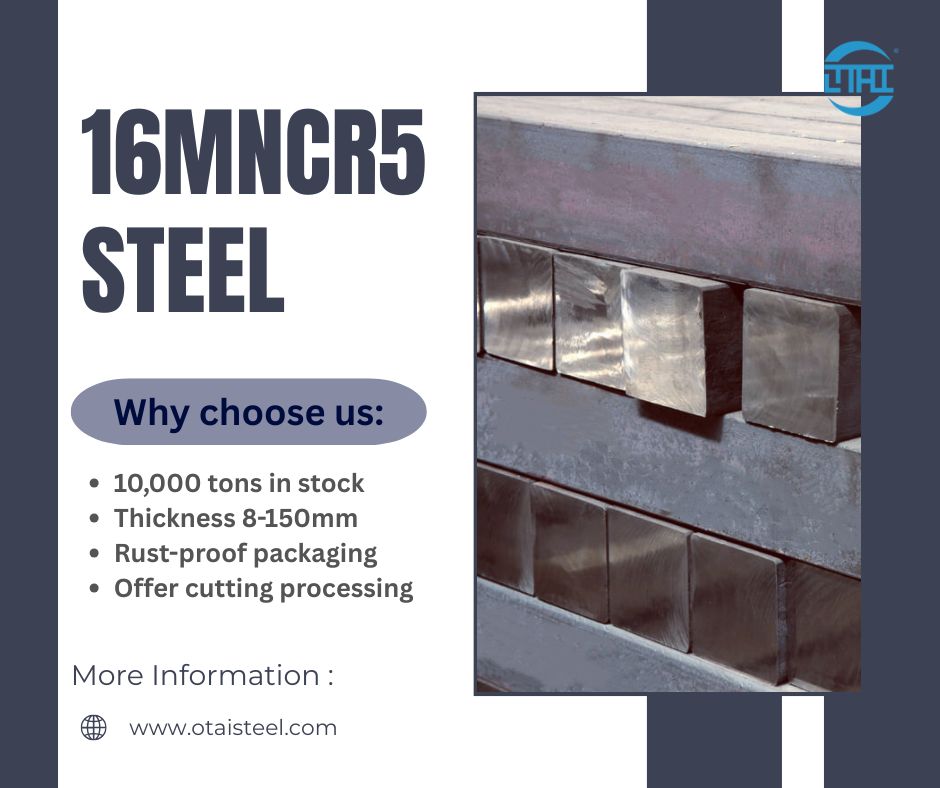
- Ready stock: Otai keeps 16MnCr5 plates in 8–150 mm thicknesses in stock, subject to current inventory.
- Different dimensions: We can supply different sizes according to project requirements and arrange cutting based on customer drawings.
- Cutting service: 16MnCr5 plates can be cut to required dimensions to reduce subsequent machining work.
- Heat treatment: We can arrange annealing, hardening, tempering and other heat-treatment services according to technical requirements.
- Quality control: Ultrasonic testing and third-party inspection can be arranged for projects with specific quality requirements.
- Export packaging: Steel strapping, wooden cases and anti-rust packaging help protect the material during international transportation.
- International supply experience: Otai has supplied steel to customers with demanding technical requirements, including Fortune Global 500 companies.
If you are looking for a 16MnCr5 alternative, provide the original grade, applicable standard, dimensions, application and heat-treatment requirements. Otai can help evaluate a suitable option for your project.
❓ 9. Frequently Asked Questions
1. What is the best alternative to 16MnCr5?
There is no single alternative for every application. 20MnCr5 is a close European option, while SAE 5115 can be considered for U.S.-standard projects. SAE 8620 may be more suitable when higher hardenability is required.
2. Can 20MnCr5 replace 16MnCr5?
Yes, 20MnCr5 can work as a replacement in suitable applications. However, it is not chemically identical to 16MnCr5. Its higher carbon, manganese and chromium levels can affect heat-treatment behavior and final properties.
3. Is SAE 5115 equivalent to 16MnCr5?
SAE 5115 is often considered a close U.S. grade for applications similar to those using 16MnCr5. However, the exact chemical limits and requirements can differ between standards. Always compare the applicable specification before approving a substitution.
4. Can 8620 be used as an alternative to 16MnCr5?
Yes. SAE 8620 can serve as a technical alternative for selected case-hardening applications. However, it is not a direct chemical equivalent because it uses a nickel-chromium-molybdenum alloy system.
5. What should I check before replacing 16MnCr5?
Check the chemical composition, hardenability, carburized case depth, surface hardness, core strength, heat-treatment process, dimensions, applicable standard and engineering drawing requirements.