 16MnCr5 Which Material? Grade, Properties and Applications Explained
📑 Table of Contents
🧪 2. 16MnCr5 Chemical Composition
⚙️ 3. What Type of Steel Is 16MnCr5?
🔥 4. 16MnCr5 Heat Treatment and Hardness
📊 6. 16MnCr5 Equivalent Grades
🔍 1. 16MnCr5 Which Material?
If you are searching for 16MnCr5 which material, the short answer is: 16MnCr5 is a low-carbon manganese-chromium alloy steel designed mainly for case hardening. It belongs to the European EN steel system and carries the material number 1.7131.
Unlike ordinary carbon steel, 16MnCr5 contains controlled amounts of manganese and chromium. Its relatively low carbon content allows the steel to undergo carburizing. During this process, carbon enters the surface and creates a carbon-rich case.
After carburizing and hardening, the surface becomes hard and wear resistant, while the core remains tougher. This combination makes 16MnCr5 particularly useful for gears, pinions, shafts, cams and transmission components.
| Item | 16MnCr5 Information |
|---|---|
| Steel Grade | 16MnCr5 |
| Material Number | 1.7131 |
| Standard | EN |
| Steel Type | Low-carbon Mn-Cr alloy case-hardening steel |
| Main Treatment | Carburizing, hardening and tempering |
| Main Advantage | Hard surface with a tougher core |
| Typical Applications | Gears, pinions, shafts, cams and transmission components |
Therefore, 16MnCr5 is not simply a general-purpose structural steel. It is a specialized case-hardening steel intended for components where surface wear resistance and core toughness must work together.
🧪 2. 16MnCr5 Chemical Composition
The chemical composition explains why 16MnCr5 performs differently from conventional carbon steels. The grade uses low carbon together with manganese and chromium to create a suitable foundation for carburizing and hardening.
| Element | Typical 16MnCr5 Range | Function |
|---|---|---|
| Carbon (C) | 0.14–0.19% | Provides the low-carbon core and supports carburizing |
| Silicon (Si) | ≤ 0.40% | Deoxidation and strength |
| Manganese (Mn) | 1.00–1.30% | Improves strength and hardenability |
| Chromium (Cr) | 0.80–1.10% | Improves hardenability and carburizing response |
| Phosphorus (P) | ≤ 0.025% | Controlled impurity |
| Sulfur (S) | ≤ 0.035% | Controlled impurity |
The low carbon content is particularly important. The original steel contains enough carbon to provide a tough core, but the surface can gain additional carbon during carburizing.
Manganese and chromium also improve the steel’s hardening response. As a result, the final component can achieve a useful combination of surface hardness and core toughness.
Why Does 16MnCr5 Use Low Carbon?
Carburizing works by adding carbon to the surface. If the starting material already contained a very high carbon level, the difference between the surface and core would become less useful.
With 16MnCr5, manufacturers can machine the component before carburizing. The heat-treatment process then creates the required hard case while preserving a relatively tough interior.
This structure makes the grade especially useful for components that experience repeated contact, friction and impact.
⚙️ 3. What Type of Steel Is 16MnCr5?
The best technical description of 16MnCr5 is low-carbon alloy case-hardening steel. More specifically, it is a manganese-chromium steel intended for carburizing applications.
This classification distinguishes 16MnCr5 from several other common engineering steels.
| Steel Category | Example | Main Characteristic |
|---|---|---|
| Carbon Steel | C45 | General mechanical applications |
| Quenched and Tempered Alloy Steel | 42CrMo4 | High bulk strength and toughness |
| Case-Hardening Steel | 16MnCr5 | Hard surface and tougher core |
| Tool Steel | 1.2379 / D2 | High hardness and wear resistance |
| Spring Steel | 51CrV4 | Elasticity and fatigue resistance |
16MnCr5 vs Ordinary Carbon Steel
A conventional carbon steel can provide good strength and machinability, but it does not necessarily provide the same combination of carburizing response, surface hardness and core toughness.
For example, a gear manufacturer may select 16MnCr5 when the teeth require a hard surface after carburizing. A simple carbon steel may not provide the same performance after the same process.
16MnCr5 vs 42CrMo4
42CrMo4 is a medium-carbon chromium-molybdenum steel normally associated with quenching and tempering. It provides high strength throughout the section.
16MnCr5 follows a different design philosophy. It creates a hard case around a tougher core. Therefore, the two grades can both appear in mechanical engineering, but they solve different material problems.
Choose 16MnCr5 when surface hardness and wear resistance are major requirements. Choose 42CrMo4 when high bulk strength, toughness and resistance to heavy mechanical loading are more important.
🔥 4. 16MnCr5 Heat Treatment and Hardness
Heat treatment gives 16MnCr5 its most important engineering advantage. The steel normally receives carburizing followed by hardening and tempering.
| Process | Purpose | Result |
|---|---|---|
| Carburizing | Add carbon to the surface | Creates a carbon-enriched case |
| Hardening | Increase surface hardness | Creates a hard martensitic case |
| Tempering | Reduce stress and improve toughness | Improves stability and service performance |
| Final Inspection | Verify hardness and case depth | Confirms treatment requirements |
16MnCr5 Surface Hardness
The final surface hardness depends on carburizing conditions, carbon potential, case depth, quenching conditions and tempering. Therefore, buyers should avoid treating one hardness number as a universal value for every 16MnCr5 component.
In many engineering applications, the carburized surface can reach approximately 58–62 HRC, while the core remains significantly tougher. The actual specification should always come from the component design and heat-treatment procedure.
Why Is Case Depth Important?
Surface hardness alone does not tell the complete story. A gear with a very hard surface may still fail if the hardened layer is too shallow for the applied contact stress.
Engineers therefore consider both surface hardness and effective case depth. Larger or heavily loaded components often require deeper cases than small components.
For this reason, a good 16MnCr5 heat treatment specification should define the required case depth, surface hardness and core properties rather than simply saying “carburized.”
Can 16MnCr5 Be Supplied Without Final Heat Treatment?
Yes. Suppliers can provide 16MnCr5 in different delivery conditions depending on the product form and customer’s requirements. Many customers purchase the material before final machining and then perform carburizing and hardening through their own heat-treatment process.
When ordering, specify the delivery condition clearly. This prevents confusion between raw material, annealed material and finished heat-treated components.
🏭 5. 16MnCr5 Applications
The properties of 16MnCr5 make it particularly suitable for components that experience repeated surface contact, friction and mechanical loading.
| Application | Why 16MnCr5 Is Suitable |
|---|---|
| Gears | Hard carburized teeth resist wear and contact fatigue |
| Pinions | Suitable for repeated tooth contact |
| Transmission Components | Combines surface hardness with core toughness |
| Cams | Hard surface helps resist repeated sliding contact |
| Shafts | Useful when surface wear resistance is important |
| Piston Pins | Can provide a hard working surface with a tougher core |
| Mechanical Drive Components | Suitable for carburized wear surfaces |
16MnCr5 for Gear Manufacturing
Gears remain one of the most important applications for this grade. During operation, gear teeth experience rolling contact, sliding, friction and repeated loads.
A carburized 16MnCr5 gear develops a hard surface that helps resist wear. The tougher core supports the tooth and reduces the risk of brittle failure.
This combination makes 16MnCr5 for gears a practical solution for many automotive, industrial and mechanical transmission applications.
16MnCr5 for Pinions
Pinions experience similar contact conditions. The teeth need a surface that can withstand repeated loading, while the core must provide adequate toughness.
For this reason, manufacturers often consider 16MnCr5 when designing carburized pinions and other power-transmission components.
When Should You Choose Another Grade?
16MnCr5 is not the best solution for every application. If the entire component requires very high strength, a quenched-and-tempered alloy steel may provide better performance.
For example, 42CrMo4 is a stronger candidate for many heavily loaded shafts. AISI 8620 can also become attractive when the application requires a different carburizing alloy system.
The correct choice depends on load, component size, hardness, case depth, toughness, machining requirements and heat-treatment capability.
📊 6. 16MnCr5 Equivalent Grades
Customers searching for 16MnCr5 which material often need an equivalent grade for a project using American or other international standards. Several grades may appear in cross-reference tables, but they do not all have the same relationship with 16MnCr5.
| Grade | Standard / Material Number | Steel Type | Relationship to 16MnCr5 |
|---|---|---|---|
| 16MnCr5 | EN / 1.7131 | Mn-Cr case-hardening steel | Original grade |
| AISI 5115 | SAE / UNS G51150 | Low-carbon alloy steel | Common US reference |
| AISI 5120 | SAE / UNS G51200 | Case-hardening alloy steel | Potential alternative |
| AISI 8620 | SAE / UNS G86200 | Ni-Cr-Mo case-hardening steel | Functional alternative |
| 20MnCr5 | EN / 1.7147 | Mn-Cr case-hardening steel | Related grade, not identical |
16MnCr5 vs 20MnCr5
20MnCr5 is closely related to 16MnCr5, but its carbon content is higher. This difference can influence carburizing behavior and final core properties.
Therefore, 16MnCr5 vs 20MnCr5 should be treated as a technical comparison rather than a simple “same material” question.
16MnCr5 vs AISI 5115
AISI 5115 is often used as a US reference when customers need an American grade for 16MnCr5. However, engineers should compare the exact chemical limits and heat-treatment requirements before approving substitution.
16MnCr5 vs AISI 8620
AISI 8620 uses nickel, chromium and molybdenum, so its alloy design differs considerably from 16MnCr5. It can provide excellent carburizing performance, but it is better considered a functional alternative than an exact equivalent.
For international purchasing, the safest method is to provide the original material specification, dimensions, required case depth and final properties to the supplier.
📦 7. Otai Special Steel Advantages
When sourcing 16MnCr5, customers often need more than a material grade. Stock availability, dimensions, cutting and inspection services can also affect the project schedule.
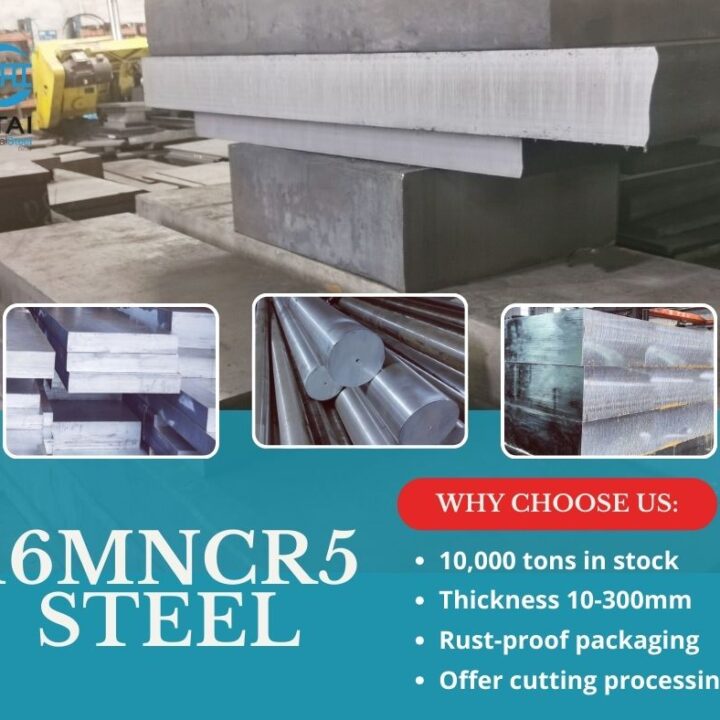
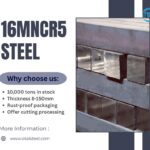
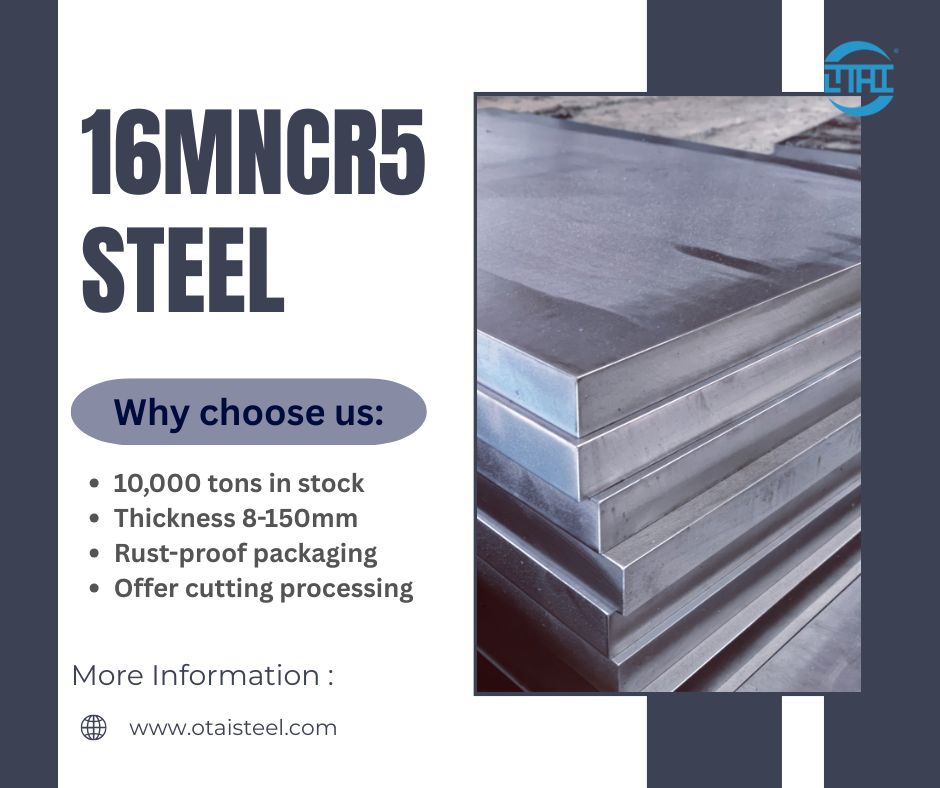
- 16MnCr5 stock: We have 8–150 mm thick 16MnCr5 plates available in stock, depending on specification and current inventory.
- Different sizes: We can supply different dimensions for machining and fabrication requirements.
- Cutting service: Steel plates can be cut according to customer dimensions and drawings.
- Heat treatment: We can arrange heat treatment services according to project requirements.
- Quality inspection: Ultrasonic testing and third-party inspection can be arranged when required.
- Export packaging: Anti-rust packaging, steel strapping and wooden cases help protect material during transportation.
If you need 16MnCr5 for gears, shafts, pinions or other case-hardened components, provide the required dimensions, delivery condition and heat-treatment requirements. Otai Special Steel can help confirm the appropriate material and supply condition.
❓ 8. Frequently Asked Questions About 16MnCr5
1. What material is 16MnCr5?
16MnCr5 is a low-carbon manganese-chromium alloy case-hardening steel. Its EN material number is 1.7131. It is mainly used for carburized components that need a hard surface and a tougher core.
2. Is 16MnCr5 a stainless steel?
No. 16MnCr5 is not stainless steel. It is an alloy case-hardening steel containing manganese and chromium, but its chromium content is far below the level normally associated with stainless steels.
3. Is 16MnCr5 a carbon steel?
16MnCr5 contains carbon, but it is more accurately classified as a low-carbon alloy case-hardening steel because manganese and chromium play important roles in its performance.
4. What is the AISI equivalent of 16MnCr5?
AISI 5115 is commonly cited as a US reference for 16MnCr5. However, it should not automatically be treated as an identical one-to-one equivalent. The actual chemical composition and application requirements should be checked.
5. Is 16MnCr5 good for gears?
Yes. 16MnCr5 is well suited to many gear applications because carburizing can create a hard, wear-resistant surface while the lower-carbon core retains useful toughness.