 4140 Steel Annealed Yield Strength: Values, Factors and Practical Use
📑 Table of Contents
🔍 1. What Is 4140 Steel Annealed Yield Strength?
🧪 2. 4140 Annealed Steel Composition
📊 3. 4140 Steel Annealed Yield Strength and Mechanical Properties
🔥 4. How Annealing Changes 4140 Steel
⚙️ 5. 4140 Annealed vs Quenched and Tempered
🏭 6. Applications of Annealed 4140 Steel
📏 7. What Affects 4140 Yield Strength?
🔍 1. What Is 4140 Steel Annealed Yield Strength?
If you are searching for 4140 steel annealed yield strength, you are usually looking for the yield strength of AISI 4140 in its soft, annealed delivery condition. 4140 is a chromium-molybdenum alloy steel that can achieve much higher strength after quenching and tempering. In the annealed condition, however, the material remains considerably softer and easier to machine.
For many commercial specifications, the yield strength of annealed 4140 steel falls roughly in the range of 415–655 MPa, depending on the product specification, section size, annealing treatment and testing requirements. A commonly referenced value is around 415 MPa (60 ksi).
Therefore, buyers should not treat one number as a universal value for every 4140 steel plate, bar or forging. The mill certificate and applicable specification provide the controlling mechanical-property values for a specific order.
| Property | Typical Annealed 4140 Value |
|---|---|
| Yield Strength | Approximately 415–655 MPa |
| Yield Strength Reference | About 415 MPa / 60 ksi is commonly cited |
| Tensile Strength | Approximately 655–850 MPa |
| Hardness | Typically around 197–241 HB, depending on condition |
| Steel Type | Chromium-molybdenum alloy steel |
| Typical Delivery Condition | Annealed / softened |
The main purpose of annealing is not to maximize strength. Instead, it produces a softer and more machinable structure. Manufacturers can then machine the material into the required shape before applying a final heat treatment.
For this reason, annealed 4140 yield strength should always be evaluated together with hardness, tensile strength and the intended manufacturing process.
🧪 2. 4140 Annealed Steel Composition
The chemistry of 4140 explains why the steel responds well to heat treatment. It contains chromium and molybdenum in addition to carbon and manganese. These alloying elements improve hardenability and allow 4140 to develop high strength after suitable heat treatment.
| Element | Typical Range | Function |
|---|---|---|
| Carbon (C) | 0.38–0.43% | Provides strength and supports hardening |
| Silicon (Si) | 0.15–0.35% | Deoxidation and strength |
| Manganese (Mn) | 0.75–1.00% | Improves strength and hardenability |
| Chromium (Cr) | 0.80–1.10% | Improves hardenability and wear resistance |
| Molybdenum (Mo) | 0.15–0.25% | Improves hardenability and high-temperature strength |
| Phosphorus (P) | ≤ 0.035% | Controlled impurity |
| Sulfur (S) | ≤ 0.040% | Controlled impurity |
The combination of chromium and molybdenum is particularly important. These elements help 4140 respond consistently to quenching and tempering, even when the material has a relatively large cross-section.
However, the same alloying system also means that 4140 does not behave like a simple low-carbon steel during annealing. Heat-treatment temperature, cooling rate and section size can all influence the final microstructure.
For customers buying 4140 annealed steel, the chemistry should therefore remain within the specified standard while the delivery condition should match the intended machining and subsequent heat-treatment process.
📊 3. 4140 Steel Annealed Yield Strength and Mechanical Properties
Yield strength describes the stress at which a material begins to deform plastically. Below the yield point, the steel can generally return to its original shape after the load disappears. Above the yield point, permanent deformation begins.
For annealed 4140, the yield strength remains moderate because the heat treatment produces a relatively soft microstructure. This makes the steel easier to cut, drill, turn and mill than quenched-and-tempered 4140.
| Mechanical Property | Typical Annealed 4140 Range | Practical Meaning |
|---|---|---|
| Yield Strength | Approx. 415–655 MPa | Resistance to permanent deformation |
| Tensile Strength | Approx. 655–850 MPa | Maximum tensile load before fracture process |
| Hardness | Approx. 197–241 HB | Useful indicator of machinability and strength |
| Elongation | Typically higher than Q&T 4140 | Indicates greater ductility |
| Machinability | Good in annealed condition | Suitable for pre-machining |
Why Does the Yield Strength Have a Range?
Steel does not always have one mechanical-property value across every product form. A plate, round bar and forged component can show different results because section size and manufacturing history affect the microstructure.
Testing direction can also influence results. Longitudinal and transverse specimens may produce different mechanical properties, especially in rolled or forged products.
Therefore, a technical data sheet may list minimum values rather than one exact measured number. When purchasing material for a specific engineering project, the 4140 steel yield strength shown on the material certificate should take priority over a generic internet value.
Tensile Strength vs Yield Strength
Yield strength and tensile strength describe different stages of material behavior. Yield strength indicates when permanent deformation begins. Tensile strength represents the maximum engineering stress reached during a tensile test.
For annealed 4140, the tensile strength is higher than the yield strength. The difference provides information about how the steel behaves after yielding and before fracture.
🔥 4. How Annealing Changes 4140 Steel
Annealing changes the microstructure of 4140 and reduces hardness and strength compared with a quenched condition. The process also relieves internal stresses and improves machinability.
A typical annealing cycle heats the steel to a suitable temperature, holds it long enough for the material to reach a uniform condition, and then cools it slowly. The exact parameters depend on the product form and applicable specification.
| Annealing Effect | Result |
|---|---|
| Hardness | Decreases |
| Yield Strength | Decreases compared with hardened conditions |
| Machinability | Improves |
| Ductility | Generally increases |
| Residual Stress | Reduces |
| Dimensional Stability | Improves during subsequent machining |
Why Do Manufacturers Supply 4140 Annealed?
Many customers do not need the final mechanical properties immediately after receiving the steel. Instead, they need to machine the raw material first.
Annealed 4140 offers a practical manufacturing route. The softer condition reduces cutting forces and tool wear compared with hardened material. After machining, the finished component can receive quenching and tempering to achieve the required strength.
This approach works especially well for shafts, gears, bolts, tooling components and heavy machine parts that require significant machining before final heat treatment.
Does Annealing Make 4140 Weak?
Annealing reduces strength, but that does not mean annealed 4140 is a poor engineering material. The delivery condition serves a different purpose.
Think of annealed 4140 as a manufacturing starting point. The customer can machine the material efficiently and then use heat treatment to develop the final strength and hardness.
Consequently, 4140 steel annealed yield strength should be considered in the context of the entire production route rather than as the final strength of every 4140 component.
⚙️ 5. 4140 Annealed vs Quenched and Tempered
The difference between annealed and quenched-and-tempered 4140 is substantial. Both conditions use the same basic alloy chemistry, but their microstructures and mechanical properties differ significantly.
| Feature | 4140 Annealed | 4140 Quenched & Tempered |
|---|---|---|
| Yield Strength | Moderate | Much higher |
| Hardness | Relatively low | Higher |
| Machinability | Good | Lower |
| Ductility | Higher | Lower than annealed condition |
| Strength | Suitable for machining condition | Suitable for high-load applications |
| Typical Purpose | Pre-machining and forming | Final service condition |
When Should You Use Annealed 4140?
Choose annealed 4140 when you need to machine, drill, mill or turn the material before final hardening. It provides a good balance between alloy performance and machinability.
This condition is also useful when a customer wants to control the final heat-treatment process after machining.
When Should You Use Q&T 4140?
Quenched-and-tempered 4140 is more appropriate when the component requires higher yield strength, tensile strength and hardness in service.
Typical examples include high-strength shafts, axles, bolts, studs, gears and machine components exposed to heavy mechanical loads.
The correct delivery condition therefore depends on whether the customer needs a machining material or a finished mechanical-performance grade.
🏭 6. Applications of Annealed 4140 Steel
Annealed 4140 is commonly used as a starting material for components that require machining followed by heat treatment. Its combination of alloy content, machinability and later hardening response makes it versatile.
| Application | Reason for Using Annealed 4140 |
|---|---|
| Machined Shafts | Good machinability before final heat treatment |
| Gears | Can be machined before hardening |
| Axles | Provides a suitable starting condition for high-strength components |
| Bolts and Studs | Useful for machining and subsequent strengthening |
| Machine Components | Good balance of machinability and hardenability |
| Tooling Components | Can receive customized heat treatment after machining |
4140 Steel for Shafts
Shafts often require accurate machining before heat treatment. Annealed 4140 makes this process easier because its lower hardness reduces machining difficulty.
After machining, the shaft can undergo quenching and tempering to obtain higher strength and hardness. This makes 4140 a popular choice for rotating components exposed to bending and torsional loads.
4140 Steel for Gears
4140 can also work for gears, especially when the design requires high bulk strength rather than a carburized surface with a low-carbon core.
However, the final heat-treatment route matters. A carburizing steel such as 16MnCr5 may offer better performance when the gear requires a very hard case and tougher core.
4140 for Bolts and Studs
High-strength bolts and studs often use quenched-and-tempered 4140 rather than annealed 4140 in the final service condition. Nevertheless, manufacturers may start with annealed or normalized material because machining and forming become easier.
This illustrates an important point: the delivery condition and final service condition do not always need to be the same.
📏 7. What Affects 4140 Yield Strength?
Several factors can change the measured yield strength of 4140. This explains why different technical references sometimes report different values for annealed 4140.
1. Heat-Treatment Condition
Annealed, normalized, quenched and tempered, and hardened conditions can produce very different yield strengths. Always identify the delivery condition before comparing values.
2. Section Size
Large sections can cool differently from small sections during heat treatment. Because cooling rate affects microstructure, section size can influence the final mechanical properties.
3. Product Form
Plate, bar and forgings may have different manufacturing histories. Rolling and forging can also influence the material’s microstructure and mechanical behavior.
4. Testing Direction
Longitudinal and transverse testing can produce different results in some rolled or forged products. The material standard should define the applicable testing requirements.
5. Specification
Different standards and purchasing specifications can establish different minimum mechanical properties. Therefore, engineers should always check the exact standard listed on the purchase order.
| Factor | Possible Influence on Yield Strength |
|---|---|
| Heat Treatment | Very high influence |
| Section Thickness | Can influence cooling and microstructure |
| Product Form | Can influence grain structure and properties |
| Testing Direction | May affect measured values |
| Material Specification | Determines required minimum values |
For that reason, if a project has a strict minimum yield-strength requirement, do not purchase material based only on a generic 4140 annealed yield strength value from a website. Ask for the applicable standard and a material test certificate.
📦 8. Otai Special Steel Advantages
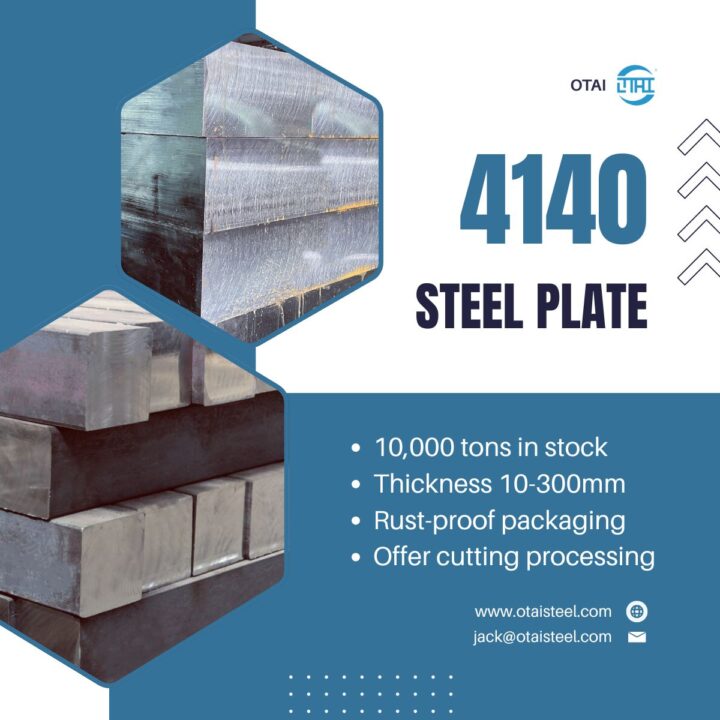
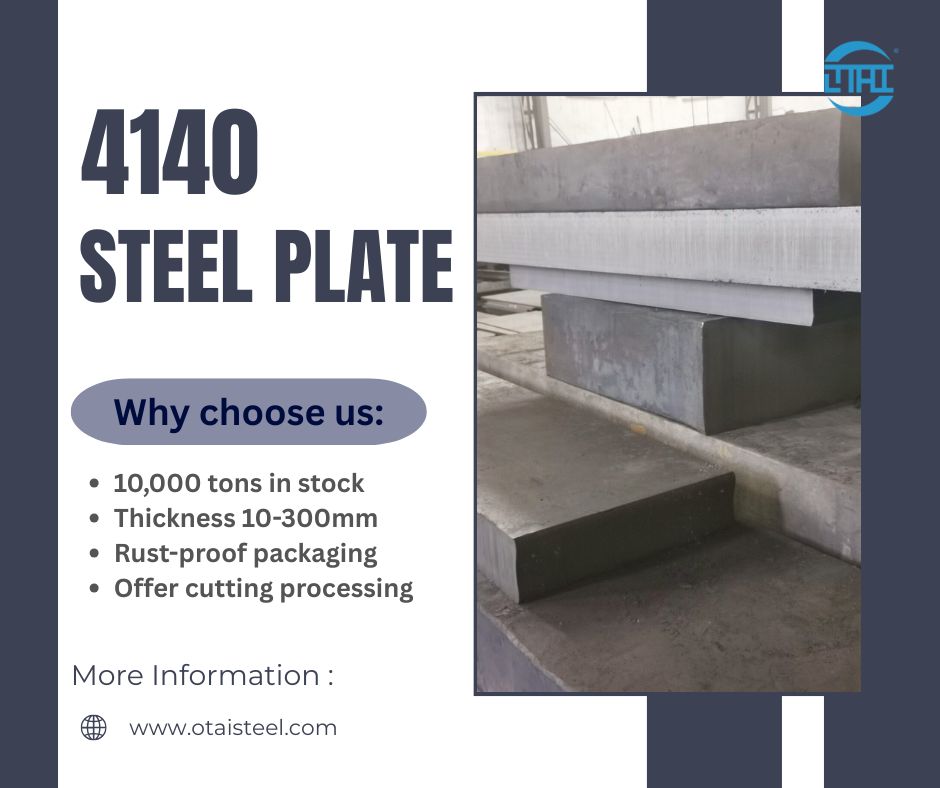
For international buyers, choosing the correct 4140 condition is just as important as choosing the grade itself. Otai Special Steel supplies 4140 alloy steel plates and supports different processing requirements.
- Large inventory: Otai maintains approximately 10,000 tons of steel inventory and stocks different sizes for fast supply.
- 4140 plate stock: Different thicknesses are available, including commonly requested sizes from 10–300 mm, subject to current inventory.
- Cutting service: We can cut 4140 plates according to customer dimensions and drawings.
- Heat treatment: We can arrange annealing, hardening, tempering and other processing according to project requirements.
- Quality assurance: Ultrasonic testing and third-party inspection can be arranged for customers with specific quality requirements.
- Export packaging: Steel strapping, wooden cases and anti-rust packaging help protect material during international transportation.
- International supply experience: Otai has supplied steel to customers with demanding technical requirements, including Fortune Global 500 companies.
If you need 4140 annealed steel, provide the required thickness, width, length, standard and delivery condition. Otai can help confirm the appropriate material and processing route for your project.
❓ 9. Frequently Asked Questions
1. What is the yield strength of annealed 4140 steel?
Annealed 4140 commonly has a yield strength around 415–655 MPa, depending on the product specification, section size and heat-treatment condition. About 415 MPa (60 ksi) is a commonly cited reference value.
2. Is annealed 4140 stronger than Q&T 4140?
No. Quenched-and-tempered 4140 generally provides much higher yield strength and tensile strength. Annealed 4140 offers lower strength but better machinability and ductility.
3. What is the hardness of annealed 4140?
A commonly referenced range is approximately 197–241 HB, although the actual hardness depends on the specification, product form and annealing process.
4. Why is 4140 supplied in the annealed condition?
Annealing softens 4140, reduces residual stress and improves machinability. Manufacturers can machine the component first and then apply quenching and tempering to achieve the required final strength.
5. Is annealed 4140 suitable for machining?
Yes. Annealed 4140 generally provides good machinability compared with hardened 4140. This makes it a useful starting material for shafts, gears, bolts and other machined components.