 16MnCr5 Gear: Why This Case Hardening Steel Is Ideal for High-Performance Gears
📑 Table of Contents
🔍 1. What Is 16MnCr5 Gear Steel?
⚙️ 2. Why Is 16MnCr5 Suitable for Gear Manufacturing?
🧪 3. Chemical Composition of 16MnCr5 Gear Steel
🔥 4. Heat Treatment Process for 16MnCr5 Gears
📊 5. Mechanical Properties and Hardness of 16MnCr5 Gear Components
⚖️ 6. 16MnCr5 Gear vs 20MnCr5 Gear Comparison
🏭 7. Industrial Applications of 16MnCr5 Gears
📦 8. Otai Special Steel Advantages
❓ FAQ About 16MnCr5 Gear Steel
🔍 1. What Is 16MnCr5 Gear Steel?
When engineers search for reliable materials for gear production, 16MnCr5 gear steel is one of the most commonly considered case hardening steels in European mechanical manufacturing.
16MnCr5 is a low-carbon alloy steel defined under the EN 10084 standard. It is designed especially for components that require a hard and wear-resistant surface while maintaining a tough and impact-resistant core.
The unique structure of 16MnCr5 makes it highly suitable for gears, sprockets, shafts, and other transmission components. Through carburizing treatment, the surface carbon content increases, allowing the material to achieve a very hard outer layer while keeping the internal structure strong and ductile.
Unlike conventional carbon steels, 16MnCr5 provides an excellent balance between surface hardness, fatigue resistance, and dimensional stability after heat treatment. These characteristics make it a preferred choice for automotive gears, industrial gearboxes, and precision mechanical systems.
The main reason manufacturers choose 16MnCr5 gear steel is its ability to handle repeated loads, friction, and impact forces during long-term operation.
Basic Information of 16MnCr5 Gear Steel
| Item | Description |
|---|---|
| Steel Grade | 16MnCr5 |
| Standard | EN 10084 |
| Material Number | 1.7131 |
| Steel Type | Low carbon alloy case hardening steel |
| Main Alloy Elements | Manganese (Mn), Chromium (Cr) |
| Main Application | Gears, shafts, transmission parts |
Why Is 16MnCr5 Called a Gear Steel?
The term “gear steel” refers to materials specially developed for manufacturing gears and transmission components. A good gear material must withstand several demanding conditions:
- High contact pressure between gear teeth.
- Repeated loading during rotation.
- Surface friction and wear.
- Impact forces during starting and stopping.
- Fatigue stress during long service periods.
Because of its carburizing ability and excellent core toughness, 16MnCr5 meets these requirements effectively. The material can develop a hard surface layer while maintaining a strong internal structure.
⚙️ 2. Why Is 16MnCr5 Suitable for Gear Manufacturing?
The performance of gears depends heavily on material selection. A gear material must provide both surface durability and internal strength. This is exactly where 16MnCr5 performs well.
The biggest advantage of 16MnCr5 gear applications is the combination of a wear-resistant surface and a tough core. After carburizing and quenching, the gear teeth become extremely resistant to abrasion, while the center remains capable of absorbing shock loads.
Main Advantages of 16MnCr5 for Gear Production
| Property | Benefit for Gears |
|---|---|
| Excellent carburizing performance | Creates a hard wear-resistant surface |
| High core toughness | Prevents cracking under impact loads |
| Good fatigue strength | Improves service life under repeated stress |
| Good machinability before heat treatment | Reduces manufacturing difficulty |
| Good dimensional stability | Maintains gear accuracy after processing |
Long-Term Performance of 16MnCr5 Gears
In automotive and industrial transmission systems, gears often operate thousands of hours under changing loads. Poor material selection can cause problems such as tooth wear, surface pitting, and premature failure.
The use of 16MnCr5 steel for gear manufacturing helps reduce these risks because the carburized surface provides strong resistance against contact stress and abrasive damage.
For this reason, many manufacturers select 16MnCr5 when they need reliable transmission components with a long operating life.
🧪 3. Chemical Composition of 16MnCr5 Gear Steel
The chemical composition of 16MnCr5 is carefully controlled to achieve excellent carburizing performance. Carbon provides the foundation for hardness, while manganese and chromium improve hardenability and strength.
Chemical Composition of 16MnCr5
| Element | Content (%) | Function |
|---|---|---|
| Carbon (C) | 0.14–0.19 | Provides surface hardness after carburizing |
| Silicon (Si) | ≤0.40 | Improves strength and deoxidation |
| Manganese (Mn) | 1.00–1.30 | Improves hardenability and toughness |
| Chromium (Cr) | 0.80–1.10 | Improves wear resistance and hardening ability |
| Phosphorus (P) | ≤0.025 | Controlled to maintain toughness |
| Sulfur (S) | ≤0.035 | Controlled for machinability |
The balanced alloy design explains why 16MnCr5 gear steel is widely used for precision gears that require both strength and durability.
🔥 4. Heat Treatment Process for 16MnCr5 Gears
The heat treatment process is one of the most important steps in producing high-performance gears. For 16MnCr5 gear components, carburizing treatment is widely used because it can significantly improve surface hardness while maintaining a tough internal structure.
As a low-carbon case hardening steel, 16MnCr5 contains relatively low carbon content in its original condition. This allows the material to maintain good toughness before treatment. During carburizing, carbon atoms penetrate into the surface layer, creating a hardened outer zone after quenching.
This combination of a hard surface and tough core allows 16MnCr5 gears to withstand high contact pressure, repeated loading and impact forces during operation.
Typical Heat Treatment Process of 16MnCr5 Gear Steel
| Process | Purpose | Effect on Gear Performance |
|---|---|---|
| Carburizing | Increase carbon content on the surface | Creates a hard wear-resistant layer |
| Quenching | Rapid cooling after heating | Improves surface hardness |
| Tempering | Reduce internal stress | Improves toughness and stability |
| Grinding and finishing | Improve dimensional accuracy | Enhances gear precision |
Why Is Carburizing Important for 16MnCr5 Gears?
Gears experience extremely high pressure at the contact points between teeth. Without sufficient surface hardness, gear teeth may suffer from wear, pitting and deformation.
The carburized layer of 16MnCr5 gear components provides excellent resistance against these problems. At the same time, the softer core absorbs impact energy and prevents brittle failure.
This structure is especially valuable for automotive transmissions, industrial gearboxes and heavy-duty mechanical systems.
Common Heat Treatment Conditions
| Condition | Typical Result |
|---|---|
| Carburized surface | High hardness and excellent wear resistance |
| Hardened case depth | Suitable for different gear load requirements |
| Tough core structure | Better impact resistance |
| Finished machining | Higher dimensional accuracy |
📊 5. Mechanical Properties and Hardness of 16MnCr5 Gear Components
The mechanical properties of a gear material directly affect its service life. A high-quality 16MnCr5 gear requires excellent hardness, fatigue resistance and toughness to operate under continuous mechanical stress.
Before heat treatment, 16MnCr5 provides good machinability, making it easier for manufacturers to perform turning, milling and gear cutting operations. After carburizing and hardening, the surface properties improve significantly.
Mechanical Properties of 16MnCr5 Steel
| Property | Typical Value | Importance for Gears |
|---|---|---|
| Tensile Strength | Approx. 800–1200 MPa after treatment | Supports heavy mechanical loads |
| Yield Strength | Approx. 500–900 MPa | Improves resistance against deformation |
| Surface Hardness | 58–62 HRC after carburizing | Improves wear resistance |
| Core Hardness | Maintains good toughness | Prevents cracking |
| Fatigue Resistance | Excellent after proper treatment | Extends gear service life |
Relationship Between Hardness and Gear Performance
For gear applications, hardness is not the only factor that determines performance. A gear that is extremely hard but lacks toughness may crack under impact loads.
The advantage of 16MnCr5 steel for gear manufacturing is its balanced structure:
- Hard surface layer for wear resistance.
- Tough core for impact resistance.
- Good fatigue performance under repeated loads.
- Excellent dimensional stability after treatment.
This balance makes 16MnCr5 a reliable material for precision transmission components.
⚖️ 6. 16MnCr5 Gear vs 20MnCr5 Gear Comparison
When selecting materials for gear manufacturing, engineers often compare 16MnCr5 and 20MnCr5 because both are European case hardening steels with similar applications.
Although they belong to the same material family, their carbon content and performance characteristics are slightly different. Choosing the correct grade depends on gear size, load conditions and required hardness.
16MnCr5 Gear vs 20MnCr5 Gear
| Comparison | 16MnCr5 | 20MnCr5 |
|---|---|---|
| Material Number | 1.7131 | 1.7147 |
| Carbon Content | Approx. 0.14–0.19% | Approx. 0.17–0.22% |
| Steel Type | Case hardening alloy steel | Case hardening alloy steel |
| Surface Hardness After Carburizing | Very high | Very high |
| Core Toughness | Excellent | Slightly higher carbon strength |
| Machinability | Very good | Good |
| Typical Application | Automotive gears, shafts, mechanical parts | Heavy-duty gears and transmission parts |
Which Material Is Better for Gear Manufacturing?
There is no absolute winner between 16MnCr5 and 20MnCr5. The best choice depends on the working environment and performance requirements.
| Requirement | Recommended Material |
|---|---|
| Precision gears requiring good machinability | 16MnCr5 |
| High-load transmission components | 20MnCr5 |
| Balanced hardness and toughness | 16MnCr5 |
| Larger gears with higher stress | 20MnCr5 |
For many standard gear manufacturing applications, 16MnCr5 gear steel remains one of the most popular choices because it provides an excellent balance between processing performance, hardness and durability.
🏭 7. Industrial Applications of 16MnCr5 Gears
The excellent combination of hardness, toughness and fatigue resistance makes 16MnCr5 gear steel widely used in different industries. This material is especially suitable for components that require a wear-resistant surface and a strong internal structure.
Compared with ordinary carbon steels, 16MnCr5 provides better performance under repeated mechanical loads. After carburizing and heat treatment, gears made from this material can maintain reliable operation under high pressure and continuous friction.
For this reason, many manufacturers select 16MnCr5 steel for gear manufacturing in automotive systems, industrial equipment and precision transmission applications.
Common Applications of 16MnCr5 Gears
| Industry | Typical Gear Components | Main Requirements |
|---|---|---|
| Automotive Industry | Transmission gears, differential gears, drive components | High fatigue strength and wear resistance |
| Industrial Gearboxes | Reduction gears, transmission systems | Long service life under continuous operation |
| Agricultural Machinery | Drive gears, power transmission parts | Impact resistance and durability |
| Construction Equipment | Heavy-duty gears and mechanical components | High load capacity |
| Automation Equipment | Precision gears and moving parts | Dimensional accuracy and stable performance |
Why Do Manufacturers Choose 16MnCr5 for Gears?
The success of 16MnCr5 gear applications comes from its balanced performance. Gear manufacturers usually need a material that can satisfy several requirements at the same time:
- High surface hardness to resist tooth wear.
- Strong core toughness to prevent sudden failure.
- Good machinability before heat treatment.
- Excellent fatigue resistance under repeated loading.
- Stable dimensions after carburizing treatment.
These characteristics make 16MnCr5 an efficient choice for engineers who need reliable transmission components with consistent quality.
📦 8. Otai Special Steel Advantages for 16MnCr5 Gear Steel Supply
Choosing a reliable steel supplier is important for gear manufacturers because material quality directly affects machining performance, heat treatment results and final component reliability.
Otai Special Steel supplies 16MnCr5 gear steel for customers in different industrial sectors, providing material solutions for gears, shafts and other transmission components.
With professional experience in alloy steel supply, Otai helps customers select suitable material conditions according to their production requirements.
Advantages of Otai Special Steel
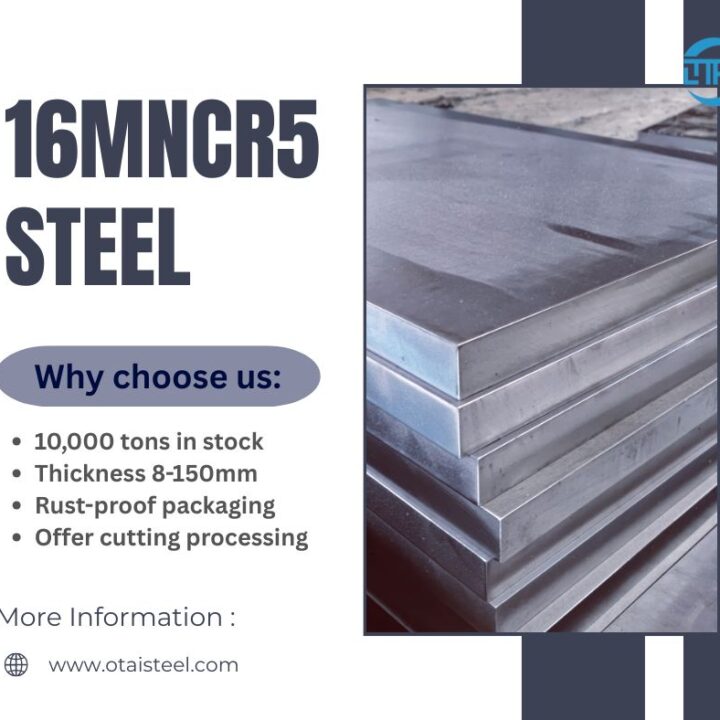
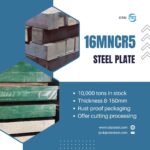
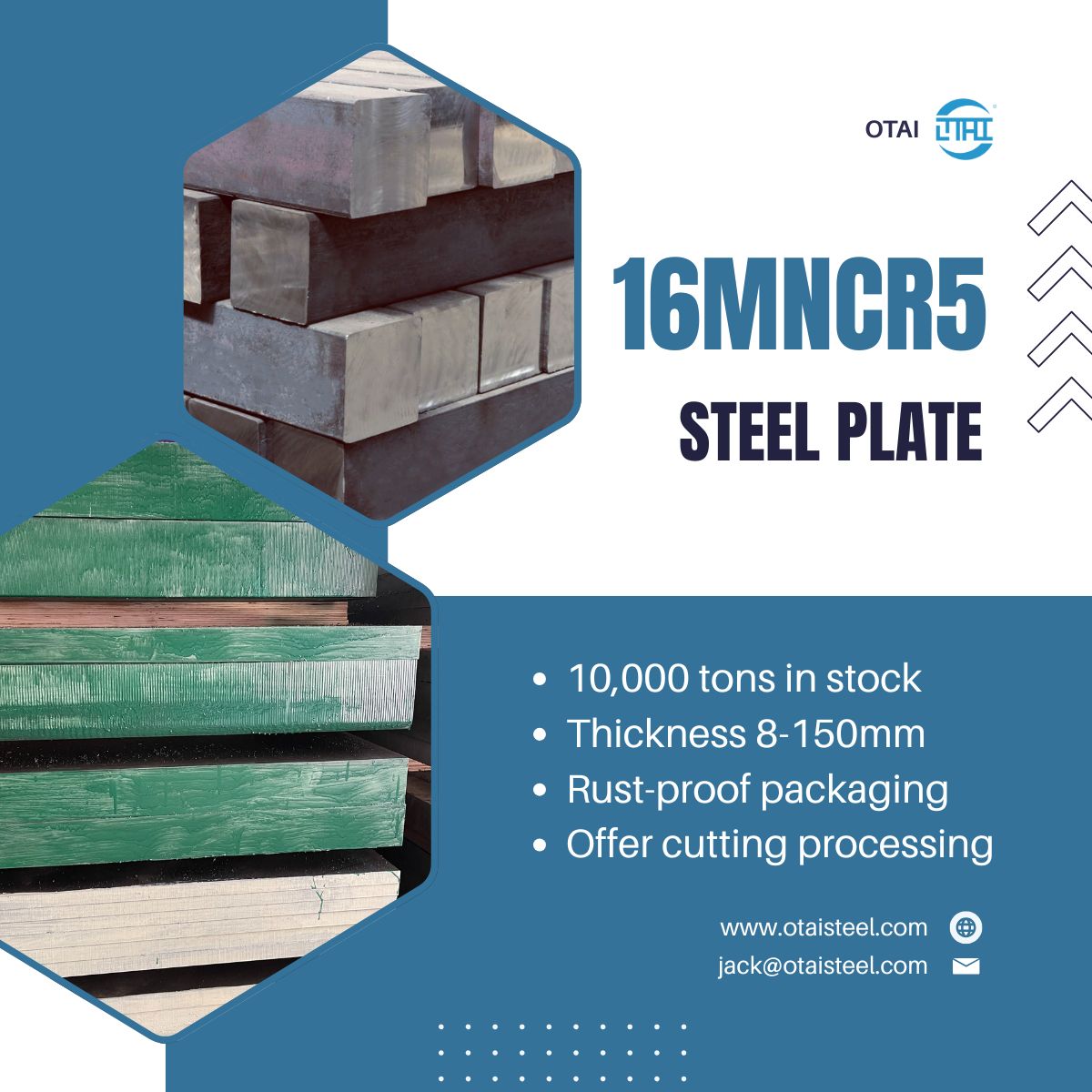
- Stock availability: Otai provides 8–150mm thickness plates available in stock to support different customer requirements.
- Cutting and processing service: Customized cutting and processing services help customers reduce preparation time before machining.
- Heat treatment support: Professional heat treatment solutions are available according to required mechanical properties.
- Quality inspection: Ultrasonic testing and third-party inspection services are available to ensure material reliability.
- Professional steel experience: Otai has experience supplying special steels for industrial manufacturing applications.
- Protective packaging: Anti-rust packaging, steel strapping and wooden box packaging are provided for safer transportation.
For manufacturers producing gears and mechanical transmission parts, selecting the right 16MnCr5 material supplier can improve production efficiency and ensure stable product quality.
❓ FAQ About 16MnCr5 Gear Steel
Q1: Why is 16MnCr5 commonly used for gears?
16MnCr5 is widely used for gears because it provides excellent carburizing performance, high surface hardness and good core toughness. These properties help gears resist wear and impact during operation.
Q2: Is 16MnCr5 suitable for automotive gears?
Yes. 16MnCr5 is commonly used for automotive transmission gears, shafts and other components that require high fatigue resistance and reliable mechanical performance.
Q3: What heat treatment is used for 16MnCr5 gears?
The most common treatment is carburizing followed by quenching and tempering. This process creates a hard surface layer while maintaining a tough core structure.
Q4: What is the hardness of carburized 16MnCr5 gear steel?
After carburizing and hardening, the surface hardness of 16MnCr5 gears can typically reach around 58–62 HRC, depending on treatment conditions and customer requirements.
Q5: Does Otai supply 16MnCr5 steel for gear manufacturing?
Yes. Otai supplies 16MnCr5 steel with available stock thicknesses from 8–150mm, and provides cutting, processing, heat treatment support, ultrasonic testing and third-party inspection services.