 16MnCr5 Elongation: Mechanical Properties, Testing Data and Engineering Applications
📑 Table of Contents
🔍 1. What Is 16MnCr5 Steel and Why Elongation Matters
📊 2. 16MnCr5 Elongation Value and Mechanical Properties
⚙️ 3. Factors Affecting the Elongation of 16MnCr5 Steel
🔥 4. 16MnCr5 Tensile Strength and Elongation After Heat Treatment
🔩 5. Relationship Between 16MnCr5 Hardness and Elongation
🏭 6. 16MnCr5 Applications Based on Mechanical Properties
🛠️ 7. How to Improve 16MnCr5 Elongation Performance
📦 8. 16MnCr5 Steel Supply and Processing Service
❓ FAQ About 16MnCr5 Elongation
🔍 1. What Is 16MnCr5 Steel and Why Elongation Matters
When engineers search for 16mncr5 elongation, they usually want to understand the ductility of this carburizing steel and how it performs under mechanical stress.
16MnCr5 is a low-carbon alloy steel widely used for gears, shafts, transmission components, and other mechanical parts that require a hard surface and a tough core after carburizing treatment.
The elongation value is an important mechanical property because it shows how much the material can deform before fracture during a tensile test. A higher elongation value generally indicates better ductility and the ability to absorb deformation without sudden failure.
Although 16MnCr5 is mainly selected for surface hardening performance, its ductility and toughness also influence manufacturing processes such as machining, forming, and component reliability.
Basic Information About 16MnCr5 Steel
| Item | Description |
|---|---|
| Steel Grade | 16MnCr5 |
| Standard | EN 10084 |
| Material Number | 1.7131 |
| Steel Type | Low carbon alloy carburizing steel |
| Main Alloy Elements | Manganese (Mn) and Chromium (Cr) |
| Main Feature | High surface hardness with tough core |
Why Is Elongation Important for 16MnCr5?
| Reason | Importance |
|---|---|
| Ductility evaluation | Shows the material’s ability to deform before breaking |
| Safety performance | Helps prevent sudden brittle failure |
| Manufacturing process | Influences machining and forming performance |
| Component reliability | Indicates resistance against unexpected loads |
For carburizing steels like 16MnCr5, elongation should always be evaluated together with tensile strength, yield strength, hardness, and impact toughness.
📊 2. 16MnCr5 Elongation Value and Mechanical Properties
The typical 16MnCr5 elongation value depends on the material condition, testing standard, and heat treatment process.
In the normalized or annealed condition, 16MnCr5 generally shows better ductility because the microstructure is softer. After carburizing and hardening, surface hardness increases while elongation usually decreases.
Typical Mechanical Properties of EN 16MnCr5 Steel
| Property | Typical Value |
|---|---|
| Elongation | Approximately 10–14% |
| Tensile Strength | Approximately 600–800 MPa |
| Yield Strength | Approximately 350–550 MPa |
| Hardness Before Carburizing | Approximately 170–220 HB |
| Surface Hardness After Carburizing | Approximately 58–62 HRC |
16MnCr5 Tensile Strength and Elongation Relationship
| Material Condition | Tensile Strength | Elongation |
|---|---|---|
| Annealed Condition | Lower | Higher ductility |
| Normalized Condition | Medium | Good balance |
| Carburized Condition | Higher surface strength | Lower elongation |
| Quenched and Tempered | High strength | Depends on tempering temperature |
The relationship between strength and elongation is an important consideration in engineering design. Increasing hardness and strength often reduces ductility, so manufacturers must select the correct heat treatment according to the final application.
16MnCr5 Mechanical Properties Comparison Before and After Heat Treatment
| Condition | Main Characteristic |
|---|---|
| Before Heat Treatment | Easier machining and higher ductility |
| After Carburizing | Hard surface and improved wear resistance |
| After Quenching | Higher hardness and strength |
| After Tempering | Improved toughness and reduced brittleness |
Understanding 16MnCr5 mechanical properties helps engineers select the correct condition for gears, shafts, and other components exposed to repeated mechanical loads.
⚙️ 3. Factors Affecting the Elongation of 16MnCr5 Steel
The elongation of 16MnCr5 steel is influenced by several factors, including chemical composition, heat treatment, microstructure, and manufacturing process.
Engineers should evaluate these factors because the same steel grade may show different elongation results under different processing conditions.
Main Factors Influencing 16MnCr5 Elongation
| Factor | Effect on Elongation |
|---|---|
| Carbon content | Higher carbon generally reduces ductility |
| Heat treatment | Changes hardness, strength, and toughness balance |
| Grain structure | Fine grains can improve mechanical performance |
| Carburizing depth | Affects surface hardness and deformation behavior |
| Testing temperature | Influences measured elongation values |
For this reason, technical datasheets should always specify the material condition when providing DIN 16MnCr5 elongation values.
🔥 4. 16MnCr5 Tensile Strength and Elongation After Heat Treatment
The relationship between 16MnCr5 tensile strength and elongation changes significantly after heat treatment. As a carburizing steel, 16MnCr5 is designed to achieve a hard surface layer while maintaining a relatively tough core.
Before heat treatment, the material has better ductility and easier machinability. After carburizing, quenching, and tempering, the surface hardness increases significantly, but the elongation value usually decreases because the steel structure becomes stronger and less deformable.
Therefore, engineers should select the correct heat treatment condition according to the final component requirements.
Effect of Different Heat Treatments on 16MnCr5 Properties
| Heat Treatment Condition | Strength | Elongation Performance | Main Application |
|---|---|---|---|
| Annealed | Lower | Higher ductility | Machining preparation |
| Normalized | Medium | Good balance | General mechanical parts |
| Carburized | High surface strength | Reduced elongation | Gears and wear-resistant parts |
| Quenched and Tempered | High strength | Improved toughness after tempering | High-load components |
Typical 16MnCr5 Properties After Carburizing Treatment
| Property | Typical Performance |
|---|---|
| Surface Hardness | 58–62 HRC |
| Core Hardness | Approximately 30–45 HRC depending on treatment |
| Wear Resistance | Excellent after carburizing |
| Impact Resistance | Good due to tough core structure |
| Elongation | Lower than untreated condition |
The main purpose of carburizing is not to maximize elongation. Instead, it creates a combination of a wear-resistant surface and a strong internal structure, which is ideal for components exposed to repeated loads.
Why Does Heat Treatment Reduce Elongation?
| Reason | Influence |
|---|---|
| Higher hardness | Reduces plastic deformation ability |
| Martensitic structure formation | Improves strength but lowers ductility |
| Surface carbon enrichment | Creates a harder but less deformable layer |
| Internal stress changes | Affects deformation behavior |
For this reason, the elongation of 16MnCr5 steel after heat treatment should always be evaluated together with hardness and strength data rather than considered separately.
🔩 5. Relationship Between 16MnCr5 Hardness and Elongation
The relationship between hardness and elongation is an important topic when evaluating 16MnCr5 hardness and elongation.
Generally, when hardness increases, elongation decreases because harder materials have less ability to undergo plastic deformation.
However, 16MnCr5 is specially designed to achieve a balance between surface hardness and core toughness through carburizing treatment.
Relationship Between Hardness and Ductility
| Hardness Level | Elongation Behavior | Typical Condition |
|---|---|---|
| Low hardness | Higher deformation ability | Annealed steel |
| Medium hardness | Balanced strength and ductility | Normalized condition |
| High hardness | Lower elongation | Carburized surface |
Comparison of 16MnCr5 With General Structural Steel
| Feature | 16MnCr5 | General Carbon Steel |
|---|---|---|
| Surface Hardness | Very high after carburizing | Limited |
| Wear Resistance | Excellent | Moderate |
| Core Toughness | Good | Depends on carbon level |
| Elongation | Controlled according to condition | Usually higher before hardening |
For gear manufacturing and transmission applications, engineers usually prefer the optimized combination of hardness, strength, and toughness rather than the highest possible elongation value.
Importance of Elongation Testing for 16MnCr5
Tensile testing provides important information about the deformation capability of the material. The elongation value helps engineers understand whether the steel can withstand mechanical stress without premature fracture.
| Testing Item | Purpose |
|---|---|
| Tensile Strength Test | Measures maximum load resistance |
| Yield Strength Test | Determines permanent deformation limit |
| Elongation Test | Evaluates ductility before fracture |
| Hardness Test | Measures resistance to indentation |
🏭 6. 16MnCr5 Applications Based on Mechanical Properties
The balanced mechanical properties of 16MnCr5 make it suitable for many industrial applications where both wear resistance and fatigue strength are required.
Although elongation is not the primary reason engineers choose this steel, it plays an important role in ensuring reliability and preventing unexpected failure during operation.
Common Applications of 16MnCr5 Steel
| Industry | Components | Required Properties |
|---|---|---|
| Automotive Industry | Transmission gears, shafts, sprockets | Wear resistance and fatigue strength |
| Gear Manufacturing | Gear wheels, pinions | Hard surface and tough core |
| Industrial Machinery | Reducers, drive components | High load resistance |
| Agricultural Equipment | Rotating parts and mechanical drives | Impact resistance |
| Automation Equipment | Precision transmission parts | Dimensional stability |
Why Engineers Choose 16MnCr5 for Mechanical Components
- Excellent carburizing performance.
- Good balance between hardness and toughness.
- Reliable fatigue resistance under repeated loading.
- Good machinability before heat treatment.
- Stable performance for precision mechanical parts.
When selecting 16MnCr5 for industrial applications, engineers should evaluate elongation together with hardness, tensile strength, and service conditions to achieve the best material performance.
🛠️ 7. How to Improve 16MnCr5 Elongation Performance
Improving the 16MnCr5 elongation value requires controlling the steel condition, heat treatment process, and manufacturing parameters. Since 16MnCr5 is mainly designed as a carburizing steel, engineers normally focus on achieving a suitable balance between strength, hardness, and ductility.
If a component requires better deformation capability, manufacturers can adjust the processing route to maintain a tougher microstructure while still achieving the required mechanical performance.
Methods to Improve 16MnCr5 Elongation
| Method | Effect on Elongation |
|---|---|
| Proper annealing treatment | Softens the structure and improves ductility before machining |
| Optimized tempering process | Reduces brittleness and improves toughness |
| Controlled cooling rate | Prevents excessive hardness and internal stress |
| Fine grain structure control | Improves overall mechanical balance |
| Correct carburizing parameters | Maintains surface hardness while protecting core toughness |
Influence of Manufacturing Process on 16MnCr5 Properties
| Process | Influence on Material Performance |
|---|---|
| Forging | Improves grain flow and mechanical consistency |
| Machining | Requires suitable hardness condition |
| Carburizing | Improves surface wear resistance |
| Quenching | Increases hardness and strength |
| Tempering | Improves toughness and reduces brittleness |
For precision mechanical components, engineers usually do not simply pursue the highest elongation. Instead, they select the correct combination of elongation, hardness, strength, and fatigue resistance.
How to Balance Strength and Elongation in 16MnCr5
| Requirement | Recommended Approach |
|---|---|
| Higher ductility | Use softer material conditions before final processing |
| Higher wear resistance | Apply carburizing and surface hardening |
| Higher toughness | Optimize tempering parameters |
| Heavy-load applications | Select suitable heat treatment according to service conditions |
A professional heat treatment process allows 16MnCr5 to achieve excellent performance in demanding applications while maintaining sufficient toughness.
📦 8. 16MnCr5 Steel Supply and Processing Service
For customers searching for accurate EN 16MnCr5 steel properties and reliable material supply, choosing an experienced steel supplier is important.
Otai Special Steel provides 16MnCr5 steel materials for international customers in gear manufacturing, mechanical engineering, automotive components, and industrial equipment industries.
Besides supplying steel plates, Otai also supports customers with cutting, processing, inspection, and heat treatment solutions.
Otai Special Steel Advantages
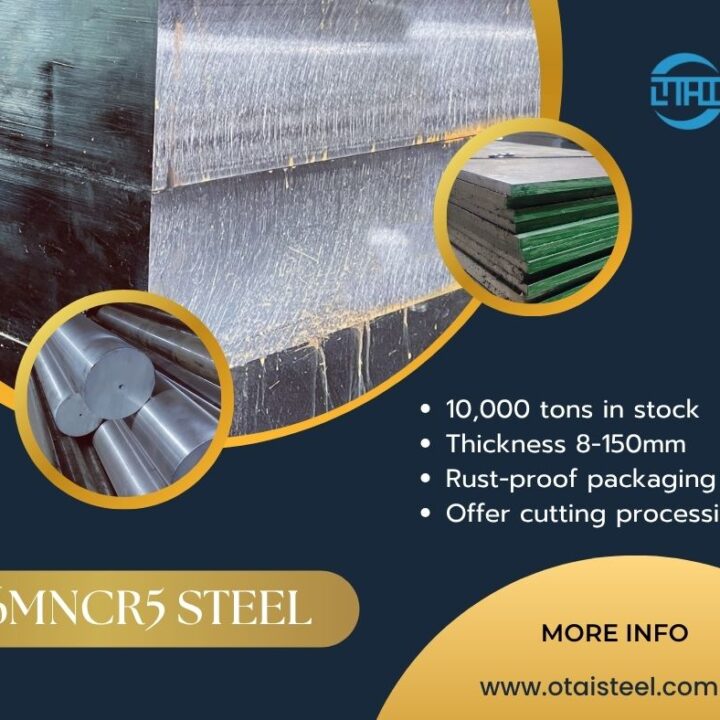
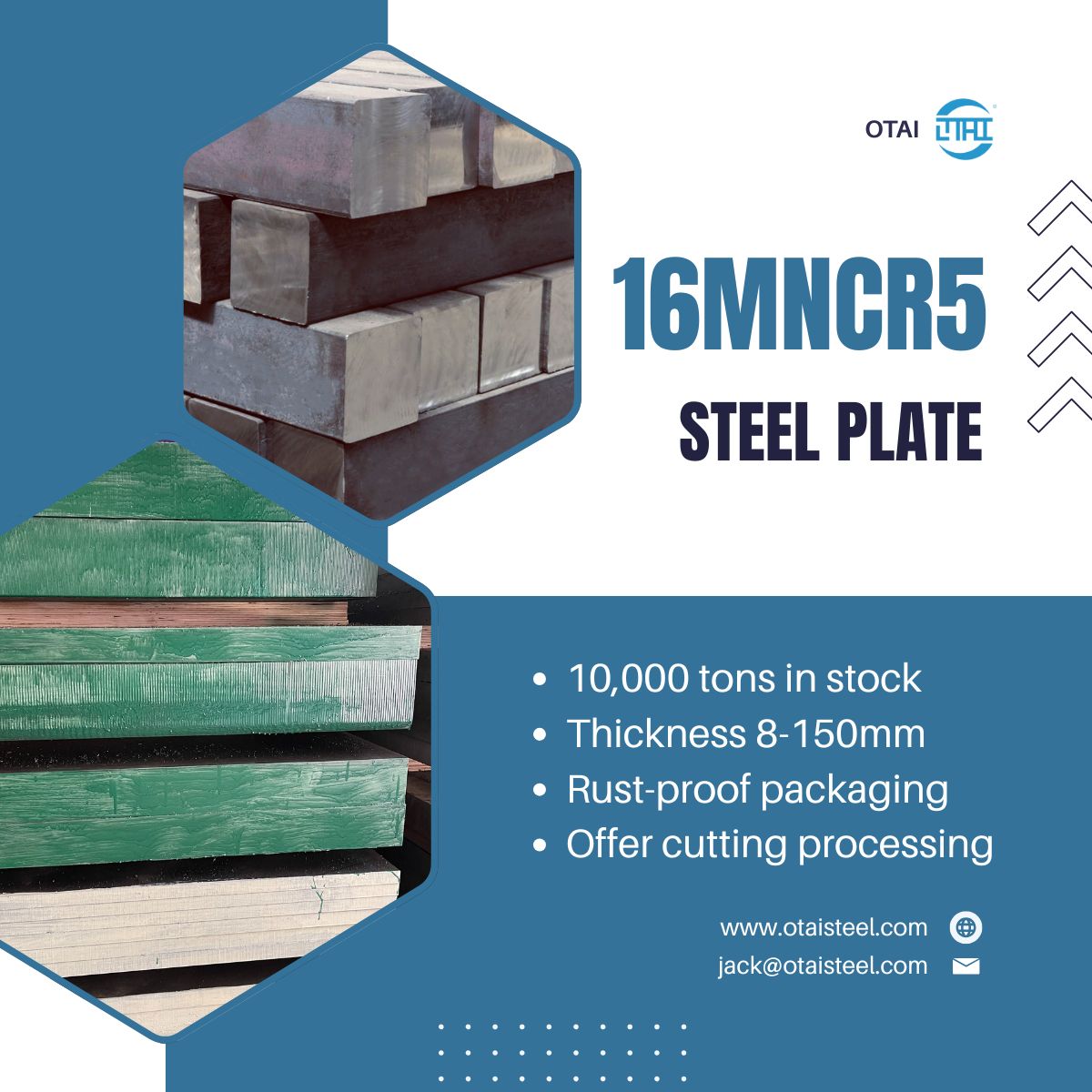
- Stock availability: Otai provides 8–150mm thickness 16MnCr5 steel plates available in stock to support different machining and production requirements.
- Customized cutting service: Professional cutting and processing services help customers reduce preparation time and improve production efficiency.
- Heat treatment support: Carburizing, quenching, tempering, and other heat treatment processes can be arranged according to application requirements.
- Quality inspection: Ultrasonic testing (UT) and third-party inspection services are available for customers requiring strict quality control.
- Technical material support: Otai helps customers select suitable alloy steel grades according to mechanical requirements.
- International supply experience: Otai supplies special steel materials to customers from different industries worldwide.
- Safe packaging: Anti-rust protection, steel strapping, and wooden box packaging ensure safe transportation.
With stable inventory, professional processing capability, and quality control systems, Otai Special Steel provides reliable 16MnCr5 solutions for customers requiring consistent material performance.
❓ FAQ About 16MnCr5 Elongation
Q1: What is the typical 16MnCr5 elongation value?
The typical elongation of 16MnCr5 steel is usually around 10–14% depending on material condition, heat treatment, and testing standards.
Q2: Does heat treatment affect 16MnCr5 elongation?
Yes. Carburizing, quenching, and hardening increase strength and hardness but usually reduce elongation. Tempering can improve toughness and balance mechanical properties.
Q3: Why is elongation important for 16MnCr5 steel?
Elongation indicates the ductility of the material and shows how much deformation it can withstand before fracture during tensile testing.
Q4: Is higher elongation always better for 16MnCr5?
Not always. 16MnCr5 is mainly selected for carburizing performance, wear resistance, and fatigue strength. The best material condition depends on the application requirements.
Q5: Does Otai supply 16MnCr5 steel plates?
Yes. Otai supplies 16MnCr5 steel plates with 8–150mm thickness stock availability, cutting service, heat treatment support, ultrasonic testing, and customized solutions.