 16MnCr5 vs SAE 8620: Chemical Composition, Properties and Gear Steel Selection
📑 Table of Contents
🔍 1. 16MnCr5 vs SAE 8620: Understanding Two Carburizing Steels
🧪 2. Chemical Composition Comparison Between 16MnCr5 and SAE 8620
⚙️ 3. 16MnCr5 and SAE 8620 Manufacturing Characteristics
📊 4. 16MnCr5 vs SAE 8620 Mechanical Properties Comparison
🔥 5. 16MnCr5 vs SAE 8620 Carburizing and Hardness Performance
🔧 6. Which Is Better 16MnCr5 or SAE 8620?
🏢 Otai Special Steel Advantages
❓ FAQ About 16MnCr5 vs SAE 8620
🔍 1. 16MnCr5 vs SAE 8620: Understanding Two Carburizing Steels
When engineers search for 16MnCr5 vs SAE 8620, they usually want to understand the differences between two popular carburizing steels used for gears, shafts, and transmission components.
Both 16MnCr5 and SAE 8620 belong to the low-carbon alloy steel family. They are designed for carburizing treatment, which creates a hard wear-resistant surface while maintaining a tough and impact-resistant core.
Although these two materials have similar applications, they are not identical. Their alloy designs, chemical compositions, hardenability, and performance characteristics are different.
The difference between 16MnCr5 and SAE 8620 mainly comes from their alloy elements. 16MnCr5 relies mainly on manganese and chromium, while SAE 8620 uses nickel, chromium, and molybdenum to improve toughness and hardenability.
Basic Information Comparison
| Item | 16MnCr5 | SAE 8620 |
|---|---|---|
| Steel Type | Low-carbon Mn-Cr carburizing steel | Low-carbon Ni-Cr-Mo carburizing steel |
| Standard | EN 10084 | AISI / SAE standard |
| Material Number | 1.7131 | 8620 |
| Main Alloy Elements | Manganese and Chromium | Nickel, Chromium and Molybdenum |
| Main Applications | Gears, shafts, mechanical parts | Gears, transmission parts, heavy-duty components |
Why Are These Two Grades Compared?
Manufacturers often compare these materials because both grades can achieve excellent surface hardness after carburizing.
| Comparison Reason | Importance |
|---|---|
| Similar applications | Both are widely used for gears and transmission components |
| Heat treatment compatibility | Both can achieve hardened surfaces through carburizing |
| Global availability | Both are internationally recognized engineering steels |
| Mechanical performance | Both provide a balance of wear resistance and toughness |
However, choosing between them requires a detailed analysis of operating conditions, component size, required hardness, and manufacturing requirements.
🧪 2. Chemical Composition Comparison Between 16MnCr5 and SAE 8620
Chemical composition is the key factor when analyzing 16MnCr5 and SAE 8620 chemical composition.
The alloy elements determine hardenability, carburizing response, toughness, and final component performance after heat treatment.
Chemical Composition Comparison
| Element | 16MnCr5 (%) | SAE 8620 (%) |
|---|---|---|
| Carbon (C) | 0.14–0.19 | 0.18–0.23 |
| Manganese (Mn) | 1.00–1.30 | 0.70–0.90 |
| Chromium (Cr) | 0.80–1.10 | 0.40–0.60 |
| Nickel (Ni) | Usually not added | 0.40–0.70 |
| Molybdenum (Mo) | Usually not added | 0.15–0.25 |
How Alloy Elements Affect Performance
| Element | Influence |
|---|---|
| Carbon | Controls hardness potential after heat treatment |
| Manganese | Improves hardenability and strength |
| Chromium | Improves wear resistance and hardening response |
| Nickel | Improves toughness and impact resistance |
| Molybdenum | Improves hardenability and high-temperature performance |
The composition difference explains why SAE 8620 usually provides better toughness for larger components, while 16MnCr5 offers an excellent balance of hardness, machinability, and cost-effective performance.
⚙️ 3. 16MnCr5 and SAE 8620 Manufacturing Characteristics
Manufacturing performance is another important factor in the 16MnCr5 vs SAE 8620 steel comparison.
Before carburizing, both steels provide good machinability. After heat treatment, they develop hardened surfaces suitable for demanding mechanical applications.
Manufacturing Performance Comparison
| Feature | 16MnCr5 | SAE 8620 |
|---|---|---|
| Machinability | Good before carburizing | Good before carburizing |
| Carburizing Response | Excellent | Excellent |
| Hardenability | Good | Higher due to Ni-Cr-Mo alloying |
| Large Section Performance | Suitable for medium sections | Better for larger components |
| Heat Treatment Control | Requires proper carburizing process | Requires proper carburizing process |
For small and medium-sized gears, 16MnCr5 provides reliable performance. For larger components requiring deeper hardening and higher toughness, SAE 8620 is often preferred.
📊 4. 16MnCr5 vs SAE 8620 Mechanical Properties Comparison
Mechanical properties are one of the most important factors when evaluating 16MnCr5 vs SAE 8620 steel comparison. Although both materials are carburizing steels, their different alloy systems create different performance characteristics.
16MnCr5 provides a good combination of surface hardness, core strength, and machining performance. SAE 8620 uses nickel and molybdenum additions to achieve improved toughness and deeper hardening ability.
Mechanical Properties Comparison
| Property | 16MnCr5 | SAE 8620 |
|---|---|---|
| Tensile Strength | Approximately 800–1100 MPa after heat treatment | Approximately 900–1200 MPa after heat treatment |
| Yield Strength | Approximately 500–800 MPa | Approximately 600–900 MPa |
| Surface Hardness After Carburizing | High hardness suitable for gears | High hardness with excellent wear resistance |
| Core Toughness | Good | Very good |
| Fatigue Resistance | Excellent for general gear applications | Excellent for heavy-duty components |
Strength and Toughness Difference
The main difference between these steels appears in core performance after carburizing.
| Performance Aspect | Better Choice | Reason |
|---|---|---|
| General gear manufacturing | 16MnCr5 | Provides balanced hardness and toughness |
| Large transmission components | SAE 8620 | Higher hardenability and toughness |
| Deep carburized layer | SAE 8620 | Nickel and molybdenum improve hardening depth |
| Cost-effective gear production | 16MnCr5 | Efficient performance for many applications |
Therefore, neither material is universally better. The correct choice depends on component size, loading conditions, and final performance requirements.
🔥 5. 16MnCr5 vs SAE 8620 Carburizing and Hardness Performance
Carburizing is the most important heat treatment process for both materials. It increases surface carbon content, allowing the steel surface to achieve high hardness while maintaining a tough core.
The comparison of 16MnCr5 vs 8620 carburizing steel mainly focuses on carburized layer depth, surface hardness, and core toughness.
Carburizing Performance Comparison
| Feature | 16MnCr5 | SAE 8620 |
|---|---|---|
| Carburizing Capability | Excellent | Excellent |
| Surface Hardness | Approximately 58–62 HRC after carburizing | Approximately 58–63 HRC after carburizing |
| Core Hardness | Good balance | Higher toughness core |
| Hardening Depth | Suitable for medium components | Suitable for deeper hardening requirements |
| Distortion Control | Good with proper treatment | Good with proper treatment |
Hardness Comparison After Carburizing
| Area | 16MnCr5 Performance | SAE 8620 Performance |
|---|---|---|
| Surface Layer | High hardness and wear resistance | High hardness and excellent wear resistance |
| Core Area | Tough and impact-resistant | Higher toughness due to alloy design |
| Gear Teeth | Excellent performance | Excellent performance |
| Heavy Load Applications | Good | Very good |
For many standard gear applications, both steels provide excellent results. However, SAE 8620 may provide advantages when components require deeper carburizing and higher impact resistance.
🔧 6. Which Is Better 16MnCr5 or SAE 8620?
The question of which is better 16MnCr5 or SAE 8620 depends on the application requirements rather than the steel grade itself.
Both materials are widely used in gear manufacturing, but engineers should select the grade according to component design, production conditions, and working environment.
Selection Guide: 16MnCr5 vs SAE 8620
| Requirement | Recommended Material |
|---|---|
| European standard projects | 16MnCr5 |
| Need DIN / EN material certification | 16MnCr5 |
| Heavy-duty gears | SAE 8620 |
| Large components requiring deeper hardening | SAE 8620 |
| General transmission gears | Both materials can work |
| Need higher toughness | SAE 8620 |
When Should You Choose 16MnCr5?
- European engineering projects: when EN standards are required.
- Gear production: when balanced hardness and toughness are needed.
- Medium-sized components: where extreme hardenability is not required.
- Cost-efficient manufacturing: when reliable carburizing performance is the priority.
When Should You Choose SAE 8620?
- Heavy-duty transmission parts: where higher toughness is important.
- Large-section components: requiring deeper hardening.
- High-impact applications: requiring stronger core performance.
- American standard projects: where SAE specifications are preferred.
In summary, 16MnCr5 and SAE 8620 are both excellent carburizing steels. The final decision should consider technical specifications, heat treatment capability, and application requirements.
🏭 7. Applications of 16MnCr5 and SAE 8620 Steel
Industries that require high surface hardness, excellent wear resistance, and a tough internal structure widely use both 16MnCr5 and SAE 8620 as carburizing steels.
Although the two materials have similar applications, engineers usually select between them based on component size, loading conditions, required hardening depth, and regional material standards.
The correct choice in the 16MnCr5 vs SAE 8620 steel comparison helps manufacturers achieve better component reliability and longer service life.
Common Applications of 16MnCr5 and SAE 8620
| Industry | Components | Recommended Grade |
|---|---|---|
| Automotive Industry | Transmission gears, shafts, sprockets | 16MnCr5 / SAE 8620 |
| Heavy Machinery | Drive gears, power transmission parts | SAE 8620 preferred for larger parts |
| Industrial Equipment | Gear wheels, rollers, mechanical components | 16MnCr5 |
| Agricultural Machinery | Gears, rotating shafts, wear parts | 16MnCr5 / SAE 8620 |
| Precision Machinery | Small gears and mechanical components | 16MnCr5 |
Gear Manufacturing Comparison
Gears are the most common application for both steels. The carburized surface provides excellent resistance against contact stress and wear, while the tough core prevents cracking under impact loads.
| Gear Requirement | 16MnCr5 | SAE 8620 |
|---|---|---|
| Wear resistance | Excellent | Excellent |
| Impact resistance | Good | Very good |
| Large gear application | Suitable for medium sizes | Better choice |
| Automotive transmission | Commonly used | Commonly used |
| Long service life | Excellent after proper treatment | Excellent after proper treatment |
How to Select Between 16MnCr5 and SAE 8620?
Before replacing one material with another, manufacturers should evaluate several technical factors.
| Evaluation Factor | Question to Consider |
|---|---|
| Component size | Does the part require deep hardening? |
| Working load | Is the component exposed to heavy impact? |
| Heat treatment process | Can the factory achieve the required carburizing result? |
| Standard requirement | Does the customer require EN or SAE specifications? |
| Material availability | Which grade provides more stable supply? |
In general, 16MnCr5 is an excellent choice for many European gear and mechanical applications, while engineers often select SAE 8620 for larger or more demanding components requiring higher toughness.
🏢 Otai Special Steel Advantages
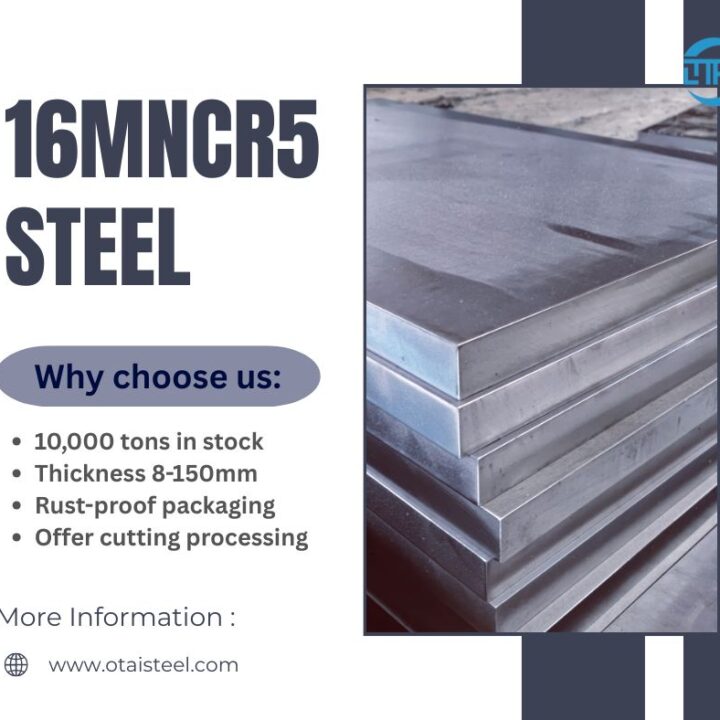
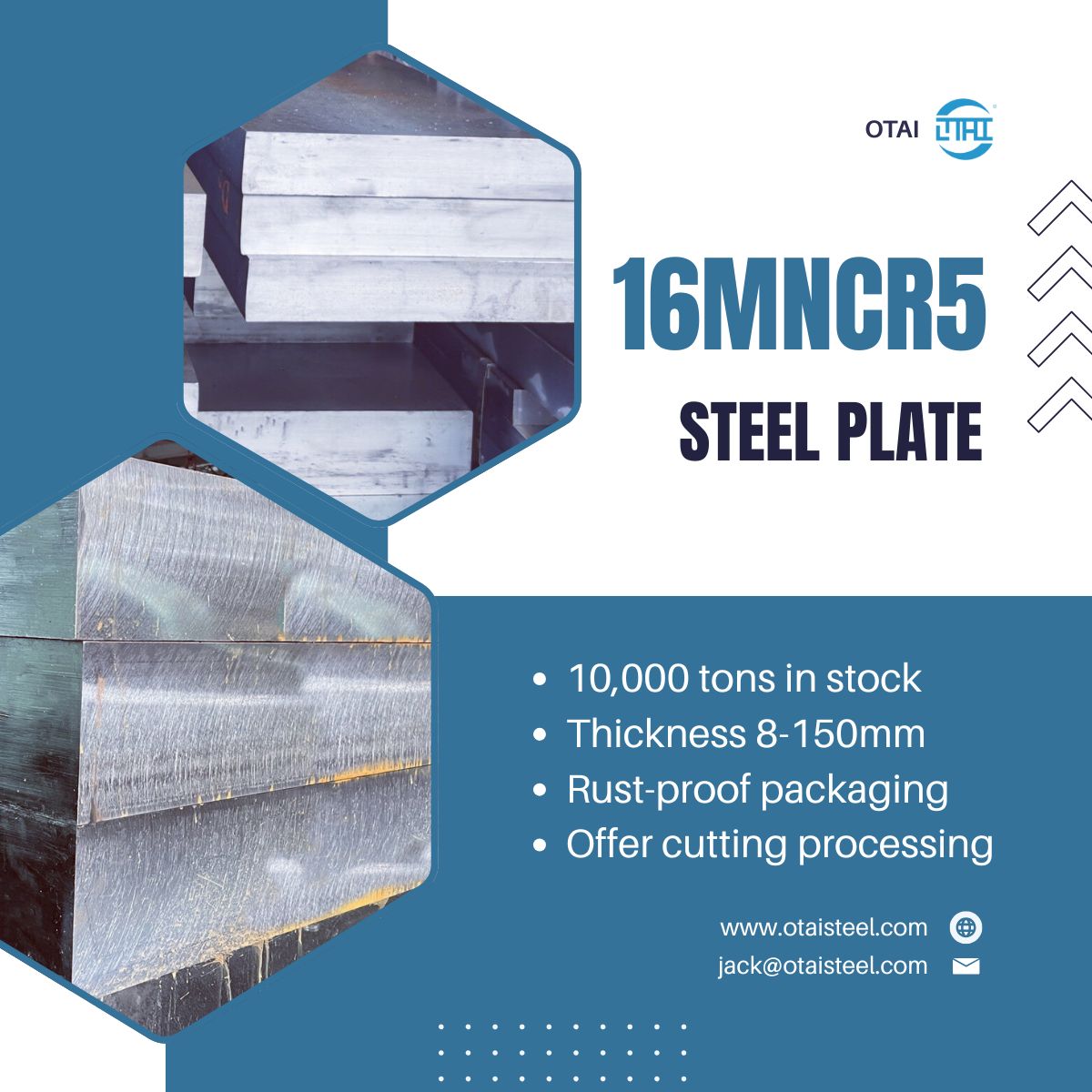
Otai Special Steel supplies high-quality 16MnCr5 steel plates and provides professional alloy steel solutions for customers requiring carburizing steel for gears, shafts, and mechanical components.
- Stable inventory: Otai keeps 8–150mm thickness 16MnCr5 steel plates available in stock to support different customer requirements and reduce waiting time.
- Different sizes available: Various dimensions of 16MnCr5 plates can be supplied according to machining and production needs.
- Cutting and processing service: Professional cutting and customized processing help customers improve production efficiency.
- Heat treatment support: Normalizing, carburizing-related processes, quenching, and tempering services can be arranged according to project requirements.
- Quality inspection: Ultrasonic testing (UT) and third-party inspection services are available for customers with strict quality requirements.
- International supply experience: Otai has experience providing alloy steel materials for customers from different industries worldwide.
- Safe packaging: Anti-rust protection, steel strapping, and wooden box packaging ensure safe transportation.
With reliable stock availability, professional processing capability, and technical support, Otai provides dependable 16MnCr5 steel solutions for global gear and mechanical component manufacturers.
❓ FAQ About 16MnCr5 vs SAE 8620
Q1: What is the main difference between 16MnCr5 and SAE 8620?
The main difference is the alloy system. 16MnCr5 is a manganese-chromium carburizing steel, while SAE 8620 contains nickel, chromium, and molybdenum to improve toughness and hardenability.
Q2: Is 16MnCr5 equivalent to SAE 8620?
No. 16MnCr5 and SAE 8620 are not identical materials. They can replace each other in some applications, but engineers should confirm chemical composition, heat treatment requirements, and mechanical properties.
Q3: Which steel is better for gears, 16MnCr5 or SAE 8620?
Both are suitable for gear manufacturing. 16MnCr5 works well for many medium-sized gears, while SAE 8620 is often preferred for larger gears requiring deeper hardening and higher toughness.
Q4: Can 16MnCr5 and SAE 8620 achieve the same hardness?
Yes. Both materials can achieve high surface hardness after carburizing. However, their core properties and hardening depth may differ.
Q5: Can Otai supply 16MnCr5 steel plates?
Yes. Otai supplies 16MnCr5 steel plates with 8–150mm thickness available in stock, different sizes, cutting service, heat treatment support, and ultrasonic testing options.