 Properties of 16MnCr5 Steel: Mechanical Performance, Hardness and Applications
📑 Table of Contents
📌 1. What Are the Properties of 16MnCr5 Steel?
⚙️ 2. Chemical Composition Influence on 16MnCr5 Properties
🔥 3. Heat Treatment Effects on 16MnCr5 Steel Properties
📊 4. Mechanical Properties of 16MnCr5 Steel
🔬 5. Microstructure and Performance Relationship
⚖️ 6. 16MnCr5 Properties Compared with Similar Steels
⚙️ 7. Industrial Applications Based on 16MnCr5 Properties
🏢 Otai Special Steel Advantages
❓ FAQ About Properties of 16MnCr5
📌 1. What Are the Properties of 16MnCr5 Steel?
When engineers search for properties of 16mncr5, they usually want to understand how this alloy steel performs in terms of strength, hardness, toughness, wear resistance, and industrial applications.
16MnCr5 is a low-carbon chromium-manganese alloy steel designed for case-hardening applications. It belongs to the EN 10084 standard family and is widely used for gears, shafts, sprockets, and mechanical transmission components.
The most important feature of 16MnCr5 is its ability to achieve a very hard surface after carburizing while maintaining a tough and shock-resistant core. This combination allows components to withstand repeated loads and friction during operation.
Unlike high-carbon steels that become hard throughout the entire section, 16MnCr5 develops hardness mainly on the surface. This design improves wear resistance without sacrificing internal toughness.
The balanced design of its chemical composition gives 16MnCr5 steel properties that are suitable for demanding mechanical applications where durability and reliability are required.
Basic Information About 16MnCr5 Steel
| Item | Description |
|---|---|
| Steel Grade | 16MnCr5 |
| Standard | EN 10084 |
| Steel Type | Low-carbon case-hardening alloy steel |
| Main Alloy Elements | Manganese (Mn), Chromium (Cr) |
| Carbon Content | Approximately 0.14–0.19% |
| Main Uses | Gears, shafts, transmission components |
Main Properties of 16MnCr5 Steel
| Property | Description |
|---|---|
| Hardness | High surface hardness after carburizing |
| Toughness | Good core toughness and impact resistance |
| Wear Resistance | Excellent after surface hardening |
| Machinability | Good before heat treatment |
| Fatigue Resistance | Suitable for repeated loading conditions |
| Dimensional Stability | Good response during heat treatment |
Why Are 16MnCr5 Properties Important for Engineering Applications?
Mechanical components such as gears and shafts often experience a combination of friction, impact, and cyclic stress. Therefore, materials must provide both surface durability and internal strength.
| Engineering Requirement | 16MnCr5 Performance |
|---|---|
| Resistance to surface damage | Achieved through carburized hard layer |
| Resistance to cracking | Supported by tough core structure |
| Long service life | Improved fatigue resistance |
| Manufacturing efficiency | Good machinability before treatment |
For these reasons, 16MnCr5 remains one of the most widely selected case-hardening steels in European mechanical engineering.
⚙️ 2. Chemical Composition Influence on 16MnCr5 Properties
The chemical composition directly controls the final 16MnCr5 material properties. The carefully balanced amounts of carbon, manganese, and chromium allow the steel to achieve excellent carburizing performance.
Carbon provides the ability to form a hard surface layer. Meanwhile, manganese and chromium improve hardenability and strengthen the steel structure.
16MnCr5 Chemical Composition
| Element | Typical Content | Influence on Properties |
|---|---|---|
| Carbon (C) | 0.14–0.19% | Provides carburizing response and surface hardness |
| Manganese (Mn) | 1.00–1.30% | Improves strength and hardenability |
| Chromium (Cr) | 0.80–1.10% | Improves wear resistance and hardening ability |
| Silicon (Si) | ≤0.40% | Supports steel quality |
| Phosphorus (P) | ≤0.025% | Controlled impurity |
| Sulfur (S) | ≤0.035% | Controls machinability |
Effect of Alloying Elements on Performance
| Element | Main Contribution |
|---|---|
| Carbon | Creates high hardness after carburizing |
| Manganese | Improves strength and core performance |
| Chromium | Enhances wear resistance and hardenability |
| Silicon | Improves steel manufacturing quality |
The combination of these alloying elements creates the foundation for the excellent 16MnCr5 chemical composition and properties required in gear manufacturing and mechanical industries.
🔥 3. Heat Treatment Effects on 16MnCr5 Steel Properties
Heat treatment is one of the most important factors affecting the final performance of 16MnCr5. The steel achieves its best properties through carburizing, quenching, and tempering.
After treatment, the surface becomes extremely hard while the core maintains excellent toughness.
Heat Treatment Process and Effects
| Process | Effect on Material |
|---|---|
| Carburizing | Increases carbon concentration on the surface |
| Quenching | Creates hard martensitic surface structure |
| Tempering | Improves toughness and reduces brittleness |
After carburizing treatment, 16MnCr5 hardness after carburizing can typically reach around 58–62 HRC on the hardened surface, making it suitable for wear-resistant components.
📊 4. Mechanical Properties of 16MnCr5 Steel
The mechanical performance of 16MnCr5 depends on its delivery condition and heat treatment process. Before carburizing, the material provides good machinability. After carburizing and quenching, it develops excellent surface hardness and wear resistance.
Understanding the 16MnCr5 mechanical properties helps engineers select the correct material for gears, shafts, and other components exposed to friction and repeated loading.
Typical Mechanical Properties of 16MnCr5 Steel Before Carburizing
| Property | Typical Value | Engineering Meaning |
|---|---|---|
| Tensile Strength | Approximately 600–800 MPa | Resistance against pulling forces |
| Yield Strength | Approximately 400–600 MPa | Ability to resist permanent deformation |
| Elongation | Approximately 10–15% | Ductility before fracture |
| Hardness | Approx. 170–220 HB | Suitable condition for machining |
| Impact Resistance | Good | Supports mechanical shock loading |
Mechanical Properties After Carburizing and Quenching
The main advantage of 16MnCr5 is the ability to create a hardened surface while keeping the core relatively tough.
| Area | Typical Property | Performance Benefit |
|---|---|---|
| Surface Layer | 58–62 HRC | Excellent wear resistance |
| Core | Lower hardness with high toughness | Good impact resistance |
| Case Depth | Depends on carburizing process | Controls service performance |
Relationship Between Mechanical Properties and Applications
| Property | Application Advantage |
|---|---|
| High surface hardness | Suitable for gears under friction |
| Strong core toughness | Prevents cracking during impact |
| Good fatigue strength | Suitable for rotating components |
| Good machinability | Reduces production difficulty before treatment |
These balanced characteristics explain why EN 16MnCr5 steel properties are highly valued in automotive and industrial machinery applications.
🔬 5. Microstructure and Performance Relationship
The microstructure has a direct influence on the final properties of 16MnCr5 steel. The combination of surface hardness and core toughness comes from controlling the internal structure through heat treatment.
Before carburizing, 16MnCr5 normally contains a ferrite-pearlite structure. After carburizing and quenching, the surface transforms into a hard martensitic layer.
Microstructure of 16MnCr5 Steel
| Condition | Microstructure | Main Characteristics |
|---|---|---|
| Before Heat Treatment | Ferrite + Pearlite | Good machinability and moderate strength |
| After Carburizing | High-carbon surface layer | Improved wear resistance |
| After Quenching | Martensitic surface | High hardness |
| After Tempering | Tempered martensite + tough core | Better balance between hardness and toughness |
How Microstructure Controls 16MnCr5 Properties
| Microstructural Feature | Effect on Performance |
|---|---|
| Fine grain structure | Improves strength and toughness |
| Hard martensitic surface | Improves wear resistance |
| Tough core structure | Improves impact resistance |
| Uniform transformation | Improves dimensional stability |
The controlled microstructure is the reason why 16MnCr5 can achieve high surface hardness without becoming excessively brittle.
⚖️ 6. 16MnCr5 Properties Compared with Similar Case Hardening Steels
When selecting case-hardening steels, engineers often compare 16MnCr5 with similar grades such as 20MnCr5 and 8620. Although these steels share similar applications, their alloy systems create different performance characteristics.
16MnCr5 vs 20MnCr5
| Feature | 16MnCr5 | 20MnCr5 |
|---|---|---|
| Carbon Content | Approx. 0.16% | Approx. 0.20% |
| Main Alloy | Mn + Cr | Mn + Cr |
| Carburizing Performance | Excellent | Excellent |
| Typical Use | Gears and shafts | Higher-load gear components |
| Core Toughness | Very good | Very good |
16MnCr5 vs 8620 Steel
| Feature | 16MnCr5 | 8620 |
|---|---|---|
| Steel System | Cr-Mn alloy steel | Ni-Cr-Mo alloy steel |
| Main Advantage | Good carburizing performance | Higher toughness due to nickel addition |
| Application | European gear manufacturing | Automotive and heavy-duty components |
| Cost Efficiency | Generally economical | Usually higher cost |
Comparison Summary
| Requirement | Recommended Material |
|---|---|
| General gear production | 16MnCr5 |
| Higher load transmission parts | 20MnCr5 or 8620 |
| Need for cost-effective case hardening | 16MnCr5 |
| High toughness requirements | 8620 |
For many industrial applications, 16MnCr5 provides an excellent balance between performance, availability, and production efficiency.
⚙️ 7. Industrial Applications Based on 16MnCr5 Properties
The excellent combination of hardness, toughness, and wear resistance makes 16MnCr5 one of the most widely used case-hardening steels in mechanical engineering. The properties of 16mncr5 allow manufacturers to produce components that can withstand heavy loads, friction, and repeated operating cycles.
Because of its carburizing capability, 16MnCr5 is especially suitable for parts that require a hard external surface and a strong internal structure. This makes it a preferred choice for automotive, machinery, and power transmission industries.
Common Applications of 16MnCr5 Steel
| Industry | Typical Components | Why 16MnCr5 Is Selected |
|---|---|---|
| Automotive Industry | Transmission gears, shafts, drive components | Excellent fatigue strength and wear resistance |
| Gear Manufacturing | Gear wheels, pinions, sprockets | Hard surface after carburizing |
| Industrial Machinery | Rotating shafts, mechanical parts | Good balance of strength and toughness |
| Agricultural Equipment | Drive parts and gear systems | Reliable performance under impact loads |
| Heavy Equipment | Transmission components | Long service life under repeated stress |
Why 16MnCr5 Is Suitable for Gear Applications
| Gear Requirement | 16MnCr5 Performance |
|---|---|
| Contact wear resistance | High surface hardness after carburizing |
| Impact resistance | Tough core prevents sudden failure |
| Fatigue performance | Suitable for repeated loading conditions |
| Manufacturing efficiency | Good machinability before heat treatment |
| Service reliability | Stable mechanical properties |
These advantages explain why 16MnCr5 steel properties are widely recognized in the production of precision gears and mechanical transmission systems.
🏭 8. How to Select the Right 16MnCr5 Steel for Your Project
Selecting the correct material condition is important because the final performance depends not only on the steel grade but also on heat treatment, dimensions, and quality control.
| Selection Factor | Recommendation |
|---|---|
| Component Type | Choose 16MnCr5 for gears, shafts, and transmission parts |
| Required Surface Hardness | Use carburizing treatment for high wear resistance |
| Core Strength Requirement | Adjust heat treatment parameters according to application |
| Material Size | Select suitable thickness and machining allowance |
| Quality Requirement | Consider ultrasonic testing and inspection services |
For industrial buyers, choosing a reliable supplier is equally important. Stable inventory, accurate cutting, proper packaging, and quality inspection help reduce production risks.
🏢 Otai Special Steel Advantages
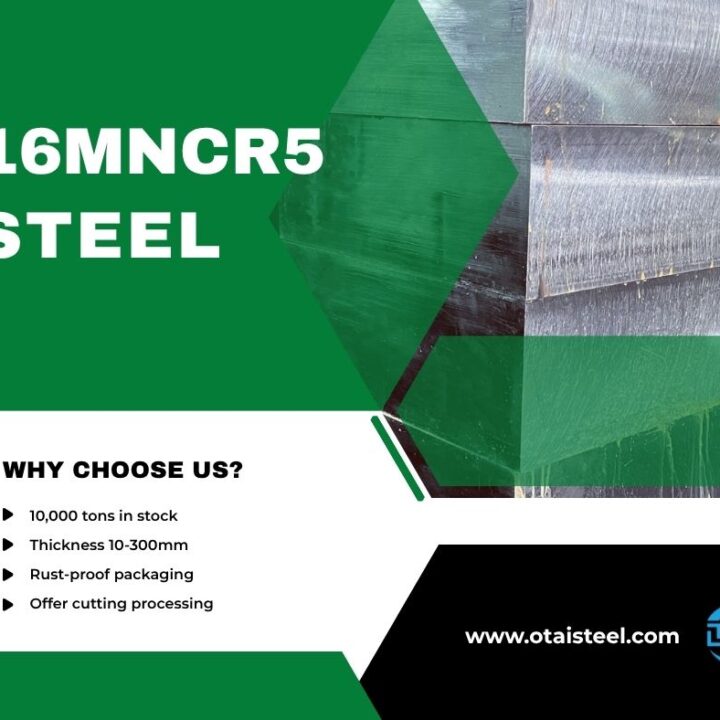
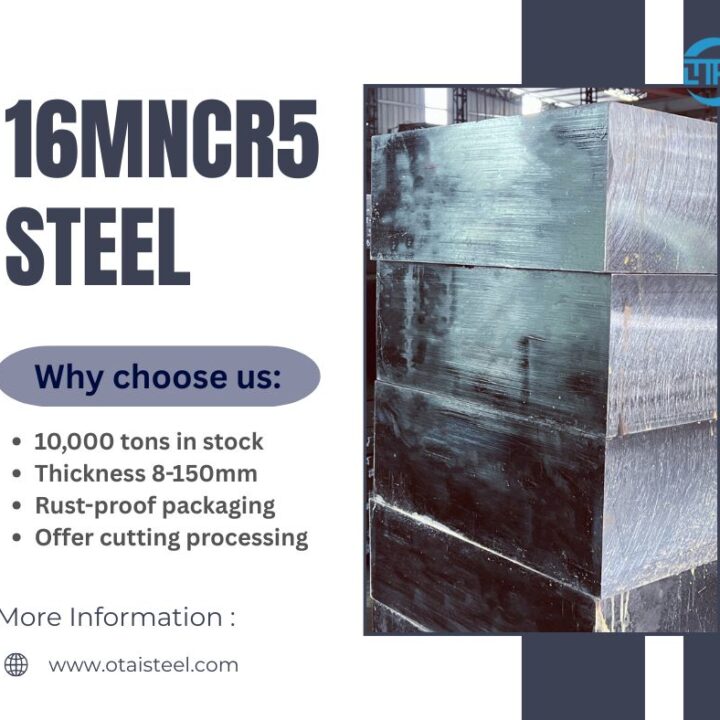
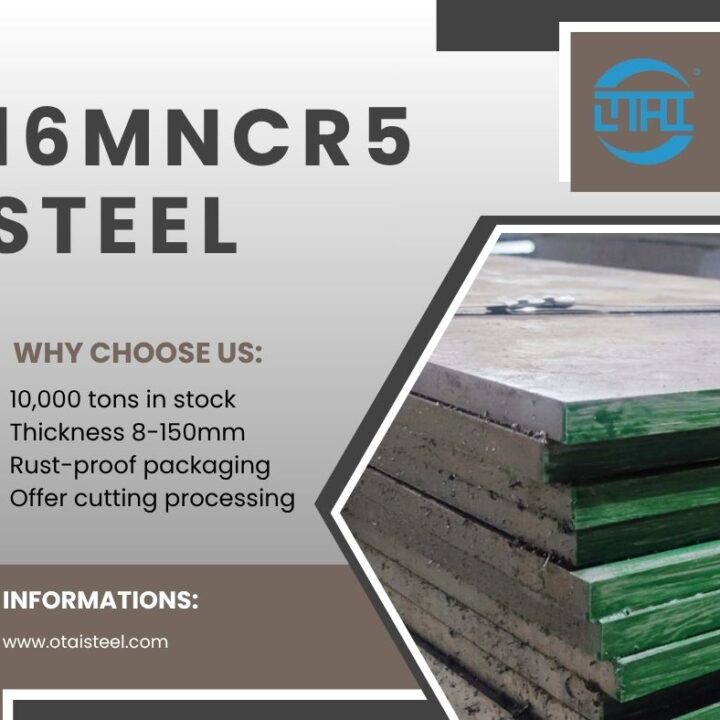
Otai Special Steel supplies high-quality 16MnCr5 steel plates and provides professional services for customers requiring reliable alloy steel materials for industrial applications.
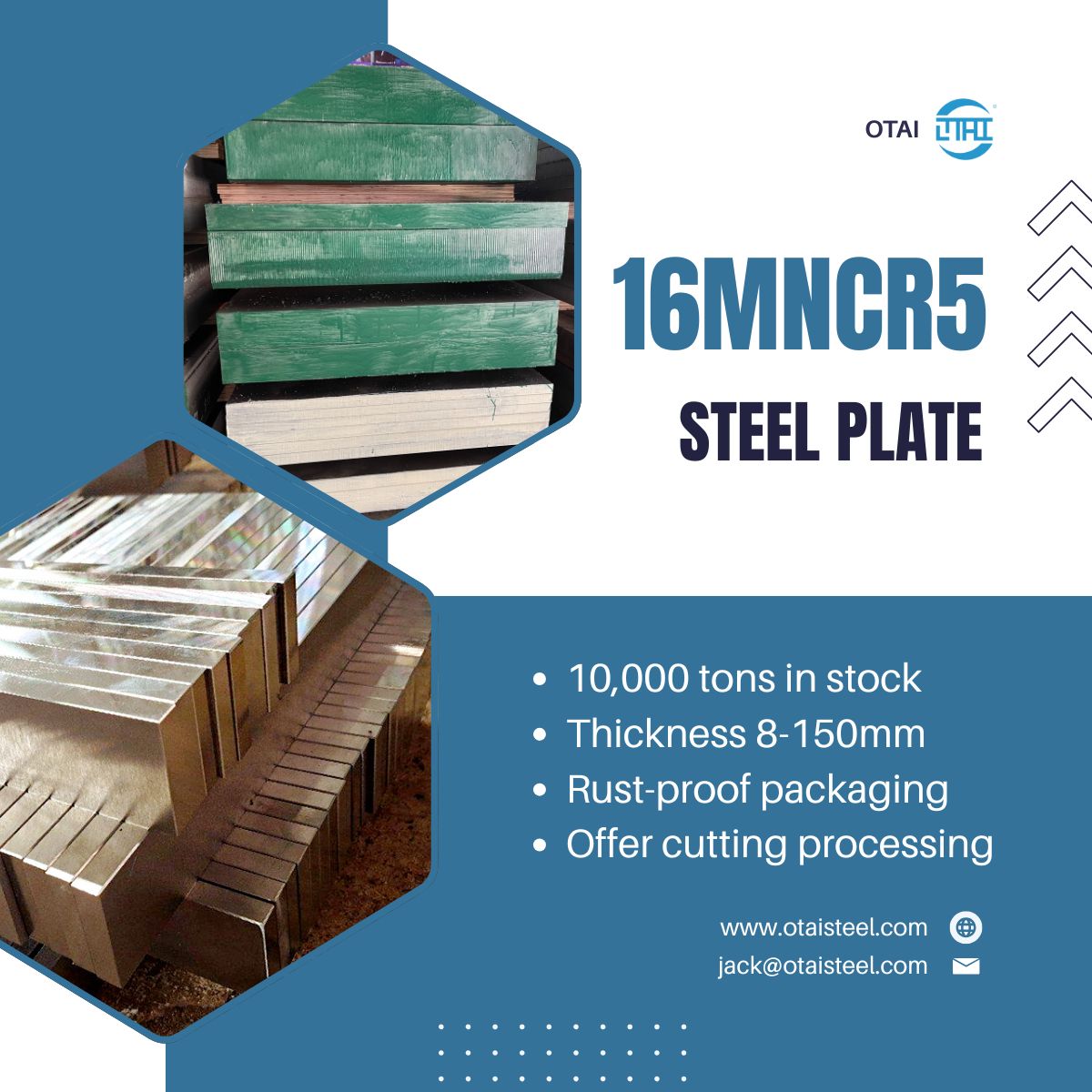
- Stock availability: Otai provides 8–150mm thickness 16MnCr5 steel plates available in stock to meet different project requirements and support faster delivery.
- Various sizes available: Different dimensions of 16MnCr5 steel plates can be supplied according to customer drawings and specifications.
- Cutting and processing service: Customized cutting, machining, and surface processing services are available to improve production efficiency.
- Heat treatment support: Professional heat treatment solutions, including carburizing, quenching, and tempering, can be arranged.
- Quality inspection: Ultrasonic testing and third-party inspection services are available for customers with strict quality requirements.
- International supply experience: Otai has experience supplying alloy steels to global customers with demanding technical standards.
- Safe packaging: Anti-rust packaging, steel strapping, and wooden box packaging ensure safe transportation during international shipping.
With reliable stock and technical support, Otai helps customers obtain consistent EN 16MnCr5 steel properties for gears, shafts, and other mechanical components.
❓ FAQ About Properties of 16MnCr5
Q1: What are the main properties of 16MnCr5 steel?
The main properties of 16MnCr5 include good machinability, excellent carburizing performance, high surface hardness after treatment, good fatigue strength, and a tough internal core.
Q2: What is the hardness of 16MnCr5 after carburizing?
The surface hardness of carburized 16MnCr5 can typically reach around 58–62 HRC, depending on the carburizing and quenching process.
Q3: What are the mechanical properties of 16MnCr5?
The 16MnCr5 mechanical properties include tensile strength around 600–800 MPa, yield strength around 400–600 MPa, and good elongation before heat treatment.
Q4: Is 16MnCr5 suitable for gear manufacturing?
Yes. 16MnCr5 is widely used for gears because it provides a wear-resistant surface and a tough core after carburizing.
Q5: What is the difference between 16MnCr5 and 20MnCr5?
Both are case-hardening steels, but 20MnCr5 contains slightly higher carbon content and may provide different hardening characteristics for heavier applications.
Q6: Does Otai supply 16MnCr5 steel plates?
Yes. Otai supplies 16MnCr5 steel plates with stock availability, cutting service, heat treatment support, and inspection options.