 16MnCr5 Elongation: Mechanical Properties and Engineering Meaning
📑 Table of Contents
🔍 1. What Is 16MnCr5 Elongation?
⚙️ 2. Importance of Elongation in 16MnCr5 Steel
📊 3. 16MnCr5 Mechanical Properties Overview
🔥 4. Factors Affecting 16MnCr5 Elongation
🏭 5. Applications Based on Elongation Performance
🏢 Otai Special Steel Advantages
❓ FAQ About 16MnCr5 Elongation
🔍 1. What Is 16MnCr5 Elongation?
When engineers search for 16MnCr5 elongation, they usually want to understand the ductility and deformation capability of this carburizing steel grade before selecting it for mechanical components.
Elongation is one of the most important mechanical properties used to describe how much a steel sample can stretch before fracture during a tensile test.
For 16MnCr5 steel, elongation reflects the material’s ability to absorb deformation while maintaining sufficient strength and toughness.
As a low-carbon alloy carburizing steel, 16MnCr5 is designed to provide a hard surface after carburizing while keeping a tough and ductile core.
This balanced structure makes the elongation value important for applications such as gears, shafts, and transmission components where both strength and resistance to impact are required.
Basic Information About 16MnCr5 Steel
| Item | Description |
|---|---|
| Steel Grade | 16MnCr5 |
| Material Number | 1.7131 |
| Standard | EN 10084 |
| Steel Type | Case hardening alloy steel |
| Main Alloy Elements | Manganese and chromium |
| Main Feature | Hard surface with tough core after carburizing |
What Does Elongation Mean in Steel?
Elongation is normally expressed as a percentage (%). It represents the increase in the original length of a tensile specimen after fracture.
| Elongation Value | Material Behavior |
|---|---|
| Low elongation | Higher brittleness and limited deformation ability |
| Medium elongation | Balanced strength and ductility |
| High elongation | Better forming ability and toughness |
A suitable elongation value helps engineers determine whether a material can withstand manufacturing processes and service loads without unexpected cracking.
⚙️ 2. Importance of Elongation in 16MnCr5 Steel
The elongation of 16MnCr5 provides valuable information about the relationship between strength and ductility.
Although carburizing steels focus mainly on surface hardness and wear resistance, the internal toughness of the material is equally important.
A component with insufficient elongation may become sensitive to impact loads and sudden stress changes.
Therefore, manufacturers consider 16MnCr5 elongation percentage together with tensile strength, yield strength, hardness, and heat treatment condition.
Why Elongation Matters for Mechanical Components
| Application Requirement | Role of Elongation |
|---|---|
| Impact resistance | Allows the material to absorb energy before failure |
| Machining process | Improves manufacturing flexibility |
| Forming operations | Provides better deformation capability |
| Fatigue resistance | Supports long service life under repeated loading |
Relationship Between Elongation and Toughness
Elongation and toughness are closely related but represent different characteristics.
| Property | Meaning |
|---|---|
| Elongation | Measures plastic deformation ability before fracture |
| Tensile Strength | Measures maximum stress before breaking |
| Yield Strength | Measures stress when permanent deformation begins |
| Toughness | Measures energy absorption capability |
For carburizing steels like 16MnCr5, the ideal structure combines high surface hardness with enough core elongation to resist operating stresses.
📊 3. 16MnCr5 Mechanical Properties Overview
The 16MnCr5 mechanical properties depend on the supply condition, heat treatment process, and testing standard.
Before carburizing, 16MnCr5 provides good machinability. After carburizing and quenching, it develops a high-hardness surface layer while maintaining a relatively tough core.
Typical Mechanical Properties of 16MnCr5 Steel
| Property | Typical Value | Condition |
|---|---|---|
| Tensile Strength | 800–1100 MPa | After heat treatment |
| Yield Strength | 500–800 MPa | Depending on condition |
| Elongation | 10–15% | Typical value |
| Surface Hardness | 58–62 HRC | After carburizing |
| Core Hardness | 30–45 HRC | After treatment |
The typical 16MnCr5 elongation value shows that this steel maintains reasonable ductility while achieving excellent wear resistance after carburizing.
🔥 4. Factors Affecting 16MnCr5 Elongation
The final 16MnCr5 elongation value is influenced by several factors, including chemical composition, heat treatment process, grain structure, and manufacturing conditions.
Although 16MnCr5 is mainly selected for carburizing applications, its internal ductility remains important because mechanical components must withstand impact, vibration, and repeated loading.
1. Influence of Chemical Composition on Elongation
The alloy elements in 16MnCr5 are carefully controlled to achieve a balance between hardenability, wear resistance, and toughness.
| Element | Typical Content | Effect on Elongation |
|---|---|---|
| Carbon (C) | 0.14–0.19% | Higher carbon increases hardness but may reduce ductility |
| Manganese (Mn) | 1.00–1.30% | Improves hardenability and maintains toughness |
| Chromium (Cr) | 0.80–1.10% | Improves wear resistance and strength |
| Silicon (Si) | ≤0.40% | Supports deoxidation and strength improvement |
| Phosphorus (P) | ≤0.025% | Controlled because excessive amounts reduce toughness |
| Sulfur (S) | ≤0.035% | Controlled to maintain mechanical performance |
The low carbon content of 16MnCr5 allows the steel to maintain good core ductility while enabling excellent surface hardness after carburizing.
2. Effect of Heat Treatment on Elongation
Heat treatment significantly changes the microstructure and mechanical behavior of 16MnCr5.
Carburizing increases surface carbon content, followed by quenching and tempering to create a hard outer layer and a tougher internal structure.
| Heat Treatment Condition | Effect on Elongation |
|---|---|
| Annealed Condition | Higher ductility and easier machining |
| Normalized Condition | Balanced strength and ductility |
| Carburized Condition | Higher surface hardness with controlled core elongation |
| Quenched and Tempered Condition | Higher strength with reduced elongation |
For most gear and transmission applications, engineers do not select 16MnCr5 only according to elongation. Instead, they evaluate elongation together with hardness, fatigue strength, and impact resistance.
3. Effect of Grain Structure on Elongation
A refined grain structure usually improves the balance between strength and ductility.
| Structure Condition | Material Performance |
|---|---|
| Coarse Grain | Lower toughness and unstable mechanical properties |
| Fine Grain | Better strength and improved ductility balance |
| Uniform Structure | More consistent elongation performance |
Therefore, controlling manufacturing and heat treatment processes is essential to achieve stable 16MnCr5 elongation percentage.
⚖️ 5. 16MnCr5 Elongation Compared with Other Carburizing Steels
When selecting carburizing steel, engineers often compare 16MnCr5 with similar grades such as 20MnCr5 and SAE 8620.
These materials have similar applications, but their alloy content and mechanical properties create differences in strength, hardenability, and elongation.
16MnCr5 vs 20MnCr5 Elongation Comparison
| Property | 16MnCr5 | 20MnCr5 |
|---|---|---|
| Carbon Content | 0.14–0.19% | 0.17–0.22% |
| Main Alloy Elements | Mn + Cr | Mn + Cr |
| Elongation | Approx. 10–15% | Approx. 10–14% |
| Surface Hardness After Carburizing | 58–62 HRC | 58–62 HRC |
| Main Application | Gears, shafts, transmission parts | Heavy-duty gears and components |
16MnCr5 vs SAE 8620 Elongation Comparison
| Property | 16MnCr5 | SAE 8620 |
|---|---|---|
| Steel Type | European carburizing steel | American carburizing steel |
| Carbon Content | 0.14–0.19% | 0.18–0.23% |
| Elongation | 10–15% | 12–16% |
| Core Toughness | Very good | Excellent |
| Common Uses | Gears and mechanical parts | Automotive gears and shafts |
The difference between these grades is usually not only the elongation value. Engineers also consider availability, standards, heat treatment requirements, and final operating conditions.
📄 6. How to Read a 16MnCr5 Steel Datasheet
A professional 16MnCr5 steel datasheet provides important information for selecting the correct material for industrial applications.
| Datasheet Section | Information Included | Importance |
|---|---|---|
| Chemical Composition | C, Mn, Cr, Si, P, S values | Confirms material grade |
| Mechanical Properties | Tensile strength, yield strength, elongation | Evaluates performance |
| Heat Treatment | Carburizing, quenching, tempering details | Controls final properties |
| Testing Requirements | Inspection and certification details | Ensures quality reliability |
A complete datasheet helps customers confirm whether the material meets their design and production requirements.
🏭 7. Applications Based on 16MnCr5 Elongation Performance
The balanced 16MnCr5 elongation and mechanical properties make this steel grade widely used in components that require a combination of surface hardness, wear resistance, and core toughness.
Unlike high-carbon steels that focus mainly on hardness, 16MnCr5 provides excellent performance by combining a carburized hard surface with a relatively ductile internal structure.
This characteristic allows components to withstand repeated loads, impact forces, and operating stresses during long-term service.
Common Applications of 16MnCr5 Steel
| Industry | Components | Why 16MnCr5 Is Selected |
|---|---|---|
| Automotive Industry | Transmission gears, shafts, pinions | High wear resistance and strong core toughness |
| Mechanical Engineering | Gear wheels, sprockets, rotating parts | Good fatigue resistance and durability |
| Agricultural Machinery | Drive components and mechanical parts | Reliable performance under impact loads |
| Industrial Equipment | Precision gears and moving components | Stable mechanical properties |
| Heavy Machinery | Shafts, bushes and power transmission parts | Good balance between hardness and toughness |
Why Elongation Matters in Gear Applications
Gear components require more than surface hardness. During operation, gears experience repeated contact stress, vibration, and sudden loading conditions.
| Requirement | Contribution of 16MnCr5 |
|---|---|
| Wear Resistance | Achieved through carburized hard surface |
| Impact Resistance | Supported by ductile core structure |
| Fatigue Life | Improved by balanced strength and toughness |
| Dimensional Stability | Maintained through controlled heat treatment |
Therefore, engineers evaluate 16MnCr5 yield strength and elongation together when designing components that must operate under complex mechanical conditions.
Material Selection Guide for 16MnCr5 Steel
Choosing the correct steel grade depends on application requirements, production methods, and final mechanical performance.
| Requirement | Recommended Choice | Reason |
|---|---|---|
| High surface hardness | 16MnCr5 carburized | Excellent case hardening ability |
| Good core toughness | 16MnCr5 | Balanced elongation and strength |
| Large gears | 16MnCr5 / similar carburizing steel | Reliable fatigue performance |
| Precision mechanical parts | Controlled heat-treated 16MnCr5 | Stable dimensional accuracy |
🏢 Otai Special Steel Advantages
Otai Special Steel supplies high-quality 16MnCr5 steel materials for customers worldwide, supporting various mechanical manufacturing industries.
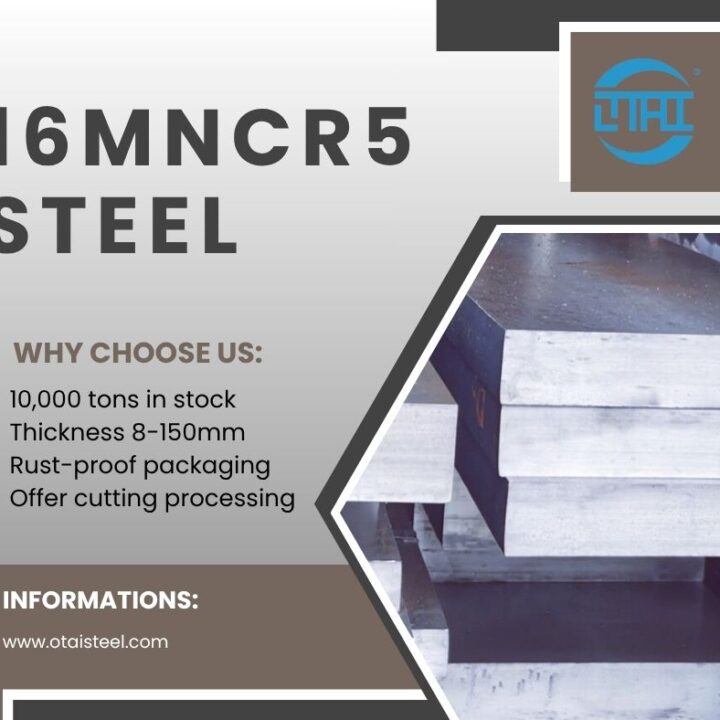
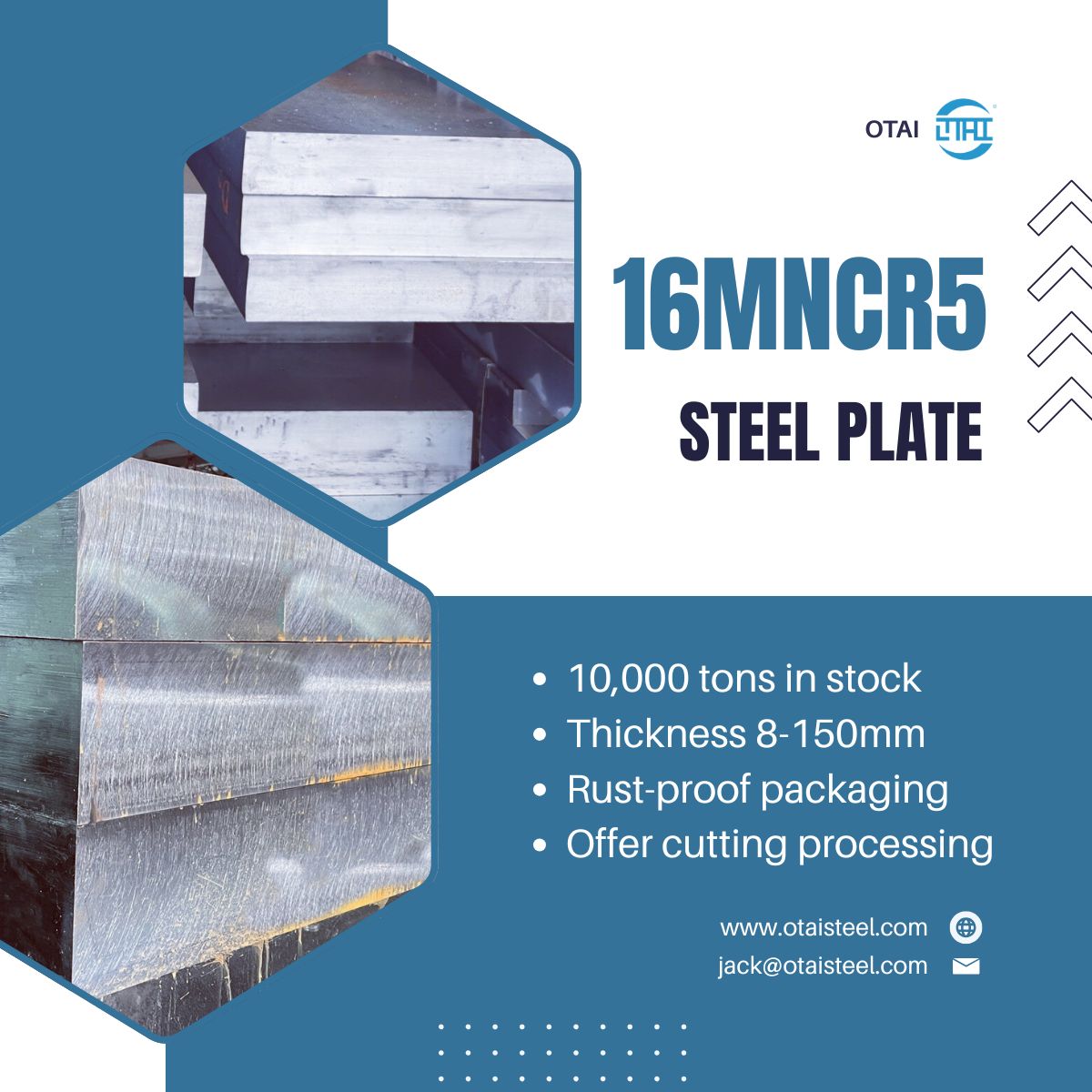
- Stock availability: Otai keeps 8–150mm thickness 16MnCr5 steel plates available in stock to support fast delivery requirements.
- Processing service: Cutting, machining, surface processing, and customized size services are available according to customer drawings.
- Heat treatment support: Professional heat treatment services can be arranged, including carburizing, quenching, and tempering.
- Quality inspection: Ultrasonic testing and third-party inspection services are available for customers requiring strict quality control.
- International supply experience: Otai has experience supplying alloy steels to customers with demanding technical requirements.
- Professional packaging: Anti-rust protection, steel strapping, and wooden box packaging ensure safe international transportation.
With stable inventory and professional processing capability, Otai helps customers obtain reliable 16MnCr5 materials for gears, shafts, and other high-performance mechanical components.
❓ FAQ About 16MnCr5 Elongation
Q1: What is the typical 16MnCr5 elongation value?
The typical 16MnCr5 elongation value is around 10–15%, depending on material condition, heat treatment, and testing standard.
Q2: Why is elongation important for 16MnCr5 steel?
Elongation shows the ductility of the steel and indicates how well the material can absorb deformation before fracture.
Q3: How does carburizing affect 16MnCr5 elongation?
Carburizing increases surface hardness while maintaining a tougher core structure, allowing the material to keep suitable ductility.
Q4: Is 16MnCr5 stronger than SAE 8620?
Both steels are carburizing grades. Their performance depends on heat treatment, but SAE 8620 generally provides excellent toughness, while 16MnCr5 offers strong European standard compatibility and good mechanical balance.
Q5: What affects 16MnCr5 mechanical properties?
Chemical composition, heat treatment, grain structure, manufacturing process, and material thickness all influence the final properties.
Q6: Does Otai supply 16MnCr5 steel?
Yes. Otai supplies 16MnCr5 steel plates with stock availability, cutting service, heat treatment support, and quality inspection options.