 DIN 16MnCr5 Steel – Complete Guide to Specification and Applications
Among European engineering steels, DIN 16MnCr5 is one of the most widely used case-hardening steel grades for components requiring a hard wear-resistant surface and a tough internal core.
This steel grade belongs to the low-carbon alloy steel family and is specifically designed for carburizing applications. Through carburizing and subsequent heat treatment, manufacturers can create a high-hardness surface layer while maintaining excellent core toughness.
The engineering value of DIN 16MnCr5 steel is not only related to its chemical composition. Its performance comes from the combination of alloy design, carburizing response, heat treatment control, and manufacturing process.
This material is widely selected for gears, shafts, transmission components, and mechanical parts that operate under repeated loads, impact forces, and wear conditions.
📑 Table of Contents
🔍 1. What Is DIN 16MnCr5 Steel?
🧪 2. DIN 16MnCr5 Chemical Composition and Material Design Logic
⚙️ 3. DIN 16MnCr5 Mechanical Properties and Performance Characteristics
🔥 4. DIN 16MnCr5 Heat Treatment Process and Carburizing Performance
📊 5. DIN 16MnCr5 Equivalent Grades and International Comparison
🏭 6. Industrial Applications of DIN 16MnCr5 Steel
🌍 7. How to Select a Reliable DIN 16MnCr5 Steel Supplier
📌 8. Buying Guide for DIN 16MnCr5 Steel Plate
🏭 Otai Special Steel Advantages
🔍 1. What Is DIN 16MnCr5 Steel?
DIN 16MnCr5 is a German standard case-hardening alloy steel defined under the DIN material classification system. It is mainly used for components that require a combination of surface hardness, wear resistance, and core strength.
The designation itself provides important information about the material structure:
- 16: Indicates approximately 0.16% carbon content.
- Mn: Represents manganese, which improves hardenability and core strength.
- Cr: Represents chromium, which improves wear resistance and carburizing performance.
- 5: Indicates the alloy group classification within the DIN steel naming system.
Unlike medium-carbon steels that are hardened throughout the entire section, 16MnCr5 is designed to create a hardness gradient.
During carburizing, carbon atoms diffuse into the surface layer. After quenching, the enriched surface transforms into hard martensite, while the lower-carbon core remains tougher and more ductile.
| Material Feature | Description |
|---|---|
| Steel Type | Low-carbon alloy carburizing steel |
| Main Standard | DIN / EN steel classification |
| Carbon Level | Approximately 0.16% |
| Main Alloy Elements | Manganese and Chromium |
| Main Function | Surface hardening with tough core |
This design makes DIN 16MnCr5 steel especially suitable for mechanical systems where surface wear and internal impact resistance are both important.
For example, gears require a hard contact surface to prevent wear, but they also need a tough core to absorb torque and shock loads. DIN 16MnCr5 provides this balanced structure after proper heat treatment.
Therefore, engineers often select this material when they need reliable fatigue performance rather than only maximum hardness.
🧪 2. DIN 16MnCr5 Chemical Composition and Material Design Logic
The performance of DIN 16MnCr5 depends strongly on its carefully controlled alloy composition. Each element contributes to the final balance between carburizing ability, hardness, toughness, and machinability.
Understanding the **16MnCr5 chemical composition** helps engineers predict how the material will behave during manufacturing and service.
| Element | Typical Content | Engineering Function |
|---|---|---|
| Carbon (C) | 0.14–0.19% | Controls carburizing potential and core toughness |
| Manganese (Mn) | 1.00–1.30% | Improves hardenability and strength |
| Chromium (Cr) | 0.80–1.10% | Improves wear resistance and case depth stability |
| Silicon (Si) | ≤0.40% | Supports strength and deoxidation |
| Phosphorus (P) | ≤0.035% | Controlled to reduce brittleness |
| Sulfur (S) | ≤0.035% | Controlled for quality and machinability |
The low carbon content is intentional. It allows the material core to maintain toughness after carburizing, while the surface can absorb additional carbon and achieve high hardness.
Chromium plays an important role because it improves hardenability and helps maintain a stable hardened layer. Meanwhile, manganese supports strength and improves the response during quenching.
This chemical balance explains why DIN 16MnCr5 steel specification focuses on carburizing performance rather than extremely high bulk strength.
When manufacturers control chemical composition accurately, the final component can achieve consistent hardness distribution and improved fatigue resistance.
⚙️ 3. DIN 16MnCr5 Mechanical Properties and Performance Characteristics
The mechanical performance of DIN 16MnCr5 depends on the supply condition and heat treatment process. Since this steel is mainly used as a carburizing material, its final properties are usually evaluated after hardening.
The most important **16MnCr5 mechanical properties** include surface hardness, core toughness, tensile strength, and fatigue resistance.
| Property | Typical Value |
|---|---|
| Tensile Strength | Approximately 600–900 MPa after treatment |
| Yield Strength | Approximately 400–650 MPa |
| Surface Hardness | 58–62 HRC after carburizing |
| Core Hardness | 30–45 HRC depending on process |
| Fatigue Resistance | High with proper carburizing control |
The unique advantage of DIN 16MnCr5 is the difference between the hardened surface and the tougher core.
The surface provides:
- High resistance against wear
- Improved contact fatigue performance
- Better protection against surface damage
The core provides:
- Impact absorption
- Resistance against sudden loading
- Improved fracture resistance
This combination makes DIN 16MnCr5 suitable for components operating under repeated stress conditions.
🔥 4. DIN 16MnCr5 Heat Treatment Process and Carburizing Performance
The most important characteristic of DIN 16MnCr5 is its excellent response to carburizing heat treatment. Unlike through-hardening steels, this material is specifically designed to create a hard surface layer while maintaining a tough internal structure.
The **16MnCr5 heat treatment process** usually includes carburizing, quenching, and tempering. Each stage controls the final hardness distribution, case depth, dimensional stability, and fatigue performance.
The typical heat treatment sequence includes:
- Carburizing: Carbon atoms diffuse into the surface at high temperature, increasing the carbon concentration near the outer layer.
- Quenching: Rapid cooling transforms the carbon-enriched surface into hard martensite.
- Tempering: Reduces internal stress and improves toughness after hardening.
| Process Stage | Typical Condition | Main Purpose |
|---|---|---|
| Carburizing | 850–950°C | Increase surface carbon content |
| Quenching | Oil or controlled cooling | Create hardened martensitic layer |
| Tempering | 150–220°C commonly | Reduce stress and improve toughness |
The depth of the carburized layer depends on temperature, time, and component requirements. Heavy-duty gears usually require deeper case depth, while smaller components may need a thinner hardened layer.
The final structure normally contains:
- High-carbon martensite on the surface
- Transition zone with gradually changing carbon concentration
- Low-carbon tough core structure
This structure gives DIN 16MnCr5 its unique combination of wear resistance and impact strength.
For example, gear teeth experience extreme contact pressure during operation. The hardened surface prevents wear, while the tough core prevents tooth breakage caused by sudden torque changes.
Therefore, the true engineering value of DIN 16MnCr5 carburizing steel comes from its ability to develop controlled surface performance through heat treatment.
📊 5. DIN 16MnCr5 Equivalent Grades and International Comparison
Understanding DIN 16MnCr5 equivalent grades is important for international purchasing and engineering replacement decisions. Different countries use different standards, but many grades have similar chemical designs and applications.
| Standard | Equivalent Grade | Country / System |
|---|---|---|
| DIN / EN | 16MnCr5 | Germany / Europe |
| EN | 1.7131 | European Material Number |
| AISI / SAE | 5115 / 5120 (approximate) | United States |
| JIS | SCr415 | Japan |
| GB | 15CrMo | China (similar application) |
Although equivalent grades may have similar characteristics, they are not always identical. Differences in chemical limits, manufacturing standards, and quality requirements can affect actual performance.
For critical components, engineers should compare:
- Chemical composition range
- Hardening response
- Carburizing depth capability
- Mechanical requirements
- Inspection standards
Compared with similar carburizing steels:
| Grade | Main Characteristic | Typical Application |
|---|---|---|
| 16MnCr5 | Balanced carburizing performance | Gears and shafts |
| 20MnCr5 | Higher alloy content and deeper hardening ability | Heavy-duty gears |
| 8620 | Excellent carburizing steel | Automotive components |
| 4140 | Through-hardening alloy steel | Shafts and structural parts |
The correct replacement depends on the application rather than simply matching the material name.
For customers purchasing internationally, understanding DIN 16MnCr5 equivalent grades helps avoid incorrect substitutions and ensures the final component achieves the required performance.
🏭 6. Industrial Applications of DIN 16MnCr5 Steel
The practical value of DIN 16MnCr5 steel becomes clear in industries that require reliable performance under repeated loading, friction, and impact conditions.
Because of its carburizing capability and balanced mechanical performance, this steel grade is widely used for transmission and power-related components.
| Industry | Typical Components | Required Performance |
|---|---|---|
| Automotive Industry | Gear wheels, transmission parts, shafts | Wear resistance and fatigue strength |
| Mechanical Engineering | Reducers, pinions, drive components | Surface hardness and toughness |
| Agricultural Machinery | Gears and rotating parts | Impact resistance |
| Industrial Equipment | Bearings, mechanical transmission parts | Long service life |
Common applications include:
- Automotive transmission gears
- Industrial gearbox components
- Drive shafts
- Pinions
- Chain wheels
- Machine components requiring wear resistance
The reason manufacturers choose DIN 16MnCr5 is not because it provides the highest hardness among all steels. Instead, it provides an optimized combination of surface durability and core toughness.
For rotating components, this balance is critical. Excessive hardness without toughness can cause brittle failure, while insufficient surface hardness can lead to rapid wear.
Therefore, DIN 16MnCr5 remains one of the most practical choices for precision mechanical parts requiring long-term reliability.
🌍 7. How to Select a Reliable DIN 16MnCr5 Steel Supplier
Selecting the right supplier is essential for maintaining consistent DIN 16MnCr5 steel specification and ensuring reliable production performance. Although many suppliers can provide the same material grade, differences in inventory, quality control, and processing capability can significantly affect the final result.
A professional DIN 16MnCr5 steel plate supplier should provide more than basic material supply. Industrial customers usually require a complete service system that includes inspection, processing, packaging, and technical support.
Important factors to evaluate include:
- Stable stock availability: Reduces waiting time and helps customers handle urgent production schedules.
- Material traceability: Provides chemical analysis reports, mill certificates, and quality documentation.
- Processing capability: Cutting, machining, heat treatment, and customized preparation improve purchasing efficiency.
- Quality inspection: Ultrasonic testing and third-party inspection help confirm internal material quality.
- Export experience: International supply experience ensures better communication and transportation management.
For customers purchasing 16MnCr5 carburizing steel, supplier capability directly influences production stability. A reliable supplier helps manufacturers reduce quality risks and maintain consistent component performance.
Before selecting a supplier, buyers should consider not only material availability but also the supplier’s technical understanding of carburizing steel applications.
📌 8. Buying Guide for DIN 16MnCr5 Steel Plate
When purchasing DIN 16MnCr5 steel plate, customers should evaluate technical requirements carefully because the correct material condition directly affects manufacturing efficiency and final component performance.
Unlike standard structural steels, carburizing steels require attention to chemical composition, size tolerance, heat treatment requirements, and inspection standards.
| Buying Factor | Why It Matters |
|---|---|
| Steel grade | Ensures correct carburizing performance |
| Thickness and dimensions | Affects machining process and material utilization |
| Surface condition | Influences further processing quality |
| Inspection requirements | Confirms material reliability |
| Delivery capability | Supports production planning |
Before requesting a quotation, customers should provide:
- Required standard (DIN / EN 10084)
- Material grade and dimensions
- Quantity requirement
- Heat treatment requirements
- Testing requirements
- Delivery destination
A complete specification allows suppliers to recommend the most suitable solution and avoid problems during manufacturing.
Although price is an important purchasing factor, the lowest price does not always represent the best value. Material consistency, delivery reliability, and technical support often create greater long-term benefits.
For international buyers, choosing an experienced supplier can reduce communication problems and improve overall project efficiency.
🏭 Otai Special Steel Advantages
Otai Special Steel specializes in supplying alloy steels and engineering materials for global customers. With stable inventory, professional processing capability, and strict quality control, Otai provides complete solutions for customers requiring DIN 16MnCr5 steel plate.
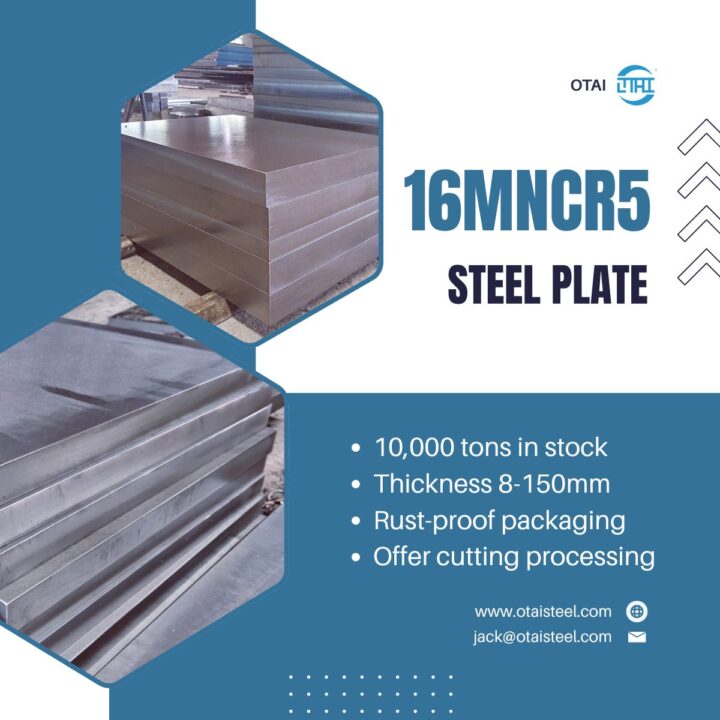
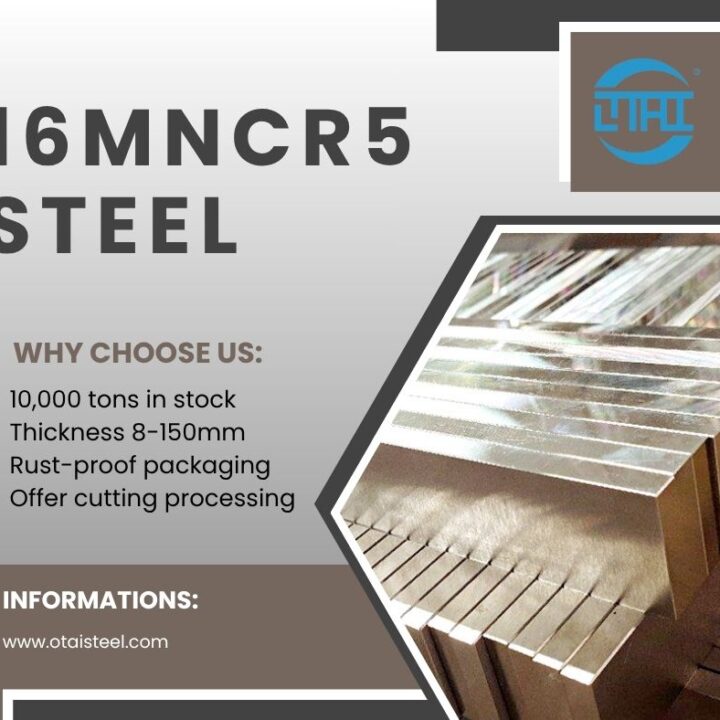
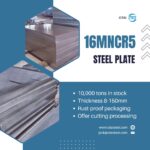
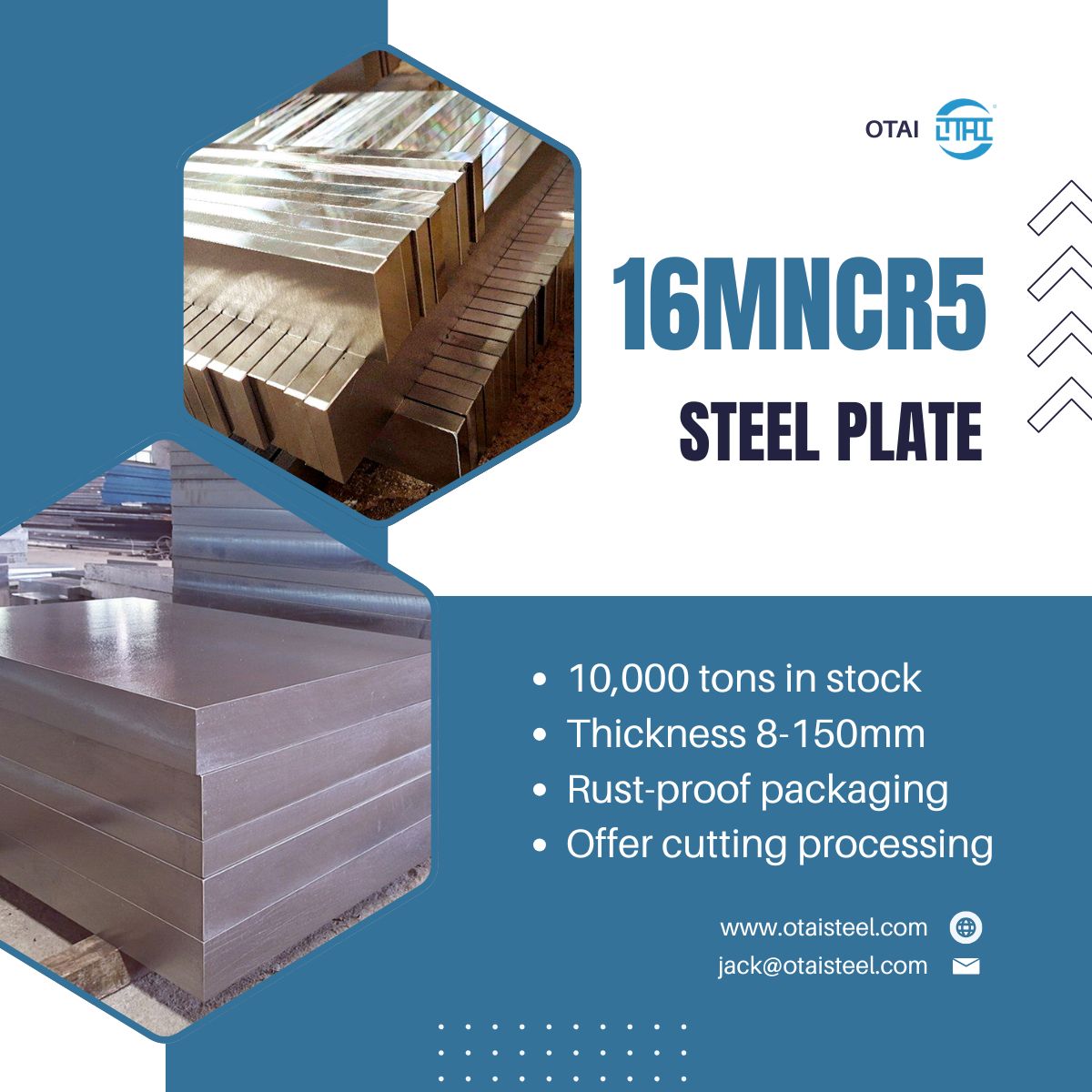
- Stable inventory advantage: Otai keeps sufficient stock of 16MnCr5 steel, including 8–150mm thickness plates available in stock to support fast delivery requirements.
- Professional alloy steel supply: Focused on alloy steels and engineering materials with years of export experience.
- Cutting and processing service: Provides cutting, machining preparation, and customized processing according to customer requirements.
- Heat treatment support: Helps customers achieve required mechanical performance through suitable treatment solutions.
- Quality assurance: Supports ultrasonic testing and third-party inspection to ensure material reliability.
- Global customer experience: Has supplied materials to international customers, including Fortune Global 500 companies with strict technical requirements.
- Professional packaging: Provides anti-rust packaging, steel strapping packaging, and wooden box packaging for safe transportation.
For customers searching for a reliable DIN 16MnCr5 steel plate supplier, Otai offers not only steel materials but also complete support from inventory management to processing solutions.
❓ FAQ – DIN 16MnCr5 Steel
Q1: What is DIN 16MnCr5 steel?
DIN 16MnCr5 is a low-carbon alloy carburizing steel designed for components requiring a hard wear-resistant surface and a tough core.
Q2: What does 16MnCr5 mean?
The number 16 represents approximately 0.16% carbon content, while Mn and Cr indicate manganese and chromium alloying elements.
Q3: What are the main applications of DIN 16MnCr5?
It is commonly used for gears, shafts, transmission components, pinions, and mechanical parts exposed to wear and repeated loads.
Q4: Is DIN 16MnCr5 suitable for carburizing?
Yes. Carburizing is the main heat treatment method used to improve surface hardness while maintaining core toughness.
Q5: What is the equivalent of DIN 16MnCr5?
Common comparable grades include EN 1.7131, JIS SCr415, and some AISI carburizing steels depending on requirements.