 4140 Alloy Composition – Chemical Makeup and Engineering Performance
Understanding the 4140 alloy composition is essential for engineers, machinists, and industrial buyers who work with high-strength alloy steels. The chemical makeup of 4140 steel directly determines its mechanical properties, heat treatment response, hardness, toughness, and wear resistance.
The popularity of the 4140 alloy composition comes from its balanced combination of carbon, chromium, and molybdenum. These alloying elements work together to create a steel grade that performs exceptionally well under high stress, cyclic loading, and demanding industrial conditions.
Many professionals searching for 4140 alloy composition also look for related terms such as 4140 steel chemistry, 4140 chemical composition chart, SAE 4140 elements, 4140 material properties, and 4140 steel heat treatment behavior. All these aspects are directly influenced by its alloy design.
🔵 What Is 4140 Steel?
4140 steel is a chromium-molybdenum low-alloy steel. Engineers widely use it in mechanical engineering applications. It belongs to the AISI/SAE steel classification system, and engineers know it for its excellent strength-to-toughness ratio.
Engineers can heat treat the steel to achieve a wide range of mechanical properties. This flexibility makes it suitable for shafts, gears, bolts, spindles, hydraulic components, and heavy machinery parts.
Manufacturers carefully control the 4140 alloy composition to ensure consistent performance in both annealed and quenched-and-tempered conditions.
| Property Category | Performance |
|---|---|
| Strength | High |
| Toughness | High |
| Wear Resistance | Good |
| Machinability | Moderate to Good |
| Hardenability | Excellent |
🟢 4140 Alloy Composition Breakdown
The 4140 alloy composition is based on a medium-carbon steel system with chromium and molybdenum as the primary alloying elements. Each element plays a specific role in determining the final performance of the steel.
| Element | Content (%) | Function |
|---|---|---|
| Carbon (C) | 0.38 – 0.43 | Strength and hardness |
| Manganese (Mn) | 0.75 – 1.00 | Improves hardenability |
| Chromium (Cr) | 0.80 – 1.10 | Wear resistance and strength |
| Molybdenum (Mo) | 0.15 – 0.25 | Reduces brittleness and improves toughness |
| Silicon (Si) | 0.15 – 0.35 | Strength enhancement and deoxidation |
| Iron (Fe) | Balance | Main matrix element |
This balanced 4140 alloy composition allows the steel to achieve high strength after heat treatment while maintaining good ductility and impact resistance.
🟠 Why Alloy Elements Matter in 4140 Steel
Each element in the 4140 alloy composition plays a critical role in defining its engineering performance. Carbon increases hardness and strength, while chromium enhances wear resistance and improves hardenability.
Molybdenum is especially important because it reduces the risk of temper brittleness and improves performance at elevated temperatures. Manganese supports deep hardening and improves overall toughness.
Without this carefully controlled chemical balance, 4140 steel would not achieve its widely recognized combination of strength, toughness, and versatility.
| Element | Main Benefit |
|---|---|
| Carbon | Hardness |
| Chromium | Wear resistance |
| Molybdenum | Toughness |
| Manganese | Hardenability |
🟣 Mechanical Properties Driven by 4140 Alloy Composition
The 4140 alloy composition directly influences its mechanical properties after heat treatment. Once quenched and tempered, 4140 steel achieves high tensile strength, excellent fatigue resistance, and good impact toughness.
These properties make it suitable for components that operate under high stress and dynamic loading conditions. Engineers often choose 4140 when failure is not an option in critical mechanical systems.
| Mechanical Property | Typical Value |
|---|---|
| Tensile Strength | 850 – 1100 MPa |
| Yield Strength | 650 – 950 MPa |
| Hardness (Q&T) | 28 – 32 HRC |
| Elongation | 10 – 15% |
🔷 Heat Treatment Response of 4140 Alloy Composition
The 4140 alloy composition shows an excellent response to heat treatment, which is one of the main reasons this steel is widely used in mechanical engineering. By adjusting quenching and tempering parameters, engineers can precisely control hardness, strength, and toughness.
During quenching, the carbon and alloying elements in 4140 transform into a hardened martensitic structure. After tempering, internal stresses are reduced while toughness is restored. This balance allows 4140 steel to perform reliably under both static and dynamic loads.
Unlike low-carbon steels, the presence of chromium and molybdenum in the 4140 alloy composition significantly improves hardenability, allowing thicker sections to achieve uniform mechanical properties.
| Heat Treatment Stage | Effect on Properties |
|---|---|
| Annealing | Improves machinability |
| Quenching | Increases hardness and strength |
| Tempering | Improves toughness and stability |
| Normalizing | Refines grain structure |
🔴 4140 Alloy Composition vs Other Steel Grades
Engineers often compare the 4140 alloy composition with other alloy steels such as 4340 and 1045. While all three are widely used, their chemical differences lead to distinct performance characteristics.
4140 offers an excellent balance of strength, toughness, and cost-effectiveness. 4340 provides higher strength and toughness but at a higher cost. 1045 is more economical but lacks the deep hardening capability of 4140.
| Steel Grade | Strength | Toughness | Cost | Application |
|---|---|---|---|---|
| 4140 | High | High | Medium | Shafts, gears, bolts |
| 4340 | Very High | Very High | High | Aerospace, heavy-duty parts |
| 1045 | Medium | Medium | Low | General machinery |
⚙️ Industrial Applications of 4140 Alloy Composition
The properties derived from the 4140 alloy composition make it suitable for a wide range of industrial applications. It is commonly used in automotive systems, oil and gas equipment, heavy machinery, and general mechanical components.
In automotive engineering, 4140 is widely used for crankshafts, axle shafts, and transmission components. In oil and gas industries, it is used for drilling equipment and high-stress connectors. Its fatigue resistance makes it especially valuable in rotating machinery.
The steel’s ability to maintain performance under cyclic loading conditions ensures long service life and reduced maintenance requirements.
| Industry | Typical Components |
|---|---|
| Automotive | Crankshafts, axles, gears |
| Oil & Gas | Drill collars, connectors |
| Industrial Machinery | Shafts, couplings, gears |
| Construction | Structural pins, fasteners |
| Mining | Wear-resistant parts |
📈 Machinability and Fabrication of 4140 Alloy Steel
The 4140 alloy composition provides moderate machinability in the annealed condition. Manufacturers often machine components before heat treatment to reduce tool wear and improve efficiency.
After machining, parts are typically heat treated to achieve final mechanical properties. This sequence allows manufacturers to combine good machinability with high final strength.
Welding 4140 steel requires proper preheating and post-weld heat treatment due to its alloy content. Without proper control, cracking may occur in the heat-affected zone.
| Property | Performance |
|---|---|
| Machinability | Moderate |
| Weldability | Moderate (requires precautions) |
| Forgeability | Good |
| Heat Treatment Response | Excellent |
🏭 Company Advantages – Otai Special Steel
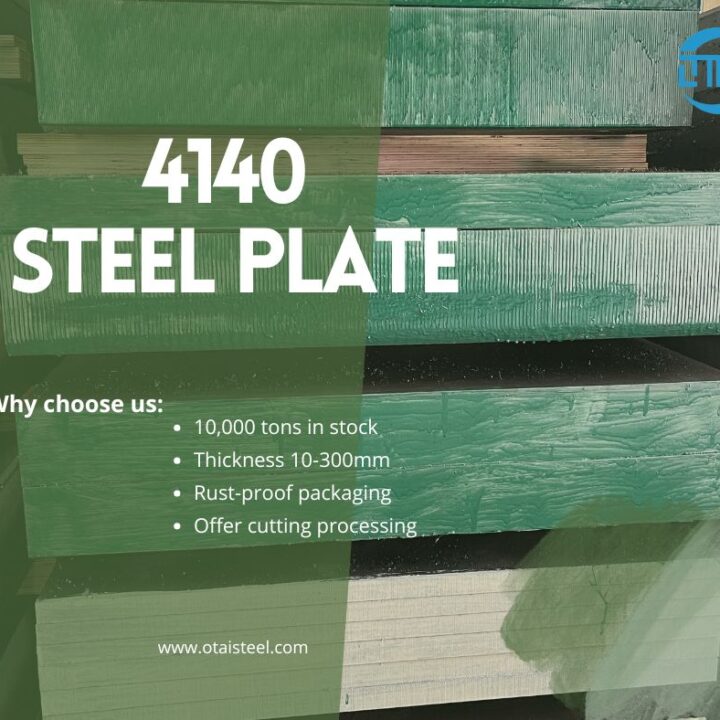
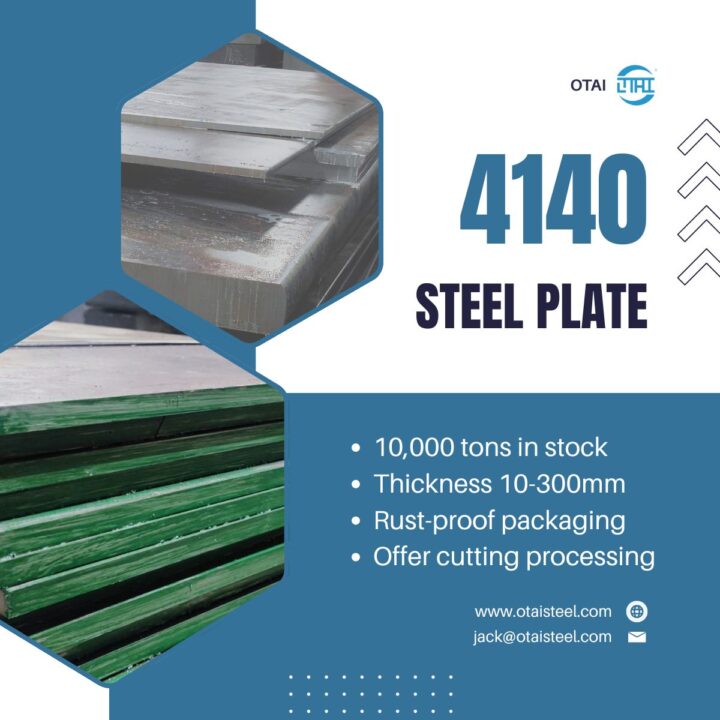
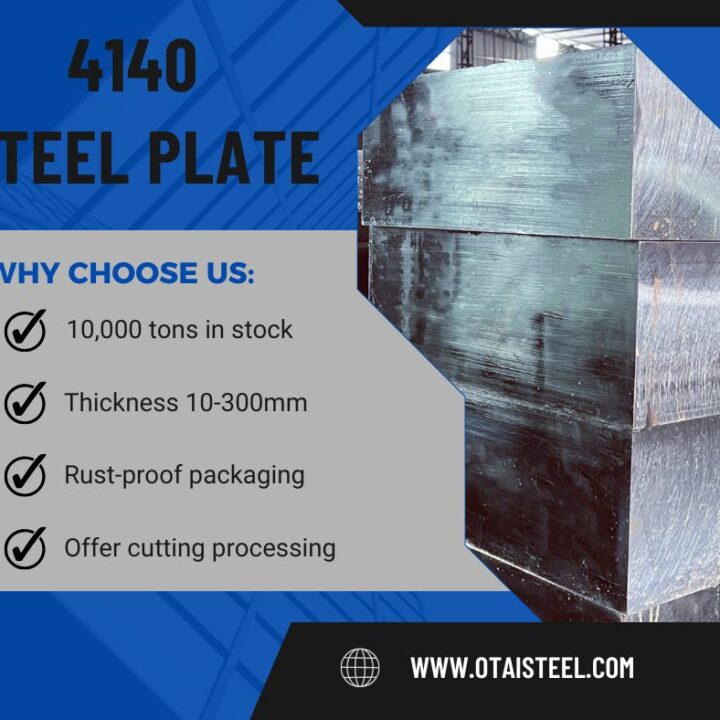
- 📦 10,000 tons of alloy steel inventory in various sizes and grades
- 📏 Wide range of 4140 steel plates and bars available from stock
- ✂️ Cutting, machining, and heat treatment services available
- 🔬 Ultrasonic testing and third-party inspection support
- 📦 Anti-rust packaging, wooden box packaging, and export packing solutions
- 🌍 Strong export experience to global industrial markets
❓ FAQ – 4140 Alloy Composition
1. What is the main composition of 4140 steel?
4140 steel mainly consists of carbon (0.38–0.43%), chromium (0.80–1.10%), molybdenum (0.15–0.25%), manganese, silicon, and iron as the base element.
2. Why is chromium important in 4140 alloy composition?
Chromium improves hardenability, wear resistance, and overall strength of the steel.
3. What is the role of molybdenum in 4140 steel?
Molybdenum improves toughness and reduces the risk of temper brittleness during heat treatment.
4. Is 4140 steel suitable for heat treatment?
Yes, 4140 steel is widely used for quenching and tempering due to its excellent alloy composition response.
5. What industries commonly use 4140 steel?
Automotive, oil and gas, construction, mining, and machinery manufacturing industries widely use 4140 steel.
🏁 Conclusion
The 4140 alloy composition provides an excellent balance of strength, toughness, and hardenability, making it one of the most widely used alloy steels in engineering applications. Its carefully designed chemical structure ensures reliable performance under high stress, cyclic loading, and demanding industrial environments.
With strong heat treatment capability, good machinability, and wide industrial usage, 4140 steel continues to be a preferred material for shafts, gears, fasteners, and heavy-duty mechanical components worldwide.