 Young’s Modulus of 16MnCr5 – Elasticity, Stiffness and Engineering Performance
Understanding the Young’s modulus of 16MnCr5 is important for engineers, designers, and manufacturers who work with gears, shafts, and case-hardened mechanical components. While hardness and tensile strength often receive the most attention, Young’s modulus plays an equally important role in determining how a component responds to elastic deformation under load.
The Young’s modulus of 16MnCr5 measures the material’s stiffness and its ability to resist elastic deformation. Engineers use this value when calculating shaft deflection, gear tooth deformation, contact stresses, and structural rigidity. A correct understanding of elastic modulus helps improve design accuracy and ensures reliable equipment performance.
Many professionals searching for Young’s modulus of 16MnCr5 also want information about 16MnCr5 mechanical properties, 16MnCr5 elastic modulus, 16MnCr5 density, 16MnCr5 hardness, and 16MnCr5 steel properties. These properties work together to determine the overall behavior of the material in service.
🔵 What Is Young’s Modulus?
Young’s modulus, also called the elastic modulus or modulus of elasticity, describes the relationship between stress and strain within the elastic region of a material. It represents the stiffness of a material before permanent deformation occurs.
A higher Young’s modulus indicates that a material resists deformation more effectively when subjected to a load. A lower modulus means the material deforms more easily under the same loading conditions.
For engineering steels, Young’s modulus remains relatively consistent regardless of heat treatment condition. Unlike hardness and tensile strength, which can vary significantly after carburizing and quenching, the elastic modulus changes only slightly.
| Property | Description |
|---|---|
| Young’s Modulus | Measures stiffness |
| Unit | GPa (Gigapascal) |
| Engineering Use | Deflection calculations |
| Material Behavior | Elastic deformation |
🟢 Young’s Modulus of 16MnCr5
The typical Young’s modulus of 16MnCr5 ranges from approximately 205 to 210 GPa. This value closely matches many low-alloy and carburizing steels used in mechanical engineering applications.
Because elastic modulus remains relatively stable, engineers can use this value for design calculations regardless of whether the material is supplied in the annealed, normalized, carburized, or quenched-and-tempered condition.
The high stiffness associated with the Young’s modulus of 16MnCr5 helps minimize elastic deflection in rotating shafts, transmission gears, and structural components. This characteristic improves dimensional accuracy and operational reliability.
| Property | Typical Value |
|---|---|
| Young’s Modulus | 205–210 GPa |
| Shear Modulus | 80 GPa |
| Poisson’s Ratio | 0.29–0.30 |
| Density | 7.85 g/cm³ |
🟠 Why Young’s Modulus Matters in Engineering Design
The Young’s modulus of 16MnCr5 directly influences how engineers design power transmission systems and load-bearing components. When a shaft experiences torque or bending loads, its elastic modulus determines how much it deflects under stress.
Excessive deflection can create alignment problems, increase vibration, accelerate wear, and reduce overall equipment efficiency. By incorporating the correct modulus value into calculations, engineers can predict component behavior more accurately.
In gear design, elastic modulus affects tooth contact patterns and load distribution. A material with high stiffness helps maintain proper gear meshing and improves transmission efficiency.
| Application | Importance of Elastic Modulus |
|---|---|
| Gear Design | Controls tooth deflection |
| Shaft Design | Reduces bending deformation |
| Transmission Systems | Improves alignment |
| Heavy Machinery | Maintains rigidity |
🟣 Relationship Between Young’s Modulus and Other Mechanical Properties
Engineers sometimes confuse stiffness with strength. However, the Young’s modulus of 16MnCr5 and tensile strength represent different material characteristics.
Young’s modulus measures resistance to elastic deformation, while tensile strength measures the maximum stress a material can withstand before failure. A steel can possess high strength and moderate stiffness or vice versa.
For 16MnCr5, the combination of high stiffness, excellent surface hardness after carburizing, and strong fatigue resistance makes the material especially suitable for precision mechanical components.
| Property | Function |
|---|---|
| Young’s Modulus | Stiffness |
| Tensile Strength | Load Capacity |
| Hardness | Wear Resistance |
| Fatigue Strength | Cyclic Load Resistance |
🔷 Does Heat Treatment Change the Young’s Modulus of 16MnCr5?
One of the most common questions engineers ask concerns the influence of heat treatment on the Young’s modulus of 16MnCr5. Unlike hardness, tensile strength, and wear resistance, the elastic modulus remains relatively stable after heat treatment.
Carburizing, quenching, and tempering can dramatically increase surface hardness and improve fatigue performance. However, these processes have only a minor effect on the stiffness of the material. Engineers therefore continue to use approximately 205–210 GPa for most design calculations regardless of the heat treatment condition.
This characteristic simplifies engineering analysis because designers do not need to adjust modulus values every time they change a heat treatment specification. Instead, they focus on modifying strength, hardness, and fatigue-related parameters.
| Property | Before Heat Treatment | After Heat Treatment |
|---|---|---|
| Young’s Modulus | 205–210 GPa | 205–210 GPa |
| Hardness | 170–220 HB | 58–62 HRC (case) |
| Wear Resistance | Moderate | Excellent |
| Fatigue Resistance | Good | High |
🔴 Young’s Modulus of 16MnCr5 vs Other Engineering Steels
Engineers often compare the Young’s modulus of 16MnCr5 with other alloy steels when selecting materials for gears and transmission systems. In practice, most engineering steels possess very similar elastic modulus values. The major differences between grades usually involve hardness, strength, wear resistance, and heat treatment response rather than stiffness.
This similarity means engineers often choose materials based on fatigue performance, surface hardness requirements, and manufacturing considerations instead of elastic modulus alone.
| Steel Grade | Young’s Modulus (GPa) | Typical Application |
|---|---|---|
| 16MnCr5 | 205–210 | Gears and shafts |
| 20MnCr5 | 205–210 | Transmission gears |
| 4140 | 205–210 | Heavy-duty shafts |
| 1045 | 200–210 | General engineering |
| 4340 | 205–210 | High-strength components |
⚙️ Engineering Applications That Depend on Elastic Modulus
The Young’s modulus of 16MnCr5 plays a critical role in applications where dimensional stability and stiffness affect performance. Gear manufacturers rely on accurate modulus values when calculating tooth deflection under load. Excessive elastic deformation can alter contact patterns and reduce transmission efficiency.
Shaft designers use elastic modulus to predict bending deflection and torsional behavior. Industrial machinery manufacturers also consider stiffness when designing components that must maintain precise alignment during operation.
In automated production equipment, even small amounts of elastic deformation can influence positioning accuracy. The high stiffness of 16MnCr5 helps maintain reliable performance under continuous operating conditions.
| Application | Role of Young’s Modulus |
|---|---|
| Gears | Controls tooth deformation |
| Shafts | Limits bending deflection |
| Gearboxes | Maintains alignment |
| Industrial Machinery | Improves rigidity |
| Automation Systems | Supports precision movement |
📈 Advantages of 16MnCr5 for Precision Mechanical Components
The combination of the Young’s modulus of 16MnCr5, excellent carburizing capability, and strong fatigue resistance provides significant advantages for precision mechanical systems. Engineers can design compact components while maintaining adequate stiffness and durability.
After carburizing, the steel develops a hard wear-resistant surface that protects against abrasion and rolling contact fatigue. At the same time, the tough core absorbs shock loads and prevents brittle failure.
This balance of properties explains why 16MnCr5 remains one of the most widely specified case-hardening steels in Europe and many international markets.
- ✔ High stiffness for accurate load distribution
- ✔ Excellent dimensional stability
- ✔ Outstanding carburizing response
- ✔ Strong fatigue resistance
- ✔ Excellent wear performance
- ✔ Long service life in gear applications
🏭 Company Advantages – Otai Special Steel
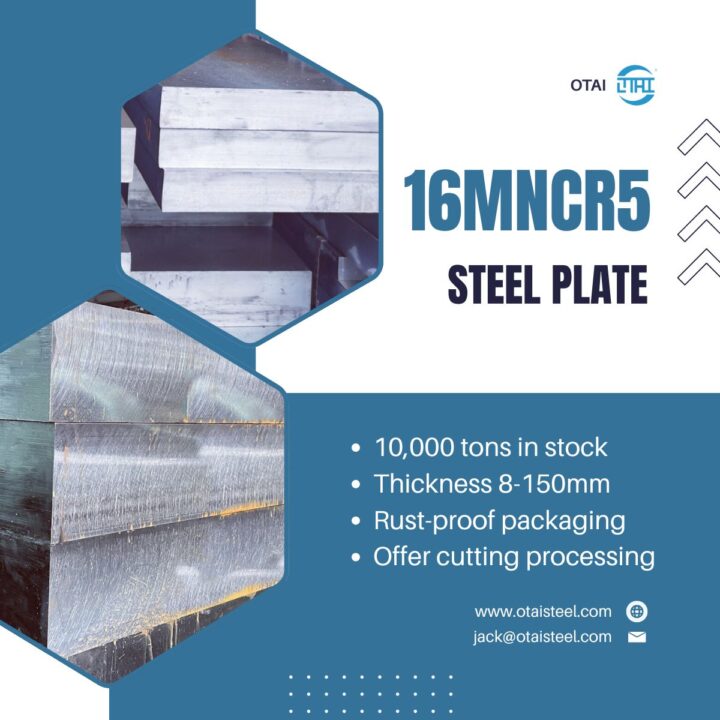
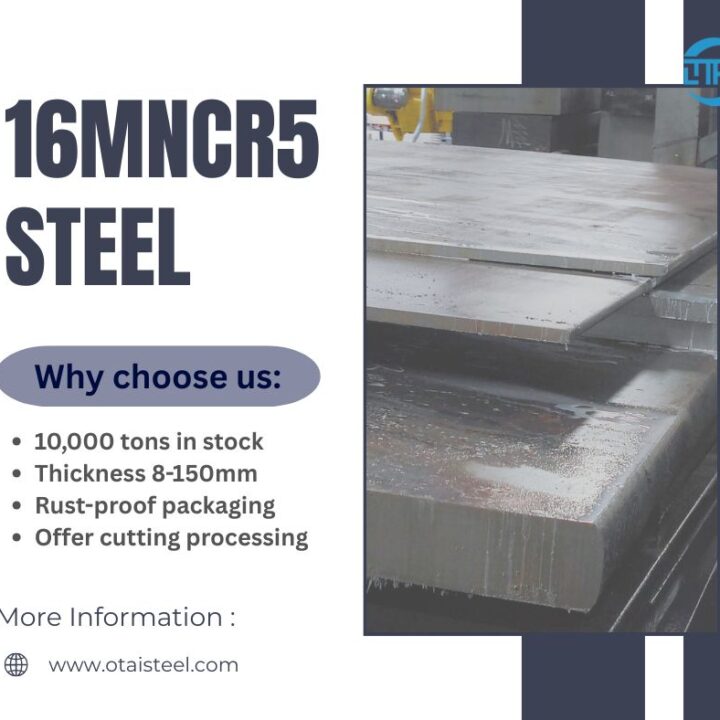
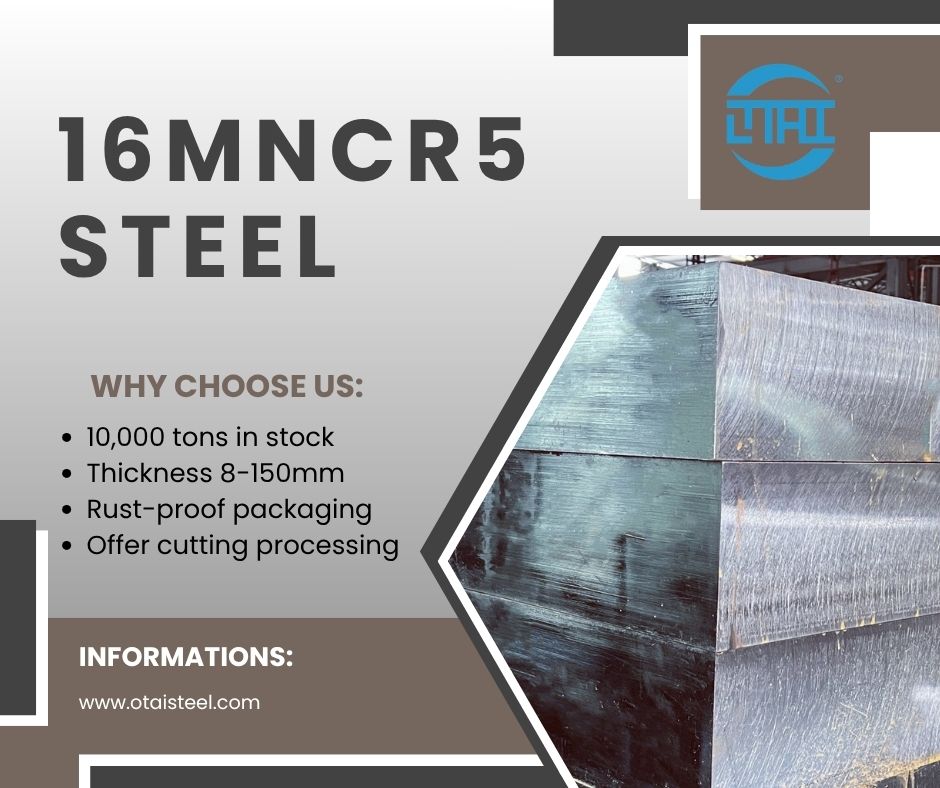
- 📏 16MnCr5 steel plate thickness range: 8–150mm in stock
- 📦 Large inventory available for immediate shipment
- ✂️ Precision cutting, machining, and heat treatment services
- 🔬 Ultrasonic testing and third-party inspection support
- 📦 Anti-rust packaging, strap packaging, and wooden box packaging available
- 🌍 Extensive experience supplying global industrial customers
❓ FAQ – Young’s Modulus of 16MnCr5
1. What is the typical Young’s modulus of 16MnCr5?
The typical Young’s modulus of 16MnCr5 ranges from approximately 205 to 210 GPa.
2. Does carburizing affect the Young’s modulus of 16MnCr5?
No. Carburizing significantly increases hardness and wear resistance, but it has very little influence on elastic modulus.
3. Why is Young’s modulus important in gear design?
Young’s modulus helps engineers predict gear tooth deformation, load distribution, and transmission efficiency.
4. Is the Young’s modulus of 16MnCr5 different from 20MnCr5?
The values are very similar. Both steels typically exhibit an elastic modulus between 205 and 210 GPa.
5. What industries commonly use 16MnCr5 steel?
Automotive, industrial gearbox, machinery manufacturing, mining, and agricultural equipment industries frequently use 16MnCr5.
🏁 Conclusion
The Young’s modulus of 16MnCr5 typically falls between 205 and 210 GPa, providing the high stiffness required for gears, shafts, and precision mechanical components. Although heat treatment can dramatically improve hardness, wear resistance, and fatigue strength, the elastic modulus remains relatively stable throughout the process.
Combined with excellent carburizing capability, strong core toughness, and outstanding fatigue performance, 16MnCr5 continues to serve as one of the most reliable case-hardening steels for modern engineering applications. Understanding the elastic modulus alongside other mechanical properties allows engineers to design safer, more efficient, and longer-lasting equipment.