 16MnCr5 Material Hardness in HRC – Surface Hardness and Core Hardness
The 16MnCr5 material hardness in HRC is one of the most frequently discussed properties among gear manufacturers, automotive suppliers, machinery builders, and heat treatment engineers. Since 16MnCr5 is primarily used as a carburizing steel, its hardness cannot be described by a single value. Instead, the final hardness depends on the heat treatment process, carburizing depth, quenching conditions, and tempering parameters.
Unlike through-hardening steels, 16MnCr5 is specifically designed to achieve a very hard wear-resistant surface while maintaining a tough and ductile core. This unique combination makes it an ideal material for gears, shafts, sprockets, pinions, and other power transmission components subjected to continuous contact stress and cyclic loading.
Understanding the 16MnCr5 hardness HRC range helps engineers optimize component life, reduce wear, and ensure reliable mechanical performance in demanding industrial applications.
📘 What Is 16MnCr5 Steel?
16MnCr5 is a low-carbon chromium-manganese alloy steel specified under EN 10084. It belongs to the family of case-hardening steels and is widely used when a hard surface layer and a tough core are required.
The relatively low carbon content allows excellent toughness and machinability before heat treatment. During carburizing, additional carbon diffuses into the surface layer, enabling the material to achieve very high hardness after quenching.
| Property | Value |
|---|---|
| Steel Grade | 16MnCr5 |
| Standard | EN 10084 |
| Steel Type | Case-Hardening Steel |
| Carbon Content | 0.14–0.19% |
| Main Alloying Elements | Chromium, Manganese |
The alloy composition allows excellent hardenability while maintaining sufficient toughness for heavy-duty industrial applications.
🔬 Typical Hardness of 16MnCr5 Before Heat Treatment
In the annealed or normalized condition, 16MnCr5 remains relatively soft, making it easy to machine and manufacture.
| Condition | Hardness |
|---|---|
| Annealed | 140–190 HB |
| Normalized | 170–220 HB |
| Approximate HRC Equivalent | 10–20 HRC |
This relatively low hardness allows efficient turning, milling, drilling, and gear cutting before carburizing treatment.
Most manufacturers perform all major machining operations before hardening because the final surface hardness becomes extremely difficult to machine using conventional cutting tools.
🔥 16MnCr5 Surface Hardness After Carburizing
The most important hardness value for engineers is the hardness achieved after carburizing, quenching, and tempering.
Following a properly controlled carburizing process, the 16MnCr5 steel hardness after carburizing typically reaches:
| Heat Treatment Condition | Surface Hardness |
|---|---|
| Carburized + Oil Quenched | 58–62 HRC |
| Carburized + Quenched + Tempered | 58–61 HRC |
| Deep Carburized Components | 60–63 HRC |
This hardness range provides excellent wear resistance and contact fatigue strength, making 16MnCr5 one of the most popular gear steels worldwide.
For transmission gears operating under heavy loads, a surface hardness of approximately 60 HRC is often considered ideal because it balances wear resistance and durability.
⚙️ Why Core Hardness Matters
Many buyers focus exclusively on surface hardness, but core hardness is equally important.
A gear with an extremely hard surface but a brittle core can crack under shock loading. The advantage of 16MnCr5 is that it maintains a strong yet ductile core beneath the hardened case.
| Location | Typical Hardness | Function |
|---|---|---|
| Surface Layer | 58–62 HRC | Wear resistance |
| Transition Zone | 35–50 HRC | Load distribution |
| Core | 28–42 HRC | Impact resistance |
This hardness gradient is one of the key reasons why 16MnCr5 gears often achieve significantly longer service life than components manufactured from conventional carbon steels.
“`html
🔥 Heat Treatment Process and Hardness Development
The final 16MnCr5 material hardness in HRC depends heavily on the heat treatment cycle. Simply selecting the correct steel grade does not guarantee the desired hardness. Proper carburizing, quenching, and tempering are essential.
A typical industrial heat treatment process consists of the following stages:
| Process Step | Typical Temperature | Purpose |
|---|---|---|
| Carburizing | 880–950°C | Increase surface carbon content |
| Diffusion | 850–900°C | Equalize carbon distribution |
| Quenching | Oil quench | Form martensite |
| Tempering | 150–200°C | Reduce brittleness |
During carburizing, carbon penetrates the surface layer. After quenching, this high-carbon surface transforms into hard martensite, while the lower-carbon core remains tougher and more ductile.
This process allows manufacturers to achieve exceptional wear resistance without sacrificing structural integrity.
📏 Relationship Between Hardness and Case Depth
Surface hardness alone does not determine component performance. Effective case depth is equally important.
If the hardened layer is too shallow, wear resistance may decrease rapidly under heavy loads. If the case depth is excessive, heat treatment costs increase unnecessarily.
| Application | Typical Case Depth | Surface Hardness |
|---|---|---|
| Small Gears | 0.5–0.8 mm | 58–62 HRC |
| Automotive Gears | 0.8–1.2 mm | 58–62 HRC |
| Heavy-Duty Gears | 1.2–2.0 mm | 60–63 HRC |
| Large Industrial Shafts | 1.0–1.8 mm | 58–61 HRC |
Engineers must balance hardness, case depth, and core toughness to achieve optimal performance.
⚙️ Hardness Requirements for Gears and Shafts
One of the primary applications of 16MnCr5 gear steel hardness is power transmission systems.
Industrial gears experience constant rolling and sliding contact. High hardness reduces wear and pitting while maintaining dimensional accuracy throughout the component’s service life.
Typical hardness targets include:
- Automotive transmission gears: 58–62 HRC
- Differential gears: 58–62 HRC
- Agricultural machinery gears: 56–60 HRC
- Industrial gearbox gears: 58–63 HRC
- Sprockets and pinions: 58–62 HRC
For shafts, slightly lower hardness may be acceptable because toughness and fatigue resistance are often more critical than wear resistance.
📊 Comparison with Other Engineering Steels
Many buyers compare 16MnCr5 with other alloy steels before selecting a material.
| Steel Grade | Typical Surface Hardness | Primary Application |
|---|---|---|
| 16MnCr5 | 58–62 HRC | Carburized gears |
| 20MnCr5 | 58–62 HRC | Automotive gears |
| AISI 8620 | 58–62 HRC | Transmission components |
| 4140 | 28–55 HRC | Through-hardened shafts |
While 4140 offers excellent strength, it is not typically selected when a very hard wear-resistant case is required. This is where 16MnCr5 demonstrates its greatest advantage.
🏭 Industrial Applications Requiring High Surface Hardness
The combination of a hard case and tough core makes 16MnCr5 suitable for demanding environments.
Common applications include:
- Automotive transmission gears
- Industrial gearbox components
- Mining equipment gears
- Agricultural machinery drive systems
- Construction equipment transmissions
- Machine tool spindles
- Heavy-duty sprockets
- Power transmission shafts
In many of these applications, achieving the correct 16MnCr5 surface hardness directly affects maintenance intervals and overall equipment reliability.
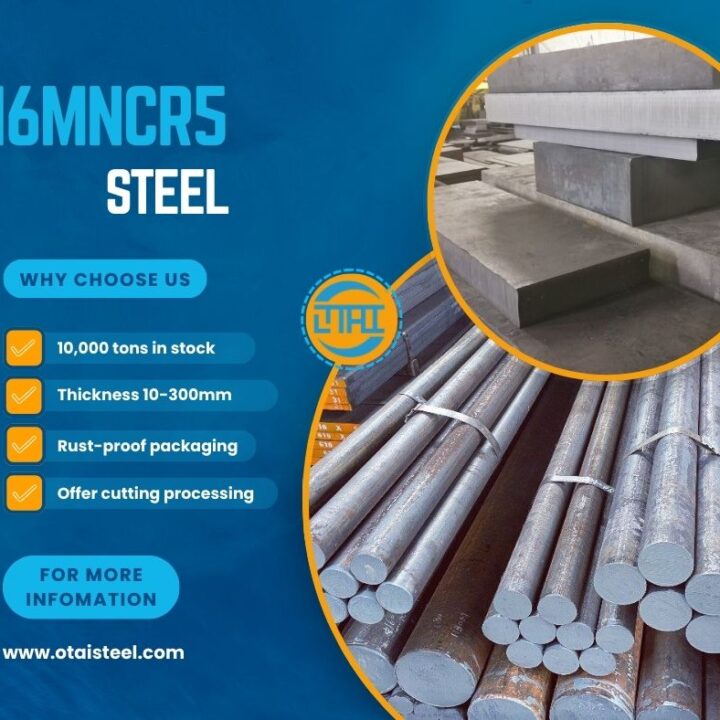
🏆 Company Advantages – Otai Special Steel
- Professional supplier of 16MnCr5 engineering steel.
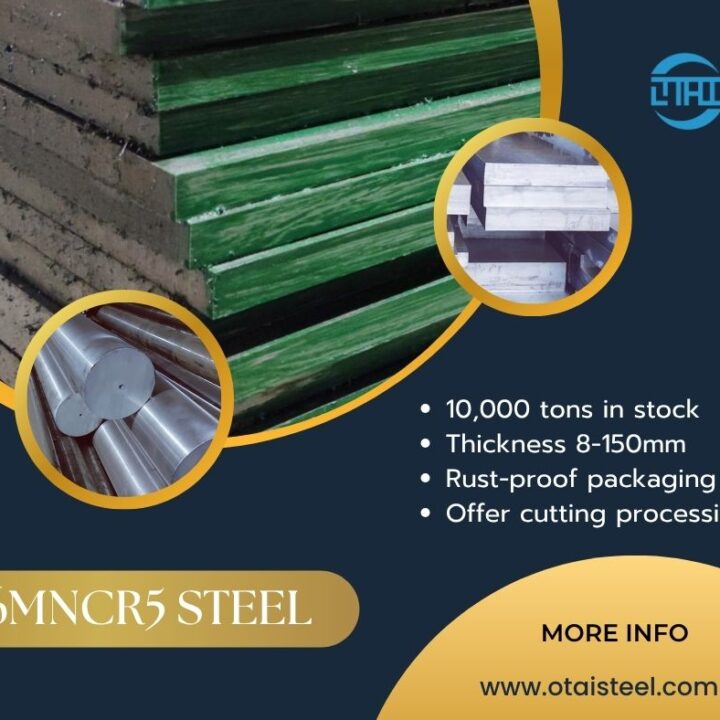
- Sufficient inventory with 8–150 mm thickness plates available in stock.
- Large inventory of plates, round bars, and forged blocks.
- Cut-to-size processing services available.
- Heat treatment support including carburizing, quenching, and tempering.
- Ultrasonic testing (UT) for quality assurance.
- Chemical composition and hardness verification.
- Third-party inspection support including SGS.
- Stable export supply chain serving global customers.
- Fast delivery and competitive pricing.
📌 FAQ
Q1: What is the typical hardness of 16MnCr5 after carburizing?
A: Most carburized components achieve 58–62 HRC surface hardness.
Q2: What is the core hardness of 16MnCr5?
A: Depending on section size and heat treatment, the core hardness is typically 28–42 HRC.
Q3: Why is surface hardness important?
A: High surface hardness improves wear resistance, pitting resistance, and service life.
Q4: Can 16MnCr5 reach 65 HRC?
A: Under specialized carburizing conditions, localized hardness may approach 63–64 HRC, but 58–62 HRC is generally recommended for industrial use.
Q5: Is 16MnCr5 harder than 4140 steel?
A: After carburizing, the surface hardness of 16MnCr5 is significantly higher than standard quenched and tempered 4140 steel.