 16MnCr5 Equivalent – Material Comparison, Specifications, and Applications
For engineers, manufacturers, and material buyers, understanding the 16MnCr5 equivalent grades is essential for selecting the right low-carbon alloy steel for case hardening, carburizing, and high-wear applications. 16MnCr5, a widely used chromium-manganese steel, combines excellent surface hardness, wear resistance, and core toughness. However, depending on regional standards, designers and procurement specialists often need to know the equivalent material grades to ensure consistent performance across international projects.
🔍 What is 16MnCr5?
16MnCr5 is a low-carbon alloy steel with moderate amounts of manganese and chromium. Its properties make it ideal for carburized parts with tough cores, such as:
- Automotive gears and shafts
- Pinions and axles
- Industrial machinery spindles
- Agricultural and construction equipment components
Its chemical composition allows for excellent machinability in the soft state and high surface hardness after case hardening, making it a reliable material for components subjected to wear and repeated torsion.
Chemical Composition of 16MnCr5
| Element | Content (%) |
|---|---|
| Carbon (C) | 0.14 – 0.19 |
| Silicon (Si) | 0.17 – 0.37 |
| Manganese (Mn) | 1.00 – 1.30 |
| Chromium (Cr) | 0.80 – 1.10 |
| Phosphorus (P) | ≤ 0.025 |
| Sulfur (S) | ≤ 0.035 |
The low carbon content ensures high ductility and core toughness, while chromium and manganese improve hardening capacity and wear resistance.
🌐 International Equivalents of 16MnCr5
Depending on regional standards, 16MnCr5 has several equivalent materials that offer similar mechanical and chemical properties:
| Standard | Equivalent Grade | Notes |
|---|---|---|
| EN / Germany | 16MnCr5 | Original European standard |
| AISI / ASTM | SAE 5115 | US equivalent for carburized components |
| JIS / Japan | SCM420 | Japanese low-alloy steel with similar properties |
| GB / China | 20CrMnTi | Chinese equivalent with minor differences in alloying |
Practical tip: When sourcing 16MnCr5 internationally, always check mechanical properties and heat treatment requirements, as minor variations can impact core toughness and surface hardness.
📊 Mechanical Properties
16MnCr5 and its equivalents are designed for high surface hardness with ductile cores. The mechanical properties vary depending on heat treatment:
| Property | Annealed | Pre-Hardened | Carburized & Tempered |
|---|---|---|---|
| Tensile Strength (MPa) | 550 – 800 | 600 – 900 | 800 – 1200 |
| Yield Strength (MPa) | 300 – 500 | 400 – 650 | 550 – 850 |
| Surface Hardness (HRC) | 180 HB | 28 – 32 HRC | 58 – 62 HRC |
| Core Toughness | Excellent | Good | Excellent |
16MnCr5’s combination of surface hardness and core toughness ensures reliable performance under torsion, bending, and cyclic loading.
🔥 Heat Treatment Recommendations
Proper heat treatment is critical to achieving the expected performance:
| Process | Temperature | Effect |
|---|---|---|
| Normalizing | 870 – 900°C | Refines grain structure, improves core toughness |
| Carburizing | 880 – 980°C | Increases surface carbon for higher hardness |
| Hardening | 820 – 860°C | Maximizes surface hardness |
| Tempering | 150 – 200°C | Relieves stresses, maintains core toughness |
Engineering tip: For automotive pinions and shafts, a tempering temperature around 180–200°C after carburizing achieves a balanced surface hardness of 60 HRC and core toughness of 45–50 HRC equivalent, which is ideal for fatigue-resistant applications.
⚙️ Applications of 16MnCr5 Equivalents
| Industry | Typical Components | Notes |
|---|---|---|
| Automotive | Gears, axles, pinions, shafts | Requires high surface hardness and fatigue resistance |
| Industrial Machinery | Spindles, rollers, couplings | Components subjected to cyclic loads |
| Heavy Equipment | Drive shafts, structural connectors | High torsion and bending stress applications |
| Agricultural Equipment | Gearboxes, rotors | Resistant to wear and surface deformation |
16MnCr5 equivalents, such as SAE 5115 or SCM420, are widely used in international projects to ensure material compatibility while maintaining mechanical performance.
🏭 Company Advantages
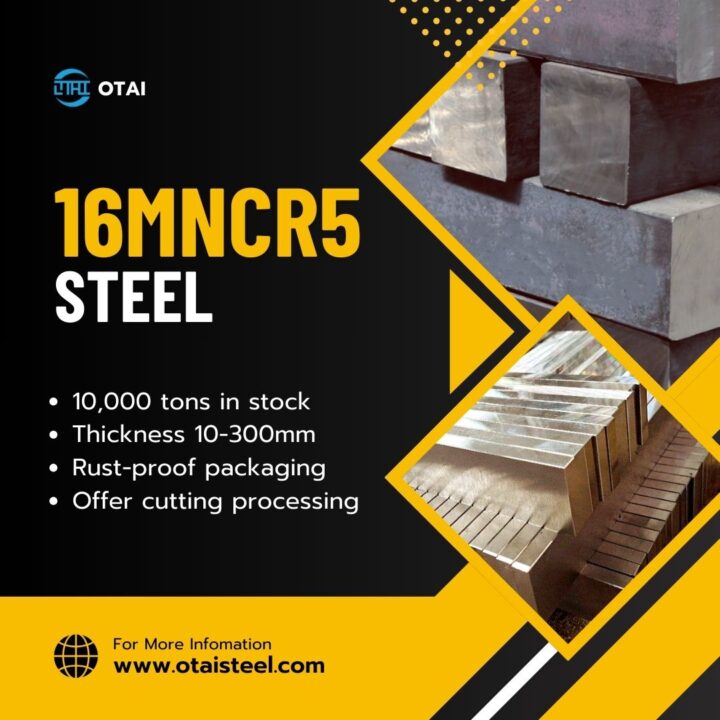
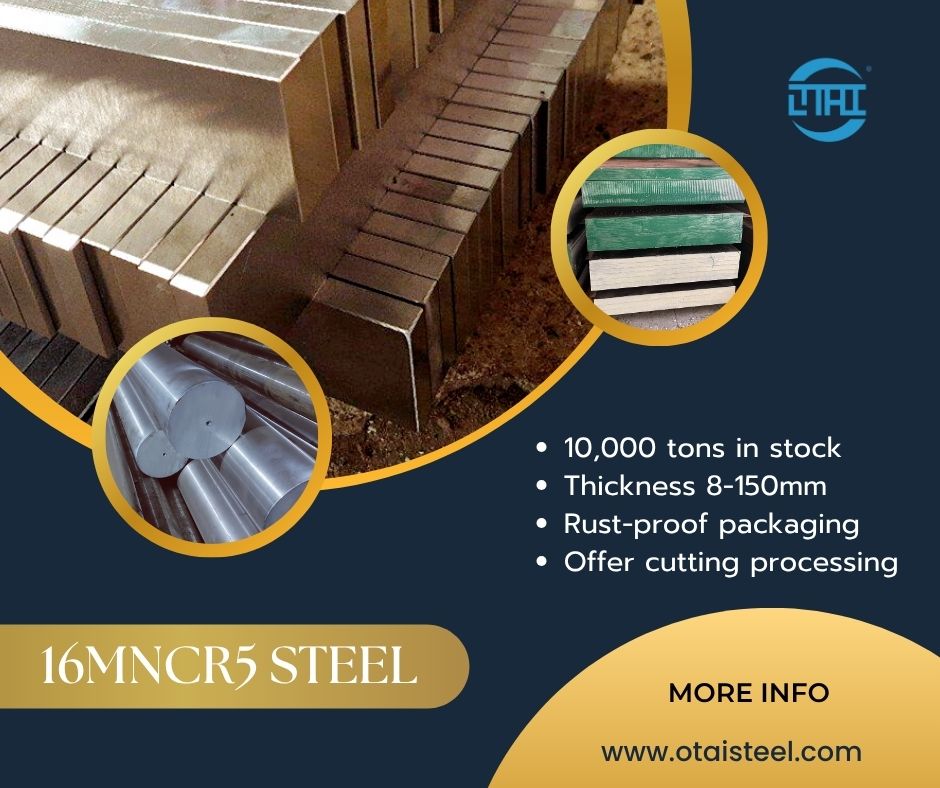
Otai Special Steel supplies 16MnCr5 and its equivalents in plates, bars, and rounds, providing high-quality steel for critical applications.
Our advantages include:
- Large inventory year-round
- 8–150mm thickness plates in stock
- Custom cutting, heat treatment, and surface finishing
- Ultrasonic testing (UT) and chemical composition verification
- Third-party inspection support (SGS)
- Stable export packaging and fast delivery
We serve automotive, industrial machinery, heavy equipment, and precision engineering sectors worldwide.
❓ FAQ
Q1: What are the international equivalents of 16MnCr5?
A1: SAE 5115 (US), SCM420 (Japan), and 20CrMnTi (China) are commonly used equivalents. Always compare mechanical properties and heat treatment requirements.
Q2: Can 16MnCr5 equivalents be carburized and hardened?
A2: Yes, all equivalents are suitable for case hardening and carburizing, providing high surface hardness and ductile cores.
Q3: Which applications are best suited for 16MnCr5 equivalents?
A3: Automotive gears, shafts, pinions, industrial spindles, and heavy-duty machinery components.
Q4: How to ensure proper material performance?
A4: Verify chemical composition, mechanical properties, and heat treatment processes to match the intended design specifications.
Q5: Can equivalents fully replace 16MnCr5 in projects?
A5: Generally yes, but always confirm mechanical properties, carbon content, and hardenability to ensure compatibility.