 16MnCr5 Equivalent Material: A Comprehensive Comparison
🔍 Introduction
16MnCr5 is a widely used alloy steel in the manufacturing of mechanical components, known for its excellent wear resistance and good hardenability. However, it’s important to understand the equivalent materials of 16MnCr5 in different international standards. These equivalent materials share similar properties and can often be substituted for 16MnCr5 depending on specific application requirements.
In this article, we will explore the 16MnCr5 equivalent grades, discuss their properties, and examine which materials can be used as substitutes in various global standards.
⚙️ What is 16MnCr5 Steel?
16MnCr5 is a low-alloy, medium-carbon steel containing manganese and chromium. It is commonly used in parts that require high strength, good wear resistance, and the ability to be hardened, such as gears, shafts, and automotive components. Its composition makes it highly suitable for case hardening processes.
Chemical Composition of 16MnCr5:
- Carbon (C): 0.14–0.19%
- Manganese (Mn): 1.00–1.30%
- Chromium (Cr): 0.80–1.10%
- Silicon (Si): 0.20–0.35%
- Phosphorus (P): ≤ 0.035%
- Sulfur (S): ≤ 0.035%
🔄 Equivalent Grades of 16MnCr5 in Different Standards
Various standards around the world use different naming conventions for equivalent materials. Below is a comparison of the 16MnCr5 equivalent materials in several key standards.
1. 16MnCr5 Equivalent Material in the European Standard (EN):
- EN 10084: 16MnCr5 is a direct equivalent to 42CrMo4 and 15CrMo5, which are also low-alloy steels with similar properties.
2. 16MnCr5 Equivalent in the SAE Standards:
- SAE 5120: This is the closest equivalent to 16MnCr5 in the SAE system. Both are chromium-molybdenum steels and offer comparable hardenability and mechanical properties.
- SAE 4130: Although this material has a slightly different composition, it can be used as an equivalent for certain applications, especially when higher strength is required.
3. 16MnCr5 Equivalent in the ASTM Standards:
- AISI 5115: This steel is very similar to 16MnCr5 and is used in applications requiring good wear resistance and machinability. It is a common alternative in the U.S.
4. 16MnCr5 Equivalent in the JIS (Japanese) Standards:
- JIS SNCM420: This is the Japanese equivalent of 16MnCr5, often used in similar mechanical applications, especially for high-strength components.
📊 Properties of 16MnCr5 and Its Equivalents
To better understand how 16MnCr5 and its equivalents compare, let’s look at their mechanical properties.
| Material | Yield Strength (MPa) | Tensile Strength (MPa) | Hardness (HRC) |
|---|---|---|---|
| 16MnCr5 | 550–800 | 850–1000 | 25–32 HRC |
| 42CrMo4 (EN) | 600–850 | 950–1200 | 30–40 HRC |
| SAE 5120 | 460–800 | 800–1000 | 30–35 HRC |
| AISI 5115 | 500–700 | 850–1000 | 25–35 HRC |
| JIS SNCM420 | 600–850 | 900–1100 | 30–35 HRC |
Key Insights:
- 16MnCr5 has a lower yield strength compared to its European and Japanese equivalents, but it is still suitable for many general engineering applications.
- 42CrMo4 and JIS SNCM420 have slightly higher strength and are often preferred for applications requiring tougher and more robust materials.
- SAE 5120 is a close alternative but may be more readily available in some regions, such as the U.S.
🔧 Heat Treatment of 16MnCr5 and Its Equivalents
The heat treatment processes for 16MnCr5 and its equivalents are quite similar, as they are all designed to achieve a hard surface while maintaining a tough core. Here are the typical treatments for these steels:
1. Carburizing:
- Manufacturers primarily use carburizing as the heat treatment for 16MnCr5. This process improves wear resistance by increasing the surface carbon content.
2. Tempering:
- After carburizing, technicians temper the material to relieve internal stresses and achieve the desired hardness range.
3. Quenching:
- Technicians quench the material after carburizing to lock in the hard, wear-resistant surface.
🏭 Applications of 16MnCr5 and Its Equivalents
All of these materials—16MnCr5, 42CrMo4, SAE 5120, AISI 5115, and JIS SNCM420—are suitable for heavy-duty mechanical components, but there are subtle differences in their ideal applications.
Common Uses:
- Automotive Components: Gears, shafts, and camshafts
- Machinery Parts: Bearings, axles, and rollers
- Aerospace: High-strength parts that require wear resistance
- Industrial Equipment: Gearboxes, drive shafts, and couplings
These materials are particularly chosen for their ability to withstand high wear, abrasion, and dynamic loading.
🏆 Company Advantages
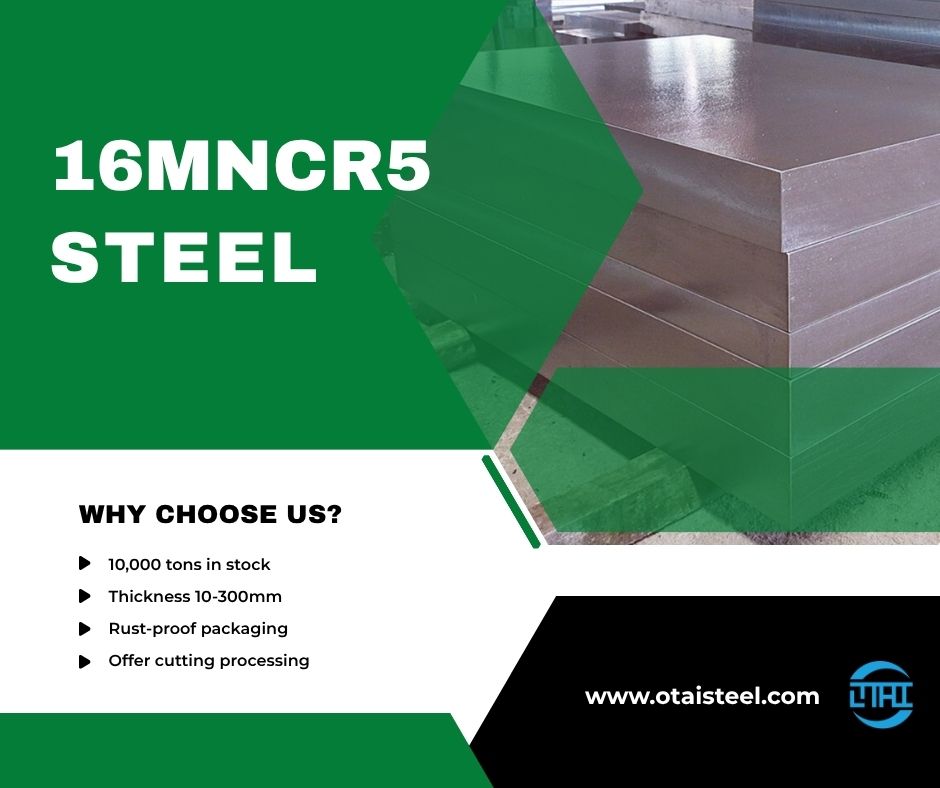
At Otai Special Steel, we offer a variety of materials, including 16MnCr5 and its equivalent grades, with premium quality and customizable options to meet the needs of diverse industries.
- Large inventory: Over 10,000 tons of steel in stock, available year-round
- Custom sizes and cutting: Precision cutting and customized heat treatment services
- Strict quality control: Ultrasonic testing (UT), chemical analysis, and third-party inspections (SGS)
- Global delivery: Serving industries across the globe with high-performance steels
We ensure the highest standards in product quality, performance, and customer satisfaction.
❓ FAQ