 16MnCr5 Steel Number – Understanding DIN 1.7131 and Global Material Equivalents
When engineers, buyers, and heat treatment specialists search for 16MnCr5 steel number, they usually want to identify the exact material designation used in international standards. This carburizing alloy steel is widely used in automotive, gear manufacturing, and mechanical engineering industries because of its excellent surface hardness, core toughness, and machinability.
The official steel number for 16MnCr5 is:
| Standard | Steel Grade | Steel Number |
|---|---|---|
| EN / DIN | 16MnCr5 | 1.7131 |
| EN 10084 | 16MnCr5 | 1.7131 |
| DIN Standard | 16MnCr5 | 1.7131 |
Many global manufacturers also compare this material with other case hardening steels such as 16MnCr5 equivalent grade, SAE 5115 steel, 20MnCr5 steel, and JIS SCM420 due to their similar carburizing performance.
🔍 What Is 16MnCr5 Steel?
16MnCr5 is a low-carbon alloy carburizing steel containing manganese and chromium. Manufacturers primarily use it for components requiring:
- High wear resistance
- Strong fatigue strength
- Tough core properties
- Excellent hardenability after carburizing
The steel performs especially well in applications involving repeated stress, friction, and contact loading.
Common products include:
- Transmission gears
- Pinions
- Shafts
- Bushings
- Camshafts
- Worm gears
- Heavy-duty mechanical parts
Because of its balanced composition, many buyers searching for 16MnCr5 steel number are actually sourcing material for gear manufacturing and precision-machined components.
🧪 Chemical Composition of 16MnCr5 Steel
The alloy chemistry directly affects carburizing response and mechanical performance.
| Element | Content (%) |
|---|---|
| Carbon (C) | 0.14 – 0.19 |
| Silicon (Si) | 0.17 – 0.37 |
| Manganese (Mn) | 1.00 – 1.30 |
| Phosphorus (P) | ≤ 0.025 |
| Sulfur (S) | ≤ 0.035 |
| Chromium (Cr) | 0.80 – 1.10 |
The chromium content improves hardenability and wear resistance, while manganese enhances strength and toughness. This combination makes the material suitable for case hardening steel applications requiring durable surfaces and impact-resistant cores.
📊 Mechanical Properties of 16MnCr5
Mechanical properties depend heavily on heat treatment condition, carburizing depth, and quenching process.
| Property | Typical Value |
|---|---|
| Tensile Strength | 800 – 1200 MPa |
| Yield Strength | 550 – 850 MPa |
| Elongation | 8 – 12% |
| Hardness Before Heat Treatment | 160 – 220 HB |
| Surface Hardness After Carburizing | 58 – 62 HRC |
After carburizing and quenching, the steel develops a hard outer case while maintaining a relatively ductile inner core. This structure helps reduce cracking under cyclic loading conditions.
🌍 Why Is the Steel Number 1.7131 Important?
The steel number system provides a universal identification method across international markets. Many global buyers prefer ordering by steel number rather than grade name because naming conventions vary between countries.
For example:
| Country/Region | Equivalent Designation |
|---|---|
| Germany | 1.7131 / 16MnCr5 |
| USA | SAE 5115 |
| Japan | SCM420 |
| China | 16CrMnH |
| France | 16MC5 |
| Italy | 16MnCr5 |
When sourcing alloy steel internationally, using the correct DIN steel number 1.7131 reduces confusion and ensures material traceability.
This becomes especially important for:
- Export orders
- Third-party inspection
- OEM manufacturing
- Automotive supply chains
- Heat treatment certification
🔥 Heat Treatment Process of 16MnCr5
One reason why 16MnCr5 steel number receives global attention is the steel’s excellent response to carburizing and quenching.
🌡️ Typical Heat Treatment Parameters
| Process | Temperature |
|---|---|
| Forging | 850 – 1050°C |
| Normalizing | 870 – 900°C |
| Carburizing | 880 – 980°C |
| Hardening | 820 – 860°C |
| Tempering | 150 – 200°C |
The carburizing process increases carbon concentration on the surface layer, producing high hardness after quenching.
Typical effective case depth:
- 0.8 mm
- 1.0 mm
- 1.2 mm
- 1.5 mm
depending on component requirements.
Manufacturers often choose this steel for carburized gear steel applications where surface wear resistance and internal toughness must coexist.
🛠️ Machining and Weldability
16MnCr5 offers good machinability in normalized condition. Many workshops machine the material before carburizing to reduce tool wear and improve dimensional control.
⚙️ Machining Characteristics
- Good turning performance
- Stable drilling behavior
- Suitable for CNC machining
- Good dimensional stability after heat treatment
🔩 Weldability
The steel can be welded, but preheating is usually recommended because chromium alloy steels may develop hard zones near weld areas.
Typical recommendations:
- Preheat: 150–250°C
- Controlled cooling
- Post-weld stress relief when necessary
For high-performance gears or shafts, manufacturers usually avoid welding after carburizing.
🚗 Common Industrial Applications
Due to its excellent combination of hardness and toughness, 16MnCr5 is widely used in several industries.
🚘 Automotive Industry
- Gearboxes
- Differential gears
- Transmission shafts
- Clutch components
🏗️ Heavy Machinery
- Mining gears
- Industrial reducers
- Power transmission parts
🚜 Agricultural Equipment
- Drive shafts
- Wear-resistant couplings
- Gear systems
🧩 Precision Engineering
- CNC machined gears
- Hardened pinions
- Mechanical bushings
Many OEMs searching for 16MnCr5 material specifications prioritize stable hardness distribution and fatigue resistance in rotating parts.
⚖️ 16MnCr5 vs 20MnCr5
Both steels belong to the carburizing alloy steel family, but they have slight differences.
| Property | 16MnCr5 | 20MnCr5 |
|---|---|---|
| Carbon Content | Lower | Higher |
| Toughness | Better | Slightly Lower |
| Surface Hardness | Excellent | Excellent |
| Core Strength | Good | Higher |
| Machinability | Very Good | Good |
16MnCr5 often becomes the preferred option when toughness and machinability matter more than maximum core strength.
🏭 Company Advantages
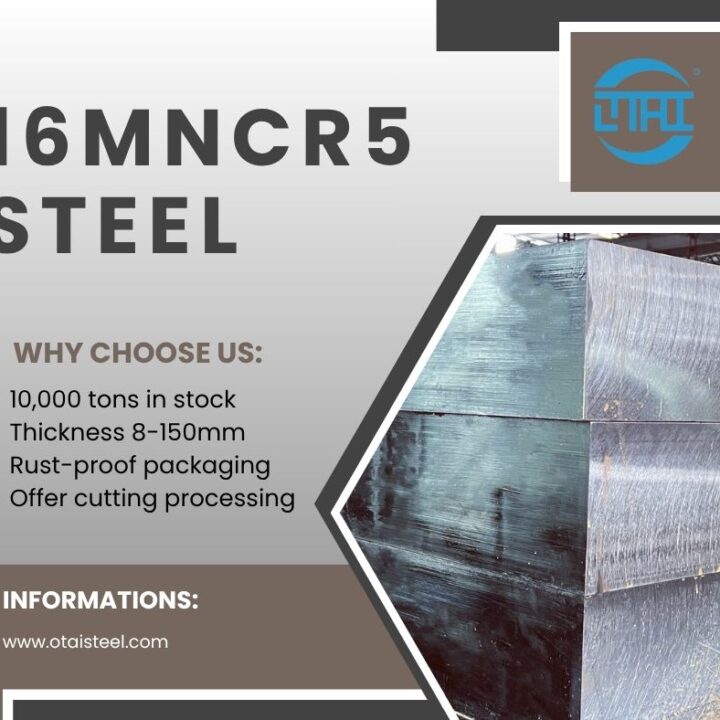
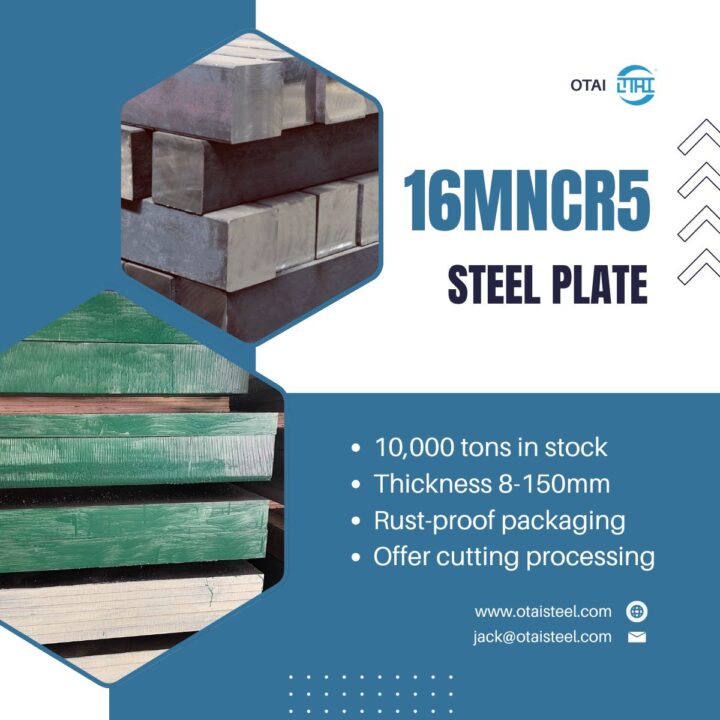
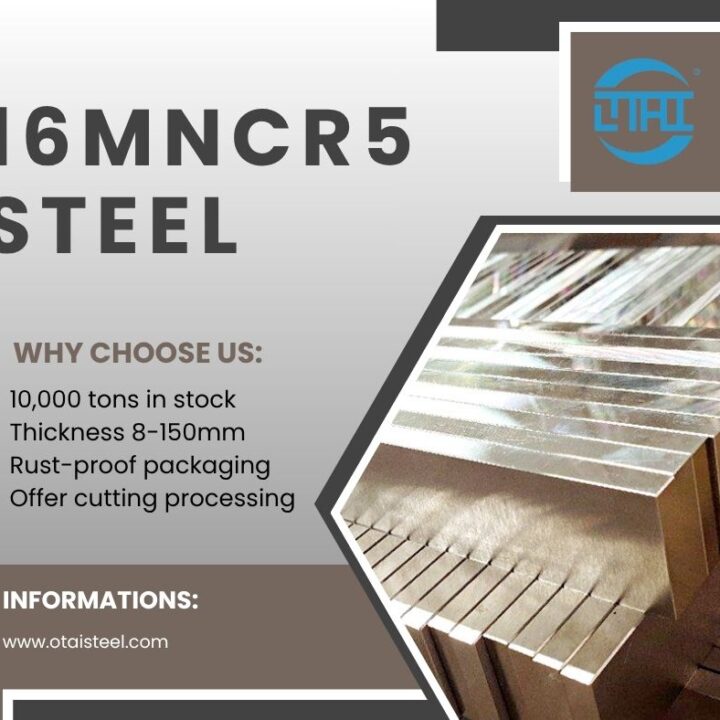
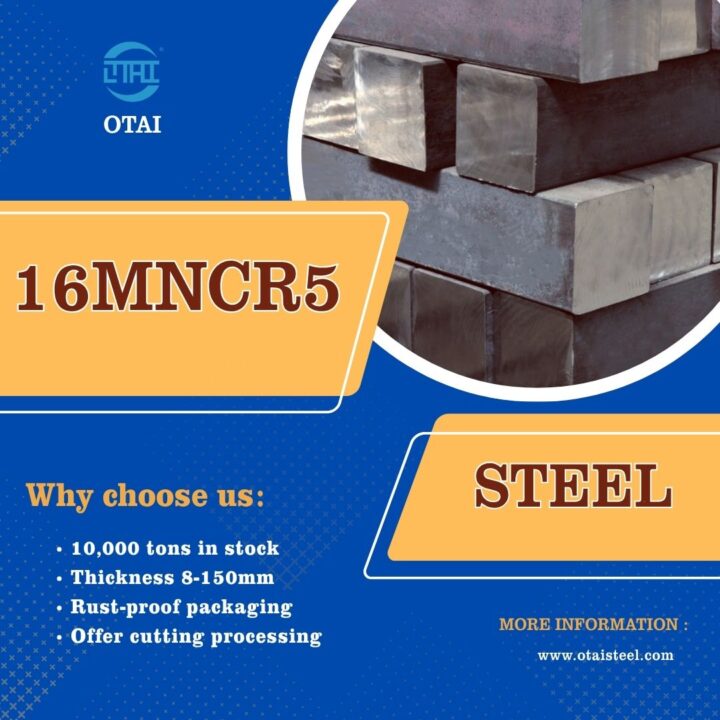
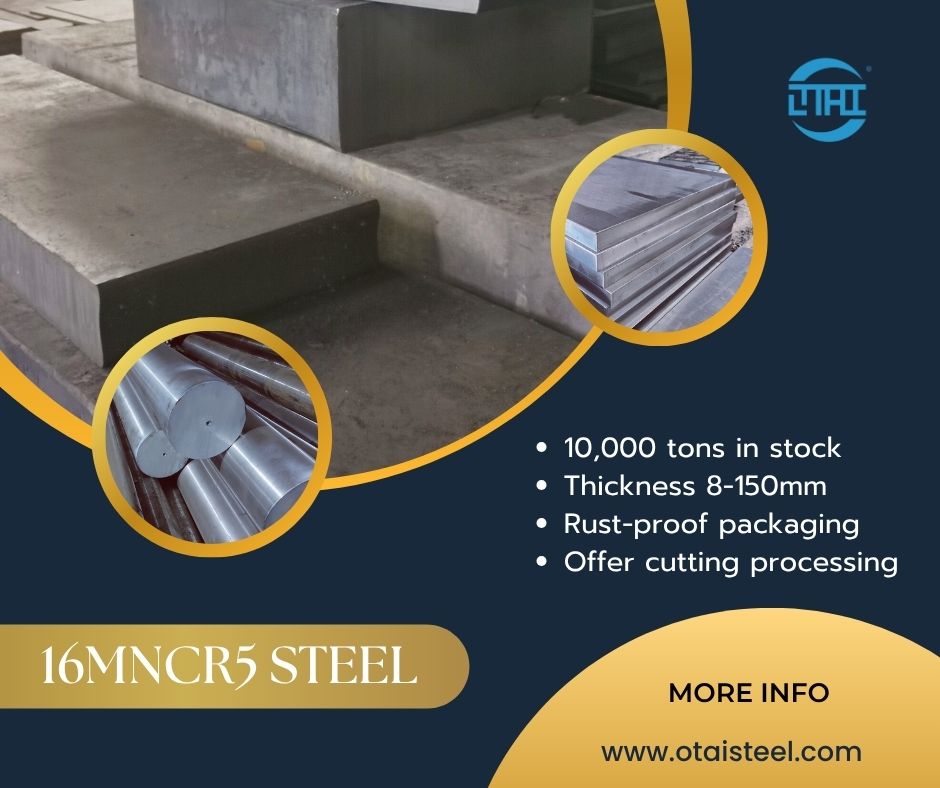
At Otai Special Steel, we supply high-quality 16MnCr5 alloy steel plates, flats, rounds, and forged blocks for global industrial applications.
Our advantages include:
- Large stock availability year-round
- 8–150mm thickness plates available in stock
- Customized cutting services
- Heat treatment support
- Ultrasonic testing (UT)
- Chemical composition verification
- Third-party inspection support such as SGS
- Stable export packaging
- Fast delivery for international orders
We provide 16MnCr5 materials in multiple dimensions suitable for gear manufacturing, machinery production, and precision engineering projects.
❓ FAQ
What is the steel number of 16MnCr5?
The official steel number is 1.7131 under DIN and EN standards.
Is 16MnCr5 a carburizing steel?
Yes. It is a low-carbon alloy carburizing steel widely used for case hardening applications.
What is the equivalent of 16MnCr5 in the USA?
The closest American equivalent is SAE 5115 steel.
What hardness can 16MnCr5 achieve?
After carburizing and quenching, the surface hardness typically reaches 58–62 HRC.
Is 16MnCr5 suitable for gears?
Yes. The material is commonly used for gears, pinions, shafts, and transmission components due to its wear resistance and fatigue strength.
Can 16MnCr5 be welded?
Yes, but controlled preheating and post-weld treatment are recommended to minimize cracking risks.