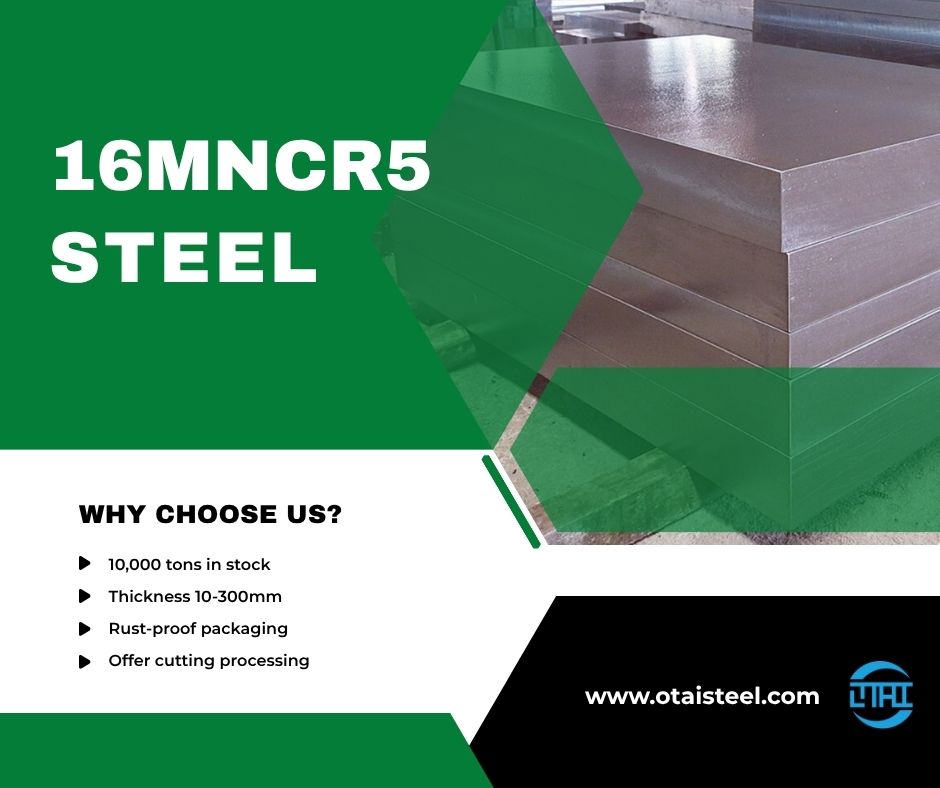
 16MnCr5 vs EN8: A Comprehensive Comparison
🔍 Introduction
When selecting the right material for a specific application, it’s crucial to compare the properties of different steel grades. 16MnCr5 and EN8 are two popular medium-carbon steels used in various industries. Each material has unique characteristics that make it suitable for specific applications. This article compares 16MnCr5 and EN8, examining their chemical compositions, mechanical properties, and common uses to help you understand their differences and choose the best option for your needs.
🛠️ What is 16MnCr5?
16MnCr5 is an alloy steel with a composition that includes manganese (Mn) and chromium (Cr). The material is commonly used for parts that require good wear resistance, fatigue strength, and the ability to withstand high cyclic loads. 16MnCr5 is often used in applications that involve heavy machinery, gears, and shafts.
Typical Chemical Composition of 16MnCr5:
- Carbon (C): 0.14% – 0.19%
- Manganese (Mn): 1.00% – 1.30%
- Chromium (Cr): 0.80% – 1.10%
- Silicon (Si): 0.20% – 0.35%
The combination of manganese and chromium provides excellent hardness, toughness, and wear resistance, making 16MnCr5 suitable for high-performance applications.
⚙️ What is EN8?
EN8, also known as 080M40, is a medium-carbon steel widely used for general engineering applications. It is well-regarded for its good tensile strength, impact resistance, and versatility in applications requiring moderate strength and durability. Unlike 16MnCr5, EN8 does not contain chromium, making it less resistant to wear and fatigue but easier to machine.
Typical Chemical Composition of EN8:
- Carbon (C): 0.35% – 0.45%
- Manganese (Mn): 0.60% – 0.90%
- Silicon (Si): 0.10% – 0.35%
- Sulfur (S): 0.035% (max)
- Phosphorus (P): 0.035% (max)
The higher carbon content in EN8 provides a good balance of strength and machinability, but it sacrifices some of the toughness and wear resistance found in alloy steels like 16MnCr5.
📊 Mechanical Properties Comparison
The mechanical properties of 16MnCr5 and EN8 differ significantly, making each material suited for different applications. Let’s compare some key properties of both materials:
| Property | 16MnCr5 | EN8 |
|---|---|---|
| Tensile Strength | 550 – 700 MPa | 600 – 750 MPa |
| Yield Strength | 350 – 450 MPa | 320 – 500 MPa |
| Hardness (HB) | 180 – 255 HB | 150 – 250 HB |
| Impact Toughness | High | Moderate |
| Fatigue Strength | Excellent | Good |
| Machinability | Moderate to Good | Good |
- Tensile Strength: Both 16MnCr5 and EN8 offer high tensile strength, but EN8 tends to be slightly stronger in certain cases.
- Yield Strength: 16MnCr5 offers a higher yield strength than EN8, which gives it an advantage in high-stress applications.
- Hardness: Both materials have a similar hardness range, but 16MnCr5 tends to have a higher hardness when carburized.
- Impact Toughness: 16MnCr5 performs better in terms of impact toughness, making it more suitable for applications that involve high-impact stress.
- Fatigue Strength: 16MnCr5 excels in fatigue resistance, making it a better choice for components subjected to repetitive loads.
⚙️ Key Differences Between 16MnCr5 and EN8
- Alloy Content and Composition
- 16MnCr5 contains chromium, which provides better wear resistance and fatigue strength than EN8, making it ideal for heavy-duty applications.
- EN8 is a more basic carbon steel and doesn’t contain chromium, making it more suitable for applications that don’t require exceptional wear resistance.
- Fatigue Resistance
- 16MnCr5 has significantly better fatigue resistance than EN8, which makes it ideal for parts that experience cyclic loading, such as gears and shafts.
- EN8 is better suited for general applications where high fatigue resistance is not the primary concern.
- Machinability
- EN8 is easier to machine compared to 16MnCr5, which can be harder and require more precise cutting tools, especially when carburized.
- This makes EN8 a better option for applications requiring easy machining and moderate strength.
- Wear Resistance
- 16MnCr5 has superior wear resistance due to its chromium content, making it suitable for high-load applications.
- EN8, while having good strength, doesn’t perform as well in applications involving high wear.
🏗️ Applications of 16MnCr5 vs EN8
1. 16MnCr5 Applications
16MnCr5 is primarily used in applications where high fatigue resistance and wear resistance are critical. Some common uses include:
- Automotive components (e.g., gears, shafts, axles)
- Heavy machinery (e.g., bearings, rotating parts)
- Industrial tools (e.g., tool holders, cutting tools)
- Energy equipment (e.g., drill bits, pumps)
2. EN8 Applications
EN8 is often used for parts that need a good balance of strength and machinability but do not require extreme wear or fatigue resistance. Common applications include:
- General engineering parts (e.g., shafts, pins, bolts)
- Machine parts (e.g., axles, brackets, clamps)
- Forging and machining (e.g., housings, spindles)
🏆 Company Advantages
At Otai Special Steel, we offer high-quality 16MnCr5 and EN8 steel products tailored to meet your specific needs. We provide various services to ensure that our materials meet the highest industry standards:
- Custom Cutting: We offer precise cutting services for 16MnCr5 and EN8 plates to your exact specifications.
- Heat Treatment: We provide treatments like carburizing, tempering, and quenching to enhance the material’s properties.
- Quality Assurance: We conduct chemical analysis, ultrasonic testing, and visual inspection to ensure that our products meet the highest quality standards.
❓ Frequently Asked Questions
1. What is the difference between 16MnCr5 and EN8?
16MnCr5 contains chromium, which gives it better wear resistance and fatigue strength than EN8. EN8 is a simpler carbon steel that is easier to machine but offers lower wear resistance.
2. Which material is better for gears and shafts?
For gears and shafts, 16MnCr5 is the better choice due to its superior wear resistance and fatigue strength.
3. Is EN8 easier to machine than 16MnCr5?
Yes, EN8 is easier to machine compared to 16MnCr5 due to its simpler composition and lower hardness.