 16MnCr5 Steel Microstructure – Understanding Grain Structure & Performance
The 16MnCr5 steel microstructure plays a critical role in determining the material’s hardness, wear resistance, fatigue strength, and service life. While many engineers focus on chemical composition and mechanical properties, the microstructure ultimately controls how the steel performs under real operating conditions.
16MnCr5 is one of the most widely used case hardening steels in the automotive, machinery, and power transmission industries. Manufacturers commonly use this grade for gears, shafts, pinions, couplings, and transmission components. After carburizing and heat treatment, the steel develops a hard wear-resistant surface while maintaining a tough core. This unique combination comes directly from the evolution of the 16MnCr5 steel microstructure.
Engineers frequently search for terms such as 16MnCr5 microstructure after carburizing, 16MnCr5 heat treatment microstructure, 16MnCr5 martensite structure, 16MnCr5 carburized layer microstructure, and 16MnCr5 grain structure analysis. Understanding these metallurgical characteristics helps manufacturers optimize heat treatment processes and improve component performance.
🔵 What Is the Microstructure of 16MnCr5 Steel?
The term 16MnCr5 steel microstructure refers to the microscopic arrangement of phases and grains within the steel. Depending on the manufacturing condition, the microstructure may consist of ferrite, pearlite, bainite, martensite, retained austenite, or a combination of these structures.
Before carburizing and heat treatment, 16MnCr5 typically exhibits a ferrite-pearlite structure. This microstructure provides good machinability and allows manufacturers to perform cutting, drilling, and shaping operations efficiently.
After carburizing, quenching, and tempering, the surface layer transforms into high-carbon martensite. Meanwhile, the core maintains a lower carbon content and develops a tougher structure. This dual-structure design gives 16MnCr5 its excellent combination of surface hardness and core toughness.
🟢 Typical Microstructures in Different Conditions
| Condition | Typical Microstructure | Main Characteristics |
|---|---|---|
| Annealed | Ferrite + Pearlite | Good machinability and ductility |
| Normalized | Refined Ferrite + Pearlite | Improved strength and grain refinement |
| Carburized | Carbon-Enriched Austenite | Prepares surface for hardening |
| Quenched | Martensite | High hardness and wear resistance |
| Tempered | Tempered Martensite | Balanced hardness and toughness |
Each stage of heat treatment modifies the 16MnCr5 steel microstructure and directly affects final performance. Proper process control ensures that the desired hardness profile develops throughout the component.
🟠 Chemical Composition and Microstructure Formation
The alloying elements within 16MnCr5 strongly influence microstructural development during heat treatment. Carbon controls hardness, manganese improves hardenability, and chromium enhances wear resistance.
| Element | Typical Content (%) | Influence on Microstructure |
|---|---|---|
| Carbon (C) | 0.14 – 0.19 | Determines hardness potential |
| Manganese (Mn) | 1.00 – 1.30 | Improves hardenability |
| Chromium (Cr) | 0.80 – 1.10 | Enhances wear resistance |
| Silicon (Si) | ≤0.40 | Strengthens ferrite matrix |
| Phosphorus (P) | ≤0.025 | Controlled impurity |
| Sulfur (S) | ≤0.035 | Improves machinability |
These alloying elements work together during carburizing and quenching to create the desired 16MnCr5 steel microstructure. The resulting structure supports excellent fatigue strength and long-term durability in demanding mechanical applications.
🟣 Microstructure Evolution During Carburizing
Carburizing is the most important heat treatment process that influences the 16MnCr5 steel microstructure. During this process, manufacturers heat the steel in a carbon-rich atmosphere at temperatures typically ranging from 900°C to 950°C. Carbon atoms gradually diffuse into the surface layer while the core composition remains relatively unchanged.
As carbon concentration increases near the surface, the steel develops a carburized case that can later transform into high-hardness martensite after quenching. The core maintains a lower carbon content, which helps preserve toughness and impact resistance.
The depth of the carburized layer depends on temperature, holding time, and process control. Engineers carefully monitor these parameters because the final microstructure directly affects fatigue life and wear performance.
A properly carburized 16MnCr5 steel microstructure produces a gradual transition from the hard surface layer to the tough core. This transition zone reduces stress concentration and improves resistance to crack propagation.
🔷 Martensitic Structure After Quenching
After carburizing, manufacturers quench the steel to transform austenite into martensite. Martensite is a supersaturated solid solution of carbon in iron and represents one of the hardest microstructures found in engineering steels.
The surface region typically develops a high-carbon martensitic structure because carburizing enriches the outer layer with carbon. This structure provides exceptional wear resistance, making 16MnCr5 suitable for gears, pinions, and heavily loaded transmission components.
The core experiences a different transformation because it contains less carbon. Instead of extremely hard martensite, the core develops a tougher microstructure that resists shock loading and impact forces.
This combination of a hard exterior and a tough interior is the primary reason why the 16MnCr5 steel microstructure performs so well in dynamic applications.
⚙️ Tempered Martensite and Service Performance
Although martensite provides excellent hardness, excessive hardness can increase brittleness. Manufacturers therefore temper the steel after quenching to improve toughness while maintaining sufficient wear resistance.
Tempering transforms freshly formed martensite into tempered martensite. This microstructure reduces internal stress and improves dimensional stability. Components subjected to repeated loading benefit significantly from this treatment because tempered martensite offers superior fatigue performance.
In many industrial applications, the final 16MnCr5 steel microstructure consists primarily of tempered martensite in the case layer combined with a tougher core structure. This balance allows gears and shafts to withstand millions of operating cycles without premature failure.
🔴 Microstructure and Mechanical Properties
The relationship between microstructure and mechanical properties is extremely important. Every phase within the steel contributes to overall performance.
| Microstructure | Main Benefit | Typical Application Effect |
|---|---|---|
| Ferrite | High ductility | Improves machinability |
| Pearlite | Balanced strength | Supports forming operations |
| Bainite | Good toughness | Improves impact resistance |
| Martensite | Maximum hardness | Enhances wear resistance |
| Tempered Martensite | Strength and toughness balance | Extends fatigue life |
Because different phases contribute unique benefits, heat treatment specialists carefully design processing schedules to achieve the desired 16MnCr5 steel microstructure. Even small changes in quenching temperature or tempering parameters can influence final performance.
🔹 Industrial Applications Requiring Optimized Microstructure
Many industries depend on the superior microstructure of 16MnCr5 steel. Automotive manufacturers use it extensively in transmission gears because the carburized martensitic layer resists wear while the tough core absorbs shock loads.
Industrial gearbox manufacturers also rely on the material to achieve long service life under continuous operating conditions. Agricultural machinery producers use 16MnCr5 for gears and drive components exposed to abrasive environments.
Mining equipment manufacturers appreciate the wear resistance created by the optimized 16MnCr5 steel microstructure. Components often operate under severe loads, making surface durability critical for long-term performance.
The material also appears in power transmission systems, heavy machinery, and precision mechanical assemblies where fatigue strength and dimensional stability are essential.
📈 Factors Affecting 16MnCr5 Steel Microstructure
Several variables influence the final microstructure. Carburizing temperature affects carbon diffusion depth. Quenching speed determines the amount of martensite that forms. Tempering temperature influences the balance between hardness and toughness.
Grain size also plays an important role. Fine grains generally improve strength and toughness, while coarse grains can reduce fatigue resistance. Modern heat treatment facilities use precise process controls to ensure consistent results.
Material cleanliness contributes as well. Lower inclusion levels help improve fatigue life and reduce the risk of crack initiation. For critical applications, manufacturers often specify ultrasonic testing and strict quality requirements to maintain microstructural integrity.
🏭 Company Advantages – Otai Special Steel
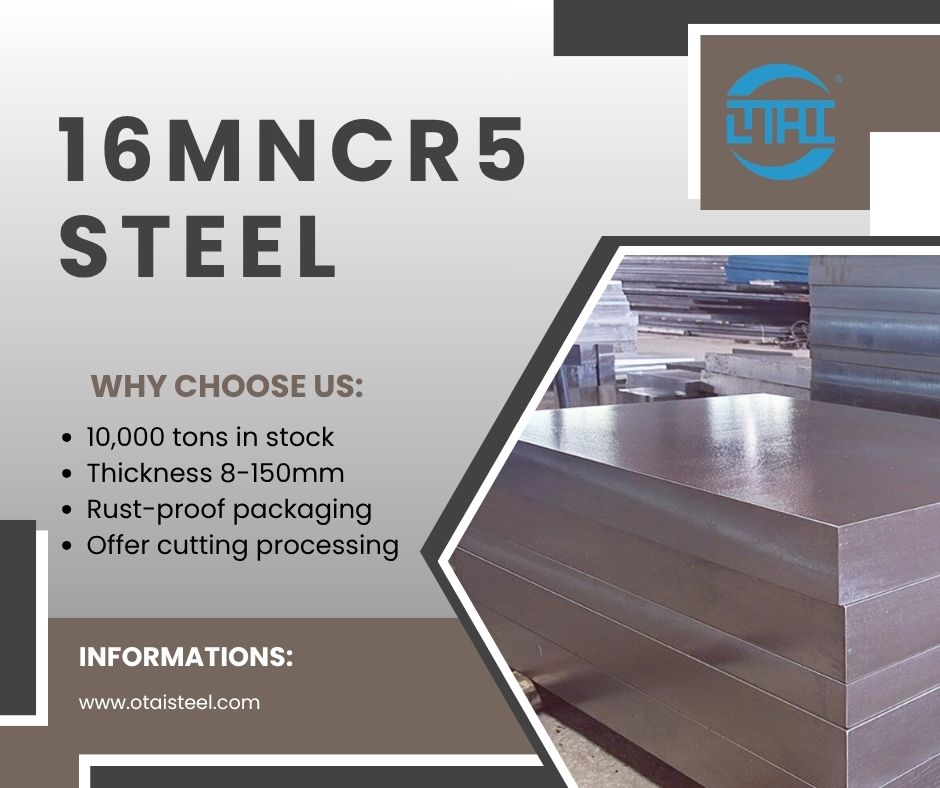
- 📏 16MnCr5 steel plate thickness range: 8–150mm in stock
- 📦 Large inventory available for immediate shipment
- ✂️ Cutting, machining, and heat treatment services
- 🔬 Ultrasonic testing (UT) and third-party inspection support
- 🌍 Rich experience supplying global automotive and machinery industries
- 🏆 Reliable quality control for demanding engineering applications
Otai Special Steel supplies high-quality 16MnCr5 steel plates, blocks, and customized materials for customers worldwide. Our inventory, processing capabilities, and quality assurance systems help manufacturers reduce lead times and improve production efficiency.
❓ FAQ – 16MnCr5 Steel Microstructure
Q1: What is the typical microstructure of annealed 16MnCr5 steel?
Annealed 16MnCr5 typically contains ferrite and pearlite, providing good machinability and forming characteristics.
Q2: What microstructure forms after carburizing and quenching?
The surface generally develops high-carbon martensite, while the core remains tougher because of its lower carbon content.
Q3: Why is tempered martensite important?
Tempered martensite improves toughness, reduces internal stress, and increases fatigue resistance while maintaining good hardness.
Q4: How does microstructure affect wear resistance?
A martensitic surface provides excellent hardness and significantly improves resistance to abrasion and contact wear.
Q5: Why is 16MnCr5 widely used for gears?
Its optimized microstructure combines a hard wear-resistant surface with a strong and tough core, making it ideal for power transmission components.
🏁 Conclusion
The 16MnCr5 steel microstructure determines the material’s wear resistance, fatigue strength, toughness, and long-term reliability. Through carburizing, quenching, and tempering, manufacturers create a hard martensitic surface layer supported by a tough core structure. This unique combination allows 16MnCr5 to perform exceptionally well in gears, shafts, and other critical transmission components.
By understanding the relationship between heat treatment and microstructural development, engineers can optimize component performance, extend service life, and improve production quality. This is why 16MnCr5 remains one of the most trusted case hardening steels in modern engineering.