16MnCr5 Plate: What Applications Is This Steel Grade Suitable For?
📑 Table of Contents
- 🔍 What Is 16MnCr5 Steel Plate?
- ⚙️ Why Is 16MnCr5 Suitable for Case-Hardened Components?
- 🚗 Can 16MnCr5 Plate Be Used for Automotive Components?
- ⚙️ Is 16MnCr5 Suitable for Industrial Gears and Shafts?
- 🏭 What Other Machine Components Can Be Made from 16MnCr5 Plate?
- 🔥 How Does Heat Treatment Affect 16MnCr5 Applications?
- 📏 What Should Buyers Check When Selecting 16MnCr5 Plate?
- 🛒 When Should You Choose 16MnCr5 Instead of Another Steel Grade?
- 🏭 OTAI Advantages in Supplying 16MnCr5 Steel Plate
- ❓ Frequently Asked Questions
When manufacturers search for 16MnCr5 plate, they are often looking for a steel grade that can provide a hard, wear-resistant surface while retaining a tougher core after suitable heat treatment. This combination makes 16MnCr5 a practical choice for selected gears, transmission components, and other machine parts exposed to contact pressure and repeated movement.
16MnCr5 is a low-carbon alloy case-hardening steel commonly specified under EN 10084. Unlike through-hardening steels, it is designed for applications where manufacturers want to harden the surface through carburizing while maintaining a relatively tough interior. The final performance depends on the component design, carburizing process, quenching conditions, and required effective case depth.
However, not every part that experiences wear or mechanical loading needs 16MnCr5. Buyers should evaluate the working environment, load type, manufacturing route, and final heat-treatment requirements before selecting this material. This article examines its main applications and explains what manufacturers and procurement teams should consider when sourcing 16MnCr5 plate.
🔍 What Is 16MnCr5 Steel Plate?
A low-carbon alloy case-hardening steel
16MnCr5 is a chromium-manganese alloy steel developed for case-hardening applications. Its relatively low carbon content supports a tougher core, while carburizing increases the carbon concentration near the surface. After suitable quenching and tempering, manufacturers can obtain a hard outer layer and a stronger supporting interior.
The main alloying elements contribute to its performance in different ways:
- Carbon: The relatively low carbon content supports the toughness requirements of the core before carburizing.
- Manganese: Contributes to hardenability and strength.
- Chromium: Improves hardenability and supports the response to heat treatment.
These characteristics make 16MnCr5 suitable for components that need surface wear resistance without requiring the entire cross-section to reach the same high hardness.
What does the designation mean?
The designation 16MnCr5 belongs to the European alloy steel naming system. The number 16 broadly indicates a nominal carbon level around 0.16%, while MnCr identifies manganese and chromium as the principal alloying elements. The final number relates to the approximate alloy content under the designation system.
For procurement purposes, buyers should not rely on the grade name alone. They should specify the applicable edition of EN 10084, the delivery condition, dimensions, and any additional inspection requirements. Equivalent grades in other standards may have similar applications, but their chemical composition and acceptance requirements should be checked individually.
Plate form and manufacturing flexibility
16MnCr5 is often associated with bars and other forms used to manufacture case-hardened components. Plate form can also support applications where manufacturers need to cut blanks, machine profiles, or produce customized parts from flat stock.
The suitability of plate depends on the required component geometry and the manufacturing route. For example, a plate may provide a convenient starting form for machining a special gear blank, wear component, or custom machine part. The final component still needs an appropriate heat-treatment procedure to achieve its required properties.
⚙️ Why Is 16MnCr5 Suitable for Case-Hardened Components?
Hard surface and tough core work together
Many machine components experience different mechanical conditions at their surfaces and interiors. A gear tooth, for example, experiences repeated contact stress and friction, while the supporting body must resist bending and impact loads.
16MnCr5 addresses this combination through carburizing. During the process, carbon enters the surface of the steel at elevated temperature. The carbon-enriched layer can then harden during quenching, while the lower-carbon core retains a comparatively tougher structure.
This difference in surface and core properties is important because a uniformly hard component may become too brittle for some applications. Conversely, a relatively soft surface may wear too quickly under repeated contact.
How carburizing improves wear resistance
Carburizing increases the carbon content near the surface, allowing the outer layer to develop high hardness after quenching. This hardened case can improve resistance to abrasive and adhesive wear under suitable operating conditions.
For gears and transmission components, surface hardness helps the material withstand repeated contact between mating surfaces. It can also support fatigue performance when manufacturers control case depth, residual stress, surface finish, and component geometry.
Nevertheless, carburizing does not automatically guarantee a long service life. Poor temperature control, excessive distortion, unsuitable quenching, or an incorrect case depth can affect the finished component.
Why hardenability matters
Manganese and chromium improve the steel’s hardenability. This helps the material develop a hardened case under appropriate heat-treatment conditions. However, the actual hardness distribution depends on section size, carbon profile, quenching conditions, and the selected process.
Manufacturers should therefore evaluate the component’s dimensions and service requirements before selecting a carburizing procedure. A small precision component and a large industrial gear may require different process controls even when both use 16MnCr5.
Typical application requirements
| Component requirement | How 16MnCr5 can contribute | Important consideration |
|---|---|---|
| Surface wear resistance | Carburizing creates a hard surface layer | Case hardness and depth must match the application |
| Core toughness | Low-carbon core supports toughness | Section size and quenching conditions affect the result |
| Contact fatigue resistance | A hardened case can support repeated contact loading | Surface finish, geometry, and residual stress also matter |
| Dimensional stability | Controlled processing can produce consistent components | Heat-treatment distortion needs allowance and control |
🚗 Can 16MnCr5 Plate Be Used for Automotive Components?
Automotive transmission gears
Gears are among the most recognized applications for case-hardening steels. In automotive transmissions and related drive systems, gear teeth experience repeated contact and sliding. The material must therefore provide suitable surface hardness and resistance to contact fatigue.
16MnCr5 can be considered for selected transmission gears when the design and heat-treatment requirements match its capabilities. Carburizing produces a hardened case on the tooth surfaces, while the core supports the mechanical loads transmitted through the gear body.
However, the choice depends on torque, operating speed, gear dimensions, lubrication, contact stress, and expected service life. More demanding applications may require other steel grades or more specific material and heat-treatment specifications.
Automotive shafts and transmission components
Some shafts and transmission components contain surfaces that experience repeated contact, friction, or wear. Case-hardening steel can be useful when the design requires a wear-resistant outer layer and a tougher core.
Manufacturers may evaluate 16MnCr5 for selected splined components, pinions, shafts, and related parts. The suitability depends on the geometry and the location of the loaded surfaces. For example, a component with concentrated contact loading may need a specific case depth and hardness profile.
Clutch and mechanical drive components
Selected clutch-related parts and mechanical drive components may also benefit from surface hardening. Components that experience repeated engagement, friction, or localized contact can require a hardened surface to limit wear.
Nevertheless, material selection must consider the complete operating environment. A part exposed to high impact, severe bending, or elevated operating temperatures may need a different balance of strength, toughness, and wear resistance.
What automotive manufacturers should evaluate
Before specifying 16MnCr5 for an automotive component, engineering teams should consider:
- Maximum torque and contact pressure.
- Surface wear and fatigue requirements.
- Required effective case depth and surface hardness.
- Core strength and toughness requirements.
- Component geometry and heat-treatment distortion.
- Applicable industry and customer-specific material specifications.
These factors help determine whether 16MnCr5 is a suitable material or whether a different case-hardening grade would provide a better performance balance.
⚙️ Is 16MnCr5 Suitable for Industrial Gears and Shafts?
Industrial gears exposed to repeated contact
Industrial gears often operate under continuous or intermittent loads. Their tooth surfaces experience repeated contact, while the gear body transfers torque through the transmission system.
For selected industrial gears, 16MnCr5 offers a practical combination of carburizing response and core toughness. After suitable heat treatment, the hardened surface can resist wear, while the core supports the tooth structure.
Examples may include selected reduction gears, machine-tool transmission gears, and smaller industrial drive components. The actual selection depends on load, speed, lubrication, tooth geometry, and the required service life.
Shafts, pins, and splined components
Some shafts and pins contain localized contact areas that need greater wear resistance than the rest of the component. In these cases, manufacturers may consider case-hardening steel rather than a through-hardening grade.
16MnCr5 can be suitable for selected pins, splined shafts, and transmission-related components when the design requires a hardened surface and a comparatively tough core. However, a shaft exposed mainly to high torsional or bending stress may require a different material strategy.
Bushings and machine elements
Selected bushings, sleeves, and machine elements may experience sliding contact or repeated surface loading. A hardened surface can help reduce wear when the component operates under suitable lubrication and contact conditions.
Manufacturers should still check the actual wear mechanism. Abrasive wear, adhesive wear, impact, and corrosion do not respond identically to material hardness. A hardened case may improve one performance characteristic without solving every failure mode.
Application suitability depends on the load profile
| Industrial component | Potential reason to use 16MnCr5 | Key design check |
|---|---|---|
| Reduction gear | Hard surface for repeated tooth contact | Contact fatigue and case depth |
| Pinion | Surface wear resistance | Tooth geometry and core strength |
| Splined shaft | Wear resistance at contact surfaces | Torsional load and dimensional stability |
| Pin or sleeve | Hardened contact surface | Sliding conditions and lubrication |
| Machine transmission part | Combination of surface hardness and core toughness | Actual load spectrum and service life |
For demanding industrial applications, engineers should verify the design requirements through calculations, material specifications, and appropriate testing. A steel grade should never be selected solely because it has been used successfully in a different machine.
🏭 What Other Machine Components Can Be Made from 16MnCr5 Plate?
Custom wear-resistant machine components
16MnCr5 plate can provide a starting material for customized machine components that require a carburized surface. Manufacturers can cut plate stock into blanks and machine the required profiles before heat treatment.
Potential applications include selected guide elements, mechanical locking parts, wear surfaces, and other components exposed to repeated contact. The material is most appropriate when the design benefits from a hard case and a tougher core rather than uniform hardness throughout the section.
Special-purpose gears and mechanical blanks
Some manufacturers produce special gears and mechanical blanks in small or medium production batches. Plate stock may offer flexibility when the required dimensions or component geometry do not match standard bar sizes.
After cutting, the blank can undergo machining to create the required shape. The manufacturer then selects a suitable carburizing and hardening process according to the component’s final dimensions and performance requirements.
Components produced through cutting and machining
Plate form can be useful when the component starts as a flat or relatively thick blank. Depending on the design, manufacturers may use sawing, milling, drilling, turning, and other machining operations to prepare the part.
However, buyers should distinguish between the raw material form and the final component form. A plate can be an appropriate starting stock without being the most efficient choice for every finished part. Material utilization, machining time, and the amount of removed material all affect production cost.
When plate form may not be the best choice
For long, slender shafts or components with a mainly cylindrical geometry, round bar may offer better material utilization. Similarly, parts requiring specific forged grain flow may need a different manufacturing route.
Before purchasing plate, compare the required dimensions with the available stock sizes and the final component geometry. This helps avoid unnecessary cutting waste and machining costs.
🔥 How Does Heat Treatment Affect 16MnCr5 Applications?
Carburizing creates the hardened surface layer
Carburizing is the central heat-treatment process associated with 16MnCr5. The steel is heated in a carbon-rich environment so that carbon diffuses into the surface. This produces a carbon-enriched case while the core retains its lower-carbon composition.
After carburizing, manufacturers typically apply a suitable hardening process to develop the required surface hardness. Depending on the component and process route, tempering may follow to adjust the final properties and reduce excessive brittleness.
Case depth must match the application
Effective case depth describes the depth of the hardened layer measured according to a defined hardness criterion. It is an important design parameter for gears, shafts, and other components exposed to contact stress.
A shallow case may not provide sufficient support under high contact loads. An excessively deep case can increase processing time and may not provide additional benefits for a particular design. The correct depth depends on component dimensions, load, geometry, and expected service life.
Quenching and tempering influence final properties
After carburizing, quenching transforms the carbon-enriched surface into a hard structure. The core also responds to the thermal cycle, but its properties differ because of its lower carbon content.
Tempering can help adjust the balance between hardness and toughness. However, the final results depend on process temperature, holding time, quenching conditions, and the material’s initial condition. Manufacturers should therefore define measurable acceptance criteria rather than relying only on a generic heat-treatment description.
Control distortion during heat treatment
Carburizing and quenching can cause dimensional changes. Thin sections, uneven geometries, sharp transitions, and differences in cooling rates may increase distortion risk.
For precision gears and mechanical components, manufacturers should plan machining allowances and consider whether pre-heat-treatment machining, post-heat-treatment grinding, or other finishing operations are necessary.
Buyers should communicate critical dimensions and tolerances before production. This allows the manufacturer to consider distortion control as part of the complete process rather than treating it as a final inspection issue.
What should be specified in a heat-treatment plan?
- Carburizing method and required case depth.
- Surface hardness and applicable test method.
- Core hardness or mechanical property requirements, where specified.
- Quenching and tempering conditions.
- Permitted dimensional changes and final tolerances.
- Inspection methods and acceptance criteria.
For critical components, the heat-treatment supplier should confirm the process parameters and provide suitable inspection records. This helps ensure that the finished part meets its design requirements.
📏 What Should Buyers Check When Selecting 16MnCr5 Plate?
Confirm the grade and applicable standard
Start by specifying 16MnCr5 and the applicable edition of EN 10084. If the project uses an equivalent designation, confirm the chemical composition and technical requirements rather than assuming that all similar grades are interchangeable.
The material certificate should identify the steel grade, heat or cast number, chemical analysis, delivery condition, and relevant test results. Buyers should compare the actual certificate with the purchase specification.
Choose the correct plate dimensions
Plate thickness, width, and length affect material utilization and machining costs. A suitable thickness should provide enough material for the finished component while allowing for machining and any required heat-treatment allowances.
For customized parts, buyers should also confirm dimensional tolerances, flatness requirements, cutting conditions, and edge quality. These details are especially important when the plate will be processed into precision blanks.
Check the delivery condition
The delivery condition affects the material’s initial hardness and machinability. Buyers should confirm whether the plate is supplied in an annealed or another agreed condition. If a specific starting condition is needed for subsequent processing, include it in the order.
Do not confuse the delivery condition with the final heat-treated condition. A plate supplied in an annealed condition will not automatically have the surface hardness required for a finished carburized component.
Review inspection and traceability requirements
Depending on the application, buyers may need dimensional inspection, hardness testing, ultrasonic testing, or third-party inspection. The required inspection level should match the component’s risk and service conditions.
Traceability is also important when one large plate is cut into multiple blanks. Ask how the supplier will maintain the relationship between the original heat number and the cut pieces, especially when the finished components require material documentation.
| Buyer checkpoint | Information to confirm |
|---|---|
| Steel grade | 16MnCr5 and EN 10084 requirements |
| Dimensions | Thickness, width, length, and tolerances |
| Delivery condition | Annealed or other agreed condition |
| Material certificate | Chemical analysis and heat identification |
| Processing | Cutting, machining allowance, and finishing requirements |
| Heat treatment | Carburizing, case depth, hardness, and distortion control |
| Inspection | Dimensional, hardness, UT, or third-party inspection as needed |
A clear specification helps the supplier confirm whether the available material matches the project. It also reduces the risk of ordering a plate that requires unnecessary processing or cannot meet the final component requirements.
🛒 When Should You Choose 16MnCr5 Instead of Another Steel Grade?
16MnCr5 versus 20MnCr5
16MnCr5 and 20MnCr5 are both chromium-manganese case-hardening steels. They are used in applications that require a hardened surface and a comparatively tough core after suitable heat treatment.
Their carbon contents and detailed chemical requirements differ. This can influence carburizing response, core properties, and the final performance of a component. However, neither grade is automatically better for every application.
When comparing them, manufacturers should examine the required core strength, case depth, surface hardness, component size, and applicable material specification.
16MnCrS5 versus 16MnCr5
16MnCrS5 is a related case-hardening steel with controlled sulfur content to improve machinability. The sulfur modification can benefit certain machining operations, but it may also affect transverse properties and other performance characteristics.
Therefore, manufacturers should consider 16MnCrS5 when machining productivity is a major concern and the component’s design permits its material characteristics. For applications with different toughness or cleanliness requirements, 16MnCr5 may be more appropriate.
16MnCr5 versus 4140 steel
4140 and 16MnCr5 serve different heat-treatment strategies. 16MnCr5 is primarily used for case-hardening applications, while 4140 is a chromium-molybdenum alloy steel commonly selected for through-hardening and quenching-and-tempering applications.
Choose 16MnCr5 when the design needs a hard carburized surface and a tougher core. Consider 4140 when the component requires strength and hardness through a greater portion of its section rather than relying mainly on a carburized case.
Compare materials according to the finished component
| Steel grade | Typical heat-treatment approach | Main selection consideration |
|---|---|---|
| 16MnCr5 | Carburizing and hardening | Hard surface with a tougher core |
| 20MnCr5 | Carburizing and hardening | Case-hardening requirements and core properties |
| 16MnCrS5 | Carburizing and hardening | Machinability requirements and sulfur-related properties |
| 4140 | Quenching and tempering, among other conditions | Strength and hardness through the section |
Ultimately, material selection should begin with the component’s working conditions rather than the steel grade’s popularity. Engineers and buyers should compare the required wear resistance, core strength, fatigue performance, machinability, heat-treatment route, and total manufacturing cost.
🏭 OTAI Advantages in Supplying 16MnCr5 Steel Plate
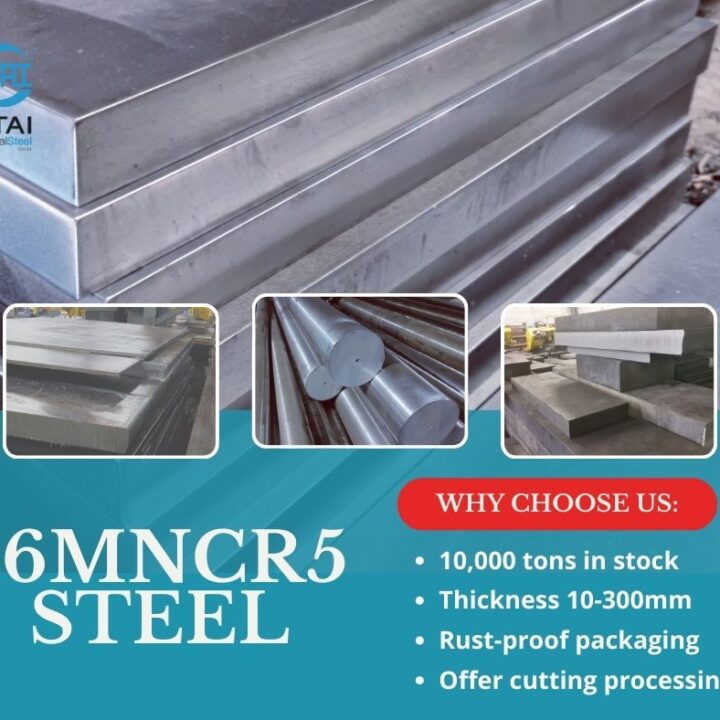
- 16MnCr5 plate stock: Thickness range of 8–150 mm, subject to confirmation of current inventory.
- Large overall inventory: More than 10,000 tons of stock across different steel grades.
- Cutting capacity: 20 saw cutting machines to prepare material according to customer dimensions.
- Machining services: CNC machining and grinding to support customized processing requirements.
- Quality support: Material testing, ultrasonic testing coordination, and third-party inspection support when required.
- Customized supply: Support for dimensional requirements, cutting tolerances, and agreed technical specifications.
- Export experience: Supplying customers in more than 54 countries since 1999.
- Export packaging: Anti-rust protection, strapping, bundling, and wooden cases according to shipment requirements.
- One-stop service: Assistance with material selection, cutting, processing coordination, inspection, and delivery.
OTAI supplies 16MnCr5 case-hardening steel plate for industrial manufacturing and customized machining applications. Buyers can review our 16MnCr5 steel product information and contact our team to confirm current stock, plate dimensions, delivery condition, and processing requirements.
❓ Frequently Asked Questions
1. What is 16MnCr5 steel plate mainly used for?
16MnCr5 is mainly used as a starting material for selected case-hardened components. Common applications include gears, pinions, shafts, splined parts, and other machine components that need a wear-resistant surface and a comparatively tough core after carburizing and suitable hardening.
2. Is 16MnCr5 suitable for manufacturing gears?
Yes. 16MnCr5 is commonly considered for selected gears because carburizing can produce a hard surface that resists contact wear, while the core supports mechanical loads. The final suitability depends on gear size, torque, contact stress, required case depth, and heat-treatment quality.
3. Does 16MnCr5 need carburizing before use?
For applications that rely on its case-hardening properties, carburizing is normally an important part of the manufacturing process. The process increases surface carbon content, followed by suitable hardening and tempering. However, the exact treatment depends on the component’s design and performance requirements.
4. What is the difference between 16MnCr5 and 20MnCr5?
Both are chromium-manganese case-hardening steels, but their specified chemical compositions differ, including their carbon content. These differences can influence core properties and heat-treatment response. Buyers should compare the applicable material standards and the finished component requirements before choosing between them.
5. What plate thicknesses of 16MnCr5 does OTAI supply?
OTAI’s stated 16MnCr5 plate stock range is 8–150 mm. Actual availability depends on current inventory and order requirements. Buyers should provide the required thickness, width, length, quantity, delivery condition, and any additional inspection requirements when requesting a quotation.