 16MnCr5 Material Yield Strength – Mechanical Properties and Heat Treatment Effects
The 16MnCr5 material yield strength is a critical mechanical property for engineers designing gears, shafts, transmission components, and other heavily loaded machinery parts. While hardness and tensile strength often receive the most attention, yield strength is equally important because it defines the stress level at which permanent deformation begins.
In practical engineering applications, a component may never reach its ultimate tensile strength during service. However, if the applied stress exceeds the yield strength, permanent deformation can occur, leading to dimensional inaccuracies, gear misalignment, reduced fatigue life, and eventual component failure.
As one of the most widely used carburizing steels in Europe and worldwide, 16MnCr5 combines excellent surface hardness after case hardening with a strong and tough core. Understanding the yield strength of 16MnCr5 steel helps manufacturers optimize material selection and improve component reliability.
📘 What Is 16MnCr5 Steel?
16MnCr5 is a low-carbon chromium-manganese alloy steel specified under EN 10084. It is primarily designed for case hardening applications where a hard wear-resistant surface and a tough load-bearing core are required.
The steel is widely used in:
- Automotive transmission gears
- Differential gears
- Industrial gearbox components
- Drive shafts
- Sprockets
- Pinions
- Machine tool parts
- Agricultural machinery components
Its popularity comes from its excellent balance of strength, toughness, wear resistance, and heat treatment response.
| Property | Value |
|---|---|
| Steel Grade | 16MnCr5 |
| Standard | EN 10084 |
| Steel Type | Case Hardening Steel |
| Main Alloying Elements | Cr, Mn |
🔬 Understanding Yield Strength
Yield strength is the stress at which a material begins to deform plastically. Below this point, the material will return to its original shape once the load is removed. Above this point, permanent deformation occurs.
For gears and shafts, maintaining dimensional accuracy is essential. Therefore, engineers often design components using yield strength rather than ultimate tensile strength.
The importance of 16MnCr5 steel yield strength includes:
- Preventing permanent deformation
- Maintaining gear tooth geometry
- Improving fatigue performance
- Increasing service life
- Ensuring reliable load transmission
- Reducing maintenance costs
In many industrial applications, yield strength becomes the primary design criterion because excessive deflection can cause failure long before fracture occurs.
📊 Typical Yield Strength of 16MnCr5
The 16MnCr5 yield strength MPa depends on the material condition and heat treatment state.
| Material Condition | Yield Strength (MPa) | Tensile Strength (MPa) |
|---|---|---|
| Annealed | 320–450 | 500–650 |
| Normalized | 450–600 | 650–850 |
| Quenched & Tempered | 700–950 | 900–1200 |
| Carburized Core | 800–1100 | 1000–1300 |
These values may vary depending on section size, chemical composition tolerances, and heat treatment parameters.
For critical applications, actual mechanical properties should always be verified through testing.
🔥 How Heat Treatment Affects Yield Strength
One of the biggest advantages of 16MnCr5 is its ability to achieve significantly higher strength after heat treatment.
Before heat treatment, the material offers excellent machinability. After carburizing, quenching, and tempering, both surface hardness and core strength increase substantially.
| Heat Treatment Stage | Effect on Yield Strength |
|---|---|
| Annealing | Reduces strength for machining |
| Normalizing | Improves grain refinement |
| Quenching | Significantly increases strength |
| Tempering | Balances strength and toughness |
| Carburizing | Creates high-strength surface layer |
The combination of a strong core and hard surface is the primary reason why 16MnCr5 remains one of the leading materials for power transmission components.
“`html
⚙️ Yield Strength vs Tensile Strength
Many buyers confuse yield strength with tensile strength, but the two properties describe different aspects of material performance.
Yield strength indicates the stress level at which permanent deformation begins, while tensile strength represents the maximum stress the material can withstand before fracture.
| Property | Definition | Engineering Importance |
|---|---|---|
| Yield Strength | Stress causing permanent deformation | Design limit for most components |
| Tensile Strength | Maximum stress before fracture | Ultimate failure resistance |
For gears and shafts, engineers usually focus on yield strength because even small permanent deformation can affect alignment, gear meshing accuracy, and operational efficiency.
For example, a gear tooth may never fracture during service, but if it plastically deforms, the transmission can become noisy, inefficient, or eventually fail due to abnormal load distribution.
⚙️ Yield Strength Requirements for Gears and Shafts
Different applications require different levels of strength. The required yield strength depends on operating load, rotational speed, impact conditions, and expected service life.
| Application | Typical Yield Strength Requirement |
|---|---|
| Automotive Transmission Gears | 800–1000 MPa |
| Industrial Gearboxes | 850–1100 MPa |
| Mining Equipment Components | 900–1100 MPa |
| Agricultural Machinery | 700–950 MPa |
| Heavy-Duty Shafts | 800–1050 MPa |
Because properly heat-treated 16MnCr5 can achieve yield strengths exceeding 900 MPa, it remains a preferred choice for many demanding power transmission systems.
📊 Comparison with Other Engineering Steels
Material selection often involves comparing several alloy steels with similar applications.
| Steel Grade | Typical Yield Strength (MPa) | Primary Application |
|---|---|---|
| 16MnCr5 | 800–1100 | Carburized gears and shafts |
| 20MnCr5 | 850–1150 | Automotive transmission parts |
| AISI 8620 | 750–1050 | Case-hardened components |
| 4140 | 650–1000 | Through-hardened shafts |
Compared with through-hardening steels such as 4140, 16MnCr5 offers the additional advantage of a carburized surface, providing superior wear resistance while maintaining a strong load-bearing core.
🏭 Real Industrial Applications
The mechanical performance of 16MnCr5 makes it suitable for industries where components experience continuous cyclic loading.
In automotive transmissions, gears are subjected to millions of loading cycles throughout their service life. A combination of high yield strength and surface hardness prevents tooth deformation and extends operational life.
In industrial gearboxes, shafts and pinions must transmit large amounts of torque without permanent bending. Here, high yield strength becomes a key factor in maintaining dimensional stability.
Mining machinery presents another demanding environment. Components experience heavy impact loads, abrasive wear, and continuous operation. The strong core of carburized 16MnCr5 helps absorb these loads while the hardened surface resists wear.
Agricultural machinery manufacturers also favor 16MnCr5 because it offers reliable performance under varying loads, harsh weather conditions, and long operating hours.
These practical applications demonstrate why yield strength is not simply a laboratory value but a critical factor influencing equipment reliability and maintenance costs.
🔩 Factors Affecting Yield Strength
Several factors can influence the final yield strength of 16MnCr5 components:
- Chemical composition variations within specification limits
- Heat treatment parameters
- Cooling rate during quenching
- Tempering temperature
- Component size and section thickness
- Grain size refinement
- Residual stresses after machining
For critical components, manufacturers often perform tensile testing and hardness testing to verify that the required mechanical properties have been achieved.
🏆 Company Advantages – Otai Special Steel
- Professional supplier of 16MnCr5 engineering steel.
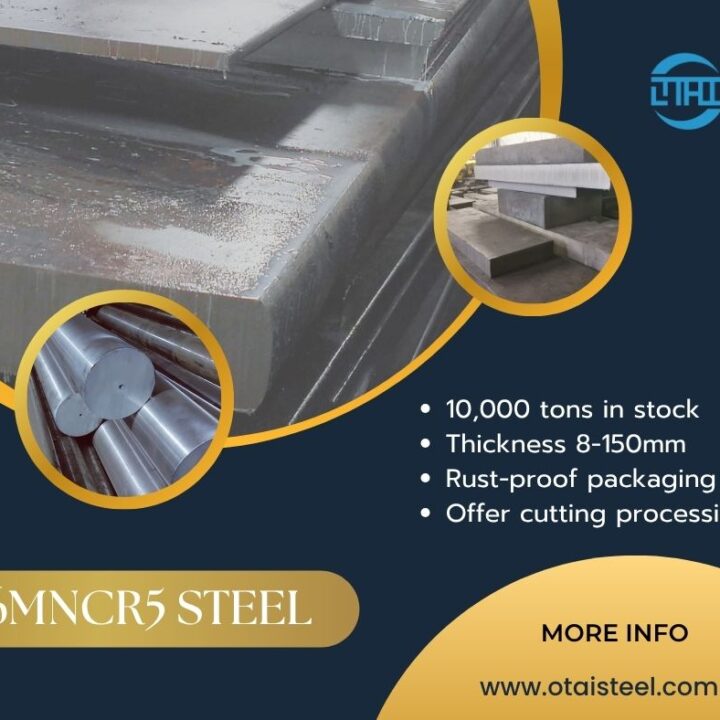
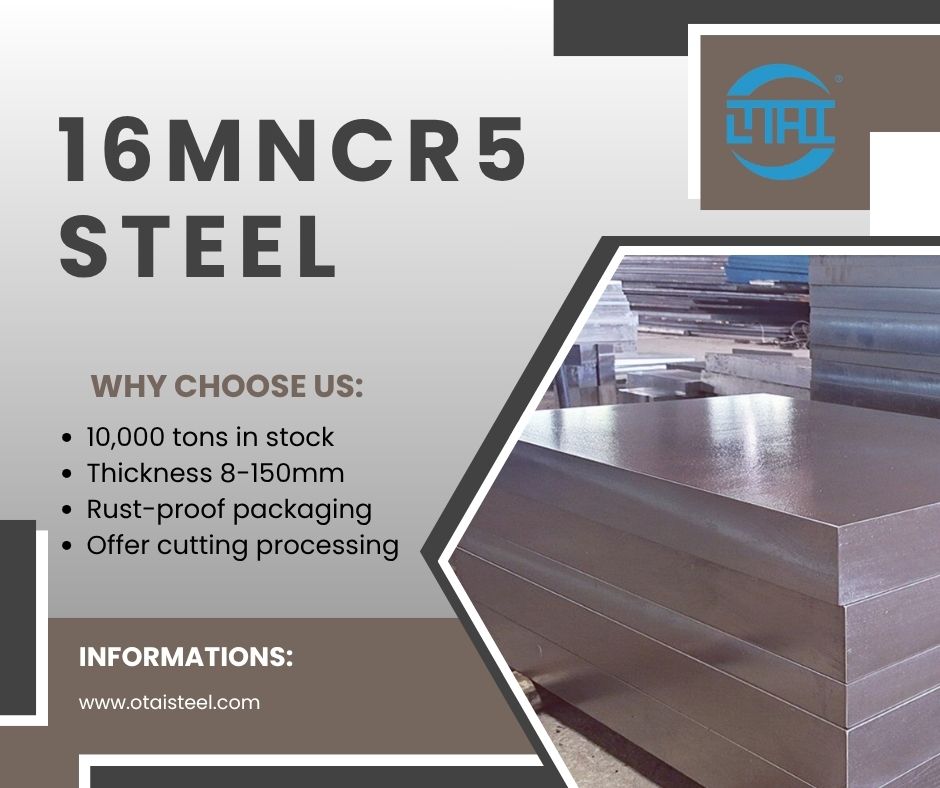
- Sufficient inventory with 8–150 mm thickness plates available in stock.
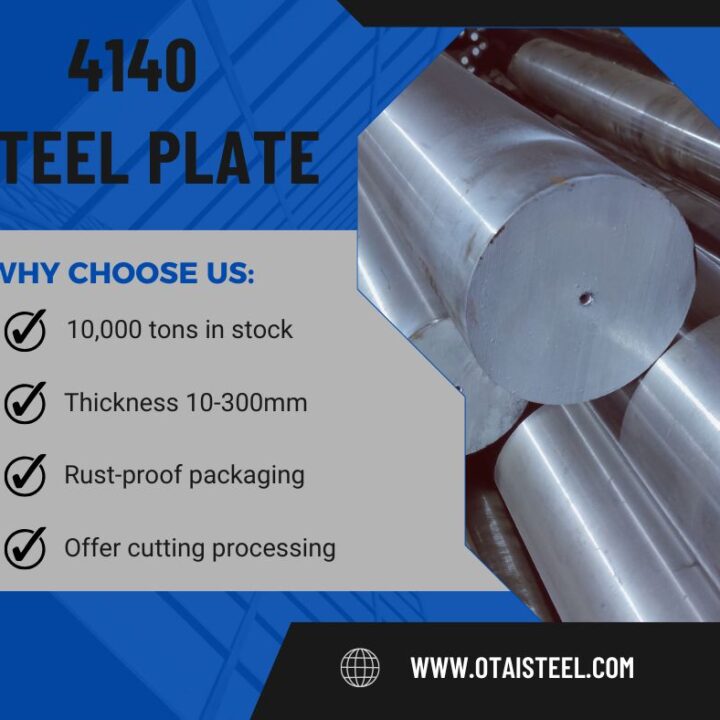
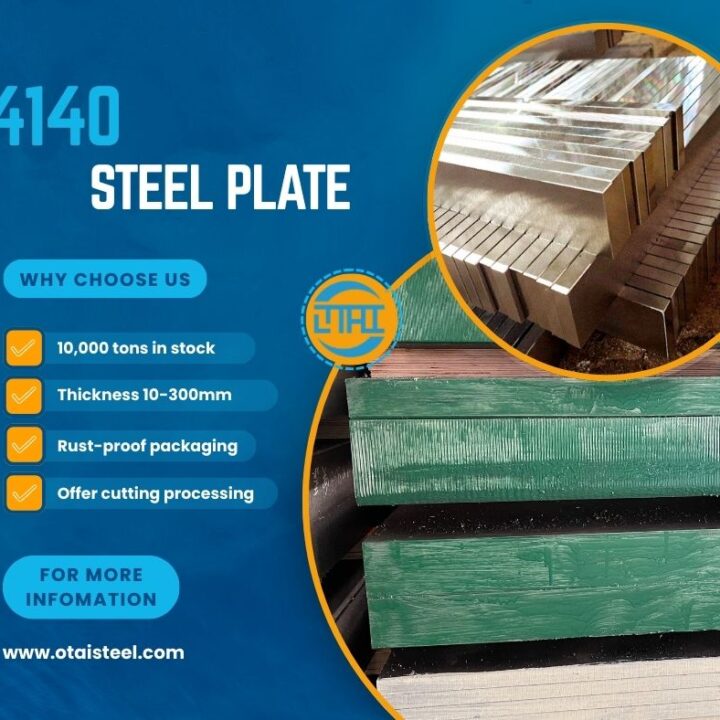
- Large inventory of plates, round bars, and forged blocks.
- Custom cutting services according to customer drawings.
- Heat treatment support including annealing, normalizing, carburizing, quenching, and tempering.
- Ultrasonic testing (UT) available for internal quality assurance.
- Chemical composition verification and mechanical property testing.
- Third-party inspection services including SGS.
- Stable global export supply chain.
- Fast delivery and competitive pricing.
📌 FAQ
Q1: What is the typical yield strength of 16MnCr5 steel?
A: Depending on heat treatment condition, the yield strength typically ranges from 700 MPa to over 1100 MPa.
Q2: Does carburizing increase yield strength?
A: Carburizing primarily increases surface hardness, but the associated heat treatment process can also improve overall strength and load-bearing capability.
Q3: Why is yield strength important for gears?
A: It prevents permanent deformation of gear teeth, ensuring accurate power transmission and longer service life.
Q4: Is yield strength more important than tensile strength?
A: For many engineering designs, yield strength is more important because components are typically designed to operate below the yielding point.
Q5: How does 16MnCr5 compare with 4140 steel?
A: Both steels provide excellent strength, but 16MnCr5 offers superior surface wear resistance after carburizing, making it especially suitable for gears and transmission components.