 16MnCr5 Material Property – Mechanical Performance and Engineering Applications
16MnCr5 material property is one of the most frequently discussed topics among engineers, gear manufacturers, and industrial buyers seeking a reliable case-hardening steel. Known internationally as steel grade 1.7131 under the EN standard, 16MnCr5 combines good machinability, excellent carburizing response, high surface hardness, and strong core toughness.
This low-carbon chromium alloy steel is widely used in automotive transmissions, industrial gear systems, shafts, pinions, sprockets, and wear-resistant mechanical components. The combination of a hard wear-resistant surface and a tough ductile core makes it one of the most popular carburizing steels worldwide.
This article provides a detailed overview of 16MnCr5 material property, including chemical composition, 16MnCr5 mechanical properties, 16MnCr5 physical properties, heat treatment characteristics, and practical engineering applications.
📊 Overview of 16MnCr5 Steel
16MnCr5 belongs to the family of low-carbon alloy steels specifically designed for case hardening. The steel contains chromium to improve hardenability and wear resistance while maintaining a relatively low carbon content for excellent toughness.
| Property | Value |
|---|---|
| Steel Grade | 16MnCr5 |
| Material Number | 1.7131 |
| Steel Type | Case Hardening Steel |
| Standard | EN 10084 |
| Primary Applications | Gears, shafts, pinions, transmission parts |
🧪 Chemical Composition
The performance of this 16MnCr5 carburizing steel begins with its carefully controlled alloy composition.
| Element | Content (%) |
|---|---|
| Carbon (C) | 0.14–0.19 |
| Silicon (Si) | ≤0.40 |
| Manganese (Mn) | 1.00–1.30 |
| Chromium (Cr) | 0.80–1.10 |
| Phosphorus (P) | ≤0.025 |
| Sulfur (S) | ≤0.035 |
⚙️ Mechanical Properties
The most important aspect of 16MnCr5 material property is its mechanical performance. The steel provides an excellent balance between strength, toughness, and fatigue resistance.
| Property | Typical Value |
|---|---|
| Tensile Strength | 650–900 MPa |
| Yield Strength | 400–650 MPa |
| Elongation | 10–16% |
| Impact Toughness | Good |
| Fatigue Resistance | Excellent after carburizing |
🔬 Physical Properties
The 16MnCr5 physical properties make this steel suitable for demanding mechanical applications.
| Property | Value |
|---|---|
| Density | 7.85 g/cm³ |
| Elastic Modulus | 210 GPa |
| Thermal Conductivity | 46 W/m·K |
| Specific Heat Capacity | 460 J/kg·K |
| Electrical Resistivity | 0.21 μΩ·m |
🔥 Heat Treatment Properties
A major advantage of 16MnCr5 material property is its excellent response to heat treatment. This steel was specifically developed for carburizing applications where a hard wear-resistant surface and a tough core are required.
The low carbon content in the core helps maintain toughness, while carbon enrichment during carburizing creates a high-hardness outer layer suitable for heavy-duty service conditions.
| Heat Treatment Process | Temperature (°C) |
|---|---|
| Annealing | 650–700 |
| Normalizing | 850–880 |
| Carburizing | 880–950 |
| Hardening | 780–860 |
| Tempering | 150–200 |
These 16MnCr5 heat treatment properties make the material highly suitable for components subjected to repeated contact stress and wear.
🛡️ Hardness and Wear Resistance
One of the most important 16MnCr5 steel properties is its ability to achieve extremely high surface hardness after carburizing.
| Condition | Typical Hardness |
|---|---|
| Annealed | 160–220 HB |
| Normalized | 170–240 HB |
| Carburized Surface | 58–62 HRC |
| Core Hardness | 30–45 HRC |
The combination of a hard outer case and a relatively tough core provides exceptional 16MnCr5 wear resistance and fatigue performance.
This unique structure explains why the steel is commonly selected for gears, pinions, transmission shafts, and automotive drivetrain components.
⚙️ Engineering Characteristics
The outstanding 16MnCr5 engineering properties result from the interaction between alloy composition and heat treatment.
Key characteristics include:
- Excellent carburizing capability
- High surface hardness after treatment
- Good core toughness
- Strong fatigue resistance
- Good machinability before hardening
- Reliable dimensional stability
- Excellent wear resistance
- Cost-effective performance compared with higher alloy steels
These characteristics allow manufacturers to produce durable mechanical components that maintain performance under demanding operating conditions.
🏭 Industrial Applications
The excellent balance of strength, toughness, and wear resistance makes 16MnCr5 suitable for numerous industries.
| Industry | Typical Components |
|---|---|
| Automotive | Transmission gears, differential gears, shafts |
| Industrial Machinery | Pinions, sprockets, couplings |
| Agricultural Equipment | Drive shafts, gear systems |
| Mining Equipment | Wear-resistant transmission components |
| Power Transmission | High-load gears and mechanical drives |
Many manufacturers choose this material because it offers a reliable balance between performance and production cost.
🏭 Company Advantages
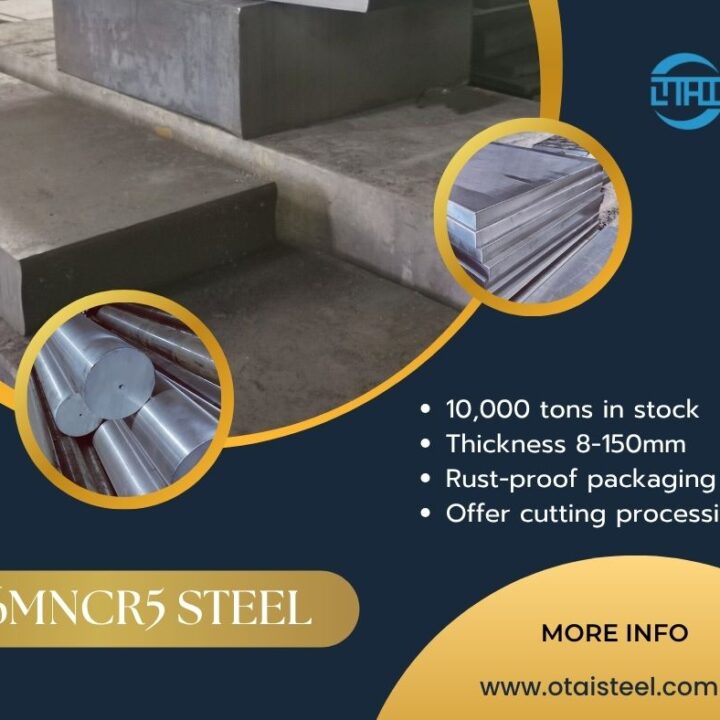
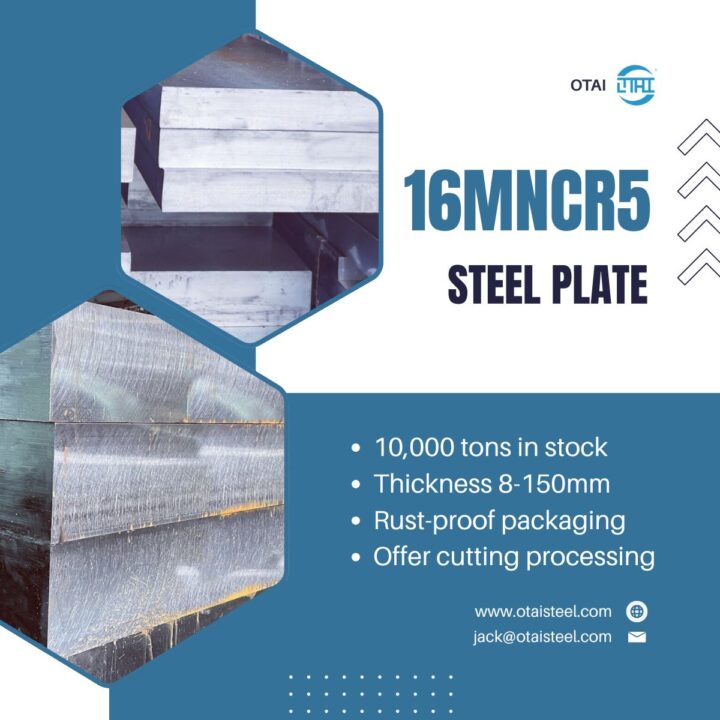
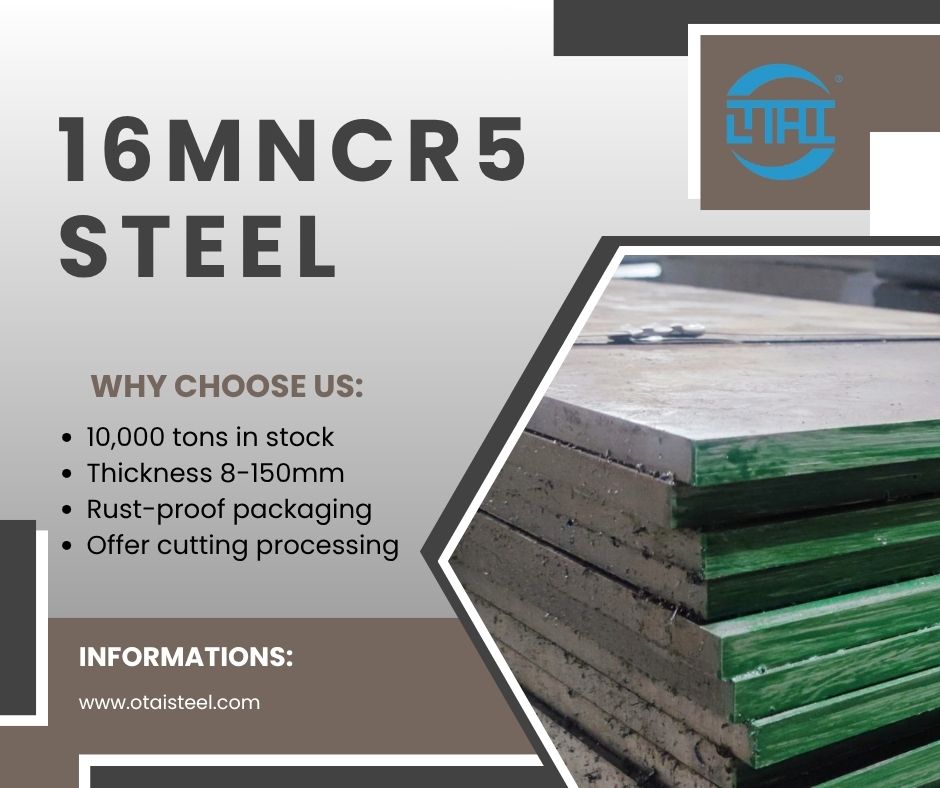
Otai Special Steel is a professional supplier of 16MnCr5 steel plates, forged blocks, and round bars for customers around the world.
- Sufficient inventory available throughout the year
- 16MnCr5 steel plates in stock from 8mm to 150mm thickness
- Custom cutting according to customer dimensions
- Heat treatment services including annealing, normalizing, and quenching
- Ultrasonic testing (UT) available upon request
- Chemical composition verification and mechanical testing
- Third-party inspection support such as SGS
- Competitive pricing with stable supply capability
- Export-standard packaging for international shipment
- Extensive experience supplying global engineering and manufacturing companies
📈 Why Engineers Choose 16MnCr5
When evaluating various case-hardening steels, engineers often select 16MnCr5 because it delivers a highly desirable combination of performance characteristics. The material offers excellent machinability before heat treatment, responds extremely well to carburizing, and develops outstanding surface hardness after hardening.
Compared with many higher-alloy steels, 16MnCr5 provides a cost-effective solution while still delivering the wear resistance and fatigue strength required for demanding mechanical systems. This balance makes it one of the most commonly specified carburizing steels in Europe and many international markets.
Another important advantage is its availability. Because 16MnCr5 is widely produced worldwide, manufacturers can often obtain material in a variety of forms including plates, bars, forgings, and custom-cut components. This availability helps reduce lead times and manufacturing costs.
📋 Summary of Key Material Properties
| Property Category | Performance Level |
|---|---|
| Machinability | Good |
| Carburizing Response | Excellent |
| Surface Hardness | Excellent |
| Core Toughness | Very Good |
| Wear Resistance | Excellent |
| Fatigue Resistance | Excellent |
| Cost Efficiency | High |
✅ Conclusion
16MnCr5 material property makes this steel one of the most widely used case-hardening grades in modern engineering. Its combination of excellent carburizing behavior, high surface hardness, strong core toughness, and reliable fatigue resistance allows it to perform exceptionally well in demanding applications.
The outstanding 16MnCr5 mechanical properties, stable 16MnCr5 physical properties, and excellent heat treatment response make it an ideal choice for gears, shafts, pinions, transmission components, and other wear-critical parts.
For manufacturers seeking a durable, economical, and proven engineering material, 16MnCr5 continues to be one of the best solutions available in the global market.
❓ FAQ
Q1: What is 16MnCr5 used for?
A1: 16MnCr5 is primarily used for gears, shafts, pinions, sprockets, transmission parts, and other carburized components requiring high wear resistance.
Q2: Is 16MnCr5 a carburizing steel?
A2: Yes. It is specifically designed as a low-carbon alloy steel for carburizing and case-hardening applications.
Q3: What hardness can 16MnCr5 achieve?
A3: After carburizing and hardening, the surface hardness typically reaches 58–62 HRC.
Q4: What are the main 16MnCr5 mechanical properties?
A4: The steel offers good tensile strength, excellent fatigue resistance, high wear resistance, and strong core toughness.
Q5: Does 16MnCr5 have good machinability?
A5: Yes. In the annealed condition, it provides good machinability, making it suitable for efficient manufacturing.
Q6: What is the density of 16MnCr5?
A6: The density is approximately 7.85 g/cm³.