 16MnCr5 Material Machinability – Cutting Performance and Best Practices
16MnCr5 material machinability is an important consideration for manufacturers producing gears, shafts, pinions, bushings, and other precision mechanical components. As one of the most widely used case-hardening steels in Europe and international markets, 16MnCr5 offers an excellent combination of strength, toughness, wear resistance, and machining performance.
Before carburizing and heat treatment, 16MnCr5 exhibits good machinability due to its relatively low carbon content and fine microstructure. This allows manufacturers to perform turning, milling, drilling, and CNC machining operations efficiently before the final hardening process. Understanding the machining characteristics of 16MnCr5 helps improve tool life, reduce production costs, and achieve superior surface finish quality.
This article explores 16MnCr5 material machinability, including cutting performance, machining parameters, recommended cutting speeds, tool selection, and best practices for industrial applications.
📊 Overview of 16MnCr5 Steel
16MnCr5 is a low-carbon chromium alloy steel that engineers design primarily for carburizing applications. Suppliers commonly deliver the steel in the annealed or normalized condition, making it suitable for extensive machining before heat treatment.
| Property | Value |
|---|---|
| Steel Grade | 16MnCr5 |
| Material Number | 1.7131 |
| Carbon Content | 0.14–0.19% |
| Chromium Content | 0.80–1.10% |
| Typical Condition | Annealed or Normalized |
| Primary Application | Case-hardened components |
Because the steel is generally machined before carburizing, its machining characteristics are a significant advantage for manufacturers producing large quantities of precision parts.
⚙️ Understanding 16MnCr5 Machining Properties
The 16MnCr5 machining properties are influenced by its low carbon content, alloying elements, hardness level, and microstructure.
In the annealed condition, the steel offers relatively low hardness and excellent chip formation. This allows efficient machining using conventional carbide and high-speed steel cutting tools.
| Factor | Effect on Machinability |
|---|---|
| Low Carbon Content | Improves machinability |
| Chromium Addition | Increases wear resistance |
| Annealed Structure | Facilitates cutting operations |
| Case Hardening Capability | Machining should be completed before heat treatment |
Compared with medium-carbon alloy steels, 16MnCr5 offers a favorable balance between machinability and final mechanical performance.
📈 16MnCr5 Machinability Rating
Experts generally consider the 16MnCr5 machinability rating good for a carburizing steel. While exact ratings vary among standards and tooling manufacturers, they often rate the material at approximately 60–70% relative to free-cutting steel AISI 1212, which they typically assign a machinability index of 100%.
| Material | Relative Machinability (%) |
|---|---|
| AISI 1212 Free-Cutting Steel | 100 |
| 16MnCr5 | 60–70 |
| 4140 Annealed | 55–65 |
| 8620 Steel | 60–70 |
This level of machinability makes 16MnCr5 a practical choice for high-volume production of automotive and industrial transmission components.
🔩 Recommended Cutting Speeds
Selecting the proper 16MnCr5 cutting speed is critical for maximizing productivity and tool life.
| Operation | Tool Material | Cutting Speed (m/min) |
|---|---|---|
| Turning | HSS | 20–35 |
| Turning | Carbide | 120–220 |
| Milling | Carbide | 100–200 |
| Drilling | HSS | 15–25 |
These values serve as general guidelines. Actual machining conditions depend on machine rigidity, coolant application, workpiece geometry, and tool coating technology.
🔧 Turning and Milling Operations
16MnCr5 turning and milling operations are commonly performed before carburizing. In its annealed condition, the material produces stable chips and allows good dimensional accuracy, making it suitable for precision machining.
Modern CNC equipment combined with coated carbide inserts can significantly improve productivity. Positive rake geometry is often preferred because it reduces cutting forces and helps achieve better surface finishes.
| Parameter | Rough Turning | Finish Turning |
|---|---|---|
| Cutting Speed (m/min) | 120–180 | 180–220 |
| Feed Rate (mm/rev) | 0.20–0.50 | 0.05–0.20 |
| Depth of Cut (mm) | 2–5 | 0.2–1 |
For milling operations, indexable carbide cutters are widely used because they provide excellent tool life and maintain dimensional consistency across large production runs.
🛠️ Drilling Performance
The 16MnCr5 drilling performance is generally considered favorable, especially in the annealed state. The low carbon content helps reduce drilling resistance while maintaining adequate chip control.
When drilling deep holes, coolant delivery becomes critical to prevent excessive heat generation and improve chip evacuation.
| Drill Type | Recommended Speed (m/min) | Feed Rate (mm/rev) |
|---|---|---|
| HSS Twist Drill | 15–25 | 0.10–0.30 |
| Coated Carbide Drill | 60–120 | 0.15–0.40 |
| Indexable Drill | 80–150 | 0.20–0.45 |
Proper coolant application not only improves hole quality but also extends tool life and reduces production downtime.
🤖 16MnCr5 CNC Machining Considerations
16MnCr5 CNC machining is widely used in automotive and industrial manufacturing because the material responds well to automated production processes.
CNC machining provides several advantages:
- Consistent dimensional accuracy
- Excellent repeatability
- Reduced cycle times
- Improved surface finish quality
- Lower scrap rates
- Efficient production of complex geometries
Many gear manufacturers machine all critical features before carburizing to avoid expensive grinding operations after hardening.
🔥 Machinability Before and After Heat Treatment
The machining characteristics of 16MnCr5 change significantly after heat treatment.
16MnCr5 machinability after annealing is substantially better than after carburizing and hardening. Therefore, most machining operations are completed before the final heat treatment cycle.
| Condition | Typical Hardness | Machinability |
|---|---|---|
| Annealed | 160–220 HB | Excellent |
| Normalized | 170–240 HB | Good |
| Carburized and Hardened | 58–62 HRC Surface | Poor |
The reduced 16MnCr5 machinability after heat treatment is due to the formation of a hard martensitic case. If machining is required after hardening, grinding or specialized hard-machining techniques are usually employed.
💡 Practical Machining Tips
The following 16MnCr5 machining tips can help improve efficiency and tool life:
- Machine components in the annealed condition whenever possible.
- Use coated carbide tools for higher productivity.
- Maintain stable cutting parameters to avoid vibration.
- Apply adequate coolant during drilling and milling.
- Optimize chip evacuation in deep-hole operations.
- Leave grinding allowance for critical surfaces after heat treatment.
- Inspect dimensional tolerances before carburizing to reduce rework.
- Use rigid workholding systems to minimize chatter.
Following these recommendations can significantly reduce tooling costs while improving production consistency.
🏭 Company Advantages
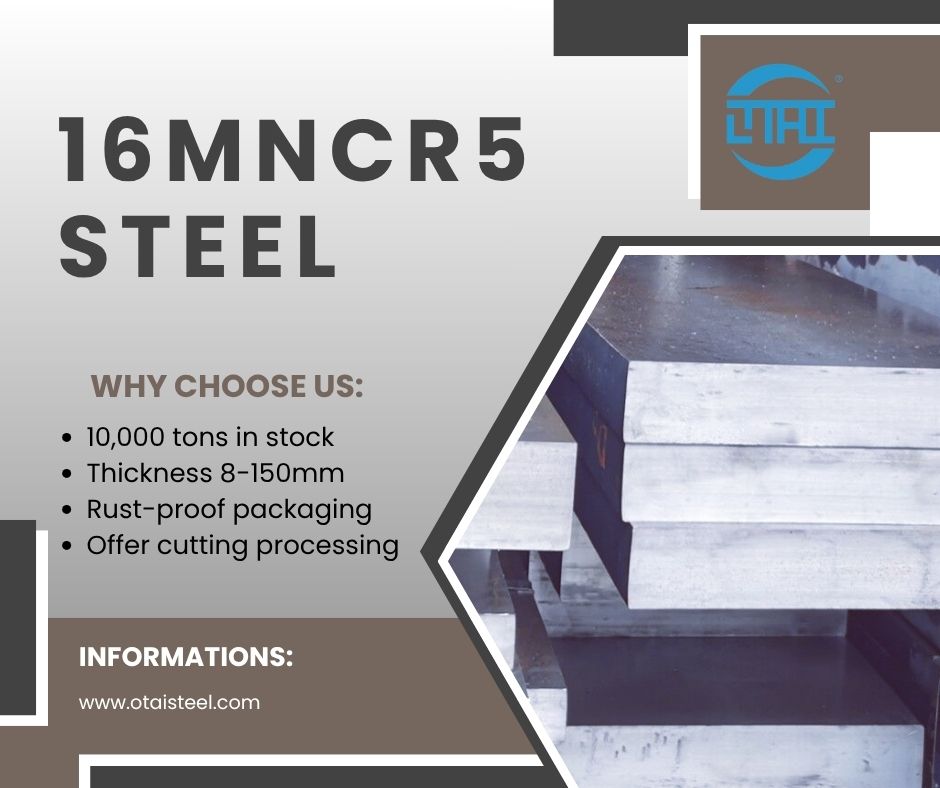
Otai Special Steel supplies premium-quality 16MnCr5 steel products for machining, gear manufacturing, and industrial engineering applications.
- More than 10,000 tons of steel inventory available year-round
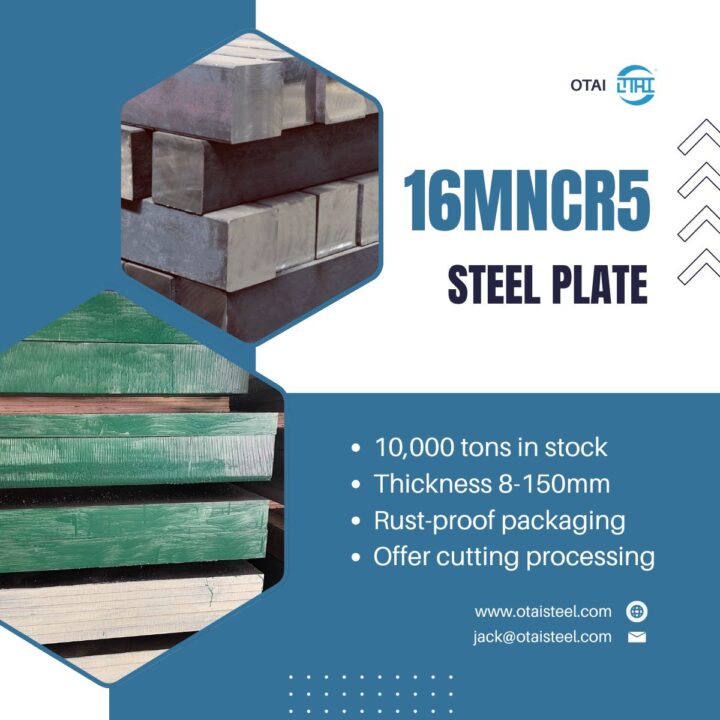
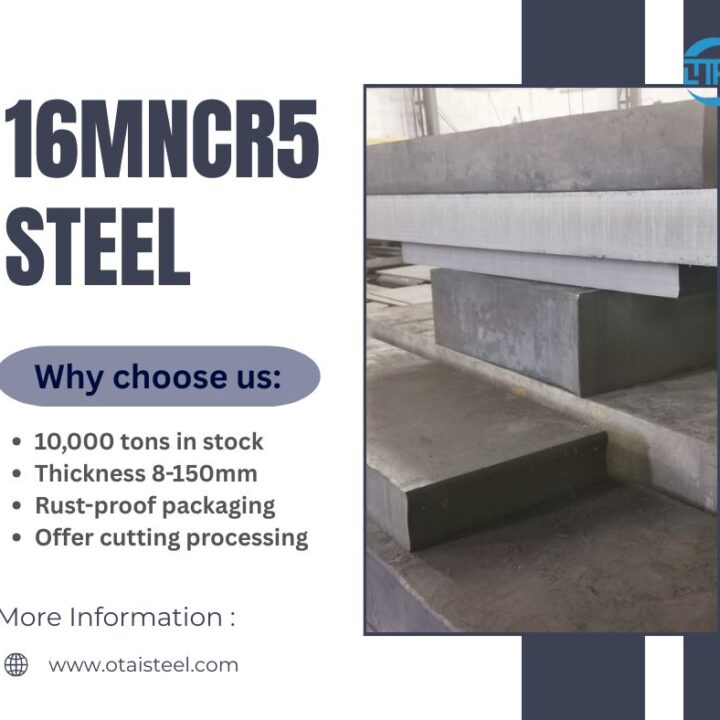
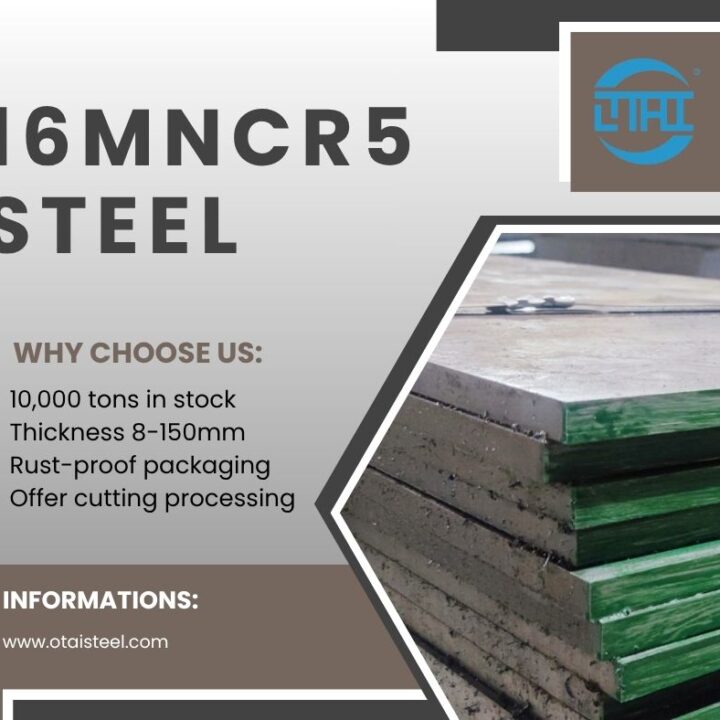
- 8–150mm thickness 16MnCr5 steel plates available in stock
- Round bars, forged blocks, flat bars, and steel plates available
- Custom cutting according to customer drawings
- Ultrasonic testing (UT) available
- Chemical composition verification and mechanical testing
- Third-party inspection services including SGS
- Professional technical support for machining and heat treatment
- Export-standard packaging for international shipment
- Extensive experience serving global engineering customers
✅ Conclusion
16MnCr5 material machinability is one of the reasons this steel remains a preferred choice for gears, shafts, pinions, and other precision components. In the annealed condition, the material offers good chip control, stable cutting behavior, and efficient machining performance using modern CNC equipment.
By selecting appropriate cutting speeds, tooling materials, and machining parameters, manufacturers can maximize productivity while maintaining excellent dimensional accuracy. Completing machining operations before carburizing and hardening further improves efficiency and reduces overall manufacturing costs.
For industries requiring both excellent machinability and outstanding surface hardness after heat treatment, 16MnCr5 continues to be one of the most practical and reliable engineering steels available.
❓ FAQ
Q1: Is 16MnCr5 easy to machine?
A1: Yes. In the annealed condition, 16MnCr5 offers good machinability and is suitable for turning, milling, drilling, and CNC machining.
Q2: What is the machinability rating of 16MnCr5?
A2: The material is typically rated at approximately 60–70% relative to free-cutting steel.
Q3: Can 16MnCr5 be machined after carburizing?
A3: It can, but machining becomes significantly more difficult due to the hardened surface layer. Grinding is usually preferred.
Q4: What cutting tools are recommended for 16MnCr5?
A4: Coated carbide tools are commonly used because they provide higher cutting speeds and longer tool life.
Q5: Is coolant necessary when machining 16MnCr5?
A5: Yes. Coolant helps reduce heat generation, improve chip evacuation, and extend tool life.
Q6: Why is 16MnCr5 popular for gear manufacturing?
A6: The material combines good machinability before heat treatment with excellent surface hardness and wear resistance after carburizing.