16MnCr5 Equivalent Grade: How Can Buyers Choose the Right Substitute?
📑 Table of Contents
- 🔍 Why Do Buyers Look for a 16MnCr5 Equivalent Grade?
- 🌍 Which International Grades Are Commonly Compared with 16MnCr5?
- 🧪 How Do Chemical Composition Ranges Differ?
- ⚙️ How Does Hardenability Affect Material Substitution?
- 🔥 Can Alternative Grades Achieve the Same Carburizing Performance?
- 🏭 Which Equivalent Grade Is Suitable for Gears and Shafts?
- 📑 What Should Buyers Verify Before Approving a Substitute?
- 🛒 How Can Buyers Specify 16MnCr5 Alternatives in an RFQ?
- 🏭 Company Advantages
- ❓ Frequently Asked Questions
When buyers search for a 16MnCr5 equivalent grade, they usually want to solve a practical sourcing problem. Their regular supplier may have limited stock, the required dimensions may not be available, or the project may use a different national material standard. In these situations, finding a technically suitable alternative can help maintain production schedules and control purchasing costs.
16MnCr5 is a European manganese-chromium case-hardening steel specified in EN 10084. Manufacturers commonly use it for gears, shafts, pins and other components that need a wear-resistant surface and a relatively tough core after carburizing and heat treatment.
Several international grades appear in comparison tables, including AISI 5115, AISI 5120, 20MnCr5, SCr415 and SAE 8620. However, these materials do not all have the same alloy composition or hardenability. Some are close chemical alternatives, while others are functional substitutes for particular applications.
The right substitute depends on the component’s final requirements, not simply the similarity of the grade names. Buyers should compare chemical composition, hardenability, carburizing performance, core properties, product dimensions and applicable standards before approving a change. This article explains how to evaluate those factors from a steel procurement perspective.
🔍 Why Do Buyers Look for a 16MnCr5 Equivalent Grade?
Availability and delivery schedules
Stock availability is one of the most common reasons for considering an alternative. A manufacturer may need 16MnCr5 plate or bar for a production order, but the required dimensions or quantity may not be immediately available. Waiting for a new production batch can affect machining schedules, heat treatment and final assembly.
In this situation, procurement teams may ask suppliers to check alternative grades. A suitable substitute could provide another sourcing route, especially when the customer accepts materials from different national standards.
Different standards in international projects
International manufacturing projects often involve drawings from European, American, Japanese or Chinese engineering teams. The original drawing may specify 16MnCr5, while a local supplier primarily works with AISI, SAE, JIS or GB/T grades.
Buyers therefore need to understand how the available grades compare. A supplier’s cross-reference table can help identify candidates, but it does not establish automatic compliance with the original specification.
Price and processing considerations
Material price is another reason to evaluate alternatives. Different grades may have different alloying costs, stock availability and production lead times. However, the lowest price per ton does not always produce the lowest manufacturing cost.
A replacement that requires a different carburizing cycle, creates more distortion or produces inconsistent core properties may increase downstream expenses. Buyers should consider the total cost of the finished component, including machining, heat treatment, inspection and possible rework.
Identify the type of equivalence first
Before comparing individual grades, buyers should distinguish three types of material relationships:
- Standard-based equivalent: A grade formally listed or recognized as a corresponding material under a relevant standard or technical reference.
- Close chemical alternative: A grade with overlapping composition ranges but potentially different element limits and hardenability.
- Functional substitute: A different alloy steel that may achieve the required component performance after an approved manufacturing and heat-treatment process.
This distinction prevents a common purchasing mistake: treating every grade in an equivalent-material chart as a direct replacement. A material can perform a similar function without meeting the same chemical or contractual specification.
🌍 Which International Grades Are Commonly Compared with 16MnCr5?
Commonly referenced alternatives
16MnCr5 belongs to the Mn-Cr family of case-hardening steels. Its material number is 1.7131, and EN 10084 defines its chemical composition and delivery requirements. Buyers may encounter several grades when searching for alternatives across international markets.
| Grade | Material System | Relationship to 16MnCr5 |
|---|---|---|
| 16MnCr5 / 1.7131 | European EN | Original reference grade |
| AISI / SAE 5115 | American | Commonly listed as a close alternative; chemistry differs |
| AISI / SAE 5120 | American | Related case-hardening grade, but not a direct match |
| 20MnCr5 / 1.7147 | European EN | Related Mn-Cr grade with higher carbon content |
| SCr415 | Japanese JIS | Similar chromium range, but lower manganese range |
| SAE 8620 | American | Functional alternative with a different Ni-Cr-Mo alloy system |
| 16MnCrS5 / 1.7139 | European EN | Sulfur-controlled free-machining variant |
AISI 5115: a commonly cited comparison
AISI 5115 is frequently associated with 16MnCr5 in international grade references. Both belong to the case-hardening steel family and contain chromium and manganese. However, AISI 5115 generally has lower manganese and chromium limits than 16MnCr5.
That difference matters because manganese and chromium contribute to hardenability. Depending on the component dimensions and heat-treatment process, the difference may affect the achievable core properties. Buyers should therefore treat AISI 5115 as a candidate for technical evaluation rather than assume complete equivalence.
20MnCr5 and AISI 5120: related but different grades
20MnCr5 is another European manganese-chromium case-hardening steel. Compared with 16MnCr5, it has a higher carbon range and different specified composition limits. This may influence core strength and the response of the material during heat treatment.
AISI 5120 is also commonly compared with 20MnCr5 in cross-reference tables. Buyers looking for a 16MnCr5 substitute may encounter it because of its similar application family. Nevertheless, neither 20MnCr5 nor AISI 5120 should be approved solely because a supplier lists it alongside 16MnCr5.
SAE 8620: a functional alternative, not a direct match
SAE 8620 contains nickel, chromium and molybdenum. Its alloy system differs from the manganese-chromium composition of 16MnCr5. Manufacturers use both grades for case-hardened components, but their hardenability, core response and processing characteristics may differ.
For demanding gears or components with specific core toughness requirements, SAE 8620 may be worth evaluating. However, the change requires engineering review and validation of the actual heat-treatment process.
Do not confuse similar applications with identical specifications
SCr415 and 16MnCrS5 also deserve attention in sourcing discussions. SCr415 has a different manganese range, while 16MnCrS5 is a sulfur-controlled variant designed to improve machinability. These grades may suit particular manufacturing conditions, but their differences should appear clearly in the purchase specification.
🧪 How Do Chemical Composition Ranges Differ?
Why chemistry matters in case-hardening steel
Chemical composition influences the steel’s response to carburizing, quenching and tempering. Carbon provides the foundation for strength and hardening. Manganese and chromium contribute to hardenability, while nickel can improve toughness. Molybdenum also affects hardenability and tempering response.
For 16MnCr5, the balance between relatively low carbon content and alloying elements supports a hard surface after carburizing while retaining a tougher core. A proposed substitute should therefore match the requirements of both regions of the finished component.
Indicative composition comparison
The following table provides representative composition ranges for preliminary screening. These figures are not a substitute for the governing standard. Different standards, editions and product specifications may use different limits. Buyers should confirm the applicable requirements before accepting a replacement.
| Element | 16MnCr5 (%) | AISI 5115 (%) | 20MnCr5 (%) |
|---|---|---|---|
| Carbon (C) | 0.14–0.19 | 0.13–0.18 | 0.17–0.22 |
| Silicon (Si) | ≤0.40 | Standard-dependent | ≤0.40 |
| Manganese (Mn) | 1.00–1.30 | 0.70–0.90 | 1.10–1.40 |
| Chromium (Cr) | 0.80–1.10 | 0.70–0.90 | 1.00–1.30 |
| Nickel (Ni) | Not a principal alloying addition | Not a principal alloying addition | Not a principal alloying addition |
| Molybdenum (Mo) | Not a principal alloying addition | Not a principal alloying addition | Not a principal alloying addition |
Note: The table focuses on the principal alloying elements in these Mn-Cr grades. It does not represent a complete chemical acceptance table. Residual elements and permitted limits must be checked against the relevant standard and material certificate.
What do the differences mean?
The carbon range of 20MnCr5 is higher than that of 16MnCr5. Its manganese and chromium ranges also differ. These changes may influence core strength and hardenability, so buyers should not assume that the same heat-treatment schedule will produce identical results.
AISI 5115 has lower manganese and chromium ranges in commonly referenced specifications. Although it is frequently listed as a 16MnCr5 comparison grade, the lower alloy content may affect hardenability, particularly in larger sections.
For SAE 8620, a direct comparison of only carbon, manganese and chromium would be incomplete because nickel and molybdenum form part of its alloy system. Buyers should assess the full chemistry and resulting performance rather than compare only the elements shared by both grades.
Standard limits versus actual MTC results
Standard composition limits define the acceptable range for a particular grade. A mill certificate, by contrast, records the measured chemical composition of the actual production heat. These are two different types of information.
For procurement acceptance, compare the MTC results with the exact standard and edition stated in the purchase order. If the customer requires product analysis rather than heat analysis, specify that requirement separately. Do not use a typical analysis from a supplier’s catalogue as proof that a batch meets the contract.
⚙️ How Does Hardenability Affect Material Substitution?
Hardenability is not the same as hardness
Buyers sometimes use hardness as the main measure when comparing two alloy steels. However, hardness and hardenability describe different characteristics.
Hardness measures resistance to indentation under a specified test method. Hardenability describes how deeply a steel can harden under particular quenching conditions. A material may reach a high surface hardness but still develop different properties through the core of a large component.
This distinction is important for 16MnCr5 because manufacturers often use it for components that need a hard surface and a tougher supporting core. The substitute must meet the requirements of both regions.
Section size changes the result
Small components cool more quickly during quenching than large components under comparable conditions. As a result, a steel that performs well in a small test section may not achieve the same core properties in a much larger shaft or gear blank.
When buyers compare 16MnCr5 with AISI 5115, 20MnCr5 or SAE 8620, they should consider the actual thickness or diameter. A grade that works for a small pin may not be suitable for a large gear without further validation.
Compare the relevant hardenability information
Depending on the specification, hardenability can be evaluated through Jominy end-quench testing or other agreed methods. The buyer should identify whether the drawing or customer specification requires a particular hardenability band, such as a specified Jominy range.
| Factor | Why It Matters | What Buyers Should Check |
|---|---|---|
| Chemical composition | Alloy elements influence hardening response | Actual chemistry and standard limits |
| Section thickness | Cooling conditions vary through the component | Actual finished part or blank dimensions |
| Quenching conditions | Cooling rate affects the hardened structure | Quenching medium and process capability |
| Hardenability test | Helps evaluate the depth of hardening response | Required test method and acceptance band |
| Core properties | Determine load-bearing and toughness performance | Required tensile, impact and hardness values |
Why buyers should avoid generic property comparisons
A datasheet may show tensile strength or hardness for a particular bar diameter and heat-treatment condition. Those figures should not automatically apply to a different product size or delivery condition.
For critical components, ask the supplier to identify the test condition, specimen location and product dimensions associated with the reported values. This makes the comparison more meaningful and helps the engineering team decide whether a substitute can meet the original design requirements.
🔥 Can Alternative Grades Achieve the Same Carburizing Performance?
Understand the surface and core requirements
Carburizing introduces additional carbon into the surface layer of a steel component. After suitable hardening and tempering, the surface can develop high hardness and wear resistance while the core retains greater toughness.
This combination makes case-hardening steels useful for gears, pinions, shafts and transmission components. However, a successful replacement must meet the required surface properties and core performance together.
Surface hardness and effective case depth
Surface hardness is important for resisting wear and contact stress. Effective case depth indicates how far the hardened layer extends into the material according to the specified measurement criterion.
Buyers should not treat surface hardness and case depth as the same requirement. A component may achieve the required surface hardness but still fail to develop the required hardened depth. The purchase specification should identify the required hardness, case-depth definition and measurement method.
Core toughness and distortion
The core supports the hardened surface during operation. If the core does not have sufficient strength or toughness, a component may deform or fail under repeated loads. The proposed substitute must therefore deliver the required core properties after the complete heat-treatment cycle.
Heat-treatment distortion is another important consideration. Differences in chemistry, hardenability, component geometry and quenching conditions can influence dimensional changes. For precision gears and shafts, even a small change may increase grinding or finishing costs.
| Performance Requirement | Possible Risk During Substitution | Validation Method |
|---|---|---|
| Surface hardness | The alternative may respond differently to carburizing and quenching | Hardness testing after the specified treatment |
| Effective case depth | The hardened layer may not meet the design requirement | Case-depth measurement using the specified method |
| Core strength | The component may not support the required operating load | Core hardness and mechanical testing where required |
| Core toughness | Impact or fatigue performance may change | Specified impact and component validation tests |
| Dimensional stability | More distortion may increase finishing costs | Dimensional inspection after heat treatment |
Keep the heat-treatment process under review
When a manufacturer changes from 16MnCr5 to another grade, the existing carburizing schedule may not produce identical results. The heat-treatment provider should review the alternative material, component geometry and target properties before production approval.
For demanding applications, a controlled trial can help compare surface hardness, effective case depth, core properties and distortion. This provides practical evidence rather than relying only on a grade comparison chart.
🏭 Which Equivalent Grade Is Suitable for Gears and Shafts?
Gears and pinions
Gears and pinions often require a hard surface to resist wear and contact fatigue. At the same time, the core must support tooth loads and resist cracking under repeated operation.
16MnCr5 is a common choice for this type of component. Buyers considering AISI 5115 or 20MnCr5 should compare the required case depth, surface hardness, core strength and actual gear dimensions. AISI 5115 may be a practical candidate for some applications, while 20MnCr5 may suit components that need a different core-strength balance.
Neither option should be selected solely because it appears in a cross-reference chart. The gear design and heat-treatment requirements determine whether the alternative is acceptable.
Shafts and transmission components
Shafts may experience bending, torsion, impact and fatigue during operation. Their diameter and load conditions can make hardenability particularly important. A replacement that works for a small shaft may not provide the required core performance in a larger section.
For some demanding transmission components, SAE 8620 may be considered because of its nickel-chromium-molybdenum alloy system. However, this is a functional substitution decision, not a direct grade equivalence. Buyers should compare the complete mechanical and heat-treatment requirements.
Pins, bushings and smaller mechanical parts
For smaller components, the required core properties and section size may allow more flexibility. AISI 5115, SCr415 or another case-hardening grade may be worth evaluating when its chemistry, processing response and final performance satisfy the design.
If machining time is a major production concern, buyers may also consider 16MnCrS5. Its controlled sulfur content improves machinability, but the sulfur range differs from standard 16MnCr5. The manufacturer should confirm that the resulting material characteristics remain acceptable for the component.
| Component | Grades Worth Evaluating | Main Approval Consideration |
|---|---|---|
| Automotive gears | 16MnCr5, AISI 5115, 20MnCr5 | Case depth, contact performance and core properties |
| Transmission shafts | 16MnCr5, 20MnCr5, SAE 8620 | Section size, hardenability and fatigue requirements |
| Pins and smaller components | 16MnCr5, AISI 5115, SCr415 | Machinability, case properties and dimensional accuracy |
| Precision machined parts | 16MnCr5, 16MnCrS5 | Machining performance and final mechanical requirements |
| Heavy-duty gear components | 20MnCr5, SAE 8620 or other approved grades | Core strength, toughness and hardenability through the section |
Make the final choice according to the finished part
The same substitute may be suitable for one component but unsuitable for another. A small pin, a large transmission shaft and a heavily loaded gear have different requirements. Buyers should provide the actual component dimensions, operating loads and heat-treatment targets when asking a supplier to recommend an alternative.
📑 What Should Buyers Verify Before Approving a Substitute?
Confirm the original specification
Before evaluating alternatives, identify the exact version of 16MnCr5 specified in the drawing or purchase document. Check the standard, product form, delivery condition and any additional technical requirements.
Some specifications may require a particular hardenability band or impose supplementary requirements for cleanliness, testing and traceability. A general grade name may not contain enough information to establish acceptance.
Review the supplier’s technical evidence
Ask the supplier to provide the proposed grade’s standard, chemical composition limits and available test documentation. The material certificate should identify the actual production heat and provide the results needed to assess compliance.
For a substitute, compare the following information:
- Original and proposed grade designations.
- Governing standards and their editions.
- Actual chemical composition and permitted limits.
- Product dimensions and delivery condition.
- Hardenability requirements and available test results.
- Mechanical properties and hardness requirements.
- Carburizing, quenching and tempering requirements.
- Surface quality, internal quality and additional inspection requirements.
Check product dimensions and delivery condition
A supplier may have a suitable grade in stock but not in the required size or condition. For example, a buyer may need a specific plate thickness for cutting gear blanks, while the available material is supplied in another product form.
Confirm thickness, width, length or diameter, dimensional tolerances and the required delivery condition. If the material needs additional machining or heat treatment, include those steps in the technical and commercial evaluation.
Use a structured approval checklist
| Verification Item | Buyer Question | Required Evidence |
|---|---|---|
| Standard compliance | Does the proposed grade meet the approved specification? | Standard reference and technical comparison |
| Chemical composition | Are the element limits suitable? | Standard limits and MTC |
| Mechanical performance | Can the material meet the required properties? | Relevant test reports |
| Heat treatment | Can the process achieve the required case and core properties? | Heat-treatment review or trial results |
| Dimensions | Can the supplier meet the required size and tolerance? | Dimensional inspection records |
| Traceability | Can the material be traced to its production heat? | MTC and material markings |
| Customer approval | Has the responsible party approved the change? | Written engineering or customer authorization |
For safety-critical or tightly controlled components, buyers should require formal engineering approval before changing the specified grade. A supplier’s recommendation is useful technical input, but it does not replace the customer’s design authority.
🛒 How Can Buyers Specify 16MnCr5 Alternatives in an RFQ?
Provide complete material information
A clear request for quotation helps suppliers identify suitable stock and avoid quoting materials that do not meet the project’s requirements. Instead of writing only “16MnCr5 equivalent,” buyers should provide the original grade, governing standard, dimensions and delivery condition.
If the project permits alternatives, state which grades may be considered and explain that technical approval is required. This gives the supplier room to propose a sourcing option without allowing an unapproved material change.
Include the following RFQ details
- Original grade: 16MnCr5, including the applicable EN 10084 standard and edition.
- Alternative policy: Whether AISI 5115, 20MnCr5, SAE 8620 or another grade may be evaluated.
- Product form: Plate, round bar or another required form.
- Dimensions: Thickness, width, length or diameter, with tolerances.
- Delivery condition: Soft annealed, treated for a specified hardness range or another agreed condition.
- Technical requirements: Chemical composition, mechanical properties and hardenability where applicable.
- Heat-treatment requirements: Carburizing, case depth, surface hardness and core properties.
- Documentation: MTC, traceability and additional inspection reports.
- Processing: Cutting, machining, grinding and surface requirements.
- Commercial details: Quantity, destination, packaging and delivery schedule.
Compare quotations on an equal basis
When comparing suppliers, check whether each quotation covers the same material grade, dimensions, delivery condition and inspection scope. A lower price may reflect a different product condition or fewer quality-control services.
Also confirm whether the quoted material is available from stock or requires new production. For urgent orders, stock availability and cutting lead time may be as important as the price per ton.
Sample RFQ wording
Please quote 16MnCr5 case-hardening steel according to the specified EN 10084 requirements, with the dimensions, delivery condition and inspection requirements listed in our inquiry. If 16MnCr5 is unavailable, you may propose an alternative grade for technical evaluation. Please provide the proposed standard, chemical composition, available mechanical and hardenability data, MTC information and confirmation of stock dimensions. No grade substitution is permitted without our written approval.
This wording helps buyers compare alternative supply options while maintaining control over technical acceptance. It also gives the supplier enough information to check inventory, processing capability and documentation requirements before preparing a quotation.
🏭 Company Advantages
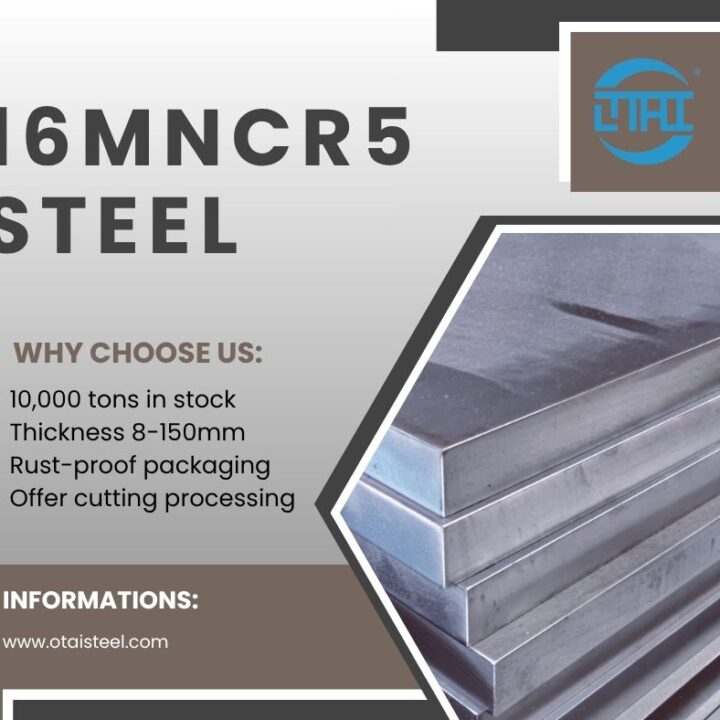
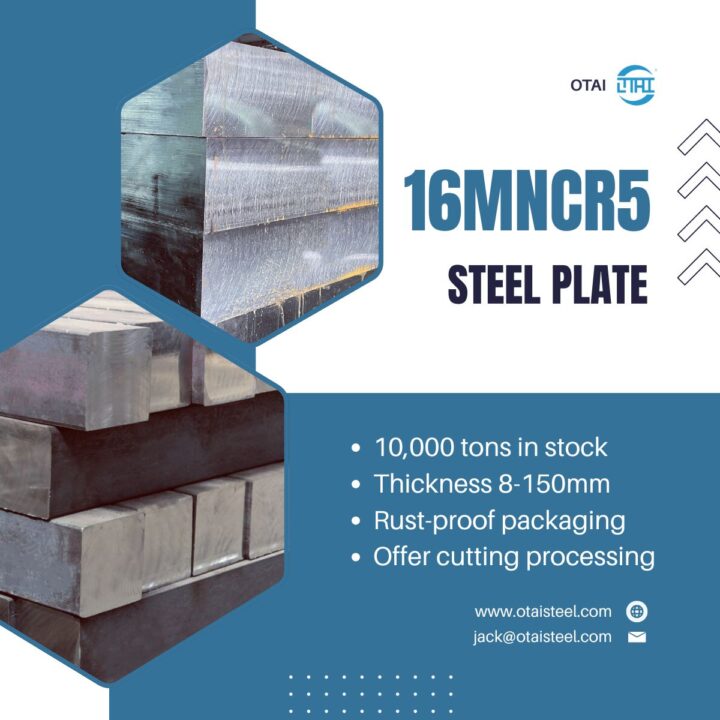
- 16MnCr5 steel plate stock: Thickness range of 8–150 mm. Actual dimensions and availability should be confirmed when requesting a quotation.
- Large inventory capacity: More than 10,000 tons of steel stock across the company’s product range.
- Cutting facilities: 20 saw cutting machines support customer-specific cutting requirements.
- Machining services: CNC machining and grinding help customers obtain dimensions and finishes suited to their production needs.
- Customized supply: Cutting dimensions, tolerances and processing requirements can be discussed according to the order specification.
- Quality control: Material testing and inspection support help verify compliance with agreed technical requirements.
- Additional inspection: Ultrasonic testing and third-party inspection can be arranged when specified.
- One-stop service: Cutting, machining coordination, inspection and export packaging can be included in the supply arrangement.
- Export experience: Since 1999, OTAI has supplied special steel to customers in more than 54 countries.
- Export packaging: Anti-rust protection, strapping and wooden case packaging can be arranged according to transportation requirements.
For product details and inquiries, visit the OTAI 16MnCr5 case-hardening steel product page. When requesting a quotation, provide the required dimensions, delivery condition, standard and inspection requirements. This allows the team to check the appropriate stock and processing options for your project.
❓ Frequently Asked Questions
1. What is the closest equivalent grade to 16MnCr5?
AISI 5115 is commonly listed as a close comparison grade, while 20MnCr5 and other Mn-Cr case-hardening steels are also frequently evaluated. However, their chemical composition and hardenability requirements differ. Buyers should confirm the applicable standards and actual material test results before approving a substitute.
2. Is AISI 5115 the same as 16MnCr5?
No. AISI 5115 and 16MnCr5 have similar applications and overlapping composition ranges, but their manganese and chromium limits differ. AISI 5115 may be suitable for certain components, but it should not be treated as an automatic one-to-one replacement.
3. Can 20MnCr5 replace 16MnCr5?
20MnCr5 may be considered for some gears and transmission components, but it has a higher carbon range and different alloying limits. These differences can affect core properties and heat-treatment response. The engineering team should evaluate the actual component requirements before approving the change.
4. Is SAE 8620 a suitable alternative to 16MnCr5?
SAE 8620 can be a functional alternative for some case-hardened components because both grades are used in applications requiring a hard surface and a tough core. However, SAE 8620 contains nickel and molybdenum, so its alloy system differs from 16MnCr5. Buyers need to validate hardenability, core properties and carburizing performance.
5. What should buyers check before purchasing a 16MnCr5 equivalent?
Buyers should verify the governing standard, chemical composition, product dimensions, delivery condition, hardenability, mechanical properties and heat-treatment requirements. They should also request an MTC with heat-number traceability and obtain written customer or engineering approval before using an alternative in a controlled design.