 16MnCr5 1.7131: Definition, Composition and Basic Properties
📑 Table of Contents
🔍 1. What Is 16MnCr5 1.7131 Steel?
⚙️ 2. Chemical Composition of 16MnCr5 1.7131
📊 3. Mechanical Properties of 16MnCr5 1.7131
🔥 4. Heat Treatment of 16MnCr5 1.7131
🔄 5. 16MnCr5 1.7131 Equivalent Materials
🏭 6. Applications of 16MnCr5 1.7131 Steel
📦 7. Otai Special Steel Advantages
🔍 1. What Is 16MnCr5 1.7131 Steel?
16MnCr5 1.7131 is a low-alloy carburizing steel widely used in European mechanical engineering applications. It belongs to the EN 10084 standard family of case-hardening steels and is specially designed for components requiring a hard surface layer and a tough internal core.
The designation “16MnCr5” provides important information about the steel grade. The number “16” indicates an approximate carbon content of 0.16%, while “MnCr5” refers to the main alloying elements manganese and chromium.
The material number 1.7131 is the European Werkstoff number assigned to this grade. Therefore, 16MnCr5 and 1.7131 represent the same steel grade in different naming systems.
Because of its excellent carburizing performance, 16MnCr5 1.7131 steel is commonly selected for gears, shafts, sprockets and other transmission components that require high wear resistance.
Basic Information of 16MnCr5 1.7131
| Item | Description |
|---|---|
| Steel Grade | 16MnCr5 |
| Material Number | 1.7131 |
| Standard | EN 10084 |
| Steel Type | Low alloy carburizing steel |
| Main Alloy Elements | Manganese (Mn), Chromium (Cr) |
| Main Feature | Hard surface after carburizing with tough core |
The key advantage of 16MnCr5 1.7131 is its balance between surface hardness and core toughness. After carburizing and quenching, the surface can achieve excellent wear resistance, while the core maintains sufficient strength to absorb impact loads.
Why Choose 16MnCr5 1.7131 for Engineering Components?
- Excellent carburizing ability: Creates a hard wear-resistant surface layer.
- Good core toughness: Prevents brittle failure under impact loading.
- Good machinability: Suitable for machining before heat treatment.
- Stable dimensional performance: Suitable for precision mechanical parts.
- Reliable fatigue resistance: Performs well in repeated loading conditions.
For manufacturers searching for 16MnCr5 1.7131 equivalent grade, understanding the chemical composition and mechanical properties is essential because different standards may use different names for similar materials.
⚙️ 2. Chemical Composition of 16MnCr5 1.7131
The chemical composition of 16MnCr5 1.7131 gives this steel its unique carburizing characteristics. The combination of low carbon content, manganese and chromium allows the material to achieve a strong hardened surface while maintaining a ductile core.
The controlled alloy design makes 16MnCr5 steel composition suitable for parts that experience both surface wear and mechanical stress.
Chemical Composition of 16MnCr5 1.7131 Steel
| Element | Content (%) | Function |
|---|---|---|
| Carbon (C) | 0.14–0.19 | Provides carburizing capability and core strength |
| Silicon (Si) | ≤0.40 | Improves strength and deoxidation |
| Manganese (Mn) | 1.00–1.30 | Improves hardenability and toughness |
| Chromium (Cr) | 0.80–1.10 | Improves wear resistance and hardenability |
| Phosphorus (P) | ≤0.025 | Controlled to maintain toughness |
| Sulfur (S) | ≤0.035 | Improves machinability when controlled |
Role of Alloying Elements in 16MnCr5 1.7131
| Element | Effect on Material Performance |
|---|---|
| Carbon | Controls hardness potential after carburizing |
| Manganese | Improves strength and hardening depth |
| Chromium | Enhances wear resistance and surface hardness |
| Silicon | Supports steel strength and production quality |
The carefully balanced composition explains why DIN 16MnCr5 1.7131 steel properties are suitable for gear manufacturing and other applications requiring long service life.
Compared with plain carbon steels, 16MnCr5 provides better hardenability and improved performance after carburizing treatment.
📊 3. Mechanical Properties of 16MnCr5 1.7131
The mechanical properties of 16MnCr5 1.7131 depend on the delivery condition and heat treatment process. In its supplied condition, this steel offers good machinability, while carburizing significantly improves surface hardness and wear resistance.
Typical Mechanical Properties of 16MnCr5 1.7131
| Property | Typical Value |
|---|---|
| Tensile Strength | Approx. 600–800 MPa |
| Yield Strength | Approx. 400 MPa or higher |
| Elongation | Approx. 10–15% |
| Hardness (Annealed) | Approx. 170–220 HB |
| Case Hardness After Carburizing | Approx. 58–62 HRC |
The combination of a hard outer layer and tough inner structure makes 16MnCr5 1.7131 an ideal choice for components exposed to friction, shock loads and repeated stress.
🔥 4. Heat Treatment of 16MnCr5 1.7131
Heat treatment plays an important role in improving the performance of 16MnCr5 1.7131. As a carburizing steel, this material achieves its best properties through surface hardening processes that increase wear resistance while maintaining a tough internal structure.
The main purpose of heat treatment for 16MnCr5 is to create a hard outer case that can withstand friction and contact stress, while the softer core absorbs impact loads without cracking.
Common Heat Treatment Processes for 16MnCr5 1.7131
| Process | Typical Temperature | Purpose |
|---|---|---|
| Carburizing | Approx. 850–950°C | Increase carbon content on the surface layer |
| Quenching | After carburizing | Create high surface hardness |
| Tempering | Approx. 150–200°C | Reduce brittleness and improve toughness |
| Annealing | Approx. 650–750°C | Improve machinability and reduce stress |
Carburizing Process of 16MnCr5 1.7131
Carburizing is the most important heat treatment process for this steel grade. During carburizing, carbon atoms diffuse into the surface layer at high temperatures.
After quenching, the enriched surface transforms into a high-hardness martensitic structure, while the low-carbon core remains tougher and more ductile.
| Material Area | After Carburizing Performance |
|---|---|
| Surface Layer | High hardness, excellent wear resistance |
| Transition Zone | Gradual hardness change |
| Core | High toughness and impact resistance |
Advantages of Heat-Treated 16MnCr5 1.7131
- High surface hardness: Improves resistance against wear and contact fatigue.
- Tough core structure: Prevents sudden failure under impact loads.
- Long service life: Suitable for continuously operating mechanical parts.
- Better fatigue performance: Handles repeated loading conditions.
- Stable dimensional performance: Suitable for precision transmission components.
For manufacturers producing gears and shafts, selecting the correct heat treatment condition is essential to maximize the advantages of 16MnCr5 steel composition and mechanical properties.
🔄 5. 16MnCr5 1.7131 Equivalent Materials
When purchasing steel internationally, customers often search for a 16MnCr5 1.7131 equivalent grade because different countries use different naming systems and standards.
Although equivalent grades may have similar chemical compositions and applications, engineers should always verify exact requirements before substitution.
Common Equivalent Grades of 16MnCr5 1.7131
| Standard | Equivalent Grade | Description |
|---|---|---|
| EN | 16MnCr5 | European carburizing steel grade |
| Werkstoff | 1.7131 | European material number |
| DIN | 16MnCr5 | German designation |
| JIS | SCM415 (similar) | Japanese chromium-molybdenum carburizing steel |
| AISI | 5115 / 5120 (similar) | American carburizing steel alternatives |
Comparison Between 16MnCr5 and Similar Materials
| Grade | Main Difference | Typical Application |
|---|---|---|
| 16MnCr5 | Balanced manganese-chromium carburizing steel | Gears and shafts |
| 20MnCr5 | Higher carbon content and deeper hardening potential | Heavy-duty gears |
| 18CrNiMo7-6 | Higher alloy content and toughness | Large transmission parts |
| 8620 Steel | Nickel-chromium-molybdenum alloy steel | Automotive gears |
16MnCr5 vs 20MnCr5
16MnCr5 and 20MnCr5 are both carburizing steels, but their carbon content and hardening characteristics are different.
| Feature | 16MnCr5 | 20MnCr5 |
|---|---|---|
| Carbon Content | Approx. 0.16% | Approx. 0.20% |
| Hardening Ability | Good | Slightly higher |
| Toughness | Excellent | Very good |
| Typical Use | Medium-load gears and shafts | Higher-load gear components |
The selection between these materials depends on component requirements, load conditions and required case hardness.
🏭 6. Applications of 16MnCr5 1.7131 Steel
Because of its excellent carburizing performance, 16MnCr5 1.7131 steel is widely used in mechanical engineering industries where components require a wear-resistant surface and a strong core.
This material provides a good balance between machinability before heat treatment and high performance after carburizing.
Main Applications of 16MnCr5 1.7131
| Industry | Components | Material Advantage |
|---|---|---|
| Automotive Industry | Transmission gears, shafts, sprockets | High wear resistance and fatigue strength |
| Mechanical Engineering | Gear wheels, drive components | Strong core and hard surface |
| Agricultural Machinery | Chains, gears and rotating parts | Good impact resistance |
| Industrial Equipment | Reducers and transmission systems | Long service life |
| Automation Equipment | Precision shafts and moving parts | Stable dimensional performance |
Why 16MnCr5/1.7131 Is Popular for Gear Manufacturing
- Wear resistance: The carburized surface withstands repeated contact stress.
- Impact resistance: The tough core absorbs mechanical shock.
- Machinability: The low-carbon structure allows efficient machining before treatment.
- Cost efficiency: Provides excellent performance compared with higher alloy steels.
- International availability: Widely recognized under EN and DIN standards.
For companies requiring reliable transmission components, EN 10084 16MnCr5 steel remains one of the most commonly selected carburizing steels in Europe and global markets.
📦 7. Otai Special Steel Advantages
Otai Special Steel supplies 16MnCr5 1.7131 steel and other special steels for customers worldwide who require stable quality, reliable delivery and professional steel processing services.
With experience in international steel supply, Otai provides complete solutions from material selection, cutting and processing to export delivery.
Why Choose Otai Special Steel?
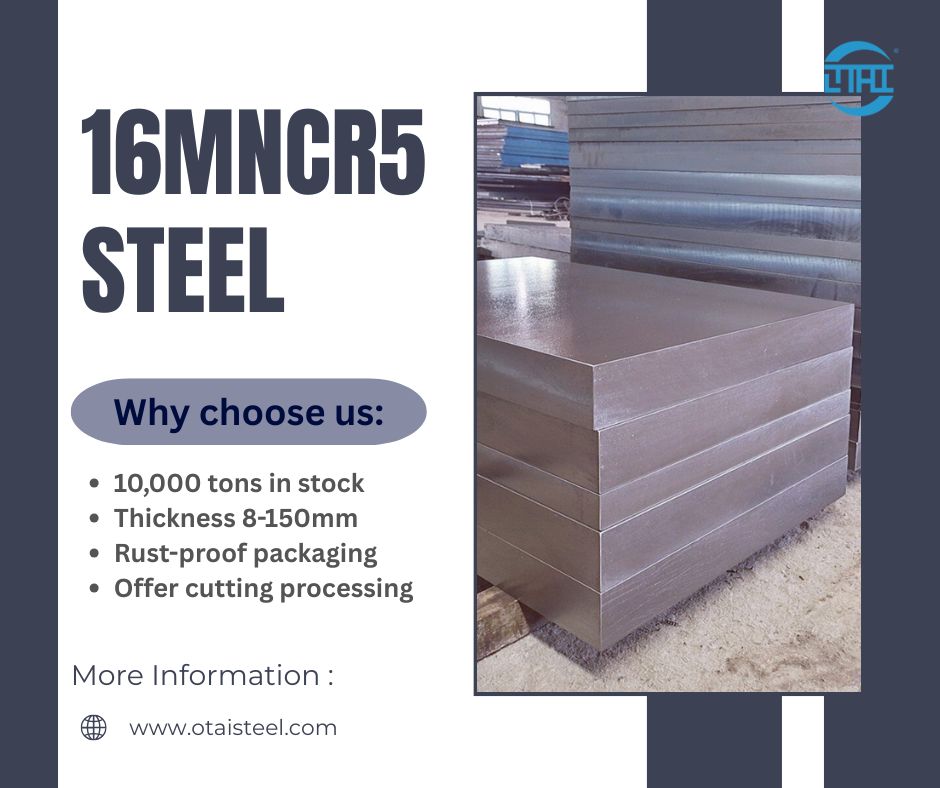
- Stock availability: Otai keeps 8–150mm thickness plates available in stock to support customers requiring fast delivery and stable supply.
- Professional steel supply: Supply 16MnCr5 1.7131 and other alloy steels according to international standards and customer specifications.
- Customized cutting service: Provide steel cutting according to drawings, dimensions and project requirements.
- Heat treatment support: Support carburizing, quenching, tempering and other heat treatment processes based on application requirements.
- Quality inspection: Provide ultrasonic testing and third-party inspection services to ensure material reliability.
- Export experience: Supply steel materials for global customers with strict technical standards.
- Professional packaging: Offer anti-rust packaging, steel strapping and wooden box packaging for international transportation.
For customers searching for a reliable 16MnCr5 1.7131 steel supplier, Otai Special Steel provides technical support and customized solutions according to different engineering applications.
❓ 8. FAQ
1. What is 16MnCr5 1.7131 steel?
16MnCr5 1.7131 is a European low-alloy carburizing steel specified under EN 10084. It is designed for components requiring a wear-resistant hardened surface and a tough core.
2. Is 16MnCr5 the same as 1.7131?
Yes. 16MnCr5 and 1.7131 refer to the same steel grade. 16MnCr5 is the material designation, while 1.7131 is the Werkstoff material number.
3. What is the chemical composition of 16MnCr5 1.7131?
The main alloying elements are carbon, manganese and chromium. Typical carbon content is around 0.16%, manganese is about 1.0–1.3%, and chromium is about 0.8–1.1%.
4. What is the heat treatment process of 16MnCr5 1.7131?
The common process includes carburizing, quenching and tempering. This treatment creates a hard surface layer while maintaining a tough internal core.
5. What are the common applications of 16MnCr5 1.7131?
16MnCr5 1.7131 is widely used for gears, shafts, sprockets, transmission components and other mechanical parts requiring wear resistance and fatigue strength.