A2 Steel Suppliers: How to Choose the Right Tool Steel Supplier for Your Order
📑 Table of Contents
- 🔍 1. What Should You Confirm When Sourcing A2 Steel?
- ⚙️ 2. Is A2 the Right Tool Steel for Your Application?
- 🧪 3. A2 Steel Chemical Composition: What Should the MTC Show?
- 🔥 4. A2 Hardness and Heat Treatment: What Condition Are You Buying?
- 📏 5. Dimensions, Tolerances and Cutting Requirements
- 📦 6. A2 Steel Stock vs Custom Processing
- 💰 7. How to Compare A2 Steel Suppliers Beyond Price
- 📋 8. What Information Should You Include in an A2 Steel RFQ?
- 🔎 9. MTC, Inspection and Export Requirements
- 🏭 10. A2 Steel Supply and Processing from Otai
- ❓ A2 Steel Suppliers FAQ
🔍 1. What Should You Confirm When Sourcing A2 Steel?
If you are sourcing A2 steel for dies, punches, forming tools, or other industrial tooling, the supplier’s name is only the starting point. The more important question is whether the supplier can provide the correct grade, condition, dimensions, documentation, and processing support required for your application.
A2 is a cold-work tool steel known for its combination of wear resistance, toughness, and dimensional stability during hardening. However, two quotations carrying the same “A2” designation may not represent exactly the same purchasing specification. Different standards, product forms, delivery conditions, tolerances, and heat-treatment requirements can change the final suitability and cost.
Before requesting a quotation, clarify these points:
| Buyer Requirement | What to Confirm with the Supplier |
|---|---|
| Grade | AISI A2, ASTM A681, EN/DIN 1.2363 or another specified standard |
| Condition | Annealed, pre-machined, hardened, or another agreed condition |
| Dimensions | Thickness, width, length, cutting tolerance, and final machining allowance |
| Inspection | MTC, ultrasonic testing, third-party inspection, or other quality documents |
| Delivery | Stock availability, cutting time, processing time, packaging, and shipping requirements |
This approach helps you compare quotations on the same technical basis. Otherwise, a lower initial price may simply reflect a different condition, tolerance, certification level, or processing scope.
⚙️ 2. Is A2 the Right Tool Steel for Your Application?
A2 is designed for demanding cold-work tooling
A2 belongs to the air-hardening cold-work tool steel family. Its alloy design combines relatively high chromium with molybdenum and vanadium. This composition gives the grade a useful balance between wear resistance, toughness, and dimensional stability.
For a buyer, the key point is not simply whether A2 has high hardness. You need to consider how the material will behave after machining and heat treatment.
A2 can fit applications such as:
- Blanking and punching dies
- Forming dies
- Punches and inserts
- Trimming tools
- Industrial shearing components
- Cold-forming tooling
- Wear-resistant tooling components
- Other precision tooling requiring a balance of wear resistance and toughness
A2 versus D2: compare the application, not just the grade name
Buyers often compare A2 with D2 because both grades serve cold-work tooling applications. D2 generally provides higher wear resistance because of its higher carbon and chromium content, while A2 provides a different balance that can be useful where toughness and dimensional stability matter.
| Consideration | A2 | D2 |
|---|---|---|
| Tool steel type | Air-hardening cold-work tool steel | High-carbon, high-chromium cold-work tool steel |
| Wear resistance | High | Very high |
| Toughness balance | Generally favorable for many cold-work applications | More wear-focused |
| Dimensional stability | Good with appropriate heat treatment | Good, but treatment and geometry remain important |
Therefore, before ordering, tell your A2 steel supplier what the tool will actually do. The material selection should consider load, wear mechanism, impact, section thickness, required hardness, machining sequence, and expected service life.
Ask the supplier whether A2 matches your tooling conditions rather than asking only for an A2 price.
🧪 3. A2 Steel Chemical Composition: What Should the MTC Show?
Check the applicable standard first
When comparing A2 steel suppliers, chemical composition deserves careful attention. AISI A2 is commonly associated with ASTM A681, while EN/DIN 1.2363 / X100CrMoV5 represents a closely related European designation. However, buyers should not assume that every standard provides identical limits or that one supplier’s typical chemistry represents a universal value.
A common reference range for AISI A2 includes approximately 0.95–1.05% carbon, 0.10–0.40% silicon, 0.40–0.60% manganese, 4.75–5.50% chromium, 0.90–1.20% molybdenum, and 0.15–0.35% vanadium, with phosphorus and sulfur controlled by the applicable specification.
These figures should serve as a reference to understand the grade, not as a substitute for the material certificate. Your purchase specification should identify the applicable standard, while the MTC should show the actual heat analysis for the material supplied.
Why the alloying elements matter to the buyer
| Element | Role in A2 | Procurement Relevance |
|---|---|---|
| Carbon | Supports hardness and carbide formation | Confirm the actual heat chemistry against the specified standard |
| Chromium | Contributes to hardenability and wear resistance | Important when comparing material certificates from different heats |
| Molybdenum | Supports hardenability and tempering behavior | Useful for verifying grade compliance and consistency |
| Vanadium | Forms hard carbides and supports wear resistance | Check actual MTC values rather than relying on a generic datasheet |
| Silicon & Manganese | Support deoxidation, strength, and hardenability | Confirm compliance with the selected specification |
If your project requires a specific standard, do not accept a quotation that only says “A2 equivalent” without further clarification. Ask for the exact standard and the corresponding MTC before final approval.
🔥 4. A2 Hardness and Heat Treatment: What Condition Are You Buying?
Delivery hardness and working hardness are different questions
One common purchasing mistake occurs when a buyer asks for “A2 hardness” without specifying the delivery condition. Tool steel may arrive in an annealed condition for machining, while the finished component may later undergo hardening and tempering to achieve its working hardness.
For this reason, your RFQ should clearly state whether you need annealed A2 for machining or hardened and tempered material for direct use. If you plan to perform the heat treatment yourself, the supplier should provide appropriate technical data for the grade and product condition.
Heat treatment requires a controlled process
A2 develops its final tooling properties through controlled heating, hardening, and tempering. Typical hardening practice uses an austenitizing temperature in approximately the 930–980°C range, depending on the exact specification, section size, furnace conditions, and supplier recommendations. A2 can then undergo air or controlled-gas cooling, followed by tempering.
These temperatures should not become a universal production recipe. Different mills and tool geometries can require different parameters. Large sections, complex shapes, and precision tooling also require careful control of heating and cooling to reduce distortion and cracking.
After suitable heat treatment, A2 commonly reaches a working hardness in roughly the high-50s to low-60s HRC range, depending on the treatment route and specification. For an actual order, always confirm the required hardness range and heat-treatment condition with the supplier rather than ordering by a generic HRC number.
For example, ask:
- Is the material supplied annealed?
- What annealed hardness does the supplier guarantee, if applicable?
- Will the supplier perform hardening and tempering?
- What final HRC range does the application require?
- What heat-treatment data applies to the specific A2 product?
- Does the supplier have experience controlling distortion for the required section size?
📏 5. Dimensions, Tolerances and Cutting Requirements
Do not treat thickness as the only dimensional requirement
When you request an A2 steel quotation, the supplier needs more than the grade name. Thickness, width, length, tolerance, surface condition, and machining allowance can all influence the quotation and production route.
For example, purchasing a standard-size A2 plate and cutting it to approximate dimensions can differ significantly from requesting tightly controlled finished blanks. If your machining process requires a specific allowance, tell the supplier before quotation.
| Specification | Why It Matters |
|---|---|
| Thickness | Determines available stock, cutting method, machining allowance, and final weight |
| Width and length | Affects material utilization and cutting efficiency |
| Cutting tolerance | Determines how much additional machining you need |
| Surface condition | Influences machining, inspection, and final tooling preparation |
| Flatness | Important for precision machining and tool manufacture |
If you need several different blank sizes, provide the complete cutting list in the first RFQ. A supplier with saw-cutting and machining capabilities may be able to optimize the material and deliver closer to your production dimensions.
📦 6. A2 Steel Stock vs Custom Processing
Stock availability can make a substantial difference to the purchasing process. When the required A2 specification already exists in inventory, the supplier may only need to cut and prepare the material instead of arranging a new production cycle.
However, “A2 in stock” does not automatically mean that the supplier has your required size. You should confirm the actual thickness, available dimensions, heat number, delivery condition, and quantity.
For buyers, the practical questions are straightforward:
- How much A2 material is physically available now?
- What thickness range can the supplier offer from stock?
- Can the supplier cut the material to my required dimensions?
- What tolerance will the cutting process achieve?
- Can the supplier provide the MTC for the actual heat?
- What additional time will machining or inspection require?
These questions help separate genuine stock availability from a supplier who still needs to arrange production.
When your project has a fixed delivery schedule, ask for a realistic lead time based on the complete scope rather than only asking whether the grade is “available.” Cutting, inspection, machining, packing, and export preparation can all affect the final dispatch date.
💰 7. How to Compare A2 Steel Suppliers Beyond Price
Price matters in industrial purchasing, but comparing only the quoted price can hide important differences. Two suppliers may quote the same nominal A2 grade while offering different product conditions, dimensions, tolerances, documentation, or processing services.
Compare the complete supply scope
A useful comparison should include at least the following:
| Comparison Point | Buyer Question |
|---|---|
| Grade compliance | Which standard does the material meet? |
| Actual material | Will the supplier provide the actual heat/MTC? |
| Stock | Is the required size physically available? |
| Processing | Can the supplier cut or machine the material? |
| Inspection | Can UT or third-party inspection be arranged? |
| Packaging | How will the steel be protected during international transport? |
| Delivery | What is the complete lead time from order confirmation to shipment? |
This comparison gives procurement teams a clearer basis for evaluating quotations. In particular, documentation and inspection requirements should enter the discussion before the purchase order, not after production starts.
📋 8. What Information Should You Include in an A2 Steel RFQ?
A complete RFQ allows A2 steel suppliers to quote the same requirement. It also reduces the chance of receiving a quotation that looks attractive but does not match your actual production needs.
A practical A2 steel RFQ checklist
- Grade: AISI A2 or the exact required standard.
- Product form: plate, sheet, or another specified form.
- Thickness: Required thickness or thickness range.
- Width and length: Original stock size or finished cutting dimensions.
- Quantity: Pieces, total weight, or both.
- Delivery condition: Annealed, hardened and tempered, or another condition.
- Hardness: Required range if applicable.
- Surface requirements: Standard or machined surface condition.
- Tolerance: Cutting, thickness, flatness, or machining tolerance.
- Inspection: MTC, UT, third-party inspection, or customer-specific requirements.
- Packaging: Export packaging and corrosion protection requirements.
- Destination: Required shipping destination and delivery terms.
If you already have a drawing or purchasing specification, attach it to the RFQ. A supplier can then check whether the requested material condition and processing route fit the final component.
The clearer your RFQ, the easier it becomes to compare suppliers on an equivalent technical basis.
🔎 9. MTC, Inspection and Export Requirements
Ask for documentation that matches the actual material
For industrial A2 purchases, a material test certificate provides important traceability. The document should correspond to the supplied material and identify the relevant heat or batch information. Buyers should review the chemistry against the agreed standard instead of accepting a generic A2 certificate that does not clearly connect to the shipment.
Depending on the application, additional inspection may also matter. Ultrasonic testing can help buyers evaluate internal quality when the specification requires it, while third-party inspection can provide an independent verification step before shipment.
International packaging is part of the supply requirement
For overseas buyers, material quality is only one part of successful delivery. Steel must also arrive without unnecessary corrosion or transport damage. Suppliers should therefore confirm the packaging method before shipment.
Typical export preparation may include bundling or strapping, protective wrapping, anti-rust measures, and wooden cases where appropriate. The correct method depends on product dimensions, destination, transport mode, and customer requirements.
If your company follows a formal incoming-inspection procedure, provide those requirements before the order. Doing so gives the supplier enough time to coordinate certificates, inspection, marking, packaging, and shipment documents.
🏭 10. A2 Steel Supply and Processing from Otai
For buyers sourcing A2 tool steel internationally, Otai Special Steel combines stock supply with cutting and processing services. The goal is to reduce the number of separate suppliers involved between material purchasing and production preparation.
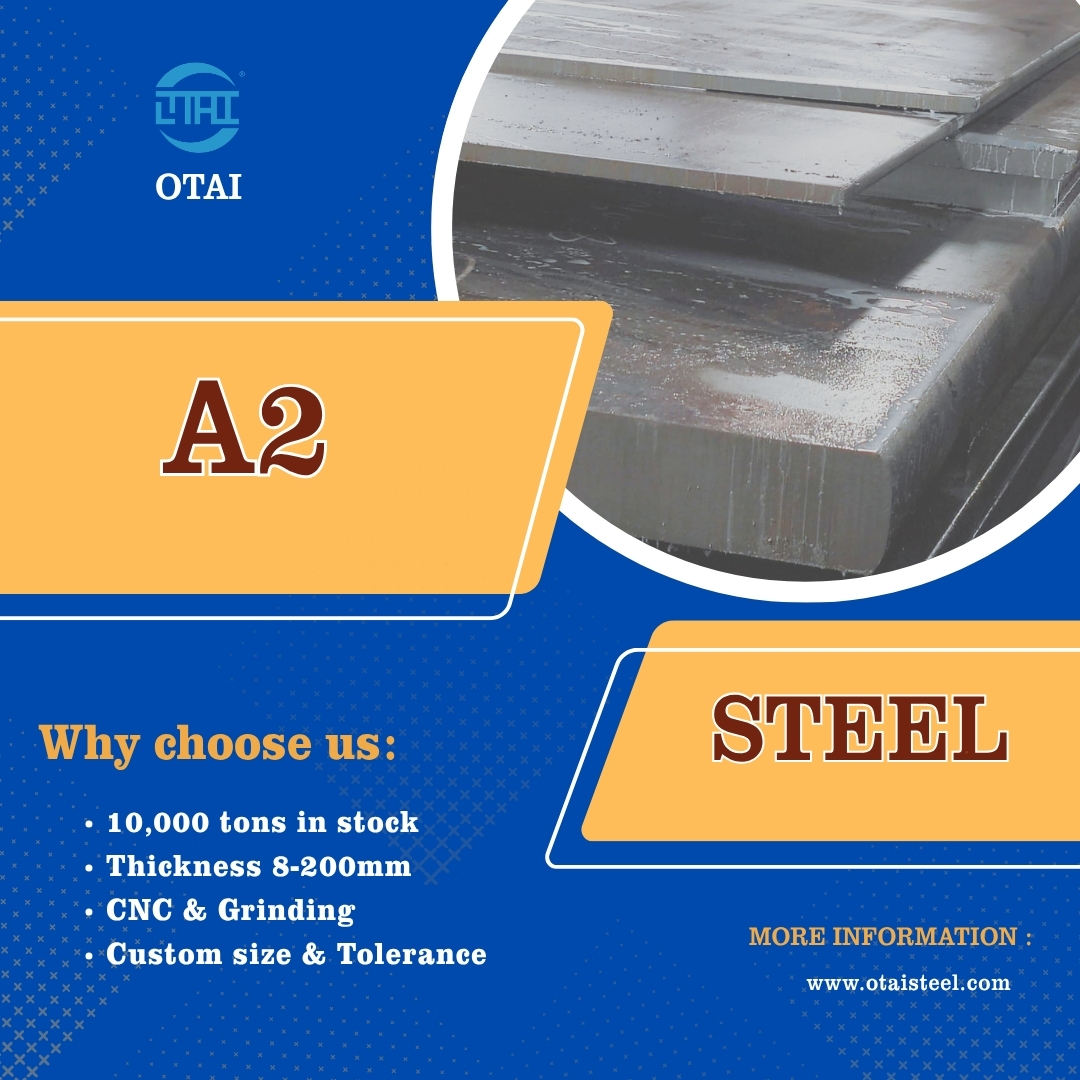
- 📦 A2 steel plate thickness range: 8–200mm in stock.
- 🏭 More than 10,000 tons of steel stock across applicable product ranges.
- 🪚 20 saw cutting machines for material cutting and preparation.
- ⚙️ CNC machining and grinding services for customers requiring additional processing.
- 📏 Custom sizes and tolerances according to agreed purchasing requirements.
- 🔎 Ultrasonic testing and third-party inspection support when required.
- 📋 Material documentation and quality testing support for international orders.
- 📦 Export packaging, including strapping, wooden cases, and anti-rust protection according to shipment requirements.
- 🌍 Export experience to more than 54 countries since 1999.
- 🤝 One-stop service covering material supply, cutting, processing, inspection, and export preparation.
For an A2 purchase, buyers can provide the required thickness, dimensions, quantity, delivery condition, hardness requirement, inspection standard, and destination. Otai can then check the available material and propose the corresponding supply and processing route.
This approach is particularly useful when the buyer needs several cut sizes from the same A2 plate. Instead of purchasing oversized material and arranging every cutting operation locally, the buyer can discuss the required blanks with the supplier before shipment.
❓ A2 Steel Suppliers FAQ
1. What should I ask A2 steel suppliers before placing an order?
Confirm the exact A2 standard, product form, dimensions, delivery condition, hardness requirement, MTC, inspection requirements, cutting tolerance, packaging, stock status, and lead time. These details allow you to compare quotations on the same technical basis.
2. Is A2 steel the same as 1.2363?
AISI A2 and EN/DIN 1.2363 are commonly associated with closely related cold-work tool steel specifications, but buyers should confirm the exact standard and chemical limits required for their project. Do not treat the designation alone as proof of complete equivalence.
3. What hardness can A2 steel reach?
After appropriate hardening and tempering, A2 commonly reaches a hardness in roughly the high-50s to low-60s HRC range. The actual result depends on the material, section size, heat-treatment process, and required specification.
4. Can A2 steel suppliers provide cut-to-size material?
Many industrial suppliers offer saw cutting or other processing services. Before ordering, provide the required dimensions and tolerances so the supplier can confirm whether the requested blanks can come directly from available stock.
5. Does Otai have A2 steel in stock?
Otai has A2 steel plate in thicknesses from 8–200mm in stock. Buyers can also discuss cutting, CNC machining, grinding, custom dimensions, inspection, and export packaging according to the project requirements.