Skip to Content

Blog Archives

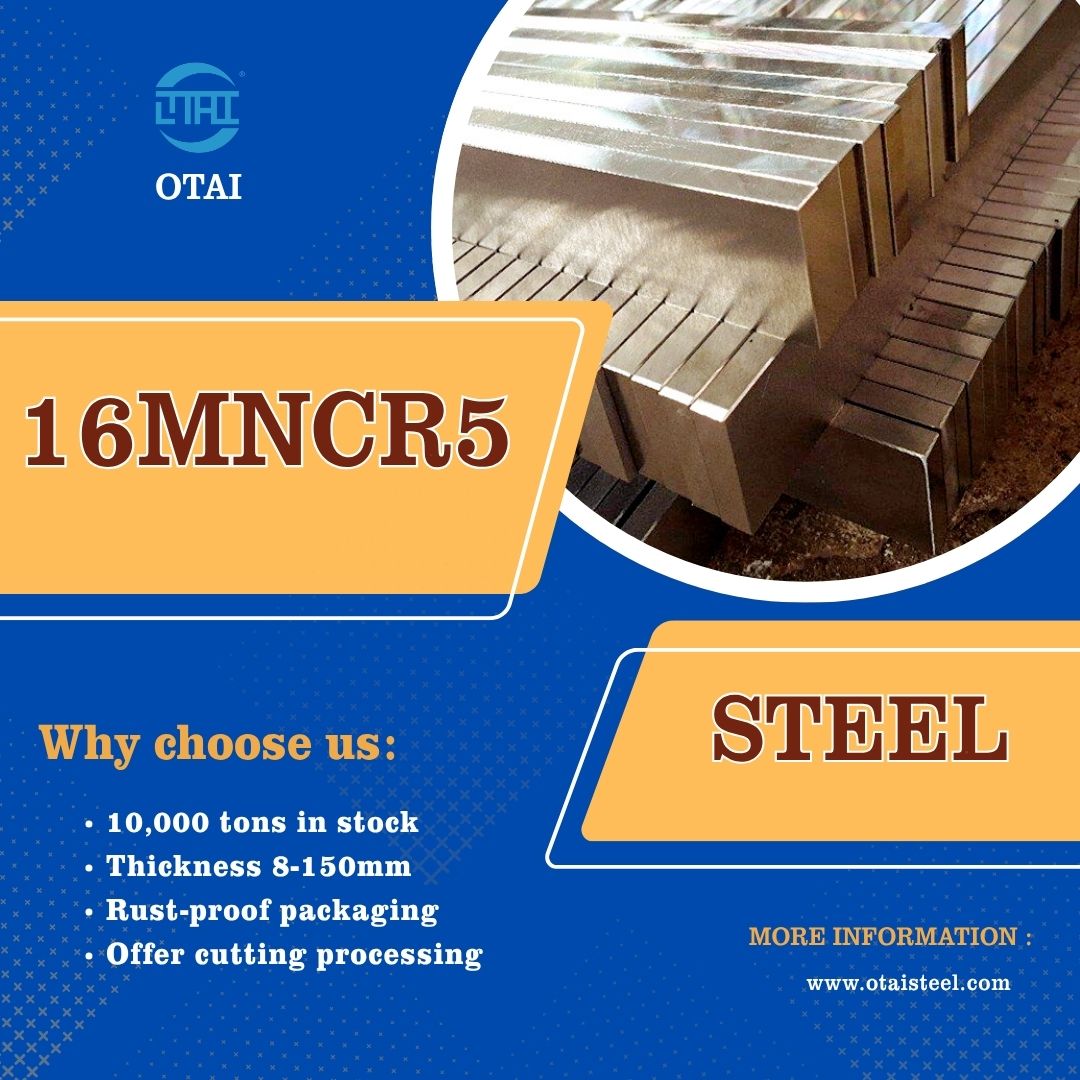
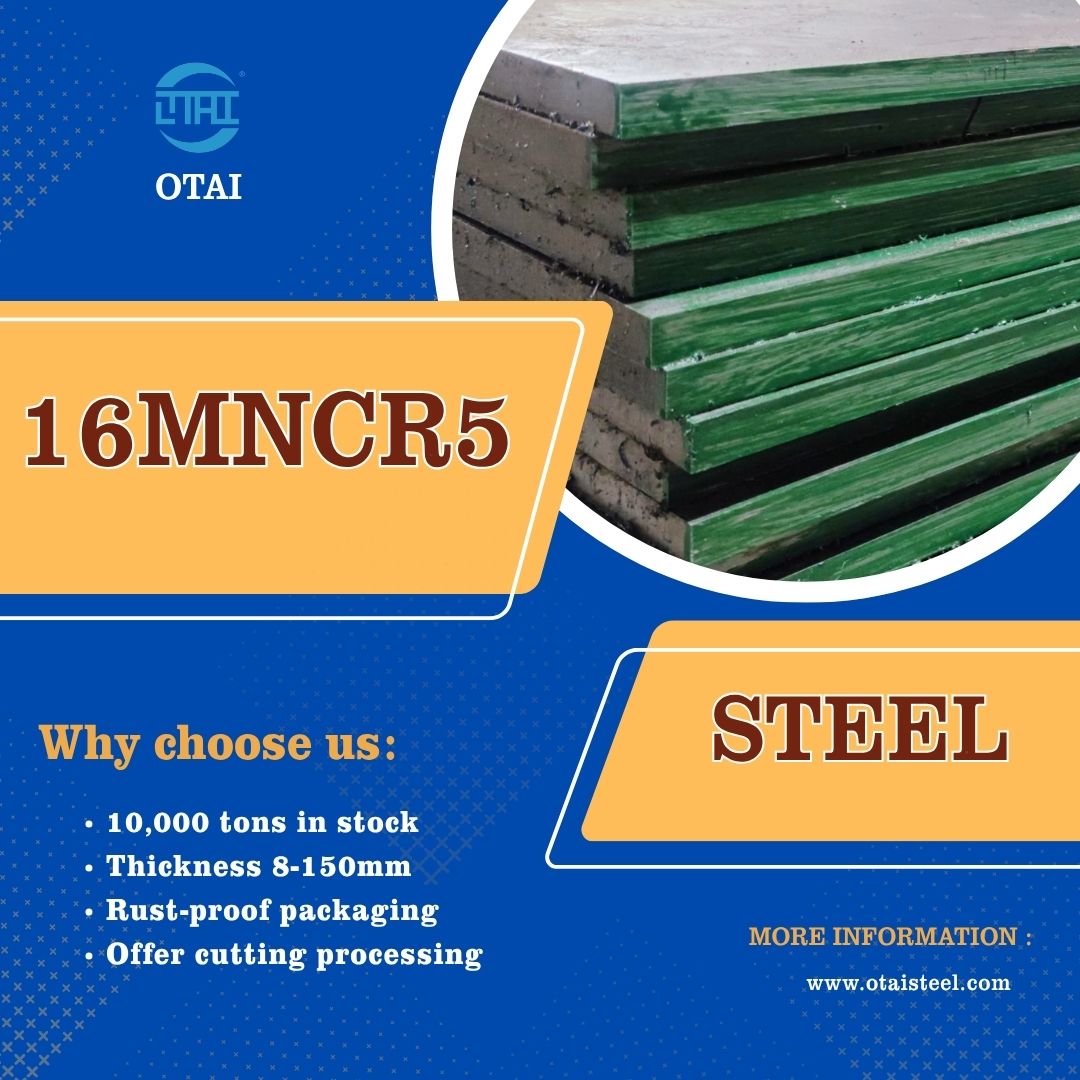
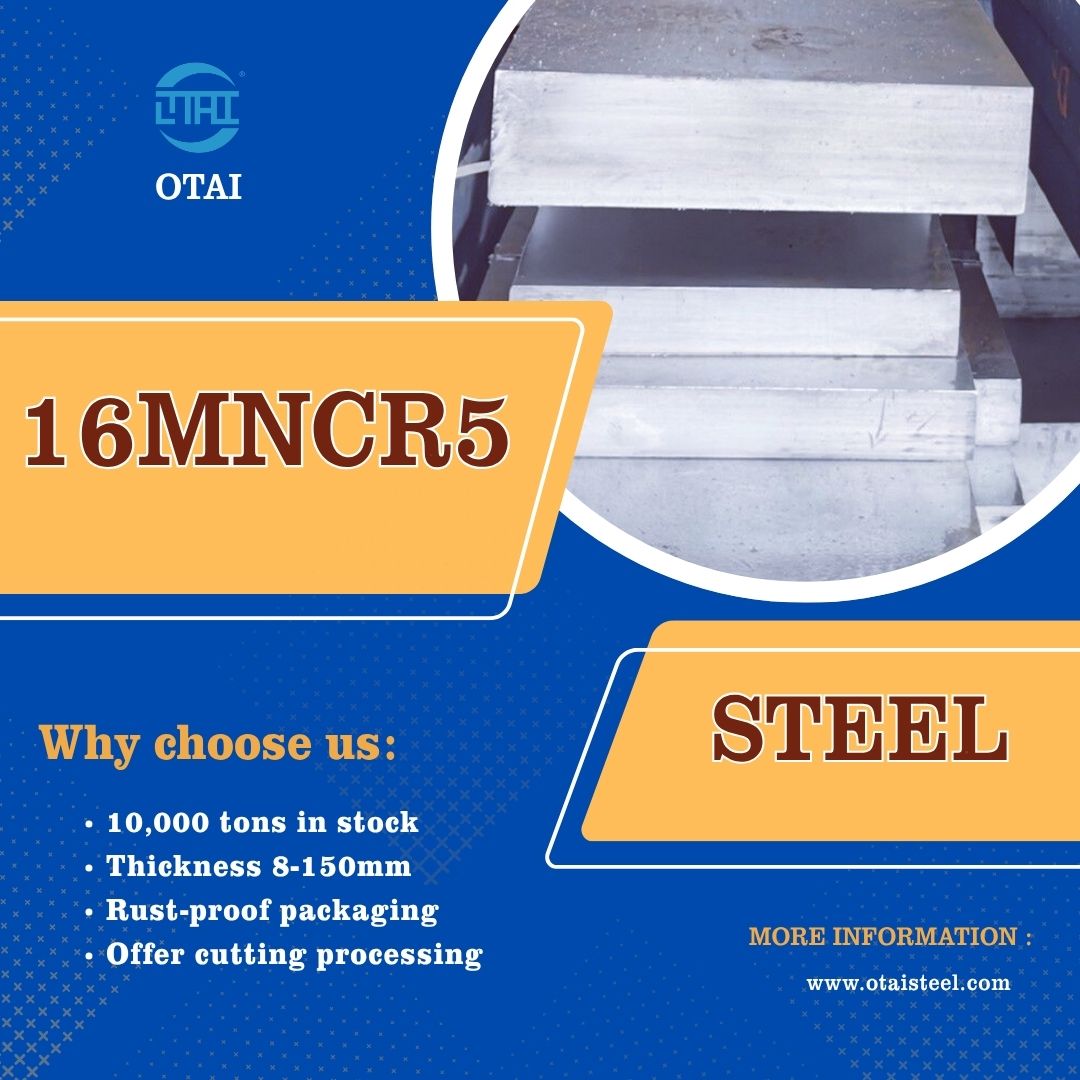
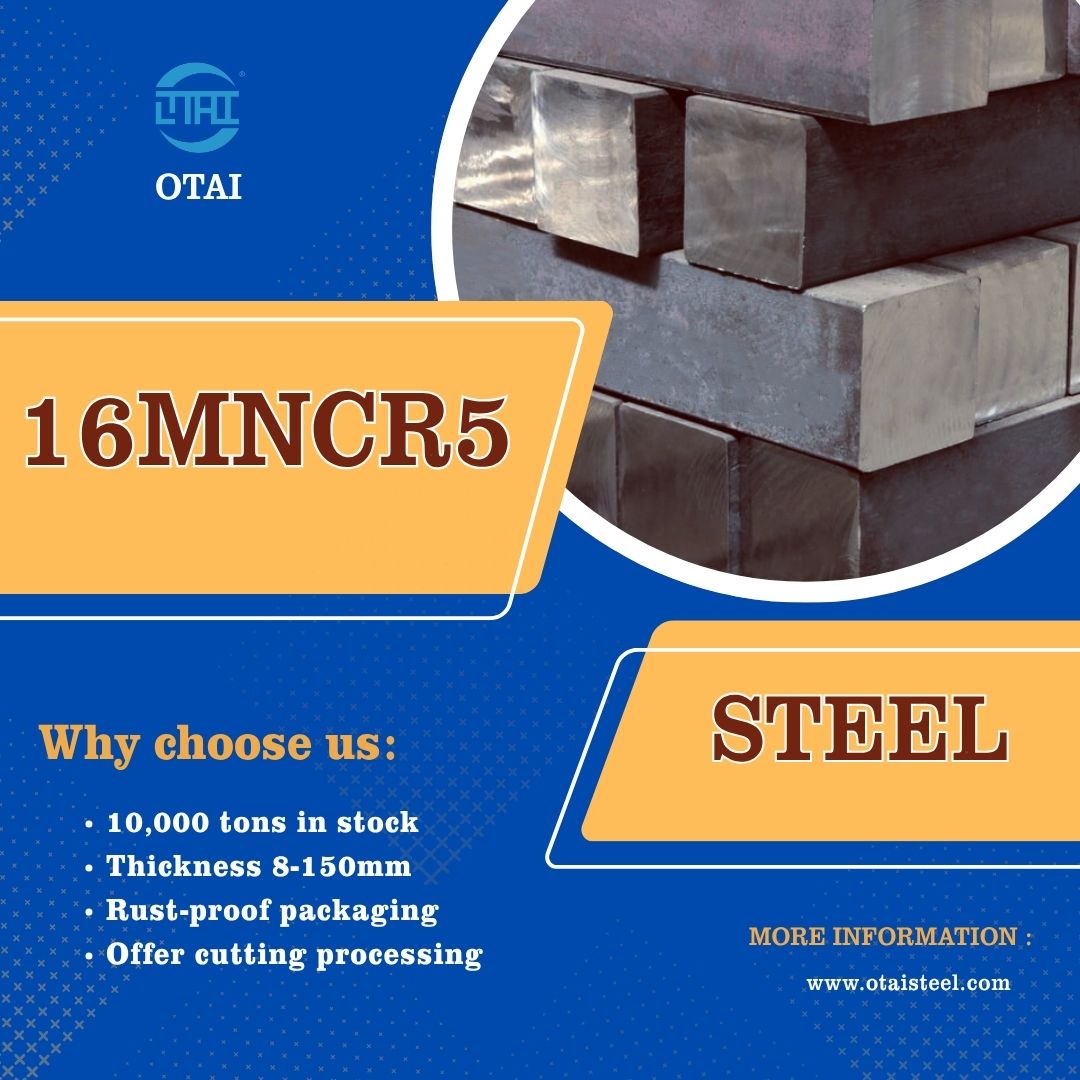
16MnCr5 Material Specification: Available Product Forms and Supply Range

16MnCr5 Material Specification: Available Product Forms and Supply Range16MnCr5 Material Specification: Available Product Forms and Supply Range

The 16MnCr5 material specification defines the chemical composition, mechanical properties, heat treatment performance, and industrial applications of one of the most widely used carburizing alloy steels in the engineering industry. 16MnCr5 is a low-carbon chromium alloy steel that engineers design for case hardening applications. These applications require high surface hardness combined with a tough and durable core.

Manufacturers commonly use the material in automotive transmissions, industrial gears, shafts, pinions, mining equipment, and heavy mechanical systems operating under repeated stress and wear conditions.

16MnCr5 steel is highly valued because it provides:

  • Excellent carburizing performance
  • High wear resistance
  • Strong fatigue resistance
  • Good machinability before heat treatment
  • Excellent dimensional stability
  • Reliable toughness after quenching and tempering

The steel is generally supplied in several conditions:

  • Hot rolled
  • Forged
  • Annealed
  • Normalized
  • Carburized and quenched

📊 16MnCr5 Material Chemical Specification

The chemical composition of 16MnCr5 is carefully controlled to achieve excellent hardenability and wear resistance.

Element Typical Content (%) Main Function
Carbon (C) 0.14 – 0.19 Supports carburized hardness
Manganese (Mn) 1.00 – 1.30 Improves hardenability and strength
Chromium (Cr) 0.80 – 1.10 Enhances wear resistance
Silicon (Si) 0.17 – 0.37 Improves structural stability
Phosphorus (P) ≤ 0.025 Controls brittleness
Sulfur (S) ≤ 0.035 Improves machinability

The balanced chromium-manganese alloy system gives 16MnCr5 excellent case hardening capability and long-term durability.

⚙️ Mechanical Property Specification

The mechanical properties of 16MnCr5 vary depending on the heat treatment condition and final hardness level.

Property Typical Value Industrial Benefit
Surface Hardness 58 – 62 HRC Excellent wear resistance
Core Hardness 30 – 45 HRC High toughness
Tensile Strength 900 – 1200 MPa Supports heavy loads
Yield Strength High after heat treatment Improves structural reliability
Fatigue Resistance Excellent Long service life

The material is widely used in applications requiring a hard wear-resistant surface and a shock-resistant core.

🔥 Heat Treatment Specification

16MnCr5 steel is specifically designed for carburizing and case hardening operations.

Heat Treatment Process Typical Temperature Purpose
Annealing 650 – 700°C Improve machinability
Normalizing 850 – 880°C Refine grain structure
Carburizing 880 – 930°C Increase surface carbon content
Quenching 780 – 820°C Increase hardness
Tempering 150 – 200°C Improve toughness

Proper heat treatment produces a martensitic surface layer with excellent wear resistance and fatigue performance.

🔬 Microstructure and Material Performance

The specification of 16MnCr5 steel includes excellent microstructural characteristics after carburizing and heat treatment. These structures directly influence hardness, toughness, wear resistance, and fatigue strength.

Microstructure Typical Condition Performance Benefit
Ferrite + Pearlite Annealed Good machinability and ductility
Refined Pearlite Normalized Improved strength and stability
Martensite Carburized & Quenched High surface hardness and wear resistance
Tempered Martensite Tempered Excellent toughness and fatigue resistance

The carburized martensitic layer is especially important for gear teeth and transmission components operating under repeated loading conditions.

📦 Available Product Forms and Supply Range

16MnCr5 steel is supplied in various forms according to industrial processing requirements.

Product Form Typical Supply Condition Main Applications
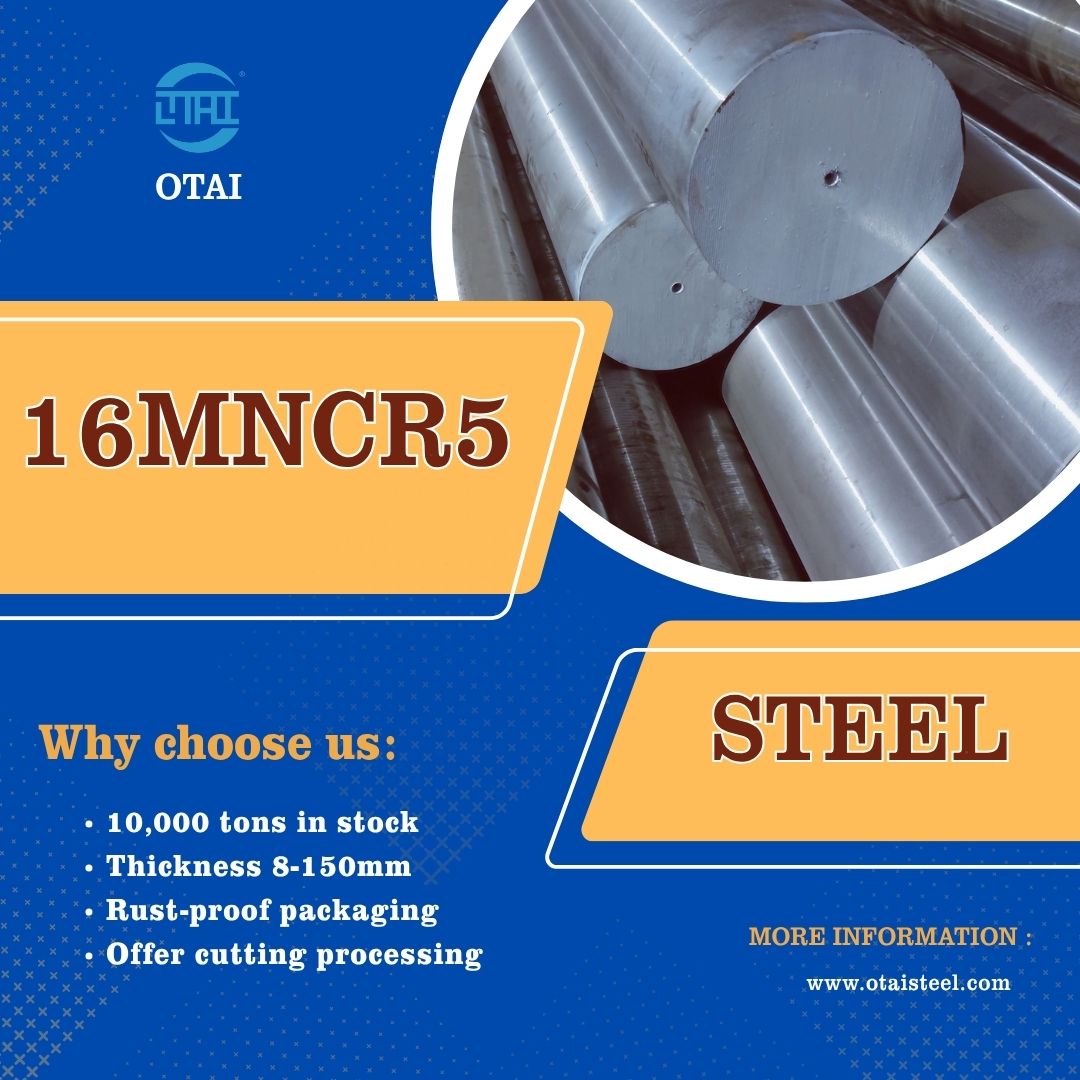
Round Bar Annealed / Forged Shafts and gears
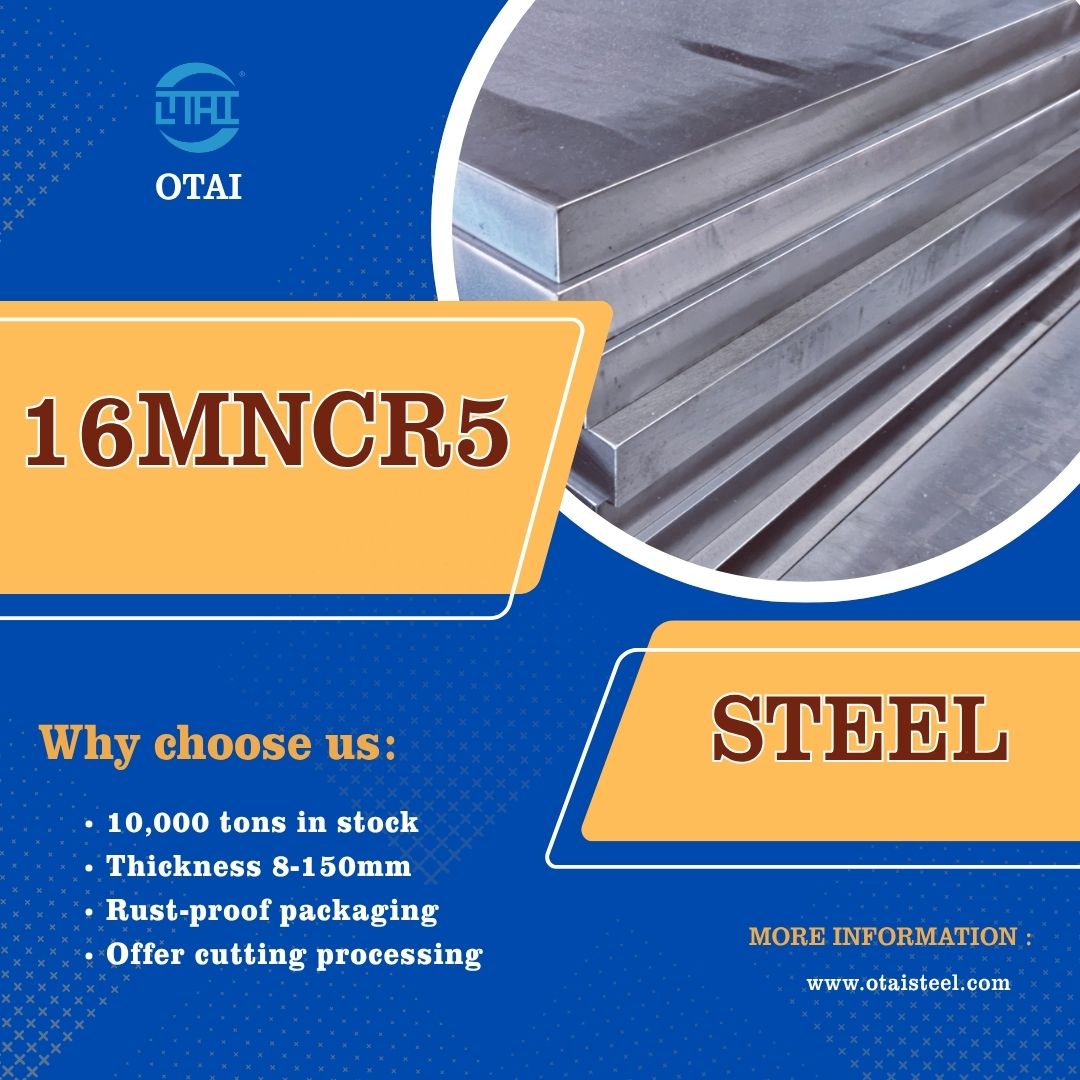
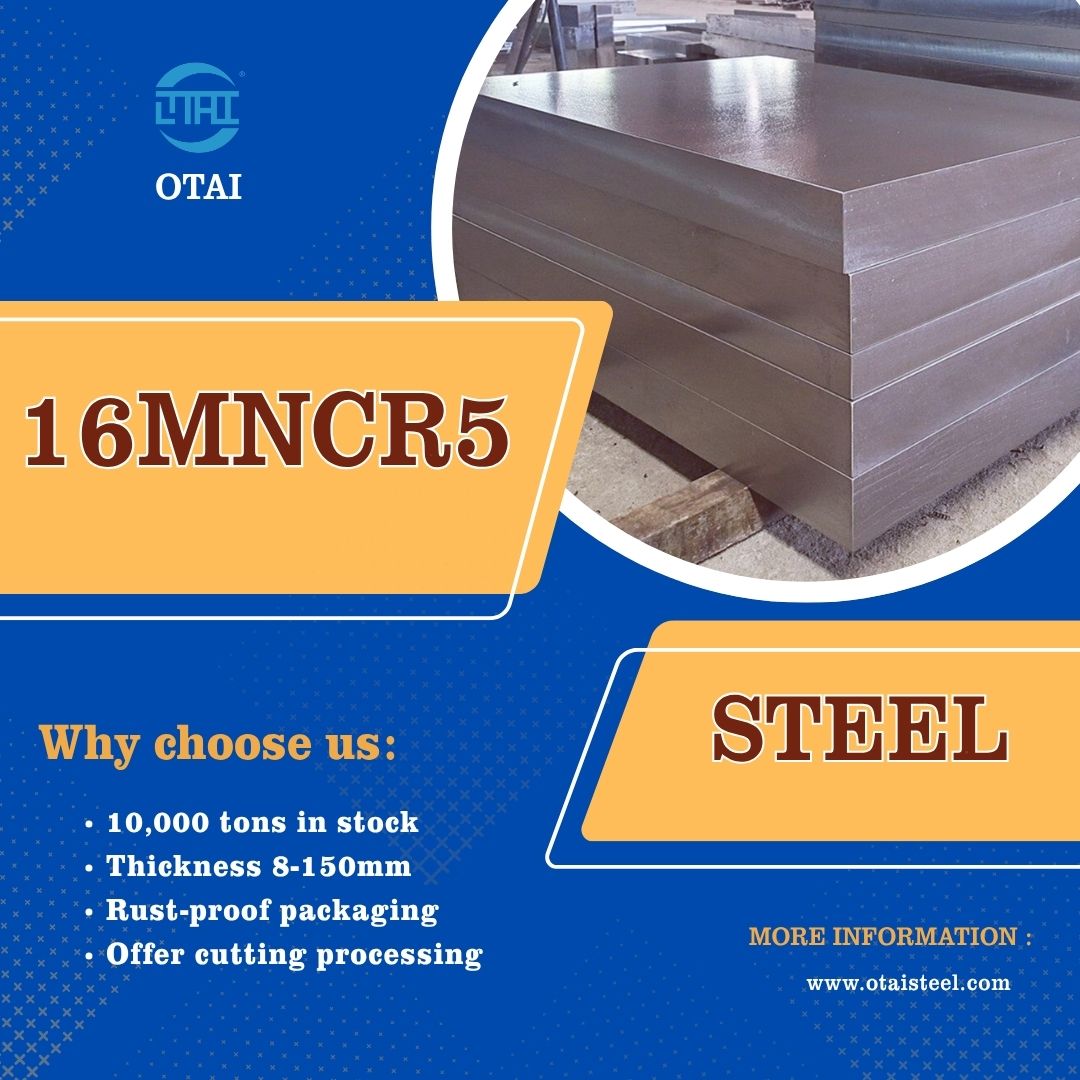
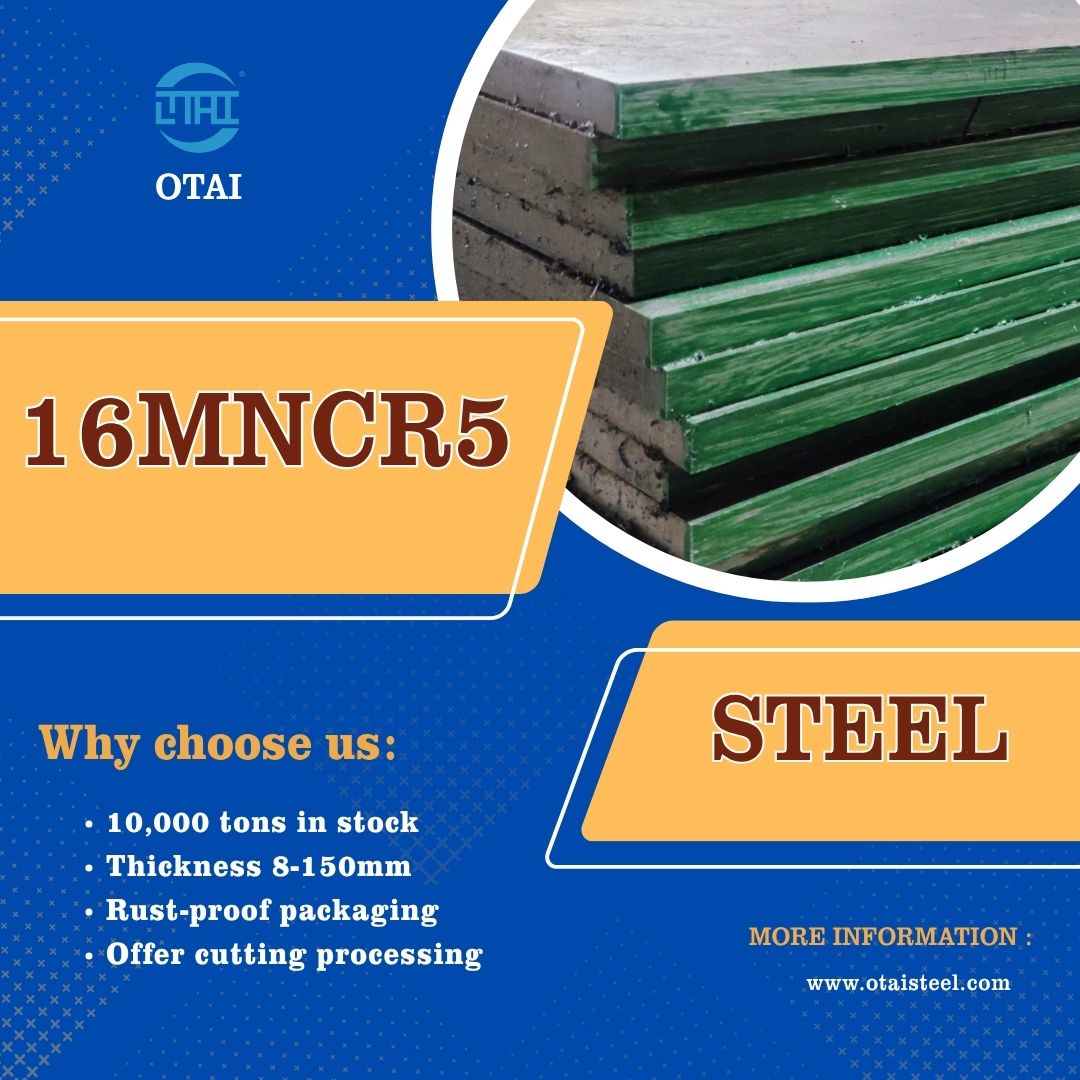
Steel Plate Hot Rolled Machinery components
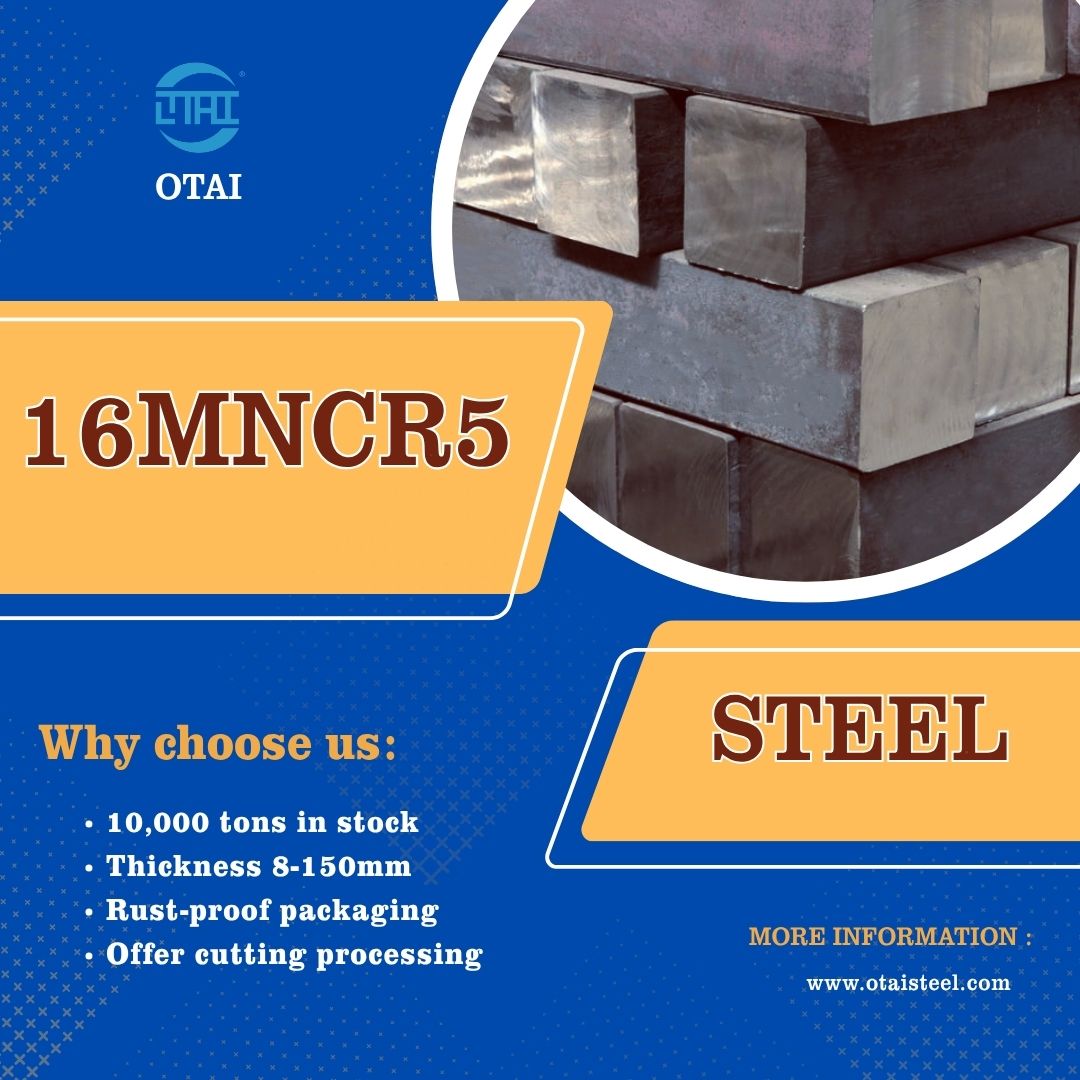
Forged Block Pre-machined Heavy engineering parts
Flat Bar Normalized Structural applications

Custom cutting and machining services are commonly provided for customer-specific engineering projects.

🏭 Industrial Applications of 16MnCr5 Steel

The excellent specification of 16MnCr5 steel makes it suitable for demanding industrial environments requiring high surface durability and mechanical reliability.

Industry Typical Components Required Performance
Automotive Transmission gears Fatigue resistance
Mining Equipment Drive systems Wear resistance
Industrial Machinery Pinions and shafts High load capacity
Agricultural Equipment Gear systems Impact resistance
Heavy Engineering Rotating components Long service life

Its combination of hard surface and ductile core makes 16MnCr5 one of the most reliable carburizing steels for industrial transmission systems.

🌍 International Equivalent Standards

Several international standards recognize 16MnCr5 material specifications.

Standard Equivalent Grade
DIN / EN 16MnCr5 / 1.7131
AFNOR 16MC5
UNI 16MnCr5
JIS Equivalent carburizing steel grades

These international standards ensure consistent mechanical properties, heat treatment performance, and industrial reliability.

🏭 Company Advantages

Otai Special Steel supplies high-quality 16MnCr5 alloy steel for gears, shafts, transmission systems, and heavy-duty engineering applications worldwide.

  • Large inventory with stable year-round supply
  • 8–150mm thickness plates available in stock
  • Round bars, plates, forged blocks, and flat bars available
  • Custom cutting and precision machining services
  • Professional carburizing and heat treatment support
  • Ultrasonic testing (UT) available
  • Chemical composition verification
  • Third-party inspection support including SGS
  • Professional export packaging and global shipping

We provide reliable quality, competitive pricing, fast delivery, and customized alloy steel solutions for customers in automotive, mining, industrial machinery, and heavy engineering industries.

❓ FAQ

Q1: What type of steel is 16MnCr5?

A1: 16MnCr5 is a low-carbon chromium alloy steel mainly used for carburizing and case hardening applications.

Q2: What is the standard designation of 16MnCr5?

A2: The EN/DIN designation is 16MnCr5 with material number 1.7131.

Q3: What hardness can 16MnCr5 achieve after carburizing?

A3: The carburized surface hardness typically reaches 58–62 HRC.

Q4: What industries commonly use 16MnCr5 steel?

A4: Automotive, mining, agricultural machinery, industrial gearbox, and heavy engineering industries commonly use the material.

Q5: Why is 16MnCr5 suitable for gears?

A5: The steel provides a hard wear-resistant surface together with a tough core structure, which improves fatigue resistance and service life.

0 0 Continue Reading →

16MnCr5 Gear Material: What industries commonly use 16MnCr5 gear steel?

16MnCr5 Gear Material: What industries commonly use 16MnCr5 gear steel?16MnCr5 Gear Material: What industries commonly use 16MnCr5 gear steel?

The 16MnCr5 gear material is one of the most widely used case-hardening alloy steels for manufacturing high-performance gears, pinions, shafts, and transmission components. This low-carbon chromium alloy steel offers an outstanding combination of surface hardness, core toughness, fatigue resistance, and wear resistance after carburizing and heat treatment.

16MnCr5 steel is especially popular in automotive, industrial machinery, mining equipment, and heavy engineering industries where gears must operate under high contact stress and repeated cyclic loading conditions.

The material develops a very hard wear-resistant outer layer after carburizing while maintaining a tough and shock-resistant core. This structure helps prevent gear tooth failure, surface wear, and fatigue cracking during long-term operation.

Typical gear applications include:

  • Automotive transmission gears
  • Spur gears and helical gears
  • Gear shafts and pinions
  • Industrial gearbox components
  • Mining transmission systems
  • Agricultural machinery gears
  • Heavy-duty drive components

🧪 Chemical Composition of 16MnCr5 Gear Steel

The alloy composition of 16MnCr5 provides excellent hardenability and mechanical strength for gear manufacturing.

Element Typical Content (%) Function in Gear Performance
Carbon (C) 0.14 – 0.19 Improves carburized hardness
Manganese (Mn) 1.00 – 1.30 Enhances hardenability and strength
Chromium (Cr) 0.80 – 1.10 Improves wear resistance
Silicon (Si) 0.17 – 0.37 Improves structural stability

The chromium-manganese alloy system gives 16MnCr5 excellent fatigue resistance and contact strength for demanding gear applications.

📊 Mechanical Properties of 16MnCr5 Gear Material

The mechanical performance of 16MnCr5 changes significantly after carburizing and heat treatment.

Property Annealed Condition Carburized & Hardened
Tensile Strength 580 – 780 MPa 800 – 1200 MPa
Yield Strength 350 – 550 MPa High after quenching
Surface Hardness 160 – 190 HB 58 – 62 HRC
Core Toughness Good Excellent

The hardened surface improves wear resistance, while the tough core helps absorb shock loads and vibration.

🔥 Heat Treatment Process for 16MnCr5 Gears

Heat treatment is critical for achieving optimal gear performance and durability.

Heat Treatment Stage Typical Temperature Purpose
Annealing 650 – 700°C Improve machinability
Normalizing 850 – 880°C Refine grain structure
Carburizing 880 – 930°C Increase surface carbon content
Quenching 780 – 820°C Develop martensitic hardness
Tempering 150 – 200°C Reduce brittleness

Proper carburizing depth and quenching control are essential for preventing premature gear wear and tooth failure.

🔬 Microstructure of 16MnCr5 Gear Steel

The microstructure of 16MnCr5 gear material changes significantly after carburizing and heat treatment.

A properly heat-treated gear develops a hard martensitic surface layer and a tough low-carbon core structure.

Microstructure Typical Location Main Performance Benefit
Martensite Gear Tooth Surface High wear resistance
Tempered Martensite Transition Zone Improved fatigue strength
Ferrite + Pearlite Core Structure Excellent toughness

This dual-structure design helps gears resist surface pitting, tooth cracking, and impact damage during long-term service.

⚙️ Why 16MnCr5 Is Ideal for Gear Manufacturing

16MnCr5 steel is one of the most preferred materials for gears because it combines high surface durability with strong core support.

Performance Requirement 16MnCr5 Advantage
Wear Resistance Excellent after carburizing
Fatigue Strength High resistance to cyclic loading
Impact Toughness Strong low-carbon core
Machinability Good before heat treatment
Dimensional Stability Reliable after tempering

These advantages make 16MnCr5 suitable for both small precision gears and large industrial transmission systems.

🚗 Common Gear Applications of 16MnCr5 Steel

16MnCr5 gear material is widely used across multiple industries requiring reliable transmission performance.

Industry Typical Gear Components Main Performance Requirement
Automotive Transmission gears High fatigue resistance
Mining Equipment Heavy-duty gear drives Wear resistance
Industrial Machinery Gearboxes and pinions Long service life
Agricultural Machinery Drive gears Shock load resistance
Construction Equipment Power transmission gears Heavy load capacity

Its excellent balance between hardness and toughness makes 16MnCr5 one of the most reliable gear steels in industrial manufacturing.

⚠️ Common Gear Failure Problems and Prevention

Proper material selection and heat treatment help prevent common gear failures.

Failure Type Possible Cause Recommended Solution
Surface Pitting Insufficient hardness Optimize carburizing depth
Tooth Cracking Poor toughness Improve tempering process
Excessive Wear Improper lubrication Use suitable lubricants
Distortion Uneven quenching Control cooling process

Careful heat treatment and machining control greatly improve gear reliability and operational lifespan.

🌍 International Equivalent Grades

16MnCr5 gear steel has several equivalent grades used globally.

Standard Equivalent Grade
DIN / EN 16MnCr5 / 1.7131
AFNOR 16MC5
UNI 16MnCr5
JIS Equivalent carburizing steel grades

These equivalent grades provide similar wear resistance, hardenability, and mechanical performance for gear manufacturing.

🏭 Company Advantages

Otai Special Steel supplies premium-quality 16MnCr5 gear steel for automotive transmissions, industrial gearboxes, mining machinery, and heavy-duty power transmission systems.

  • Large inventory with stable year-round supply
  • 8–150mm thickness plates available in stock
  • Custom cutting, forging, and precision machining services
  • Professional carburizing and heat treatment support
  • Ultrasonic testing (UT) support
  • Chemical composition verification
  • Third-party inspection support including SGS
  • Professional export packaging and global shipping support

We provide reliable quality, competitive pricing, fast delivery, and customized alloy steel solutions for global industrial customers.

❓ FAQ

Q1: Why is 16MnCr5 commonly used for gears?

A1: 16MnCr5 offers excellent wear resistance, fatigue strength, surface hardness, and core toughness after carburizing and heat treatment.

Q2: What hardness can 16MnCr5 gears achieve?

A2: After carburizing and quenching, the surface hardness typically reaches 58–62 HRC.

Q3: Is 16MnCr5 suitable for heavy-duty gears?

A3: Yes. Its excellent combination of surface durability and core toughness makes it suitable for heavy-load transmission systems.

Q4: Can 16MnCr5 gears resist fatigue failure?

A4: Yes. Proper carburizing and tempering significantly improve fatigue resistance and gear tooth durability.

Q5: What industries commonly use 16MnCr5 gear steel?

A5: Automotive, mining, agricultural machinery, industrial transmission, and heavy equipment industries widely use this material.

0 0 Continue Reading →

Young’s Modulus of 16MnCr5 – Elasticity, Stiffness and Engineering Performance


Young's Modulus of 16MnCr5 – Elasticity, Stiffness and Engineering PerformanceYoung’s Modulus of 16MnCr5 – Elasticity, Stiffness and Engineering Performance

Understanding the Young’s modulus of 16MnCr5 is important for engineers, designers, and manufacturers who work with gears, shafts, and case-hardened mechanical components. While hardness and tensile strength often receive the most attention, Young’s modulus plays an equally important role in determining how a component responds to elastic deformation under load.

The Young’s modulus of 16MnCr5 measures the material’s stiffness and its ability to resist elastic deformation. Engineers use this value when calculating shaft deflection, gear tooth deformation, contact stresses, and structural rigidity. A correct understanding of elastic modulus helps improve design accuracy and ensures reliable equipment performance.

Many professionals searching for Young’s modulus of 16MnCr5 also want information about 16MnCr5 mechanical properties, 16MnCr5 elastic modulus, 16MnCr5 density, 16MnCr5 hardness, and 16MnCr5 steel properties. These properties work together to determine the overall behavior of the material in service.

🔵 What Is Young’s Modulus?

Young’s modulus, also called the elastic modulus or modulus of elasticity, describes the relationship between stress and strain within the elastic region of a material. It represents the stiffness of a material before permanent deformation occurs.

A higher Young’s modulus indicates that a material resists deformation more effectively when subjected to a load. A lower modulus means the material deforms more easily under the same loading conditions.

For engineering steels, Young’s modulus remains relatively consistent regardless of heat treatment condition. Unlike hardness and tensile strength, which can vary significantly after carburizing and quenching, the elastic modulus changes only slightly.

Property Description
Young’s Modulus Measures stiffness
Unit GPa (Gigapascal)
Engineering Use Deflection calculations
Material Behavior Elastic deformation

🟢 Young’s Modulus of 16MnCr5

The typical Young’s modulus of 16MnCr5 ranges from approximately 205 to 210 GPa. This value closely matches many low-alloy and carburizing steels used in mechanical engineering applications.

Because elastic modulus remains relatively stable, engineers can use this value for design calculations regardless of whether the material is supplied in the annealed, normalized, carburized, or quenched-and-tempered condition.

The high stiffness associated with the Young’s modulus of 16MnCr5 helps minimize elastic deflection in rotating shafts, transmission gears, and structural components. This characteristic improves dimensional accuracy and operational reliability.

Property Typical Value
Young’s Modulus 205–210 GPa
Shear Modulus 80 GPa
Poisson’s Ratio 0.29–0.30
Density 7.85 g/cm³

🟠 Why Young’s Modulus Matters in Engineering Design

The Young’s modulus of 16MnCr5 directly influences how engineers design power transmission systems and load-bearing components. When a shaft experiences torque or bending loads, its elastic modulus determines how much it deflects under stress.

Excessive deflection can create alignment problems, increase vibration, accelerate wear, and reduce overall equipment efficiency. By incorporating the correct modulus value into calculations, engineers can predict component behavior more accurately.

In gear design, elastic modulus affects tooth contact patterns and load distribution. A material with high stiffness helps maintain proper gear meshing and improves transmission efficiency.

Application Importance of Elastic Modulus
Gear Design Controls tooth deflection
Shaft Design Reduces bending deformation
Transmission Systems Improves alignment
Heavy Machinery Maintains rigidity

🟣 Relationship Between Young’s Modulus and Other Mechanical Properties

Engineers sometimes confuse stiffness with strength. However, the Young’s modulus of 16MnCr5 and tensile strength represent different material characteristics.

Young’s modulus measures resistance to elastic deformation, while tensile strength measures the maximum stress a material can withstand before failure. A steel can possess high strength and moderate stiffness or vice versa.

For 16MnCr5, the combination of high stiffness, excellent surface hardness after carburizing, and strong fatigue resistance makes the material especially suitable for precision mechanical components.

Property Function
Young’s Modulus Stiffness
Tensile Strength Load Capacity
Hardness Wear Resistance
Fatigue Strength Cyclic Load Resistance

🔷 Does Heat Treatment Change the Young’s Modulus of 16MnCr5?

One of the most common questions engineers ask concerns the influence of heat treatment on the Young’s modulus of 16MnCr5. Unlike hardness, tensile strength, and wear resistance, the elastic modulus remains relatively stable after heat treatment.

Carburizing, quenching, and tempering can dramatically increase surface hardness and improve fatigue performance. However, these processes have only a minor effect on the stiffness of the material. Engineers therefore continue to use approximately 205–210 GPa for most design calculations regardless of the heat treatment condition.

This characteristic simplifies engineering analysis because designers do not need to adjust modulus values every time they change a heat treatment specification. Instead, they focus on modifying strength, hardness, and fatigue-related parameters.

Property Before Heat Treatment After Heat Treatment
Young’s Modulus 205–210 GPa 205–210 GPa
Hardness 170–220 HB 58–62 HRC (case)
Wear Resistance Moderate Excellent
Fatigue Resistance Good High

🔴 Young’s Modulus of 16MnCr5 vs Other Engineering Steels

Engineers often compare the Young’s modulus of 16MnCr5 with other alloy steels when selecting materials for gears and transmission systems. In practice, most engineering steels possess very similar elastic modulus values. The major differences between grades usually involve hardness, strength, wear resistance, and heat treatment response rather than stiffness.

This similarity means engineers often choose materials based on fatigue performance, surface hardness requirements, and manufacturing considerations instead of elastic modulus alone.

Steel Grade Young’s Modulus (GPa) Typical Application
16MnCr5 205–210 Gears and shafts
20MnCr5 205–210 Transmission gears
4140 205–210 Heavy-duty shafts
1045 200–210 General engineering
4340 205–210 High-strength components

⚙️ Engineering Applications That Depend on Elastic Modulus

The Young’s modulus of 16MnCr5 plays a critical role in applications where dimensional stability and stiffness affect performance. Gear manufacturers rely on accurate modulus values when calculating tooth deflection under load. Excessive elastic deformation can alter contact patterns and reduce transmission efficiency.

Shaft designers use elastic modulus to predict bending deflection and torsional behavior. Industrial machinery manufacturers also consider stiffness when designing components that must maintain precise alignment during operation.

In automated production equipment, even small amounts of elastic deformation can influence positioning accuracy. The high stiffness of 16MnCr5 helps maintain reliable performance under continuous operating conditions.

Application Role of Young’s Modulus
Gears Controls tooth deformation
Shafts Limits bending deflection
Gearboxes Maintains alignment
Industrial Machinery Improves rigidity
Automation Systems Supports precision movement

📈 Advantages of 16MnCr5 for Precision Mechanical Components

The combination of the Young’s modulus of 16MnCr5, excellent carburizing capability, and strong fatigue resistance provides significant advantages for precision mechanical systems. Engineers can design compact components while maintaining adequate stiffness and durability.

After carburizing, the steel develops a hard wear-resistant surface that protects against abrasion and rolling contact fatigue. At the same time, the tough core absorbs shock loads and prevents brittle failure.

This balance of properties explains why 16MnCr5 remains one of the most widely specified case-hardening steels in Europe and many international markets.

  • ✔ High stiffness for accurate load distribution
  • ✔ Excellent dimensional stability
  • ✔ Outstanding carburizing response
  • ✔ Strong fatigue resistance
  • ✔ Excellent wear performance
  • ✔ Long service life in gear applications

🏭 Company Advantages – Otai Special Steel

  • 📏 16MnCr5 steel plate thickness range: 8–150mm in stock
  • 📦 Large inventory available for immediate shipment
  • ✂️ Precision cutting, machining, and heat treatment services
  • 🔬 Ultrasonic testing and third-party inspection support
  • 📦 Anti-rust packaging, strap packaging, and wooden box packaging available
  • 🌍 Extensive experience supplying global industrial customers

❓ FAQ – Young’s Modulus of 16MnCr5

1. What is the typical Young’s modulus of 16MnCr5?

The typical Young’s modulus of 16MnCr5 ranges from approximately 205 to 210 GPa.

2. Does carburizing affect the Young’s modulus of 16MnCr5?

No. Carburizing significantly increases hardness and wear resistance, but it has very little influence on elastic modulus.

3. Why is Young’s modulus important in gear design?

Young’s modulus helps engineers predict gear tooth deformation, load distribution, and transmission efficiency.

4. Is the Young’s modulus of 16MnCr5 different from 20MnCr5?

The values are very similar. Both steels typically exhibit an elastic modulus between 205 and 210 GPa.

5. What industries commonly use 16MnCr5 steel?

Automotive, industrial gearbox, machinery manufacturing, mining, and agricultural equipment industries frequently use 16MnCr5.

🏁 Conclusion

The Young’s modulus of 16MnCr5 typically falls between 205 and 210 GPa, providing the high stiffness required for gears, shafts, and precision mechanical components. Although heat treatment can dramatically improve hardness, wear resistance, and fatigue strength, the elastic modulus remains relatively stable throughout the process.

Combined with excellent carburizing capability, strong core toughness, and outstanding fatigue performance, 16MnCr5 continues to serve as one of the most reliable case-hardening steels for modern engineering applications. Understanding the elastic modulus alongside other mechanical properties allows engineers to design safer, more efficient, and longer-lasting equipment.

0 0 Continue Reading →

Mechanical Properties of 16MnCr5 –  Engineering Performance


Mechanical Properties of 16MnCr5 –  Engineering PerformanceMechanical Properties of 16MnCr5 –  Engineering Performance

Understanding the mechanical properties of 16MnCr5 is essential for engineers, heat treatment specialists, and industrial buyers who require a steel grade that combines excellent core toughness with a hard, wear-resistant surface. As one of the most widely used case-hardening steels in Europe, 16MnCr5 offers an outstanding balance of strength, durability, machinability, and carburizing performance.

The popularity of mechanical properties of 16MnCr5 comes from its ability to develop a very hard surface layer after carburizing while maintaining a tough and ductile core. This combination allows manufacturers to produce gears, shafts, sprockets, pinions, and transmission components that withstand heavy loads and repeated contact stresses.

Many buyers searching for mechanical properties of 16MnCr5 also want information about 16MnCr5 hardness, 16MnCr5 tensile strength, 16MnCr5 carburized hardness, 16MnCr5 heat treatment properties, and 16MnCr5 steel applications. Understanding these characteristics helps engineers select the right material and heat treatment process for demanding mechanical systems.

🔵 What Is 16MnCr5 Steel?

16MnCr5 is a low-carbon alloy carburizing steel defined under the EN 10084 standard. The steel contains manganese and chromium, which improve hardenability and enhance mechanical performance after heat treatment.

Manufacturers typically use 16MnCr5 for parts that require a hard wear-resistant surface and a strong, impact-resistant core. Unlike through-hardening steels, 16MnCr5 achieves its best performance after carburizing, quenching, and tempering.

Because of this unique property combination, engineers frequently specify 16MnCr5 for automotive transmission systems, industrial gearboxes, agricultural machinery, and heavy equipment.

Property Category Performance Level
Core Toughness High
Surface Hardness Excellent
Wear Resistance Excellent
Machinability Good
Carburizing Response Excellent

🟢 Chemical Composition and Its Effect on Mechanical Properties

The excellent mechanical properties of 16MnCr5 originate from its carefully controlled alloy composition. Carbon contributes to hardness after carburizing, while chromium and manganese improve hardenability and wear resistance.

Element Content (%) Function
Carbon (C) 0.14–0.19 Case hardening capability
Manganese (Mn) 1.00–1.30 Improves hardenability
Chromium (Cr) 0.80–1.10 Wear resistance
Silicon (Si) ≤0.40 Strength enhancement

This alloy combination creates a steel grade that responds exceptionally well to carburizing and develops excellent fatigue resistance under cyclic loading conditions.

🟠 Mechanical Properties in the Annealed Condition

Before heat treatment, the mechanical properties of 16MnCr5 provide good machinability and formability. Manufacturers often machine complex parts in the annealed condition before carburizing and final hardening.

The relatively low hardness of annealed 16MnCr5 allows efficient machining while maintaining dimensional stability. This characteristic reduces manufacturing costs and improves productivity during large-scale production.

Property Typical Value
Tensile Strength 600–800 MPa
Yield Strength 350–500 MPa
Elongation 15–20%
Hardness 170–220 HB

🟣 Mechanical Properties After Carburizing

Most engineers evaluate the mechanical properties of 16MnCr5 after carburizing because this condition represents the steel’s primary service state. During carburizing, carbon diffuses into the surface layer and significantly increases potential hardness after quenching.

The hardened case provides excellent wear resistance, while the low-carbon core maintains toughness and impact resistance. This combination allows gears and shafts to resist both surface wear and internal fracture.

Property Typical Value
Surface Hardness 58–62 HRC
Core Hardness 30–45 HRC
Wear Resistance Excellent
Contact Fatigue Resistance High

🔷 Heat Treatment and Its Influence on Mechanical Properties of 16MnCr5

Heat treatment plays the most important role in developing the final mechanical properties of 16MnCr5. Although the steel offers reasonable strength in the annealed condition, carburizing, quenching, and tempering transform it into a high-performance engineering material suitable for demanding power transmission applications.

During carburizing, carbon atoms penetrate the surface layer and create a carbon-rich case. After quenching, this layer transforms into hard martensite, while the core remains comparatively tougher because of its lower carbon content. Tempering then reduces internal stresses and improves dimensional stability without significantly reducing surface hardness.

This treatment sequence enables manufacturers to achieve exceptional wear resistance and contact fatigue strength while maintaining sufficient core toughness to absorb shock loads.

Heat Treatment Stage Purpose Result
Carburizing Increase surface carbon Hard case formation
Quenching Transform microstructure High hardness
Tempering Reduce stress Improved toughness
Final Inspection Verify properties Quality assurance

🔴 Hardness and Strength Characteristics

Among all the mechanical properties of 16MnCr5, hardness receives the most attention because it directly influences wear resistance and service life. After proper carburizing treatment, the steel develops a very hard outer layer that withstands friction, rolling contact, and abrasive wear.

At the same time, the tougher core prevents brittle fracture when components encounter impact loads. This dual-property structure makes 16MnCr5 one of the preferred materials for heavily loaded gears and shafts.

The combination of a hard surface and tough core often outperforms many through-hardened steels in applications involving continuous cyclic loading.

Mechanical Characteristic Performance Level
Surface Hardness Excellent
Core Toughness High
Wear Resistance Excellent
Fatigue Strength High
Impact Resistance Good

⚙️ Industrial Applications of 16MnCr5

The excellent mechanical properties of 16MnCr5 make the steel suitable for numerous engineering applications. Automotive manufacturers use it extensively for transmission gears, differential gears, synchronizer hubs, and pinion shafts. These components require high contact fatigue resistance and outstanding wear performance.

Industrial gearbox manufacturers also rely on 16MnCr5 because the material maintains dimensional stability and mechanical reliability under heavy loads. Agricultural machinery producers use the steel for sprockets, shafts, and transmission parts that operate in abrasive environments.

In addition, mining equipment, construction machinery, and power transmission systems frequently utilize 16MnCr5 components because they combine durability with long service life.

Industry Typical Components
Automotive Gears, pinions, shafts
Industrial Gearboxes Transmission gears
Agricultural Machinery Sprockets and drive shafts
Mining Equipment Wear-resistant components
Construction Machinery Transmission systems

📈 16MnCr5 vs 20MnCr5 Mechanical Properties

Engineers often compare 16MnCr5 and 20MnCr5 because both materials belong to the carburizing steel family. Although they share many similarities, differences in carbon content create subtle variations in mechanical performance.

16MnCr5 generally offers excellent toughness and dimensional stability, while 20MnCr5 can achieve slightly higher strength after heat treatment. The final choice depends on application requirements, component size, and heat treatment conditions.

Property 16MnCr5 20MnCr5
Carbon Content 0.14–0.19% 0.17–0.22%
Case Hardening Ability Excellent Excellent
Core Toughness Higher Good
Wear Resistance Excellent Excellent
Gear Applications Widely Used Widely Used

🛠️ Why Engineers Choose 16MnCr5

Engineers continue to specify 16MnCr5 because the material delivers an outstanding balance of manufacturing efficiency and operational performance. The steel machines easily before heat treatment, responds consistently to carburizing, and develops excellent surface hardness after quenching.

Another major advantage involves fatigue performance. Gears and transmission components experience millions of stress cycles during operation. The superior contact fatigue resistance associated with the mechanical properties of 16MnCr5 helps extend service life and reduce maintenance costs.

For these reasons, 16MnCr5 remains one of the most trusted case-hardening steels in modern engineering.

🏭 Company Advantages – Otai Special Steel

  • 📏 16MnCr5 steel plate thickness range: 8–150mm in stock
  • 📦 Large inventory available for immediate shipment
  • ✂️ Precision cutting, machining, and heat treatment services
  • 🔬 Ultrasonic testing and third-party inspection support
  • 📦 Anti-rust packaging, strap packaging, and wooden box packaging available
  • 🌍 Extensive experience supplying global industrial customers

❓ FAQ – Mechanical Properties of 16MnCr5

1. What are the key mechanical properties of 16MnCr5?

The key properties include high surface hardness after carburizing, excellent wear resistance, strong fatigue performance, and a tough core structure.

2. What hardness can 16MnCr5 achieve after carburizing?

The surface hardness typically reaches 58–62 HRC after proper carburizing, quenching, and tempering.

3. Is 16MnCr5 suitable for gears?

Yes. Its combination of wear resistance and core toughness makes it one of the most widely used gear steels in automotive and industrial applications.

4. What industries commonly use 16MnCr5 steel?

Automotive, industrial gearbox, mining, agricultural machinery, and construction equipment manufacturers frequently use 16MnCr5.

5. How does 16MnCr5 compare with 20MnCr5?

Both steels offer excellent carburizing performance, but 16MnCr5 often provides slightly better toughness while maintaining excellent wear resistance.

🏁 Conclusion

The outstanding mechanical properties of 16MnCr5 make this steel one of the most popular carburizing grades for gears, shafts, and power transmission components. Its ability to develop a hard wear-resistant case while maintaining a strong and tough core provides an excellent balance of performance and reliability.

Whether used in automotive transmissions, industrial gearboxes, or heavy machinery, 16MnCr5 continues to deliver exceptional durability, fatigue resistance, and long-term value. With proper heat treatment, this versatile steel meets the demanding requirements of modern engineering applications around the world.

0 0 Continue Reading →

16MnCr5 MatWeb – Material Properties and Engineering Applications


16MnCr5 MatWeb – Material Properties and Engineering Applications16MnCr5 MatWeb – Material Properties and Engineering Applications

Many engineers search for 16MnCr5 MatWeb when they need reliable material data for design, manufacturing, and procurement decisions. As one of the most widely used case hardening steels, 16MnCr5 offers an excellent combination of wear resistance, fatigue strength, and core toughness after carburizing and heat treatment.

Material databases such as MatWeb provide valuable information regarding chemical composition, mechanical properties, physical characteristics, and processing recommendations. However, engineers often need additional context to understand how these values translate into real-world applications. This article explains the key information typically associated with 16MnCr5 MatWeb data and shows how manufacturers use this steel in demanding industrial environments.

Buyers frequently search for related terms such as 16MnCr5 material properties, 16MnCr5 steel specification, 16MnCr5 density, 16MnCr5 hardness, and 16MnCr5 equivalent material. Understanding these characteristics helps engineers select the correct material for gears, shafts, pinions, and other power transmission components.

🔵 What Is 16MnCr5 Steel?

16MnCr5 is a low-carbon chromium-manganese alloy steel developed primarily for carburizing applications. Engineers choose this material when components require a hard wear-resistant surface while maintaining a strong and impact-resistant core.

After carburizing, quenching, and tempering, the surface hardness typically reaches levels suitable for heavily loaded gears and transmission parts. At the same time, the core retains excellent toughness, allowing the component to withstand shock loading and cyclic stresses.

Because of this balanced performance, 16MnCr5 remains one of the most common engineering steels used in automotive transmissions, industrial gearboxes, agricultural machinery, and mining equipment.

🟢 Typical Chemical Composition Found in 16MnCr5 MatWeb Data

One of the most important sections engineers review when searching 16MnCr5 MatWeb information is chemical composition. Alloying elements determine hardenability, wear resistance, and heat treatment response.

Element Typical Content (%) Function
Carbon (C) 0.14–0.19 Supports carburized hardness
Manganese (Mn) 1.00–1.30 Improves hardenability
Chromium (Cr) 0.80–1.10 Enhances wear resistance
Silicon (Si) ≤0.40 Contributes to strength
Phosphorus (P) ≤0.025 Controlled impurity
Sulfur (S) ≤0.035 Supports machinability

This composition allows 16MnCr5 to achieve excellent surface hardness after carburizing while maintaining sufficient core ductility for demanding mechanical applications.

🟠 Mechanical Properties Engineers Commonly Review

Another critical section associated with 16MnCr5 MatWeb searches is mechanical property data. Although exact values vary depending on heat treatment conditions, engineers often use typical ranges when evaluating material suitability.

Property Typical Value
Density 7.85 g/cm³
Tensile Strength 800–1200 MPa
Yield Strength 600–900 MPa
Surface Hardness After Carburizing 58–62 HRC
Elongation 10–15%

These properties make the material suitable for components that must resist wear while maintaining structural integrity under repeated loading cycles.

🟣 Heat Treatment Information Commonly Referenced in 16MnCr5 MatWeb Searches

When engineers review 16MnCr5 MatWeb data, they often focus on heat treatment recommendations because heat treatment has a direct impact on final component performance. Unlike through-hardening steels, 16MnCr5 achieves its best results through carburizing, followed by quenching and tempering.

During carburizing, carbon diffuses into the surface layer of the steel. This process creates a high-carbon outer zone that can reach very high hardness levels after quenching. Meanwhile, the lower-carbon core remains relatively tough and ductile. This combination allows gears and shafts to resist wear while absorbing impact loads.

Manufacturers frequently adjust carburizing depth according to component size and service requirements. Shallow case depths may suit small gears, while heavy-duty transmission components often require deeper carburized layers to maximize service life.

Heat Treatment Stage Typical Temperature Purpose
Carburizing 880–950°C Increase surface carbon content
Quenching Oil Quench Develop high hardness
Tempering 150–200°C Improve toughness
Stress Relieving Optional Reduce residual stress

The excellent carburizing response is one of the main reasons engineers continue to rely on 16MnCr5 MatWeb property data when designing wear-resistant mechanical systems.

🔷 Physical Properties of 16MnCr5 Steel

In addition to mechanical performance, engineers often review physical properties when selecting materials. Thermal expansion, density, and thermal conductivity influence machining, assembly, and operating behavior. These characteristics become particularly important when components operate at elevated temperatures or under varying environmental conditions.

Physical Property Typical Value
Density 7.85 g/cm³
Elastic Modulus 210 GPa
Thermal Conductivity Approximately 46 W/m·K
Thermal Expansion 11–12 ×10⁻⁶ /°C
Specific Heat Capacity Approximately 460 J/kg·K

These values help engineers predict dimensional changes, heat transfer characteristics, and structural behavior during operation. As a result, many technical teams review this information alongside mechanical properties when evaluating 16MnCr5 MatWeb data.

🔴 16MnCr5 vs 20MnCr5 Comparison

Many buyers compare 16MnCr5 with 20MnCr5 because both grades belong to the carburizing steel family. Although they share many similarities, differences in carbon content can influence hardness potential and heat treatment response.

Property 16MnCr5 20MnCr5
Carbon Content 0.14–0.19% 0.17–0.22%
Carburizing Capability Excellent Excellent
Core Toughness Very Good Good
Wear Resistance High Slightly Higher
Typical Applications Gears, shafts Heavy-duty gears

For many applications, both materials perform exceptionally well. However, engineers should always review project-specific requirements before selecting a substitute.

🟤 International Equivalent Grades

Another common reason engineers search for 16MnCr5 MatWeb information is to identify equivalent grades from different standards. Global supply chains often require cross-referencing materials between European, American, Japanese, and Chinese systems.

Standard Equivalent Grade Remarks
EN 16MnCr5 Reference Grade
DIN 1.7131 Material Number
JIS SCr420 Similar Application
AISI 5115 Comparable Grade
GB 20CrMnTi Similar Engineering Use

Equivalent grades may share similar applications, but engineers should always verify composition and heat treatment requirements before approval.

⚙️ Major Applications of 16MnCr5 Steel

The popularity of 16MnCr5 MatWeb searches reflects the broad industrial use of this material. Manufacturers rely on 16MnCr5 when components require excellent wear resistance, fatigue strength, and dimensional stability.

Automotive companies use the material extensively for transmission gears, synchronizer hubs, differential gears, and drive shafts. Industrial machinery manufacturers select it for couplings, bushings, pinions, and precision mechanical components. Agricultural equipment producers also use it because of its durability in harsh operating environments.

The combination of a hardened case and a tough core enables long service life, making 16MnCr5 one of the most economical carburizing steels available today.

🏭 Company Advantages – Otai Special Steel

  • 📏 16MnCr5 steel plate thickness range: 8–150mm in stock
  • 📦 Large inventory available for rapid delivery
  • ✂️ Precision cutting, machining, and heat treatment services
  • 🔬 Ultrasonic testing and third-party inspection support
  • 🌍 Rich export experience serving customers worldwide
  • 🏆 Reliable quality control and technical support

❓ FAQ About 16MnCr5 MatWeb Data

1. What information does 16MnCr5 MatWeb typically provide?

It usually includes chemical composition, mechanical properties, physical properties, heat treatment information, and material standards.

2. What is the density of 16MnCr5 steel?

The typical density is approximately 7.85 g/cm³.

3. Is 16MnCr5 suitable for gears?

Yes. Engineers commonly use 16MnCr5 for gears because it develops high surface hardness after carburizing while maintaining a tough core.

4. What is the material number for 16MnCr5?

The European material number is 1.7131.

5. Which industries use 16MnCr5 steel?

Automotive, industrial machinery, mining equipment, agricultural machinery, and power transmission industries frequently use this grade.

🏁 Conclusion

Engineers frequently search for 16MnCr5 MatWeb information because this steel offers an outstanding balance of carburizing performance, wear resistance, fatigue strength, and core toughness. Understanding chemical composition, mechanical properties, physical characteristics, and heat treatment recommendations helps manufacturers select the right material for demanding applications.

Whether the application involves automotive gears, industrial shafts, or precision transmission components, 16MnCr5 remains one of the most trusted case hardening steels available in the global engineering market.

0 0 Continue Reading →

16MnCr5 Material Name – Designation and International Equivalents

16MnCr5 Material Name – Designation and International Equivalents

16MnCr5 Material Name – Designation and International Equivalents

Understanding the 16MnCr5 material name is important for engineers,managers, and manufacturers who work with case hardening steels. Although 16MnCr5 is one of the most common carburizing steels used worldwide, many buyers encounter different names, standards, and material numbers when sourcing steel from international suppliers. These variations can create confusion during procurement, technical documentation review, and material substitution projects.

The 16MnCr5 material name originates from the European EN steel designation system. The name itself provides information about the steel’s composition and intended application. Manufacturers commonly use this grade for gears, shafts, pinions, bushings, transmission components, and other wear-resistant mechanical parts that require a hard surface and a tough core.

Many engineers also search for terms such as 16MnCr5 steel grade, 16MnCr5 material designation, 16MnCr5 steel equivalent, DIN 16MnCr5 material number, and 16MnCr5 steel specification. Understanding these related terms helps buyers communicate more effectively with suppliers and ensures accurate material selection.

🔵 What Does the 16MnCr5 Material Name Mean?

The 16MnCr5 material name follows the European steel naming convention. Each part of the designation provides technical information about the steel grade. The number “16” indicates the approximate carbon content multiplied by 100, meaning the steel contains roughly 0.16% carbon. The letters “Mn” and “Cr” represent manganese and chromium, which are the primary alloying elements. The number “5” relates to the alloy content classification used within the EN system.

This naming method allows engineers to quickly identify the steel’s composition and intended performance characteristics. Because 16MnCr5 belongs to the carburizing steel family, manufacturers primarily use it when components require high surface hardness and excellent wear resistance after heat treatment.

The designation also helps differentiate 16MnCr5 from other alloy steels such as 20MnCr5, 18CrNiMo7-6, and 8620 steel. Although these grades may appear similar, their chemical compositions and hardenability characteristics differ significantly.

Designation Part Meaning
16 Approximately 0.16% carbon
Mn Manganese alloy addition
Cr Chromium alloy addition
5 Alloy classification indicator

🟢 Material Number Associated with 16MnCr5

In addition to the grade designation, the 16MnCr5 material name has an official European material number: 1.7131. Many technical drawings, procurement specifications, and quality documents reference this number instead of the grade name. Engineers should recognize both identifiers because suppliers may use either format.

The material number system provides a standardized method for identifying steels regardless of language differences. This approach simplifies international trade and reduces the risk of material selection errors. When reviewing certificates or technical specifications, buyers should verify that both the grade designation and material number match project requirements.

Grade Name Material Number Standard
16MnCr5 1.7131 EN 10084
16MnCrS5 1.7139 EN 10084
20MnCr5 1.7147 EN 10084

🟠 Chemical Composition Behind the 16MnCr5 Material Name

The popularity of the 16MnCr5 material name comes from its balanced chemical composition. The steel contains enough carbon to achieve high surface hardness after carburizing while maintaining a tough and ductile core. Chromium and manganese improve hardenability and wear resistance, making the material suitable for heavily loaded mechanical components.

This composition allows manufacturers to achieve excellent fatigue performance, which is critical for gears and transmission systems that operate under repeated stress cycles. As a result, 16MnCr5 remains one of the most widely specified case hardening steels in Europe and many international markets.

Element Typical Content (%) Main Function
Carbon (C) 0.14–0.19 Supports case hardening
Manganese (Mn) 1.00–1.30 Improves hardenability
Chromium (Cr) 0.80–1.10 Enhances wear resistance
Silicon (Si) ≤0.40 Improves strength
Phosphorus (P) ≤0.025 Controlled impurity
Sulfur (S) ≤0.035 Supports machinability

🟣 International Names and Equivalent Grades

Many buyers searching for the 16MnCr5 material name also need equivalent grades from other standards. Different regions use different naming systems, but several materials provide similar carburizing performance. Engineers should evaluate chemical composition and heat treatment response before selecting an equivalent grade.

Although equivalent grades often perform similarly, small differences in alloy content can influence hardenability, core strength, and carburizing depth. Therefore, engineers should review technical requirements carefully before approving a substitute.

Country/Standard Equivalent Grade
Germany (DIN) 1.7131
USA (AISI) 5115 / Similar
USA (AISI) 8620 (Application dependent)
Japan (JIS) SCr420
China (GB) 20CrMnTi (Similar application)

🔷 Applications Associated with the 16MnCr5 Material Name

The 16MnCr5 material name frequently appears in industries that require excellent wear resistance and fatigue strength. Automotive manufacturers use it extensively for gears, synchronizer hubs, and transmission shafts. Industrial machinery companies select it for couplings, bushings, and precision motion components.

The steel performs particularly well in applications where a hard wear-resistant surface must coexist with a shock-resistant core. This combination helps components survive long operating cycles while maintaining dimensional stability and mechanical reliability.

Because of these advantages, engineers continue to specify 16MnCr5 for both high-volume manufacturing and custom-engineered mechanical systems.

⚙️ Why Engineers Prefer 16MnCr5

Engineers choose 16MnCr5 because it offers an excellent balance between cost, machinability, heat treatment response, and final performance. Compared with higher-alloy alternatives, the material delivers reliable carburizing results without significantly increasing manufacturing costs.

The steel also supports efficient machining before heat treatment, which helps manufacturers reduce production time and tooling expenses. After carburizing and quenching, components achieve the hardness levels necessary for demanding industrial service.

These advantages explain why the 16MnCr5 material name appears frequently in engineering specifications across automotive, industrial, and power transmission industries.

🏭 Company Advantages – Otai Special Steel

  • 📏 16MnCr5 steel plate thickness range: 8–150mm in stock
  • 📦 Large inventory available for fast shipment
  • ✂️ Precision cutting, machining, and heat treatment services
  • 🔬 Ultrasonic testing and third-party inspection support
  • 🌍 Extensive export experience serving global customers

❓ FAQ – 16MnCr5 Material Name

1. What is the material number of 16MnCr5?

The official European material number for 16MnCr5 is 1.7131.

2. What does the name 16MnCr5 mean?

It indicates a carburizing steel containing approximately 0.16% carbon with manganese and chromium alloy additions.

3. Is 16MnCr5 the same as 8620 steel?

They share similar applications but have different chemical compositions and heat treatment characteristics.

4. What standard defines 16MnCr5?

EN 10084 defines the technical requirements for 16MnCr5 carburizing steel.

5. Where is 16MnCr5 commonly used?

Manufacturers commonly use it for gears, shafts, pinions, bushings, and transmission components.

🏁 Conclusion

The 16MnCr5 material name represents one of the most important carburizing steel grades used in modern engineering. Understanding its designation, material number, composition, and international equivalents helps engineers and buyers make informed material selection decisions.

By working with an experienced supplier and verifying technical specifications, manufacturers can fully utilize the performance advantages that 16MnCr5 offers in demanding industrial applications.

0 0 Continue Reading →

16MnCr5 Vendor – How to Choose a Reliable Supplier for Quality Case Hardening Steel


16MnCr5 Vendor – How to Choose a Reliable Supplier for Quality Case Hardening Steel16MnCr5 Vendor – How to Choose a Reliable Supplier for Quality Case Hardening Steel

Finding a reliable 16MnCr5 vendor is one of the most important decisions for manufacturers, distributors, and procurement professionals. While many companies claim to supply high-quality alloy steel, only a small number consistently deliver certified materials, stable inventory, technical support, and dependable lead times.

16MnCr5 is one of the most widely used case hardening steels in the automotive, agricultural machinery, mining equipment, and industrial gearbox industries. Engineers select this grade because it offers excellent carburizing performance, high surface hardness after heat treatment, and strong core toughness. However, these advantages depend heavily on material quality. For this reason, choosing the right 16MnCr5 vendor can directly influence manufacturing efficiency, product reliability, and long-term operating costs.

Many global buyers search for terms such as 16MnCr5 steel supplier, 16MnCr5 steel plate supplier, 16MnCr5 steel stockist, reliable 16MnCr5 vendor, and buy 16MnCr5 steel. These searches reflect a growing demand for suppliers who can provide both quality assurance and fast delivery.

🔵 Why Choosing the Right 16MnCr5 Vendor Matters

Many purchasing departments focus heavily on price when comparing suppliers. Although cost remains an important factor, experienced procurement managers understand that material quality and delivery performance often have a much greater impact on overall project success. A shipment delay can stop production lines, while inconsistent material quality can increase machining costs and create warranty risks.

A professional 16MnCr5 vendor offers more than steel products. The supplier should provide traceability documentation, material test certificates, inspection reports, and technical support. This level of service helps manufacturers maintain quality standards and reduce supply chain risks. In critical engineering applications, reliability often creates more value than a small reduction in material price.

Industries such as automotive transmission manufacturing and heavy machinery production require strict material consistency. A trusted supplier helps customers avoid unexpected performance variations and ensures that components meet design requirements throughout their service life.

🟢 Key Characteristics of a Reliable 16MnCr5 Vendor

Not all suppliers provide the same level of service. Buyers should evaluate several factors before selecting a 16MnCr5 steel supplier. Inventory availability, quality assurance systems, processing capabilities, and export experience all play important roles in supplier performance.

Inventory is particularly important because many projects require fast delivery. Suppliers with sufficient stock can reduce lead times and help customers respond quickly to changing production schedules. Processing capabilities also matter. Many manufacturers prefer suppliers who can provide cutting, machining, heat treatment, and inspection services under one roof.

Technical knowledge is another key factor. An experienced 16MnCr5 steel distributor understands carburizing requirements, heat treatment processes, mechanical property expectations, and application-specific challenges. This expertise helps customers make better purchasing decisions and avoid costly mistakes.

Evaluation Factor Importance Buyer Benefit
Inventory Availability High Faster delivery and reduced downtime
Quality Certification High Traceability and compliance assurance
Processing Services High Lower outsourcing costs
Technical Support Medium-High Better material selection
Export Experience Medium-High Smoother international logistics

🟠 Understanding 16MnCr5 Steel Specifications

Before selecting a 16MnCr5 vendor, buyers should understand the material’s specification requirements. 16MnCr5 is a low-carbon alloy steel developed for carburizing applications. Manufacturers commonly use it for gears, shafts, pinions, bushings, couplings, and other components that require high wear resistance combined with excellent core toughness.

After carburizing and heat treatment, the steel develops a hard surface layer while maintaining a durable and impact-resistant core. This unique property combination makes 16MnCr5 one of the most popular engineering steels for power transmission systems.

Element Typical Content (%) Main Function
Carbon (C) 0.14–0.19 Supports case hardening
Manganese (Mn) 1.00–1.30 Improves hardenability
Chromium (Cr) 0.80–1.10 Enhances wear resistance
Silicon (Si) ≤0.40 Increases strength
Phosphorus (P) ≤0.025 Controlled impurity
Sulfur (S) ≤0.035 Supports machinability

🟣 Mechanical Properties Buyers Should Verify

When evaluating a 16MnCr5 vendor, buyers should examine more than chemical composition. Mechanical properties determine how the material performs under real working conditions. Components such as gears and transmission shafts experience continuous loads, friction, and cyclic stresses. Therefore, engineers must ensure that the selected material can achieve the required hardness, strength, and toughness after heat treatment.

One of the main advantages of 16MnCr5 steel is its excellent response to carburizing. After carburization and quenching, the surface can reach very high hardness levels while the core remains tough and resistant to impact. This combination significantly extends component service life and reduces maintenance requirements in demanding industrial environments.

Property Typical Value
Density 7.85 g/cm³
Tensile Strength 800–1200 MPa*
Yield Strength 600–900 MPa*
Surface Hardness After Carburizing 58–62 HRC
Elongation 10–15%*

*Actual values vary depending on component dimensions, heat treatment procedures, and operating conditions.

🔷 Global Supply Chain Considerations

Modern manufacturing companies often purchase steel from international sources. As a result, selecting a globally experienced 16MnCr5 vendor becomes increasingly important. International buyers need suppliers who understand export documentation, shipping procedures, packaging requirements, and customs regulations.

A professional 16MnCr5 steel supplier should provide complete documentation, including Mill Test Certificates (MTC), packing lists, commercial invoices, and inspection reports. These documents help customers maintain traceability and comply with quality management systems.

Supply chain stability also deserves careful attention. Buyers should evaluate whether the supplier maintains long-term inventory and diversified sourcing channels. Strong supply chain management helps reduce the risk of shortages and unexpected delays.

🔴 Why Inventory Availability Matters

Inventory availability often separates average suppliers from excellent suppliers. Many steel distributors operate primarily on a trading model and keep limited stock. While this approach reduces their inventory costs, it frequently increases lead times for customers.

An experienced 16MnCr5 steel stockist maintains substantial inventory to support urgent requirements. This capability helps customers reduce procurement cycles and maintain production continuity. For industries operating under tight delivery schedules, rapid material availability can become a significant competitive advantage.

Large inventory levels also provide greater flexibility regarding dimensions, thicknesses, and customized cutting requirements. Buyers can often obtain exactly the material size they need instead of purchasing oversized plates and performing additional machining.

⚙️ Value-Added Processing Services

Many manufacturers prefer working with a reliable 16MnCr5 vendor that offers processing services in addition to raw material supply. These services help reduce outsourcing costs and simplify project management.

Common value-added services include precision cutting, milling, drilling, heat treatment, ultrasonic testing, hardness testing, and packaging. By consolidating these operations under a single supplier, customers can reduce lead times and improve quality consistency throughout the production process.

Technical support also creates additional value. Experienced suppliers often assist customers with material selection, heat treatment recommendations, and machining considerations. This support helps buyers optimize component performance and avoid unnecessary production issues.

📊 Comparing Different Types of 16MnCr5 Suppliers

Not all suppliers operate with the same business model. Understanding these differences can help buyers select the most suitable partner for their requirements.

Supplier Type Inventory Processing Services Technical Support Lead Time
Trading Company Low Limited Basic Longer
Steel Distributor Medium Moderate Moderate Medium
Stockholding Supplier High Comprehensive Strong Short
Integrated Steel Service Center Very High Extensive Advanced Fastest

For most industrial applications, buyers achieve the best balance of cost, quality, and delivery performance by working with a stockholding supplier or integrated steel service center.

🌍 How to Select the Best 16MnCr5 Vendor

Before making a purchasing decision, buyers should evaluate several key factors. First, verify material certification and quality management procedures. Second, confirm inventory availability and processing capabilities. Third, review export experience and customer service responsiveness.

A trustworthy 16MnCr5 vendor should communicate clearly, provide accurate documentation, and respond quickly to technical inquiries. Long-term supplier relationships often generate greater value than continuously changing vendors in search of minor price reductions.

Companies that prioritize quality, reliability, and technical support generally achieve better production results and lower total procurement costs over time.

🏭 Company Advantages – Otai Special Steel

  • 📏 16MnCr5 steel plate thickness range: 8–150mm in stock
  • 📦 Large inventory available for fast delivery
  • ✂️ Precision cutting, machining, and heat treatment services
  • 🔬 Ultrasonic testing and third-party inspection support
  • 🌍 Rich export experience serving customers worldwide
  • 🏆 Proven supply capability for demanding industrial applications

❓ FAQ About 16MnCr5 Vendors

1. What should I look for in a 16MnCr5 vendor?

Focus on inventory availability, quality certification, processing capabilities, and export experience.

2. Why is inventory important when buying 16MnCr5 steel?

Large inventory reduces lead times and helps manufacturers maintain stable production schedules.

3. Can a 16MnCr5 vendor provide customized sizes?

Yes. Many professional suppliers offer cutting and machining services based on customer requirements.

4. What documents should accompany 16MnCr5 steel purchases?

Buyers should request Mill Test Certificates, inspection reports, and traceability documentation.

5. Is technical support important when selecting a supplier?

Yes. Technical expertise helps customers choose the correct material condition and processing methods.

🏁 Conclusion

Choosing the right 16MnCr5 vendor involves much more than comparing prices. Buyers should evaluate inventory levels, material certification, processing services, technical expertise, and supply chain reliability before making a purchasing decision.

A professional 16MnCr5 steel supplier provides certified materials, dependable delivery performance, and valuable technical support. These advantages help manufacturers improve product quality, reduce procurement risks, and achieve long-term operational success.

0 0 Continue Reading →

16MnCr5 Steel Microstructure – Understanding Grain Structure & Performance


16MnCr5 Steel Microstructure – Understanding Grain Structure & Performance16MnCr5 Steel Microstructure – Understanding Grain Structure & Performance

The 16MnCr5 steel microstructure plays a critical role in determining the material’s hardness, wear resistance, fatigue strength, and service life. While many engineers focus on chemical composition and mechanical properties, the microstructure ultimately controls how the steel performs under real operating conditions.

16MnCr5 is one of the most widely used case hardening steels in the automotive, machinery, and power transmission industries. Manufacturers commonly use this grade for gears, shafts, pinions, couplings, and transmission components. After carburizing and heat treatment, the steel develops a hard wear-resistant surface while maintaining a tough core. This unique combination comes directly from the evolution of the 16MnCr5 steel microstructure.

Engineers frequently search for terms such as 16MnCr5 microstructure after carburizing, 16MnCr5 heat treatment microstructure, 16MnCr5 martensite structure, 16MnCr5 carburized layer microstructure, and 16MnCr5 grain structure analysis. Understanding these metallurgical characteristics helps manufacturers optimize heat treatment processes and improve component performance.

🔵 What Is the Microstructure of 16MnCr5 Steel?

The term 16MnCr5 steel microstructure refers to the microscopic arrangement of phases and grains within the steel. Depending on the manufacturing condition, the microstructure may consist of ferrite, pearlite, bainite, martensite, retained austenite, or a combination of these structures.

Before carburizing and heat treatment, 16MnCr5 typically exhibits a ferrite-pearlite structure. This microstructure provides good machinability and allows manufacturers to perform cutting, drilling, and shaping operations efficiently.

After carburizing, quenching, and tempering, the surface layer transforms into high-carbon martensite. Meanwhile, the core maintains a lower carbon content and develops a tougher structure. This dual-structure design gives 16MnCr5 its excellent combination of surface hardness and core toughness.

🟢 Typical Microstructures in Different Conditions

Condition Typical Microstructure Main Characteristics
Annealed Ferrite + Pearlite Good machinability and ductility
Normalized Refined Ferrite + Pearlite Improved strength and grain refinement
Carburized Carbon-Enriched Austenite Prepares surface for hardening
Quenched Martensite High hardness and wear resistance
Tempered Tempered Martensite Balanced hardness and toughness

Each stage of heat treatment modifies the 16MnCr5 steel microstructure and directly affects final performance. Proper process control ensures that the desired hardness profile develops throughout the component.

🟠 Chemical Composition and Microstructure Formation

The alloying elements within 16MnCr5 strongly influence microstructural development during heat treatment. Carbon controls hardness, manganese improves hardenability, and chromium enhances wear resistance.

Element Typical Content (%) Influence on Microstructure
Carbon (C) 0.14 – 0.19 Determines hardness potential
Manganese (Mn) 1.00 – 1.30 Improves hardenability
Chromium (Cr) 0.80 – 1.10 Enhances wear resistance
Silicon (Si) ≤0.40 Strengthens ferrite matrix
Phosphorus (P) ≤0.025 Controlled impurity
Sulfur (S) ≤0.035 Improves machinability

These alloying elements work together during carburizing and quenching to create the desired 16MnCr5 steel microstructure. The resulting structure supports excellent fatigue strength and long-term durability in demanding mechanical applications.

🟣 Microstructure Evolution During Carburizing

Carburizing is the most important heat treatment process that influences the 16MnCr5 steel microstructure. During this process, manufacturers heat the steel in a carbon-rich atmosphere at temperatures typically ranging from 900°C to 950°C. Carbon atoms gradually diffuse into the surface layer while the core composition remains relatively unchanged.

As carbon concentration increases near the surface, the steel develops a carburized case that can later transform into high-hardness martensite after quenching. The core maintains a lower carbon content, which helps preserve toughness and impact resistance.

The depth of the carburized layer depends on temperature, holding time, and process control. Engineers carefully monitor these parameters because the final microstructure directly affects fatigue life and wear performance.

A properly carburized 16MnCr5 steel microstructure produces a gradual transition from the hard surface layer to the tough core. This transition zone reduces stress concentration and improves resistance to crack propagation.

🔷 Martensitic Structure After Quenching

After carburizing, manufacturers quench the steel to transform austenite into martensite. Martensite is a supersaturated solid solution of carbon in iron and represents one of the hardest microstructures found in engineering steels.

The surface region typically develops a high-carbon martensitic structure because carburizing enriches the outer layer with carbon. This structure provides exceptional wear resistance, making 16MnCr5 suitable for gears, pinions, and heavily loaded transmission components.

The core experiences a different transformation because it contains less carbon. Instead of extremely hard martensite, the core develops a tougher microstructure that resists shock loading and impact forces.

This combination of a hard exterior and a tough interior is the primary reason why the 16MnCr5 steel microstructure performs so well in dynamic applications.

⚙️ Tempered Martensite and Service Performance

Although martensite provides excellent hardness, excessive hardness can increase brittleness. Manufacturers therefore temper the steel after quenching to improve toughness while maintaining sufficient wear resistance.

Tempering transforms freshly formed martensite into tempered martensite. This microstructure reduces internal stress and improves dimensional stability. Components subjected to repeated loading benefit significantly from this treatment because tempered martensite offers superior fatigue performance.

In many industrial applications, the final 16MnCr5 steel microstructure consists primarily of tempered martensite in the case layer combined with a tougher core structure. This balance allows gears and shafts to withstand millions of operating cycles without premature failure.

🔴 Microstructure and Mechanical Properties

The relationship between microstructure and mechanical properties is extremely important. Every phase within the steel contributes to overall performance.

Microstructure Main Benefit Typical Application Effect
Ferrite High ductility Improves machinability
Pearlite Balanced strength Supports forming operations
Bainite Good toughness Improves impact resistance
Martensite Maximum hardness Enhances wear resistance
Tempered Martensite Strength and toughness balance Extends fatigue life

Because different phases contribute unique benefits, heat treatment specialists carefully design processing schedules to achieve the desired 16MnCr5 steel microstructure. Even small changes in quenching temperature or tempering parameters can influence final performance.

🔹 Industrial Applications Requiring Optimized Microstructure

Many industries depend on the superior microstructure of 16MnCr5 steel. Automotive manufacturers use it extensively in transmission gears because the carburized martensitic layer resists wear while the tough core absorbs shock loads.

Industrial gearbox manufacturers also rely on the material to achieve long service life under continuous operating conditions. Agricultural machinery producers use 16MnCr5 for gears and drive components exposed to abrasive environments.

Mining equipment manufacturers appreciate the wear resistance created by the optimized 16MnCr5 steel microstructure. Components often operate under severe loads, making surface durability critical for long-term performance.

The material also appears in power transmission systems, heavy machinery, and precision mechanical assemblies where fatigue strength and dimensional stability are essential.

📈 Factors Affecting 16MnCr5 Steel Microstructure

Several variables influence the final microstructure. Carburizing temperature affects carbon diffusion depth. Quenching speed determines the amount of martensite that forms. Tempering temperature influences the balance between hardness and toughness.

Grain size also plays an important role. Fine grains generally improve strength and toughness, while coarse grains can reduce fatigue resistance. Modern heat treatment facilities use precise process controls to ensure consistent results.

Material cleanliness contributes as well. Lower inclusion levels help improve fatigue life and reduce the risk of crack initiation. For critical applications, manufacturers often specify ultrasonic testing and strict quality requirements to maintain microstructural integrity.

🏭 Company Advantages – Otai Special Steel

  • 📏 16MnCr5 steel plate thickness range: 8–150mm in stock
  • 📦 Large inventory available for immediate shipment
  • ✂️ Cutting, machining, and heat treatment services
  • 🔬 Ultrasonic testing (UT) and third-party inspection support
  • 🌍 Rich experience supplying global automotive and machinery industries
  • 🏆 Reliable quality control for demanding engineering applications

Otai Special Steel supplies high-quality 16MnCr5 steel plates, blocks, and customized materials for customers worldwide. Our inventory, processing capabilities, and quality assurance systems help manufacturers reduce lead times and improve production efficiency.

❓ FAQ – 16MnCr5 Steel Microstructure

Q1: What is the typical microstructure of annealed 16MnCr5 steel?

Annealed 16MnCr5 typically contains ferrite and pearlite, providing good machinability and forming characteristics.

Q2: What microstructure forms after carburizing and quenching?

The surface generally develops high-carbon martensite, while the core remains tougher because of its lower carbon content.

Q3: Why is tempered martensite important?

Tempered martensite improves toughness, reduces internal stress, and increases fatigue resistance while maintaining good hardness.

Q4: How does microstructure affect wear resistance?

A martensitic surface provides excellent hardness and significantly improves resistance to abrasion and contact wear.

Q5: Why is 16MnCr5 widely used for gears?

Its optimized microstructure combines a hard wear-resistant surface with a strong and tough core, making it ideal for power transmission components.

🏁 Conclusion

The 16MnCr5 steel microstructure determines the material’s wear resistance, fatigue strength, toughness, and long-term reliability. Through carburizing, quenching, and tempering, manufacturers create a hard martensitic surface layer supported by a tough core structure. This unique combination allows 16MnCr5 to perform exceptionally well in gears, shafts, and other critical transmission components.

By understanding the relationship between heat treatment and microstructural development, engineers can optimize component performance, extend service life, and improve production quality. This is why 16MnCr5 remains one of the most trusted case hardening steels in modern engineering.

0 0 Continue Reading →

16MnCr5 Steel Density – Weight Calculation & Engineering Applications


16MnCr5 Steel Density – Weight Calculation & Engineering Applications16MnCr5 Steel Density – Weight Calculation & Engineering Applications

The 16MnCr5 steel density is one of the most important physical properties engineers use when designing gears, shafts, pinions, and carburized mechanical components. While many buyers focus on hardness, tensile strength, and heat treatment performance, density plays an equally important role in weight calculation, material estimation, transportation planning, and manufacturing cost control.

As a popular case hardening steel specified under EN 10084, 16MnCr5 offers excellent wear resistance, high fatigue strength, and outstanding carburizing performance. Manufacturers widely use this steel grade in automotive transmission systems, industrial gearboxes, agricultural machinery, and heavy engineering equipment. Understanding the 16MnCr5 steel density helps engineers calculate component weight accurately and optimize product design before production begins.

Many professionals search online for terms such as 16MnCr5 density kg/m3, 16MnCr5 steel weight calculation, density of 16MnCr5 steel, 16MnCr5 material density, and 16MnCr5 steel plate weight. These searches demonstrate how frequently density data influences engineering and purchasing decisions.

🔵 What Is the Density of 16MnCr5 Steel?

The standard 16MnCr5 steel density is approximately 7.85 g/cm³. This value equals approximately 7850 kg/m³ in metric units and about 0.284 lb/in³ in imperial units.

The density remains similar to most carbon and alloy steels because iron constitutes the majority of the material composition. Although manganese and chromium improve hardenability and wear resistance, they represent only a small percentage of the alloy and therefore do not significantly alter the overall density value.

Engineers use this density value when estimating the weight of steel plates, bars, forgings, and finished components. Accurate calculations help reduce material waste, improve procurement efficiency, and support cost control throughout the manufacturing process.

🟢 16MnCr5 Steel Density Conversion Table

Unit Density Value
g/cm³ 7.85
kg/m³ 7850
kg/mm³ 7.85 × 10⁻⁶
lb/in³ 0.284
lb/ft³ 490

These conversion values help engineers and purchasing teams communicate across international markets. European manufacturers typically use metric measurements, while North American companies often rely on imperial units.

🟠 Why Does 16MnCr5 Steel Density Matter?

The 16MnCr5 steel density affects much more than simple weight calculations. Engineers use density data during product design, finite element analysis, transportation planning, and inventory management.

For example, automotive transmission designers calculate gear weight to optimize rotational efficiency. Heavy gears increase inertia, requiring more energy during acceleration and deceleration. By understanding material density, engineers can predict system behavior more accurately.

Manufacturers also depend on density calculations when estimating raw material requirements. Accurate weight predictions reduce purchasing errors and help companies maintain efficient production schedules.

In large industrial projects, logistics teams use density values to estimate transportation costs, determine crane capacity requirements, and plan warehouse storage arrangements. Even a small calculation error can create significant cost differences when handling large steel components.

🟣 How to Calculate the Weight of 16MnCr5 Steel

Weight calculations follow a simple engineering formula:

Weight = Volume × Density

Because the standard 16MnCr5 steel density equals 7850 kg/m³, engineers can quickly estimate the weight of any steel plate, round bar, or forging once they determine the volume.

For example, consider a 16MnCr5 steel plate measuring 1000 mm × 1000 mm × 50 mm.

Volume = 1.0 × 1.0 × 0.05 = 0.05 m³

Weight = 0.05 × 7850 = 392.5 kg

Therefore, the estimated plate weight is approximately 392.5 kg.

🔷 Estimated Weight of Common 16MnCr5 Steel Plates

Plate Size (mm) Volume (m³) Weight (kg)
1000 × 1000 × 20 0.020 157
1000 × 1000 × 50 0.050 392.5
1500 × 1000 × 50 0.075 588.8
2000 × 1000 × 80 0.160 1256
2500 × 1500 × 100 0.375 2943.8

These figures provide a practical reference for procurement teams, warehouse managers, and production planners. Instead of performing calculations repeatedly, engineers can quickly estimate material weight and transportation requirements using standard density values.

⚙️ Chemical Composition of 16MnCr5 Steel

Although engineers often focus on the 16MnCr5 steel density, the material’s excellent performance actually comes from its carefully balanced chemical composition. The combination of carbon, manganese, and chromium allows the steel to achieve outstanding case hardening characteristics while maintaining a tough core structure.

Element Typical Content (%) Main Function
Carbon (C) 0.14 – 0.19 Improves surface hardness after carburizing
Manganese (Mn) 1.00 – 1.30 Enhances hardenability and strength
Chromium (Cr) 0.80 – 1.10 Improves wear resistance and fatigue strength
Silicon (Si) ≤ 0.40 Increases strength and stability
Phosphorus (P) ≤ 0.025 Controlled impurity
Sulfur (S) ≤ 0.035 Supports machinability

Despite the presence of alloying elements, iron still makes up the majority of the material. As a result, the 16MnCr5 steel density remains close to the standard density value found in most engineering steels.

🔴 16MnCr5 Steel Density vs Other Engineering Steels

Many buyers compare 16MnCr5 with other popular alloy steels before selecting a material for gears and transmission components. While density values remain similar, mechanical performance can vary significantly.

Steel Grade Density (g/cm³) Main Advantage
16MnCr5 7.85 Excellent carburizing performance
20MnCr5 7.85 Higher core strength
8620 Steel 7.85 Popular case hardening steel in North America
4140 Steel 7.85 High strength structural applications
1045 Steel 7.85 Cost-effective general engineering steel

The table clearly shows that density alone rarely determines material selection. Engineers usually focus on wear resistance, fatigue strength, toughness, and heat treatment performance when comparing steel grades.

🔹 Applications That Depend on Accurate Density Calculations

Accurate density data supports a wide range of engineering applications. Automotive manufacturers use density values when calculating gear mass and transmission efficiency. Industrial machinery producers calculate shaft weight to improve balance and rotational stability.

Manufacturers of agricultural equipment frequently use 16MnCr5 for gears, sprockets, and drive components because of its excellent wear resistance after carburizing. Density calculations help determine material consumption before production begins.

The aerospace sector also uses density information during component design and stress analysis. Although 16MnCr5 is not a primary aerospace alloy, many supporting mechanical systems still require accurate mass calculations.

Large industrial gearboxes provide another good example. Designers often calculate the total rotating mass of shafts and gears before selecting motors and bearings. Accurate density values improve calculation accuracy and help prevent costly design errors.

🛠️ Benefits of Using 16MnCr5 Steel

The popularity of 16MnCr5 extends far beyond its density value. Manufacturers around the world rely on this steel grade because it delivers an excellent combination of machinability, hardenability, wear resistance, and fatigue strength.

After carburizing, the surface can achieve very high hardness levels while the core remains tough and resistant to impact loading. This combination makes the material particularly suitable for power transmission components.

Key benefits include:

  • ✅ Excellent carburizing response
  • ✅ High surface hardness after heat treatment
  • ✅ Good core toughness
  • ✅ Strong fatigue resistance
  • ✅ Reliable dimensional stability
  • ✅ Excellent performance in gears and shafts

These advantages explain why industries continue to specify 16MnCr5 for critical mechanical applications throughout automotive, industrial machinery, mining, and agricultural sectors.

📈 How Density Influences Material Costs

The 16MnCr5 steel density directly affects material cost calculations because steel suppliers typically quote products by weight. Purchasing managers use density values to estimate the total tonnage required before requesting quotations.

For example, a project requiring several large carburized gears may consume thousands of kilograms of steel. Accurate density calculations help buyers avoid ordering excess material and reduce inventory carrying costs.

Transportation expenses also depend heavily on weight. When exporting steel plates internationally, accurate density data helps logistics teams estimate freight charges and container loading requirements more effectively.

🏭 Company Advantages – Otai Special Steel

  • 📏 16MnCr5 steel plate thickness range: 8–150mm in stock
  • 📦 Large inventory available for immediate shipment
  • ✂️ Precision cutting, machining, and heat treatment services
  • 🔬 Ultrasonic testing (UT) and third-party inspection support
  • 🌍 Rich export experience serving global industrial customers
  • 🏆 Proven supply experience with demanding engineering projects

Otai Special Steel supplies high-quality 16MnCr5 steel plates and alloy steel products to customers worldwide. Our team supports customized dimensions, processing services, and technical assistance to help customers reduce lead times and improve production efficiency.

❓ FAQ – 16MnCr5 Steel Density

Q1: What is the standard density of 16MnCr5 steel?

The standard density of 16MnCr5 steel is approximately 7.85 g/cm³ or 7850 kg/m³.

Q2: Does carburizing affect the density of 16MnCr5 steel?

Carburizing may cause extremely small changes, but engineers continue using 7.85 g/cm³ for practical calculations.

Q3: How can I calculate the weight of a 16MnCr5 steel plate?

Multiply the plate volume by the standard density value of 7850 kg/m³.

Q4: Is 16MnCr5 denser than 20MnCr5?

No. Both grades have nearly identical density values because their chemical compositions are very similar.

Q5: Why is density important when buying steel?

Density helps determine weight, transportation costs, material consumption, inventory requirements, and overall project budgeting.

🏁 Conclusion

Understanding the 16MnCr5 steel density is essential for engineers, buyers, and manufacturers who work with carburizing steels. The standard density value of 7.85 g/cm³ supports accurate weight calculations, logistics planning, inventory management, and engineering design.

Although many steel grades share similar density values, 16MnCr5 stands out because of its excellent carburizing characteristics, wear resistance, fatigue performance, and dimensional stability. These advantages make it one of the most widely used case hardening steels in the world.

Whether you need to calculate the weight of a steel plate, compare alloy steels, or source material for transmission components, understanding the density of 16MnCr5 provides a solid foundation for better engineering and purchasing decisions.

0 0 Continue Reading →

16MnCr5 steel Material: What type of steel is 16MnCr5?

16MnCr5 steel Material: What type of steel is 16MnCr5?16MnCr5 steel Material: What type of steel is 16MnCr5?

The 16MnCr5 material is one of the most widely used case-hardening steels in the global engineering and manufacturing industries. Engineers prefer this alloy steel because it combines excellent carburizing capability, good machinability, high surface hardness, and strong core toughness.

16MnCr5 belongs to the low-carbon chromium alloy steel family and is commonly supplied according to the EN 10084 standard. The material performs exceptionally well in applications requiring wear-resistant surfaces and durable internal strength.

Manufacturers frequently use this steel for:

  • Automotive transmission gears
  • Pinion shafts
  • Camshafts
  • Gear wheels
  • Industrial couplings
  • Heavy-duty mechanical components

Its excellent balance of machinability, heat treatment response, and fatigue resistance makes it one of the most reliable materials for dynamic mechanical systems.

🧪 Chemical Composition of 16MnCr5 Material

The chemical composition of 16MnCr5 steel provides the foundation for its excellent mechanical and heat treatment performance.

The low carbon content improves machinability and toughness, while chromium and manganese increase hardenability and wear resistance after carburizing.

Element Content (%) Function
Carbon (C) 0.14 – 0.19 Improves carburizing response
Manganese (Mn) 1.00 – 1.30 Increases hardenability
Chromium (Cr) 0.80 – 1.10 Improves wear resistance
Silicon (Si) 0.17 – 0.37 Enhances structural stability
Phosphorus (P) ≤ 0.025 Controls brittleness
Sulfur (S) ≤ 0.035 Improves machinability

This balanced composition allows the steel to achieve high surface hardness while maintaining excellent impact resistance at the core.

📊 Mechanical Properties of 16MnCr5 Material

16MnCr5 steel provides excellent mechanical properties, especially after carburizing and heat treatment.

The material combines surface wear resistance with core toughness, making it ideal for components subjected to cyclic loading and heavy contact stress.

Property Typical Value
Tensile Strength 800 – 1200 MPa
Yield Strength 550 – 900 MPa
Surface Hardness After Carburizing 58 – 62 HRC
Core Hardness 30 – 45 HRC
Impact Toughness Good

The excellent fatigue resistance of this material makes it highly suitable for rotating and heavily loaded mechanical systems.

🔥 Heat Treatment Characteristics

16MnCr5 steel is specifically designed for carburizing and case hardening processes.

The carburizing process enriches the surface layer with carbon, allowing the material to develop a very hard wear-resistant outer layer while maintaining a tough inner core.

The standard heat treatment process typically includes:

  • Carburizing
  • Quenching
  • Tempering
Heat Treatment Step Typical Temperature
Carburizing 880 – 930°C
Quenching 780 – 820°C
Tempering 150 – 200°C

After heat treatment, the material achieves excellent wear resistance and contact fatigue performance.

⚙️ Machinability and Fabrication Performance

16MnCr5 material offers good machinability in the annealed condition, which allows manufacturers to machine components efficiently before heat treatment.

Common machining operations include:

  • Turning
  • Milling
  • Drilling
  • Gear hobbing
  • Grinding
  • CNC machining

Manufacturers generally perform all major machining processes before carburizing because the hardened surface becomes significantly more difficult to cut afterward.

Fabrication Property Performance
Machinability Good
Weldability Moderate
Grinding Performance Excellent after hardening

Its excellent machining performance contributes significantly to manufacturing efficiency in the automotive and machinery industries.

🚗 Industrial Applications of 16MnCr5 Material

16MnCr5 steel is widely used in industries that require high wear resistance, fatigue strength, and reliable mechanical performance.

The material performs exceptionally well in components exposed to repeated contact stress, friction, and dynamic loading.

Industry Typical Components
Automotive Transmission gears, shafts, pinions
Industrial Machinery Couplings, wear-resistant parts
Agricultural Equipment Drive systems and gear assemblies
Heavy Engineering Mechanical power transmission components
Mining Equipment Wear-resistant rotating parts

Automotive gear manufacturers especially prefer this material because it provides excellent durability after carburizing and hardening.

🔬 Microstructure and Performance Advantages

The microstructure of 16MnCr5 steel changes significantly after carburizing and quenching.

The hardened surface layer typically develops a martensitic structure with excellent hardness and wear resistance, while the core remains tougher and more ductile.

Microstructural Region Main Structure Performance Benefit
Surface Layer Martensite High wear resistance
Transition Zone Mixed martensite and bainite Improved fatigue strength
Core Region Ferrite and pearlite Excellent toughness

This combination of hard surface and ductile core is one of the main reasons why 16MnCr5 performs so effectively in gears and rotating components.

🌍 International Equivalent Grades

16MnCr5 steel has several international equivalents used in different standards worldwide.

Standard Equivalent Grade
AISI / SAE SAE 5115
JIS SCM420
GB 20CrMnTi
DIN / EN 16MnCr5 / 1.7131

Although these materials are similar, slight differences in chemical composition and heat treatment response may affect final mechanical properties.

⚠️ Common Problems and Processing Recommendations

Proper processing control is essential for achieving the best performance from 16MnCr5 material.

Common manufacturing problems include:

  • Distortion after quenching
  • Uneven carburized depth
  • Surface cracking
  • Excessive retained austenite
  • Insufficient hardness
Problem Possible Cause Recommended Solution
Distortion Uneven cooling Optimize quenching process
Low Hardness Insufficient carburizing Increase carburizing time
Surface Cracking Excessive quenching stress Control cooling rate
Uneven Case Depth Poor furnace atmosphere Improve carburizing control

Careful control of machining, carburizing, and heat treatment processes helps manufacturers maximize component durability and operational reliability.

🏭 Company Advantages

Otai Special Steel supplies high-quality 16MnCr5 material for automotive systems, industrial machinery, transmission components, and precision engineering applications.

  • Large inventory and stable year-round supply
  • 8–150mm thickness plates available in stock
  • Custom cutting and machining services
  • Heat treatment support including carburizing and quenching
  • Ultrasonic testing (UT) support
  • Chemical composition verification
  • Third-party inspection support including SGS
  • Professional export packaging and worldwide logistics support

We provide reliable material quality, fast delivery, and professional technical assistance for customers worldwide.

❓ FAQ

Q1: What type of steel is 16MnCr5 material?

A1: 16MnCr5 is a low-carbon chromium alloy case-hardening steel widely used for gears and transmission components.

Q2: What hardness can 16MnCr5 achieve after carburizing?

A2: The carburized surface hardness typically reaches approximately 58–62 HRC.

Q3: Is 16MnCr5 suitable for machining?

A3: Yes. The material offers good machinability in the annealed condition before heat treatment.

Q4: Which industries commonly use 16MnCr5 steel?

A4: Automotive, industrial machinery, agricultural equipment, mining, and heavy engineering industries commonly use this material.

Q5: Why is 16MnCr5 popular for gears?

A5: The material combines high surface hardness, excellent wear resistance, and strong core toughness after carburizing.

0 0 Continue Reading →