A2 Steel: Hardness, Heat Treatment, Applications and Equivalent Grades
📑 Table of Contents
A2 steel is a widely used cold-work tool steel for applications that require a practical balance of wear resistance, toughness, hardenability and dimensional stability. Unlike oil-hardening O1 steel, A2 develops its hardness primarily through air cooling after austenitizing. Compared with high-chromium D2, it provides a different balance between wear resistance and toughness, which makes it useful for many punches, dies, forming tools and industrial cutting components.
For buyers, however, simply asking for “A2 steel” may not be enough. The final performance depends on the material standard, thickness, delivery condition, heat treatment, hardness requirement, machining allowance and inspection requirements. This article explains the material from both an engineering and procurement perspective.
🔍 1. What Is A2 Steel?
A2 steel is an air-hardening cold-work tool steel alloyed mainly with chromium, molybdenum and vanadium. In the AISI tool-steel classification, it belongs to the A-series of air-hardening grades. Its commonly associated material designation is 1.2363.
The grade offers considerably higher hardenability than many simple carbon tool steels. As a result, manufacturers can achieve high hardness with comparatively low dimensional change when the heat-treatment process is properly controlled.
A2 steel also contains enough alloying elements to form hard carbides, supporting its wear resistance during repeated contact, cutting or forming operations. At the same time, its alloy balance avoids the extremely high chromium content found in D2 tool steel.
| Item | A2 Steel |
|---|---|
| Steel category | Cold-work tool steel |
| Hardening type | Air hardening |
| Main alloying elements | Cr, Mo, V |
| Common designation | AISI A2 / UNS T30102 |
| European designation | 1.2363 |
| Typical role | Punches, dies, forming and cutting tools |
It is important to note that A2 is not stainless steel. Although its chromium content improves hardenability and wear behavior, the grade does not provide stainless-steel corrosion resistance.
🧪 2. A2 Steel Chemical Composition
The chemical composition explains much of the behavior of this tool steel. A typical A2 composition contains approximately 1% carbon, about 5.3% chromium, 1.1% molybdenum and a smaller vanadium addition.
| Element | Typical / Reference Content (%) | Main Contribution |
|---|---|---|
| C | 0.95~1.05 | Hardness and carbide formation |
| Si | 0.10~0.50 | Deoxidation and strength |
| Mn | 0.40~1.00 | Hardenability and strength |
| Cr | 4.75~5.50 | Hardenability and wear resistance |
| Mo | 0.90~1.40 | Hardenability and tempering response |
| V | 0.15~0.50 | Carbide formation and wear resistance |
| P | ≤0.030 |
Exact chemistry can vary slightly between standards and producers. Therefore, procurement teams should compare the actual mill certificate with the required specification instead of assuming that every material sold under an A2 designation has identical chemistry.
Carbon provides the foundation for high hardness after hardening, while chromium improves hardenability and contributes to carbide formation. Molybdenum helps maintain the desired response during tempering, and vanadium forms hard alloy carbides that support wear resistance.
For this reason, A2 steel combines several useful characteristics rather than relying on one alloying element alone.
⚙️ 3. A2 Steel Properties and Performance
The main reason engineers specify A2 is its balance of properties. The grade can reach high hardness while retaining useful toughness and dimensional stability. Its air-hardening behavior also makes it suitable for tools where controlling distortion matters.
Typical reference data for A2 includes a density of approximately 7.86 g/cm³ and an elastic modulus of about 203 GPa. Thermal and mechanical properties can vary with heat-treatment condition, so engineers should treat these values as reference data rather than universal design values.
| Property | Typical Reference Value |
|---|---|
| Density | Approx. 7.86 g/cm³ |
| Elastic modulus | Approx. 203 GPa |
| Poisson’s ratio | Approx. 0.30 |
| Shear modulus | Approx. 78 GPa |
| Soft-annealed hardness | Around 215 HB in a typical reference |
| Thermal conductivity at 20°C | Approx. 26 W/m·K in a hardened reference |
| Specific heat at 20°C | Approx. 0.460 J/g·°C |
In practice, the most important performance characteristics are high hardenability, good wear resistance, useful toughness, good machinability in the annealed condition and relatively good dimensional stability during hardening.
A2 also provides high compressive strength after proper hardening and tempering. One manufacturer reference reports compressive yield strengths of approximately 1,350 MPa at 50 HRC, 1,800 MPa at 55 HRC and 2,150 MPa at 60 HRC. These values demonstrate why the grade works well in heavily loaded forming and punching applications.
🔨 4. A2 Steel Hardness
Hardness depends strongly on the heat-treatment condition. Therefore, there is no single hardness value that applies to every A2 product.
In the annealed or soft-annealed condition, A2 can have a hardness around 215 HB in a typical manufacturer reference. After hardening and suitable tempering, the material can reach approximately 58–62 HRC for many tooling applications. Some reference data reports air-hardened hardness around 63–65 HRC before selecting a final tempering condition.
| Condition | Typical Hardness Reference | Typical Purpose |
|---|---|---|
| Soft annealed | Approx. 215 HB | Machining and fabrication |
| Hardened / low temper | Approx. 60–62 HRC | High-wear tooling |
| Higher temper condition | Approx. 50–58 HRC | Applications requiring a different toughness/hardness balance |
The correct target hardness depends on the tool design. A stamping punch, forming die and cutting blade may require different hardness levels because impact loading, edge retention and dimensional requirements differ.
When purchasing, specify the required delivery condition clearly. “A2 steel plate” alone does not tell the supplier whether you require annealed material for machining or hardened and tempered material for direct tool use.
🔥 5. A2 Steel Heat Treatment
Heat treatment determines the final hardness, toughness and dimensional stability of A2. The process normally includes annealing when necessary, preheating, austenitizing, air cooling or controlled cooling, and immediate tempering.
Reference data commonly places the hardening temperature around 925–980°C, while annealing commonly falls around 845–870°C. Tempering temperatures can range from approximately 175–540°C, depending on the required final properties.
| Heat Treatment Stage | Typical Reference Range | Purpose |
|---|---|---|
| Annealing | 845–870°C | Reduce hardness and improve machinability |
| Hardening / Austenitizing | 925–980°C | Create the hardened structure |
| Cooling | Air cooling is typical | Develop high hardness with controlled distortion |
| Tempering | Approx. 175–540°C | Adjust hardness, toughness and residual stress |
Holding time cannot safely be reduced to one universal number because section thickness, furnace type, loading arrangement and starting temperature all affect the required soaking period. For example, one manufacturer-specific A2 reference uses a hardening treatment around 930–970°C with a defined holding period based on section size. Such schedules should be followed according to the supplier’s datasheet rather than transferred blindly to every A2 product.
After hardening, temper the material immediately. The selected tempering temperature should reflect the required final hardness and service conditions. Multiple tempering cycles may also be used in industrial toolmaking when the applicable heat-treatment specification requires them.
For precision tooling, manufacturers should also consider vacuum heat treatment or another controlled-atmosphere process when surface condition, distortion and dimensional accuracy are critical.
🛠️ 6. Machining, Grinding and Dimensional Stability
A2 offers good machinability when supplied in the annealed condition. However, its alloy content and carbide structure still require suitable tooling and cutting parameters. Excessive cutting heat can affect tool life and surface quality, especially when machining larger sections.
For rough machining, leave sufficient material for subsequent heat treatment and finish machining. This approach helps compensate for the small dimensional changes that can occur during hardening.
Grinding becomes particularly important after hardening. A2 can reach high hardness, so grinding wheels, coolant flow and grinding depth must match the hardened condition. Aggressive grinding can generate local heat and produce grinding burns or unwanted surface stresses.
Dimensional stability represents one of A2’s practical advantages. Its air-hardening characteristics generally produce less severe distortion than oil-hardening processes, although “air hardening” does not mean zero movement. Tool geometry, section thickness, machining condition and heat-treatment control still influence the final dimensions.
For precision components, a sensible manufacturing sequence is:
annealed material → rough machining → stress relief → semi-finish machining → hardening → tempering → grinding / finish machining → dimensional inspection.
This sequence can reduce the risk of machining away too much material before the final heat-treatment movement becomes known.
🏭 7. A2 Steel Applications
A2 steel suits tooling where engineers need a combination of wear resistance, compressive strength, toughness and dimensional stability. Its application range covers many cold-work operations.
| Application | Why A2 Can Be Suitable |
|---|---|
| Blanking dies | High hardness and wear resistance |
| Punches | High compressive strength and toughness |
| Forming dies | Good dimensional stability after hardening |
| Shear blades | Hard cutting edge with useful toughness |
| Knives and cutters | Wear resistance and edge retention |
| Gauges | Dimensional stability and hardness |
| Forming rolls | Wear resistance and high hardness |
| Drill bushings | Wear resistance under repeated contact |
Material selection should still follow the actual service conditions. A tool exposed to severe abrasive wear may require a different grade, while an application dominated by impact loading may place greater emphasis on toughness.
For this reason, engineers should evaluate tool life, load type, cutting or forming conditions, required hardness and failure mode before selecting a grade.
🔄 8. A2 Steel Equivalent Grades
A2 is associated with several international designations. However, buyers should treat these as commonly referenced equivalents or related designations rather than automatically interchangeable grades. Product standards, chemical limits, delivery condition and certification requirements must match the project specification.
| Standard / System | Common A2-Related Designation |
|---|---|
| AISI | A2 |
| UNS | T30102 |
| DIN / EN | 1.2363 |
| JIS | SKD12 |
| AFNOR | Z100CDV5 |
| BS | BA2 |
| Swedish designation | SS 14 2260 |
Among these designations, DIN 1.2363 and JIS SKD12 are commonly encountered when international buyers compare A2 specifications. Even so, procurement teams should request the applicable material certificate and compare the actual chemistry and standard before approving substitution.
A2 is also frequently compared with O1 and D2. O1 is an oil-hardening cold-work tool steel, whereas A2 uses an air-hardening system. D2 contains substantially more chromium and generally provides greater resistance to abrasive wear, while A2 offers a different balance of toughness, machinability and dimensional stability.
The right comparison therefore depends on the failure mechanism of the tool rather than simply choosing the grade with the highest hardness or chromium content.
🛒 9. How to Buy A2 Steel for Industrial Use
For international buyers, purchasing the correct A2 steel involves more than confirming the grade name. A detailed inquiry helps the supplier quote the correct material and reduces problems during production.
Start with the required standard, thickness, width, length, delivery condition and quantity. If the material will enter a precision tooling process, also specify surface condition, dimensional tolerance and inspection requirements.
| Purchasing Item | What the Buyer Should Confirm |
|---|---|
| Grade | AISI A2 and the required international standard |
| Material condition | Annealed, pre-hardened or another specified condition |
| Dimensions | Thickness, width, length and tolerance |
| Surface | As-rolled, machined, ground or other requirement |
| Inspection | Mill test certificate, ultrasonic testing or third-party inspection if required |
| Cutting | Finished dimensions and cutting tolerance |
| Packaging | Anti-rust protection, bundled or wooden-box packaging |
When comparing A2 steel suppliers, buyers should also examine whether the supplier can maintain consistent dimensions and provide documentation for the complete order. For overseas shipments, cutting and packaging can matter almost as much as the base material because incorrect dimensions increase machining waste and poor protection can create surface problems during transportation.
For precision tooling, it is useful to confirm the expected hardness after heat treatment before placing a large order. If the application has demanding dimensional requirements, discuss machining allowance and heat-treatment requirements with the supplier before production begins.
🏢 10. Why Choose Otai for A2 Steel?
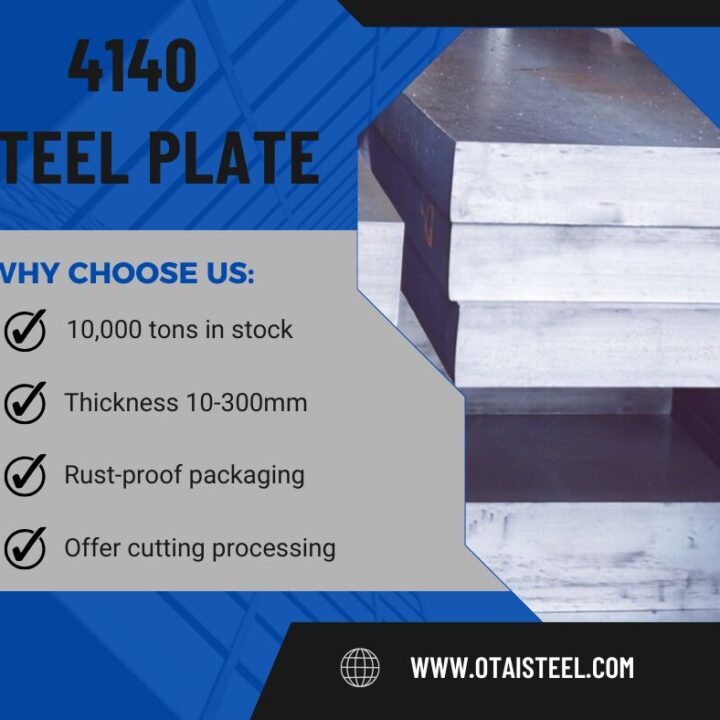
- A2 steel plate in stock: A2 steel plate is available in thicknesses of 8–200 mm, supporting common industrial purchasing requirements.
- 10,000+ tons of total steel stock: Large inventory capacity helps support regular international orders and production schedules.
- 20 saw cutting machines: Otai can provide cutting services for customers who need specific plate dimensions.
- CNC and grinding: Additional processing can reduce machining work for customers who need tighter dimensional or surface requirements.
- Custom size and tolerance: Buyers can discuss required dimensions and tolerances before cutting or processing.
- One-stop service: Cutting, machining, inspection, packaging and other related services can be coordinated through one supplier.
- International export experience: Otai has exported steel to 54+ countries since 1999 and works with international industrial buyers.
- Inspection support: Material testing, ultrasonic testing and third-party inspection support can be arranged according to project requirements.
- Export packaging: Anti-rust protection, bundled packaging and wooden-box packaging can be arranged according to shipment requirements.
For an A2 steel inquiry, provide the required thickness, width, length, quantity, standard, delivery condition and processing requirements. This allows the supplier to confirm availability and prepare a quotation based on the actual specification rather than a generic A2 grade description.
❓ FAQ
1. What is A2 steel?
A2 steel is an air-hardening cold-work tool steel containing approximately 1% carbon, 5.3% chromium, 1.1% molybdenum and 0.2% vanadium in a common reference composition. It is widely used for punches, dies, forming tools, shear blades, knives and other cold-work tooling.
2. How hard is A2 steel?
The hardness depends on the delivery and heat-treatment condition. Soft-annealed A2 can be around 215 HB, while hardened and tempered material commonly reaches approximately 58–62 HRC. Some air-hardened references report around 63–65 HRC before final tempering.
3. What temperature is used to heat treat A2 steel?
A typical reference places the A2 hardening temperature around 925–980°C. Annealing commonly falls around 845–870°C, while tempering may range from approximately 175–540°C. The exact cycle should follow the applicable manufacturer’s datasheet and account for section size and equipment.
4. Is A2 steel the same as D2 steel?
No. A2 and D2 are different cold-work tool steels. A2 contains about 5.3% chromium in a typical composition, whereas D2 contains substantially more chromium. Their wear resistance, toughness, carbide structure and heat-treatment response therefore differ. The correct grade depends on the application’s operating conditions.
5. Is 1.2363 an A2 steel equivalent?
1.2363 is the commonly associated European designation for A2, and JIS SKD12 is another commonly referenced equivalent designation. However, buyers should verify the exact standard, chemistry, product form, heat-treatment condition and certification before treating different designations as interchangeable.