42CrMo4 EN 10083-3: What Does the European Standard Require?
📑 Table of Contents
- 📘 What Is the 42CrMo4 EN 10083-3 Standard?
- 🧪 42CrMo4 Chemical Composition Requirements
- 📊 42CrMo4 Mechanical Properties and Strength
- 🔥 Heat Treatment and Delivery Conditions
- 📏 Product Forms, Dimensions, and Surface Requirements
- 📋 What Should Buyers Check on the 42CrMo4 MTC?
- 🔍 42CrMo4 EN 10083-3 vs. EN ISO 683-2:2018
- 🌍 42CrMo4 vs. AISI 4140 and Other Equivalent Grades
- 🏭 How to Select a Reliable 42CrMo4 Steel Supplier
- ⭐ Company Advantages
- ❓ Frequently Asked Questions
📘 What Is the 42CrMo4 EN 10083-3 Standard?
42CrMo4 is a chromium-molybdenum alloy steel designed primarily for applications requiring high strength, toughness, and good hardenability after heat treatment. It is widely used in automotive engineering, machinery manufacturing, heavy equipment, and industrial transmission systems.
The designation 42CrMo4 is commonly associated with material number 1.7225. Buyers frequently encounter this grade in European technical drawings, engineering specifications, and international steel procurement documents.
However, understanding the material designation alone is not enough. The applicable standard also determines important technical requirements, including chemical composition, mechanical properties, heat treatment conditions, and inspection arrangements.
What Does EN 10083-3 Specify?
EN 10083-3:2006 was titled Steels for Quenching and Tempering – Part 3: Technical Delivery Conditions for Alloy Steels.
It established technical delivery requirements for alloy steels intended for quenching and tempering. Its scope covered several product forms, including:
- Hot-formed semi-finished products such as billets and blooms.
- Steel bars and wire rods.
- Hot-rolled flat products, including plates and sheets.
- Forged steel products.
For 42CrMo4, the standard provided requirements covering steel designation, chemical composition, manufacturing conditions, delivery conditions, and mechanical properties.
These requirements helped manufacturers and buyers establish a common technical basis for steel production and acceptance.
What Is the Current Standard for 42CrMo4?
An important update concerns the replacement of EN 10083-3:2006 by EN ISO 683-2:2018.
The successor standard is titled Heat-Treatable Steels, Alloy Steels and Free-Cutting Steels – Part 2: Alloy Steels for Quenching and Tempering. It continues to cover 42CrMo4 and specifies technical delivery requirements for relevant steel products.
Therefore, buyers should distinguish between historical references and current purchasing specifications.
| Standard | Description | Status |
|---|---|---|
| EN 10083-3:2006 | Technical delivery conditions for alloy steels | Superseded |
| EN ISO 683-2:2018 | Alloy steels for quenching and tempering | Successor standard |
If an engineering drawing specifies EN 10083-3, buyers should not automatically change the reference without approval. Instead, confirm whether the customer requires the historical edition or accepts the corresponding requirements under EN ISO 683-2:2018.
**Buyer tip:** Always confirm the exact standard edition, product form, and delivery condition before requesting a quotation.
🧪 42CrMo4 Chemical Composition Requirements
Chemical composition is one of the fundamental requirements for 42CrMo4. The steel combines carbon, chromium, and molybdenum to achieve a balance of strength, hardenability, and toughness.
For procurement teams, checking chemical composition is particularly important when evaluating different steel mills or comparing European grades with internationally available alternatives.
42CrMo4 Chemical Composition Reference
The following table shows commonly published composition limits for 42CrMo4 under EN 10083-3:2006 and EN ISO 683-2:2018.
These values are reference limits, not the actual chemical analysis of every production heat. Product-specific requirements and permitted deviations must also be considered.
| Chemical Element | Reference Content (%) | Main Function |
|---|---|---|
| Carbon (C) | 0.38–0.45 | Strength and hardness |
| Silicon (Si) | 0.10–0.40 | Deoxidation and strength |
| Manganese (Mn) | 0.60–0.90 | Hardenability and strength |
| Phosphorus (P) | ≤0.025 | Controlled impurity |
| Sulfur (S) | ≤0.035 | Controlled impurity |
| Chromium (Cr) | 0.90–1.20 | Hardenability and wear resistance |
| Molybdenum (Mo) | 0.15–0.30 | Tempering resistance and hardenability |
| Copper (Cu) | ≤0.40 | Residual element control |
Why Are Carbon, Chromium, and Molybdenum Important?
Carbon determines much of the steel’s achievable hardness and strength. Its content also affects hardenability and welding behavior.
Chromium improves hardenability, allowing the steel to develop a hardened structure more effectively during quenching. It also contributes to wear resistance.
Molybdenum supports hardenability and helps maintain mechanical properties during tempering. This element is particularly valuable in components exposed to demanding mechanical loads.
Together, these alloying elements make 42CrMo4 suitable for components requiring higher strength than conventional carbon structural steels.
Standard Limits vs. Typical Analysis vs. Actual MTC Results
Buyers should understand three different types of chemical composition information:
- Standard limits: The permitted composition ranges and maximum values specified by the applicable standard.
- Typical analysis: Representative values published by a steel mill to describe its usual production chemistry.
- Actual MTC results: The measured chemical composition of the specific production heat supplied to the customer.
A typical analysis is not a universal chemical composition requirement. Actual MTC values may vary between production heats while remaining within the applicable limits.
When purchasing 42CrMo4, request the actual heat analysis and compare it with the correct standard edition and any additional contractual requirements.
📊 42CrMo4 Mechanical Properties and Strength
Mechanical properties are essential when determining whether 42CrMo4 is suitable for a specific engineering application.
The grade is frequently selected for components that experience high static loads, repeated stress, impact forces, or demanding operating conditions.
However, buyers should not assume that every 42CrMo4 product has identical mechanical properties. The standard relates certain mechanical requirements to delivery condition, product dimensions, and specimen conditions.
Important Mechanical Properties
| Property | What It Measures | Why Buyers Should Check It |
|---|---|---|
| Tensile strength (Rm) | Maximum tensile stress before failure | Load-bearing capability |
| Yield strength (Re or Rp0.2) | Resistance to permanent deformation | Structural reliability |
| Elongation (A) | Plastic deformation before fracture | Ductility |
| Impact energy (KV) | Energy absorbed during impact testing | Toughness |
| Hardness | Resistance to indentation | Machining and service performance |
Why Does Product Size Affect Mechanical Properties?
One important characteristic of alloy steel is that its response to quenching depends on the cross-sectional dimensions.
For example, a smaller round bar generally cools more uniformly during quenching than a much larger bar. As a result, the hardness and microstructure may vary between the surface and the center of a large section.
This explains why mechanical property requirements are often linked to product dimensions or ruling sections.
Buyers should therefore avoid applying a tensile strength value taken from a small-diameter round bar directly to a thick steel plate without checking the relevant standard conditions.
What Mechanical Test Results Should Be Included?
For a 42CrMo4 order, the required mechanical testing should match the agreed delivery condition and product specification.
Commonly requested results include:
- Tensile strength and yield strength.
- Elongation after fracture.
- Impact test results when specified.
- Hardness results using the agreed measurement scale.
For demanding applications, additional tests may be necessary. These could include hardenability testing, microstructure examination, or supplementary mechanical testing.
Is Higher Hardness Always Better?
Not necessarily. Higher hardness may improve wear resistance, but it can also reduce ductility and make machining more difficult.
For components exposed to impact or cyclic loading, toughness may be just as important as hardness.
Therefore, buyers should specify the required mechanical performance based on the component’s actual working conditions instead of selecting the highest available hardness.
🔥 Heat Treatment and Delivery Conditions
42CrMo4 is commonly used in quenched and tempered applications. Its alloy composition allows it to achieve a useful combination of strength, hardness, and toughness through controlled heat treatment.
Nevertheless, the delivery condition must be clearly identified because different conditions can produce significantly different mechanical properties.
Common Delivery Conditions for 42CrMo4
| Condition | Description | Typical Application |
|---|---|---|
| +A | Soft annealed | Machining before final heat treatment |
| +N | Normalized | Intermediate processing and specified normalized applications |
| +QT | Quenched and tempered | High-strength mechanical components |
What Does 42CrMo4 +QT Mean?
The +QT designation indicates that the material has undergone quenching followed by tempering.
During quenching, the steel is heated to a suitable austenitizing temperature and rapidly cooled using an appropriate medium. This process produces a hardened microstructure.
Tempering follows quenching to adjust hardness, reduce brittleness, and improve the balance between strength and toughness.
The final mechanical properties depend on the heating temperature, holding time, cooling conditions, tempering temperature, and product section size.
Why Should Buyers Specify the Heat Treatment Condition?
Consider two quotations for 42CrMo4 steel. One supplier offers annealed material, while another offers quenched and tempered material.
Although both products carry the same grade designation, their hardness, strength, machining characteristics, and processing costs may differ considerably.
For this reason, the purchase specification should clearly state:
- Required delivery condition.
- Hardness range, if applicable.
- Mechanical property requirements.
- Whether additional heat treatment is required after delivery.
- Inspection and documentation requirements.
When purchasing QT plate or round bar, buyers should also confirm whether the requested properties apply to the supplied dimensions and test specimen location.
📏 Product Forms, Dimensions, and Surface Requirements
The EN 10083-3 and EN ISO 683-2 standard families address technical delivery requirements for several forms of heat-treatable steel. However, the applicable dimensional and surface requirements depend on the specific product and other relevant standards.
For buyers, this distinction is important because material grade compliance does not automatically guarantee that the supplied dimensions or surface condition meet the purchase specification.
Common 42CrMo4 Product Forms
42CrMo4 is available in different product forms depending on manufacturing capabilities and application requirements.
- Steel plate: Used for machined machine components, structural parts, and heavy industrial equipment.
- Round bar: Commonly used for shafts, pins, gears, and other cylindrical components.
- Forged products: Used for larger or specially shaped components requiring suitable mechanical properties.
- Semi-finished products: Used as starting material for further rolling, forging, or machining operations.
Which Dimensional Requirements Should Buyers Confirm?
Before purchasing, specify the exact thickness, diameter, width, and length.
Dimensional tolerance is another important consideration. Standard rolled dimensions may not meet the tighter requirements of precision machining or finished components.
For example, a buyer requiring a plate with a specific final thickness should clarify whether the requested dimension is a raw material size or a finished machined size.
The same principle applies to round bars. Diameter tolerance, straightness, and surface condition can influence subsequent machining operations.
Surface Quality and Additional Inspection
Surface condition can affect machining efficiency and the amount of material that needs to be removed.
Depending on the application, buyers may specify surface inspection, ultrasonic testing, or additional quality requirements.
For large-section 42CrMo4 materials, internal quality may also be important. Ultrasonic testing can help identify certain internal discontinuities when carried out under an agreed testing procedure.
However, the purchase order should identify the applicable inspection standard, testing coverage, and acceptance level rather than simply stating that inspection is required.
**Practical recommendation:** Confirm grade, product form, dimensions, tolerance, delivery condition, and inspection requirements as separate items in the purchase specification.
📋 What Should Buyers Check on the 42CrMo4 MTC?
A Mill Test Certificate (MTC) provides important evidence that the supplied material has undergone the specified inspection and testing.
For international procurement, the certificate also supports material traceability and quality documentation.
However, buyers should not accept a certificate simply because it contains the words 42CrMo4. They should verify that the document corresponds to the actual material and the agreed technical requirements.
Essential MTC Information
| MTC Information | What Buyers Should Verify |
|---|---|
| Material grade | 42CrMo4 |
| Material number | 1.7225 |
| Applicable standard | EN 10083-3 or EN ISO 683-2, as agreed |
| Heat number | Traceability to the production heat |
| Chemical analysis | Actual C, Si, Mn, Cr, Mo, and other element values |
| Mechanical testing | Tensile, yield, elongation, and impact results when required |
| Hardness | Actual hardness and measurement scale |
| Heat treatment | Agreed delivery condition |
| Dimensions | Actual supplied dimensions |
| Inspection information | Testing identification and certificate authorization |
Understand EN 10204 Inspection Documents
EN 10204 defines different types of inspection documents for metallic products.
For steel procurement, buyers commonly encounter Type 2.2 and Type 3.1 certificates.
A Type 2.2 document provides a statement of compliance with the order, based on non-specific inspection.
A Type 3.1 inspection certificate provides inspection results for the delivered products or inspection unit and is validated by the manufacturer’s authorized inspection representative who is independent of the manufacturing department.
If the project requires independent third-party validation, buyers may need to arrange additional inspection under the agreed contractual conditions.
Therefore, specify the required inspection document before production or shipment.
Check Heat Number Traceability
Heat number identification is essential for connecting the MTC to the actual steel products.
For example, when a supplier cuts one large plate into several smaller pieces, the original material identification should remain traceable through the cutting and processing stages.
Buyers should confirm that the material markings, cutting records, and certificate information can be matched.
This is particularly important for orders involving several production heats or multiple material dimensions.
Verify Actual Results Instead of Generic Data
A supplier may provide a technical datasheet showing typical 42CrMo4 properties. However, this document does not replace the actual MTC for the supplied material.
Compare the reported chemical composition and mechanical test results with the agreed requirements.
If any value falls outside the permitted range, request clarification before accepting the material.
🔍 42CrMo4 EN 10083-3 vs. EN ISO 683-2:2018
One of the most important issues in 42CrMo4 procurement is the relationship between EN 10083-3:2006 and EN ISO 683-2:2018.
Many technical drawings, old quotations, and supplier datasheets still mention EN 10083-3. Meanwhile, newer purchasing specifications may reference EN ISO 683-2.
Understanding this change helps buyers avoid unnecessary disputes about material compliance.
Why Was EN 10083-3 Replaced?
European standards for heat-treatable steels were reorganized through the adoption of the ISO 683 standard series.
EN ISO 683-2:2018 became the successor to EN 10083-3:2006 for alloy steels used in quenching and tempering.
The newer standard maintains the 42CrMo4 grade within its scope and provides technical delivery requirements for relevant product forms.
However, buyers should not assume that every old purchase condition automatically transfers without review.
Key Differences Buyers Should Understand
| Comparison Item | EN 10083-3:2006 | EN ISO 683-2:2018 |
|---|---|---|
| Standard title | Steels for quenching and tempering, Part 3 | Heat-treatable steels, alloy steels and free-cutting steels, Part 2 |
| Material category | Alloy steels for quenching and tempering | Alloy steels for quenching and tempering |
| 42CrMo4 coverage | Yes | Yes |
| Material number | 1.7225 | 1.7225 |
| Standard status | Superseded | Successor standard |
| Procurement use | Historical drawings and specifications | Updated purchasing specifications |
What If a Customer Still Specifies EN 10083-3?
This situation is common in international manufacturing.
A customer may have an established drawing or quality document that references EN 10083-3:2006. Even if the standard has been superseded, the customer may still require compliance with its original contractual requirements.
In this case, the supplier should clarify:
- Whether the customer accepts EN ISO 683-2:2018 as the replacement reference.
- Whether the original EN 10083-3 requirements must be maintained.
- Which chemical and mechanical acceptance limits apply.
- Whether additional testing or documentation is required.
The buyer and supplier should agree on the applicable specification in writing.
**Important:** A newer standard reference should not be treated as automatic approval to change an existing engineering specification.
🌍 42CrMo4 vs. AISI 4140 and Other Equivalent Grades
International buyers frequently compare 42CrMo4 with AISI 4140, SAE 4140, SCM440, and other chromium-molybdenum alloy steels.
These grades belong to a similar material family and may serve comparable engineering purposes. Nevertheless, their standards and technical requirements are not necessarily identical.
Commonly Compared Grades
| Standard System | Grade | Material Number |
|---|---|---|
| EN | 42CrMo4 | 1.7225 |
| AISI / SAE | 4140 | — |
| JIS | SCM440 | — |
| GB | 42CrMo | — |
These materials have similar alloying concepts, especially their chromium and molybdenum additions.
However, differences may exist in carbon limits, silicon requirements, residual elements, mechanical properties, and inspection conditions.
Is AISI 4140 Equivalent to 42CrMo4?
AISI 4140 is one of the most frequently compared alternatives to 42CrMo4.
Both grades contain chromium and molybdenum and are commonly used for high-strength mechanical components.
Their typical chemical composition ranges are similar, which makes them potential alternatives in some applications.
However, buyers should not assume that an AISI 4140 certificate automatically demonstrates compliance with EN ISO 683-2.
Before approving substitution, compare:
- Chemical composition limits.
- Mechanical properties and specimen conditions.
- Heat treatment requirements.
- Product dimensions and manufacturing route.
- Inspection and certification requirements.
When Should Buyers Consider an Equivalent Grade?
An alternative grade may be worth considering when the specified material has limited availability, a long delivery time, or a higher procurement cost.
For example, an international buyer may compare 42CrMo4 and 4140 when sourcing alloy steel plates or round bars from different regions.
However, the final decision should involve the engineering or quality department, especially when the material is used in safety-critical or heavily loaded components.
A lower quotation does not necessarily represent a better purchasing decision if the substitute requires additional processing or cannot meet the original technical specification.
🏭 How to Select a Reliable 42CrMo4 Steel Supplier
Choosing a reliable supplier is an important part of 42CrMo4 procurement. Even when the material specification is clear, differences in stock availability, processing capabilities, inspection procedures, and export experience can influence the final purchasing result.
For overseas buyers, supplier evaluation should cover both technical capability and commercial reliability.
Check Stock Availability and Material Traceability
Start by confirming whether the supplier has the required grade and dimensions available.
Stock material can help shorten lead times compared with arranging new production. However, buyers should also request the corresponding MTC and confirm that the material identification is traceable.
If the supplier offers several product sizes, check whether the actual stock dimensions match the project requirements or require additional cutting.
Evaluate Cutting and Machining Capabilities
Many industrial buyers need customized steel dimensions rather than standard mill sizes.
A supplier with suitable processing equipment can help reduce machining preparation time and improve purchasing efficiency.
Depending on the order, relevant services may include:
- Precision saw cutting.
- CNC machining.
- Surface grinding.
- Customized dimensions and tolerances.
- Additional heat treatment arrangements.
When requesting a quotation, provide the finished or required delivery dimensions and clarify whether the supplier should include machining allowances.
Confirm Quality Inspection Capabilities
A reliable supplier should understand the inspection requirements associated with alloy steel procurement.
Depending on the application, buyers may request chemical analysis, tensile testing, hardness testing, ultrasonic testing, dimensional inspection, or third-party inspection.
The inspection scope should be agreed before shipment. This avoids misunderstandings about testing methods, acceptance criteria, and reporting responsibilities.
Consider Packaging and Export Experience
International transportation creates additional risks for steel products, including surface corrosion, handling damage, and identification loss.
Therefore, packaging should match the product form and transportation method.
For example, steel plates may require anti-rust protection and wooden case packaging. Round bars may need suitable bundling, strapping, and protective wrapping.
An experienced export supplier can help coordinate these details together with documentation and shipping arrangements.
Compare Total Purchasing Cost
The lowest price per ton does not always result in the lowest total procurement cost.
Buyers should consider:
- Material price and available stock sizes.
- Cutting and machining costs.
- Inspection and certification costs.
- Packaging and transportation expenses.
- Delivery time and production scheduling.
Comparing these factors provides a more realistic picture of the total cost and helps buyers select a supplier that can meet both technical and commercial requirements.
⭐ Company Advantages
OTAI Special Steel supplies 42CrMo4, 4140, SCM440, and other alloy structural steels to international industrial buyers. We support distributors, manufacturers, machining companies, and engineering procurement teams with stock materials and customized processing services.
- 📦 Large Inventory: More than 10,000 tons of steel stock available to support different purchasing requirements.
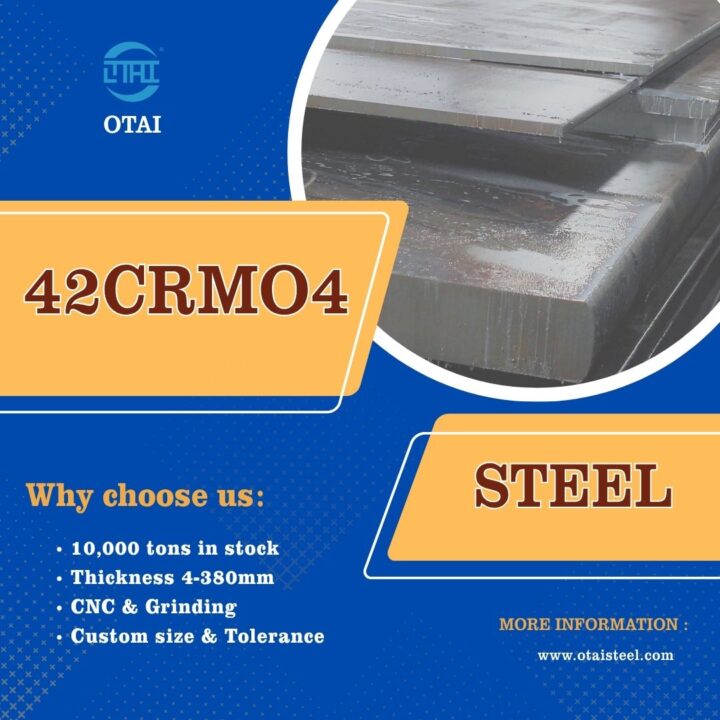
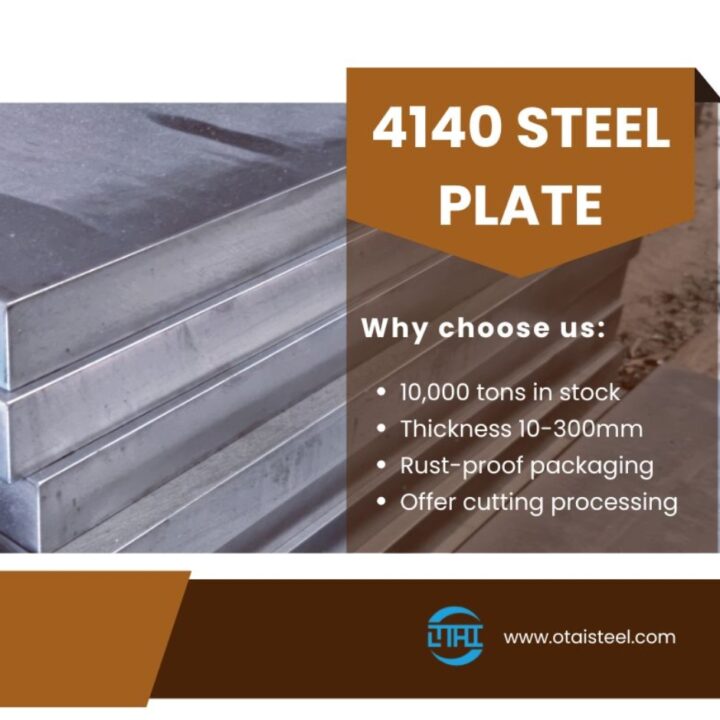
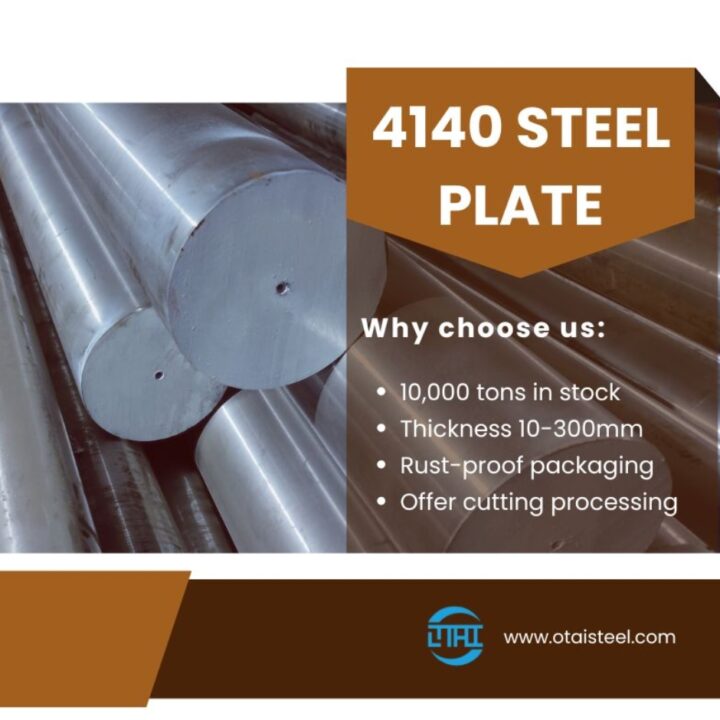
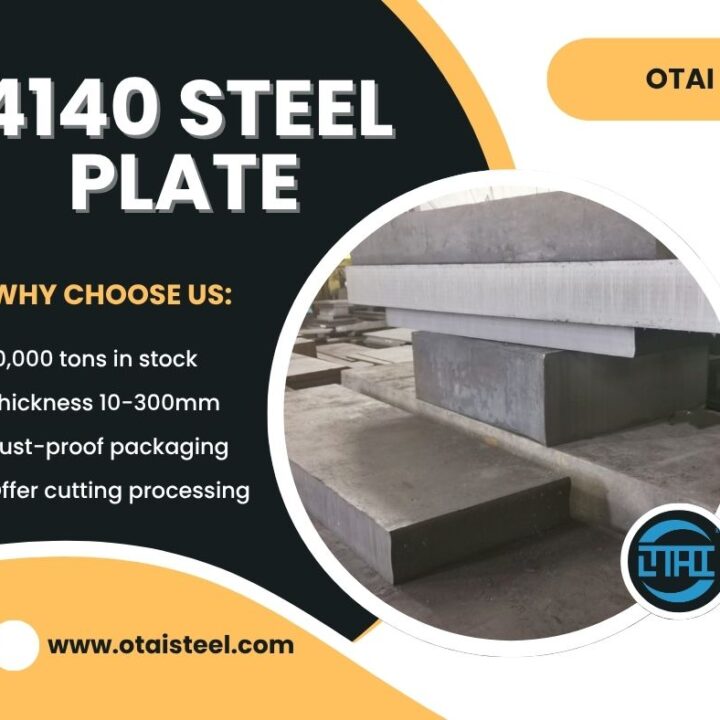
- 📏 42CrMo4 Stock Sizes: 42CrMo4 / 4140 / SCM440 alloy steel plate thickness from 4–380 mm, quenched and tempered plate from 13–200 mm, and round bars with diameters from 14–500 mm.
- ⚙️ Processing Facilities: 20 saw cutting machines, CNC machining, and grinding equipment support customized dimensions and tolerances.
- 🔬 Quality Control: Chemical analysis, mechanical testing, dimensional inspection, ultrasonic testing, and third-party inspection support according to agreed requirements.
- 🌍 International Export Experience: Serving customers in more than 54 countries since 1999.
- 📋 One-Stop Service: Material sourcing, precision cutting, machining, heat treatment arrangements, inspection, and export packaging.
- 🛡️ Protective Packaging: Anti-rust treatment, steel strapping, bundling, and wooden case packaging according to transportation requirements.
- 🤝 B2B Supply Support: Stable supply, competitive pricing, and customized solutions for international industrial customers.
If you are sourcing 42CrMo4 steel plate or round bar, OTAI can help you check available dimensions, delivery conditions, inspection documents, and processing requirements.
Visit our 42CrMo4 alloy steel product page for more product information and purchasing inquiries.
❓ Frequently Asked Questions
1. What is the EN 10083-3 standard for 42CrMo4?
EN 10083-3:2006 was a European standard specifying technical delivery conditions for alloy steels used in quenching and tempering. It covered 42CrMo4 and established requirements for chemical composition, manufacturing, delivery conditions, and mechanical properties. It has been superseded by EN ISO 683-2:2018.
2. Is 42CrMo4 the same as 1.7225?
Yes. 42CrMo4 is the steel grade designation, while 1.7225 is its European material number. Both identify the same alloy steel grade, although the applicable product standard and delivery condition must still be confirmed.
3. What is the chemical composition of 42CrMo4?
The commonly specified composition includes 0.38–0.45% carbon, 0.60–0.90% manganese, 0.90–1.20% chromium, and 0.15–0.30% molybdenum. Other elements, including silicon, phosphorus, sulfur, and copper, also have specified limits.
4. Is 42CrMo4 equivalent to AISI 4140?
42CrMo4 and AISI 4140 are commonly considered comparable chromium-molybdenum alloy steels. However, their chemical composition limits and mechanical requirements differ in some respects. Buyers should compare the applicable standards and actual MTC results before approving substitution.
5. What documents should buyers request when purchasing 42CrMo4?
Buyers should request an appropriate material inspection certificate, preferably EN 10204 Type 3.1 when required by the purchase specification. The document should include material identification, heat number, actual chemical composition, mechanical test results, and delivery condition. Additional inspection reports may be necessary for demanding applications.