4130 Steel Yield Strength: How Does Heat Treatment Affect It?
📑 Table of Contents
- 🔍 What Is the Yield Strength of 4130 Steel?
- 🔥 How Heat Treatment Changes 4130 Yield Strength
- 📊 4130 Steel Yield Strength in Different Conditions
- ⚙️ Why Quenching and Tempering Affect Strength
- 📏 How Product Size Influences Yield Strength
- 🧪 Yield Strength vs. Tensile Strength and Hardness
- 🏭 Choosing the Right 4130 Condition for Industrial Applications
- 📋 What Buyers Should Check in a 4130 Steel MTC
- 🏢 Why Source 4130 Steel from Otai?
- ❓ Frequently Asked Questions
4130 steel yield strength is not a fixed value. The actual result depends on the material’s heat treatment, product dimensions, manufacturing route, and testing conditions. Annealed 4130 generally offers lower strength and better formability, while normalizing can increase its strength. Quenching and tempering can raise yield strength substantially, although the final result depends on the selected tempering temperature and section size. For engineers and procurement teams, understanding these differences helps match 4130 alloy steel to the required component performance rather than relying on one general-purpose data figure.
🔍 What Is the Yield Strength of 4130 Steel?
Yield strength measures the stress at which a metal begins to deform permanently. Below this point, a steel component generally returns to its original shape after the load disappears, provided it remains within its elastic range. Once the applied stress exceeds the yield strength, permanent deformation can occur.
For AISI 4130 steel, yield strength varies considerably with heat treatment. A single figure cannot accurately represent every 4130 plate, bar, tube, or machined component.
Typical yield strength values
Reference data illustrate the difference between common heat-treatment conditions. One published dataset reports approximately 361 MPa for annealed 4130 and 436 MPa for normalized material. Quenched-and-tempered specimens in the same dataset reach substantially higher values, depending on tempering temperature.
| Condition | Illustrative Yield Strength | General Characteristics |
|---|---|---|
| Annealed | About 361 MPa | Lower strength, better formability |
| Normalized | About 436 MPa | Higher strength than the cited annealed condition |
| Q&T, tempered at 425°C | About 1,193 MPa | High strength in the cited specimen |
| Q&T, tempered at 540°C | About 910 MPa | Lower strength with improved ductility |
| Q&T, tempered at 650°C | About 703 MPa | Lower strength and greater ductility |
Important: These figures are illustrative reference results, not universal minimum requirements or guaranteed values for every 4130 product. The cited data use specific laboratory specimens and heat-treatment procedures. Buyers should use the applicable product specification and actual mill test certificate (MTC) when approving material.
For procurement purposes, always identify the required product form, delivery condition, dimensions, and mechanical-property standard before comparing supplier quotations.
🔥 How Heat Treatment Changes 4130 Yield Strength
Heat treatment changes the internal microstructure of 4130 steel. This process influences how the material responds to applied loads, machining, forming, and service conditions. Because 4130 contains chromium and molybdenum, it offers useful hardenability compared with plain carbon steel. However, its hardenability remains dependent on section size and cooling conditions.
Annealing: Lower strength and easier processing
Annealing softens 4130 steel and improves its machinability and formability. The process usually involves heating the material to a suitable temperature, holding it long enough for the section to reach a uniform condition, and then cooling it slowly under controlled conditions.
After annealing, 4130 generally has lower yield strength than normalized or quenched-and-tempered material. This condition can suit parts that require substantial machining or forming before a later heat-treatment operation.
Normalizing: A balance of strength and workability
Normalizing involves heating the steel above its critical transformation range and allowing it to cool in still air. This treatment can refine the microstructure and produce a more uniform structure than some other processing conditions.
Normalized 4130 often provides higher strength than annealed material while retaining useful ductility. It can therefore suit fabricated and machined components that do not require the highest possible strength level.
Quenching and tempering: Higher strength potential
Quenching heats 4130 into its austenitizing range before rapid cooling in a suitable medium. The process forms a hard microstructure, but the as-quenched material may have excessive hardness and brittleness for many engineering applications.
Tempering follows quenching. It reduces brittleness and adjusts the balance between strength, hardness, and toughness. A lower tempering temperature generally retains higher strength, while a higher tempering temperature usually reduces strength and improves ductility and toughness.
Consequently, the required yield strength should guide the heat-treatment specification. Simply asking a supplier for “high-strength 4130” does not define a complete or verifiable delivery requirement.
📊 4130 Steel Yield Strength in Different Conditions
Comparing different heat-treatment conditions helps engineers understand the potential strength range of 4130 steel. The following table presents one reference dataset to show how the material responds to different treatments. It should not replace a specification for a particular plate or bar size.
Illustrative mechanical-property comparison
| Treatment | Tensile Strength (MPa) | Yield Strength (MPa) | Elongation (%) |
|---|---|---|---|
| Annealed at 865°C | 560.5 | 360.6 | 28.2 |
| Normalized at 870°C | 668.8 | 436.4 | 25.5 |
| Quenched, tempered at 205°C | 1,627 | 1,462 | 10 |
| Quenched, tempered at 315°C | 1,496 | 1,379 | 11 |
| Quenched, tempered at 425°C | 1,282 | 1,193 | 13 |
| Quenched, tempered at 540°C | 1,034 | 910 | 17 |
| Quenched, tempered at 650°C | 814 | 703 | 22 |
The quenched-and-tempered figures come from a specific fine-grained specimen dataset. They demonstrate the effect of tempering temperature, but they do not establish guaranteed properties for commercial plate or bar. Actual results can differ with section dimensions, austenitizing conditions, quenching medium, holding time, and the steel’s hardenability.
How should engineers interpret the data?
Two points stand out. First, normalizing increases the yield strength in this comparison without creating the very high strength levels associated with quenching and tempering. Second, increasing the tempering temperature reduces the reported yield strength while elongation rises.
For component design, the highest available yield strength is not automatically the best choice. Engineers must also consider toughness, fatigue performance, weldability, impact loading, and the risk of distortion during heat treatment.
⚙️ Why Quenching and Tempering Affect Strength
The effect of quenching and tempering comes from changes in the steel’s microstructure. These changes influence dislocation movement, hardness, and the material’s resistance to permanent deformation.
What happens during quenching?
During austenitizing, the steel transforms into austenite. Rapid cooling then produces a harder transformation structure, typically martensite when the cooling rate is sufficient. This structure offers high strength and hardness, but it can also create high internal stresses.
4130 has moderate hardenability. Therefore, the cooling rate at the surface may differ from the rate at the center of a thick section. A thin specimen and a thick industrial plate may not develop the same through-section properties under identical heat-treatment conditions.
How tempering controls the final properties
Tempering allows the quenched structure to become less brittle and more suitable for engineering service. During this process, the steel’s internal stresses decrease and its microstructure changes. The selected temperature and holding time determine the final balance of strength and toughness.
For example, a component designed for high static loading may require a different tempering condition from one exposed to impact or cyclic loading. A higher yield strength may help resist permanent deformation, but the design must still account for fracture resistance and fatigue behavior.
Why the heat-treatment record matters
When purchasing quenched-and-tempered 4130, buyers should not rely only on a hardness figure. They should confirm the required yield strength, tensile strength, elongation, and impact properties where applicable. The supplier should also clarify whether the material received the specified treatment before delivery or whether the buyer must arrange heat treatment after machining.
📏 How Product Size Influences Yield Strength
Product dimensions play an important role in the final mechanical properties of 4130 steel. A heat-treatment schedule that works for a small test bar may not produce the same results throughout a thick plate or large-diameter bar.
Section thickness and cooling rate
During quenching, the surface cools faster than the core in many industrial sections. As thickness increases, the center may cool more slowly. This difference can produce variations in microstructure and hardness between the surface and the center.
Because 4130 has lower hardenability than some higher-alloy grades, section size deserves particular attention when a design requires high through-hardness or uniform mechanical properties. The selected quenching medium and the actual geometry also influence the result.
Plate, bar, and tube are not automatically equivalent
Product form affects manufacturing history, testing location, and applicable specifications. Hot-rolled plate, forged bar, seamless tube, and cold-drawn products may have different delivery conditions and mechanical-property requirements.
For this reason, buyers should not transfer a yield-strength value from a 4130 tube datasheet directly to a thick plate purchase. Even when both products use the same grade designation, the relevant product specification and testing requirements may differ.
Questions to settle before ordering
- What is the required finished thickness or diameter?
- Will the component receive heat treatment after machining?
- Must the specified yield strength apply through the full section or only to a defined test location?
- Which product standard and test method govern acceptance?
- Does the supplier provide traceable mechanical-test results for the supplied batch?
These details help prevent a common procurement problem: receiving chemically correct 4130 steel that does not meet the mechanical properties required by the component design.
🧪 Yield Strength vs. Tensile Strength and Hardness
Yield strength, tensile strength, and hardness describe different aspects of steel performance. Buyers sometimes treat these values as interchangeable, but each measurement answers a different engineering question.
| Property | What It Measures | Why It Matters |
|---|---|---|
| Yield strength | Stress at the start of permanent deformation | Helps determine resistance to permanent deformation |
| Tensile strength | Maximum engineering stress reached during a tensile test | Indicates maximum tensile load capacity before necking and fracture |
| Hardness | Resistance to localized indentation | Useful for checking surface and heat-treatment consistency |
| Elongation | Plastic extension before fracture | Helps assess ductility |
Can hardness predict 4130 yield strength?
Hardness can provide a useful indication of strength, particularly when the material condition and grade are known. However, a hardness conversion chart does not replace a tensile test. The relationship between hardness and yield strength depends on the alloy, microstructure, heat treatment, and testing method.
For example, a supplier may report a Brinell hardness result for an annealed plate. That value can help confirm the delivery condition, but it does not independently prove that the plate meets a specified minimum yield strength.
Why buyers should request both hardness and tensile results when needed
Hardness testing offers a relatively quick way to assess material consistency. Tensile testing provides direct measurements of yield strength, tensile strength, and elongation. When a project has strict mechanical requirements, buyers should specify which tests must appear on the MTC and which additional tests require separate approval.
🏭 Choosing the Right 4130 Condition for Industrial Applications
The best 4130 condition depends on how a component will be manufactured and used. Rather than selecting material solely by its highest yield-strength figure, engineers should match the delivery condition to the production route and service requirements.
Machined components
Annealed 4130 can be a practical starting point for components that require extensive machining. Its lower hardness can reduce machining difficulty. If the finished component needs higher strength, the production plan may include a subsequent hardening and tempering operation. However, engineers should account for dimensional changes and distortion during that process.
Fabricated structures and welded components
Normalized 4130 can suit certain fabricated components where a balance of strength and workability matters. Welding requires additional attention because the heat-affected zone may develop different properties from the unaffected base metal.
For critical welded structures, the welding procedure, preheating requirements, post-weld heat treatment, and final inspection should follow the applicable engineering specification. A high-strength delivery condition does not automatically guarantee that the welded assembly retains the same properties.
High-strength mechanical components
Quenched-and-tempered 4130 may suit shafts, pins, fasteners, and other mechanical parts that require higher strength. The selected tempering condition should reflect the required strength, toughness, and fatigue performance.
For cyclically loaded components, fatigue resistance also depends on surface finish, stress concentrations, residual stress, geometry, and manufacturing quality. Yield strength alone cannot determine service life.
Match the purchase condition to the production plan
Before requesting a quotation, specify whether the material should arrive annealed, normalized, or quenched and tempered. If the buyer plans to heat-treat the material after machining, the supplier should know the intended process and final property requirements.
This approach helps suppliers recommend a suitable stock condition and reduces the risk of paying for a treatment that the production process will later change.
📋 What Buyers Should Check in a 4130 Steel MTC
A mill test certificate provides important evidence of material identity and test results. When purchasing 4130 steel, procurement teams should check more than the grade name. The certificate should match the purchase order and the material actually delivered.
1. Confirm the material grade and applicable standard
Check that the certificate identifies AISI/SAE 4130 or the precise specification required by the project. Different product standards can set different requirements for chemical composition, dimensions, testing, and acceptance. Do not assume that every product sold as 4130 automatically meets every 4130-related standard.
2. Review the chemical composition
Common 4130 chemistry includes carbon, manganese, chromium, and molybdenum. These elements contribute to strength, hardenability, and other material characteristics. However, buyers should distinguish the standard’s permitted composition limits from a supplier’s typical analysis and the actual heat analysis shown on the MTC.
The actual heat analysis should correspond to the supplied material’s heat or batch identification. A general datasheet cannot replace this traceability.
3. Check the mechanical test results
Review yield strength, tensile strength, elongation, and any other specified properties. Confirm the units, test standard, test direction, specimen location, and material condition. If the purchase order requires a minimum yield strength, compare the actual reported result with that exact requirement.
4. Verify dimensions and traceability
Confirm the supplied thickness, width, length, and quantity. Check heat numbers, bundle identification, and markings so the material can be traced back to its certificate. For critical applications, agree on additional inspection, ultrasonic testing, or third-party verification before production begins.
| MTC Check | Buyer Verification |
|---|---|
| Grade and standard | Confirm the specified 4130 grade and product standard |
| Chemical analysis | Compare actual heat analysis with the applicable limits |
| Yield and tensile strength | Check results against the required condition and acceptance criteria |
| Elongation and hardness | Verify specified values and test methods |
| Dimensions and heat number | Match the certificate to the delivered material |
For international buyers, these checks are particularly important when comparing quotations from different stockists. A lower price does not necessarily represent the same delivery condition, inspection level, or mechanical-property guarantee.
🏢 Why Source 4130 Steel from Otai?
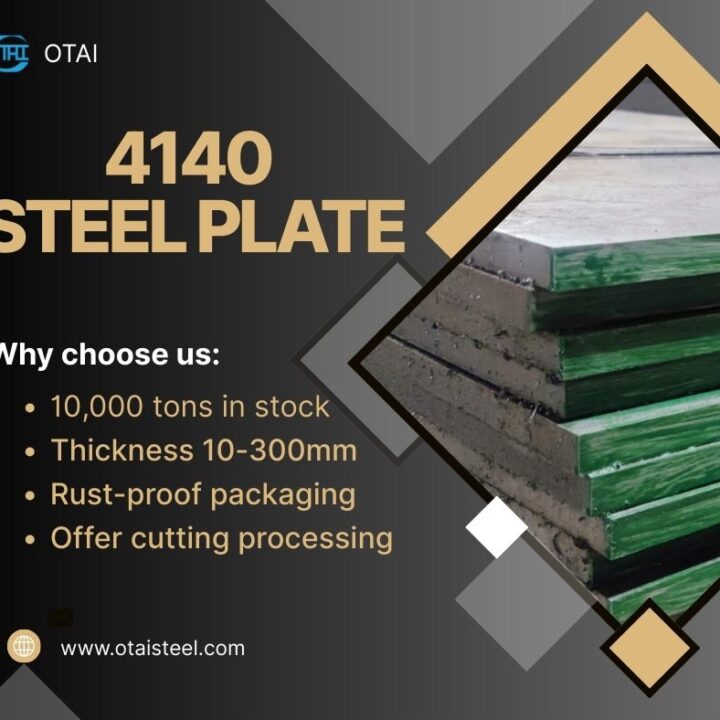
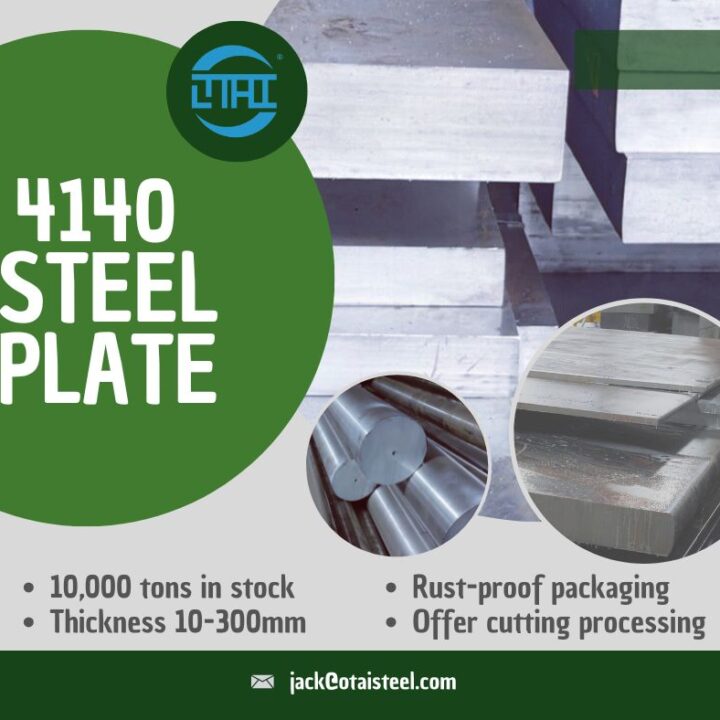
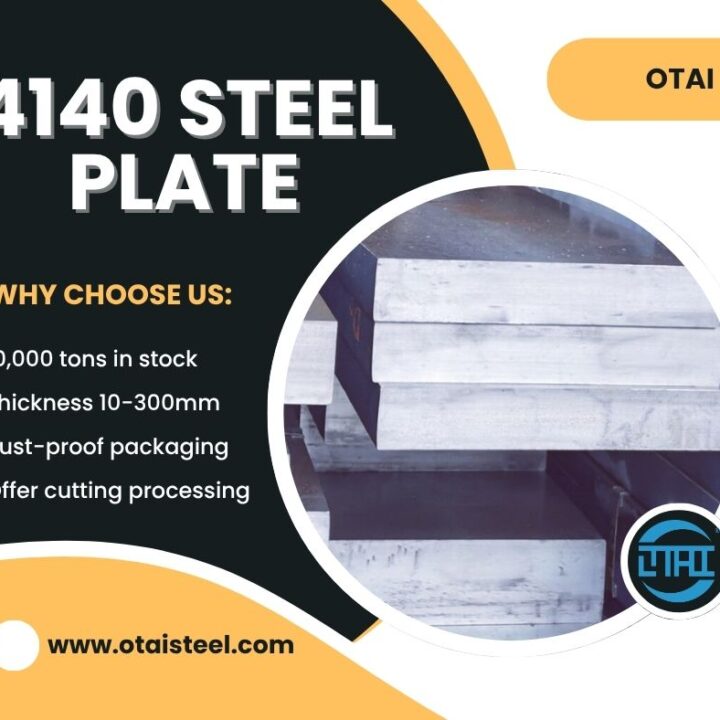
- 4130 steel plate stock: Thickness range of 10–70 mm in stock.
- 10,000+ tons of steel inventory: Supports sourcing requirements across tool steel and alloy steel grades.
- 20 saw-cutting machines: Helps arrange cutting services for different order dimensions.
- Machining support: CNC machining and grinding services are available for specified requirements.
- Custom dimensions and tolerances: Material can be prepared according to agreed project specifications.
- Quality documentation: Material certificates and traceability support help buyers verify supplied products.
- Inspection support: Ultrasonic testing and third-party inspection can be arranged when required and agreed.
- Export experience: Supplying customers in more than 54 countries since 1999.
- Export packaging: Anti-rust protection, strapping, bundling, and wooden packaging options help prepare steel for international shipment.
- One-stop service: Cutting, machining, inspection coordination, and packaging support can simplify procurement.
For product specifications and available 4130 steel plate options, visit the Otai 4130 steel product page. When requesting a quotation, provide the required thickness, dimensions, quantity, delivery condition, applicable standard, and mechanical-property requirements. This information helps the supply team assess the most suitable stock and processing arrangement.
❓ Frequently Asked Questions
1. What is the yield strength of 4130 steel?
There is no single yield-strength value for all 4130 steel. One reference dataset reports approximately 361 MPa for annealed material and 436 MPa for normalized material. Quenched-and-tempered 4130 can reach much higher values, depending on the heat-treatment procedure, section size, and required properties.
2. Does heat treatment increase the yield strength of 4130 steel?
Yes. Quenching and tempering can substantially increase 4130 yield strength compared with annealed or normalized conditions. However, the final result depends on the quenching process, tempering temperature, holding time, and material dimensions.
3. Is normalized 4130 stronger than annealed 4130?
In many reference datasets, normalized 4130 has higher yield strength than annealed 4130. Normalizing also provides a useful balance of strength and ductility. The actual values still depend on the product specification and manufacturing conditions.
4. Does a higher tempering temperature reduce 4130 yield strength?
Generally, yes. Increasing the tempering temperature usually reduces hardness and strength while improving ductility and toughness. Engineers select the tempering condition according to the component’s required mechanical properties rather than maximizing strength alone.
5. How can buyers verify the yield strength of 4130 steel?
Buyers should check the actual tensile-test results on the MTC and confirm that the material condition, product dimensions, test method, and applicable standard match the purchase requirements. Hardness results can provide supporting information, but they do not replace a required tensile test.